A good running result is not a night-time breathing assessment
‘I exercise, so I definitely don’t have sleep apnoea.’ It is an understandable thought, but misleading. Running fitness can tell us a great deal about performance, yet it does not establish uninterrupted breathing during sleep. The same applies to body type: higher body weight is one possible risk factor, not the only condition.
If someone regularly reports unrefreshing sleep, daytime sleepiness or observed pauses in breathing, do not attribute symptoms solely to training load. Sleep problems need individual assessment. A sports watch, a good race or still being able to get through the working day does not replace that.
What is obstructive sleep apnoea?
According to the US NHLBI information, obstructive sleep apnoea involves blocked airflow through the upper airways during sleep. Other types of sleep-related breathing disorder exist, including central forms with a different underlying mechanism. A snoring recording is not how to decide the distinction at home.
Airway anatomy, age, family factors and certain health conditions can all influence risk. Obesity can be important, but its absence does not rule out the condition. Fitness is not a simple protective shield that makes every night-time symptom insignificant.
The condition is not a character flaw or proof of an unhealthy lifestyle. Athletes can request assessment just like anyone else. The aim is not to acquire a label but to understand what disrupts sleep and daytime functioning.
Which patterns are worth noticing?
The NHLBI symptom overview lists night-time breathing pauses, loud snoring and gasping, along with daytime sleepiness and difficulty concentrating. Unrefreshing sleep, headaches or insomnia symptoms may also occur. Not everyone experiences the same pattern.
A bed partner’s observation can be valuable information, but not everyone sleeps with someone else. Nobody reporting breathing pauses is not a negative test. Equally, one noisy night is not a diagnosis. Symptoms, history and daytime effects need consideration together.
For a runner, persistent sleepiness despite apparently adequate sleep time, or a condition not explained by rest days, may raise concern. This does not automatically mean apnoea: other sleep, physical or psychological causes may underlie it. Assessing symptoms is broader than searching for one illness.
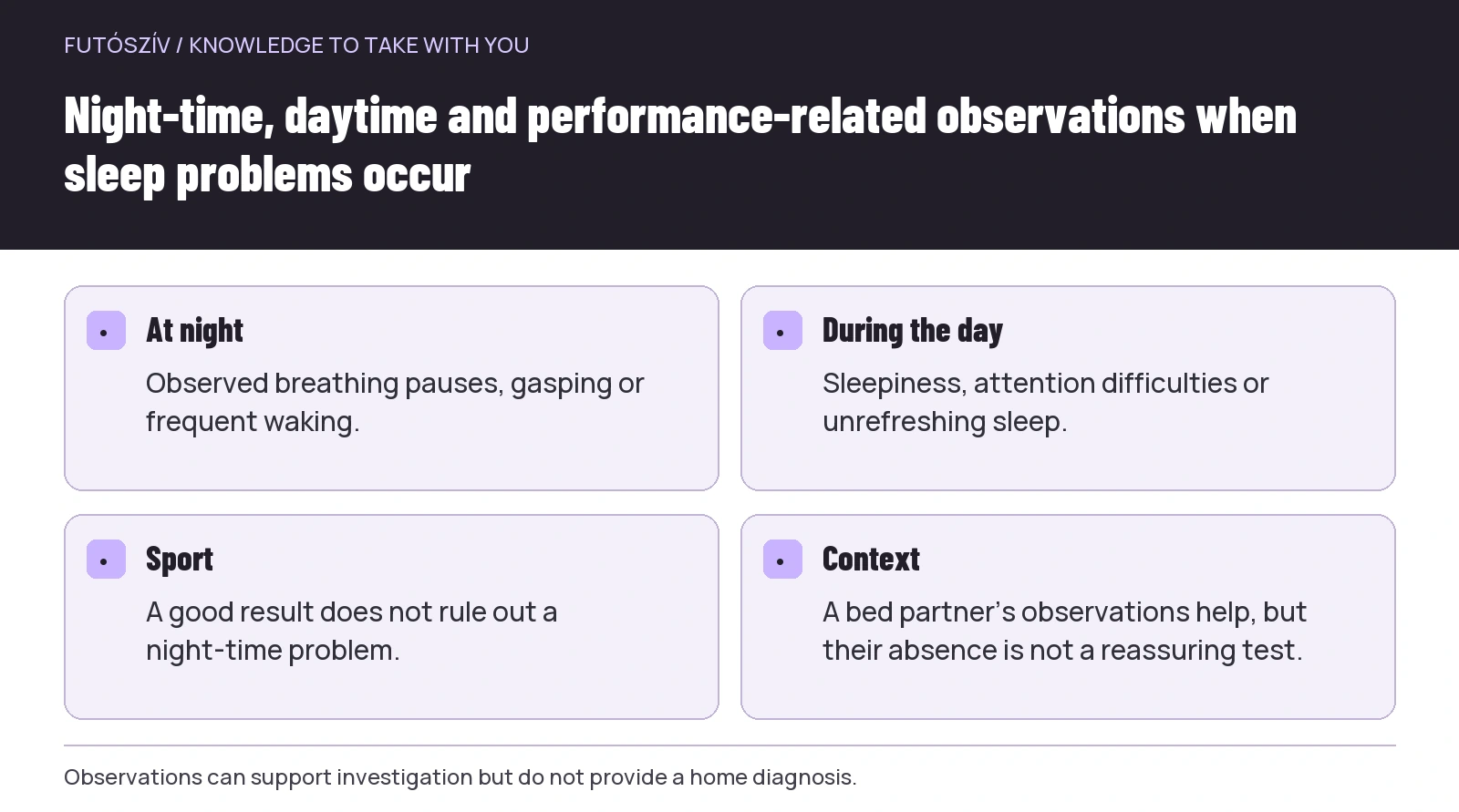 Enlarge diagram
Text version of the diagram
- At night
- Observed breathing pauses, gasping or frequent waking.
- During the day
- Sleepiness, attention difficulties or unrefreshing sleep.
- Sport
- A good result does not rule out a night-time problem.
- Context
- A bed partner’s observations help, but their absence is not a reassuring test.
Fatigue and sleepiness are not quite the same
Describing the problem more precisely can help. Do you feel tired and weak, or actually doze off in situations when you want to remain awake? Is concentrating difficult, or are your legs heavy after training? These can coexist, but the distinction matters in a medical discussion.
Athletes tend to label everything a recovery problem. More rest or less training may be important changes, but they do not resolve every sleep disorder. If symptoms persist, worsen or occur in dangerous situations, do not postpone seeking help until another training cycle ends.
Daytime sleepiness affects more than the quality of running. It can matter significantly in transport, work and household tasks too. The sporting plan is therefore only part of what needs reviewing.
What should you bring to the first discussion?
Briefly record how long symptoms have lasted, your opportunity to sleep, when sleepiness occurs and whether anyone noticed unusual breathing. Regular medicines, alcohol use, shifts, travel and other health conditions are also worth mentioning. You do not need to perfect your whole lifestyle before asking for help.
You can show a simple sleep record or device data if you have them, but make the symptom the main message. For example, ‘I’ve been dozing off in the afternoons for weeks despite leaving enough time for sleep’ or ‘my partner has repeatedly noticed pauses in my breathing’. These are more useful than presenting only a recovery score.
You do not need to buy expensive equipment before assessment. Observations should help the professional understand the situation, not prove a disease at home. If collecting data is burdensome, a short written summary is valuable too.
Questionnaires, home testing and sleep laboratories
According to the AASM adult diagnostic guideline, a questionnaire or predictive algorithm alone cannot diagnose obstructive sleep apnoea. In an appropriate situation, home sleep testing or polysomnography can be used alongside individual clinical assessment.
Home testing is not the same as a commercial sleep tracker’s nightly estimates. It has a defined purpose, appropriate equipment and professional interpretation. The same test type is not suitable for everyone; other illnesses and sleep problems influence the choice too.
The prospect of laboratory testing can raise many questions. Ask what will happen, which sensors are used, what to bring and how difficulty falling asleep is handled. Understanding the test setting is preparation, not unnecessary worrying.
A negative result does not always close the question
The AASM guideline recommends polysomnography after a single negative, inconclusive or technically inadequate home sleep apnoea test when this is indicated within the diagnostic process. The point is not for everyone to repeat tests independently, but for a professional to interpret results together with symptoms.
The NICE NG202 guideline also addresses choosing tests and evaluating continuing symptoms. If the problem does not resolve, explain that at follow-up. ‘The device showed nothing’ does not always mean there is nothing further to do.
Do not compare numbers in a report with another runner’s data. Measurement method, the full report and personal condition matter together. Ask the professional for a plain-language explanation of what the result means and the next step.
Why is harder training not the answer?
Exhausting yourself completely in the evening is not a general treatment for night-time breathing disorders. If a genuine problem underlies poor sleep, more training can add demands without changing the cause. Suppressing tiredness with more caffeine or an energy boost is not an investigation either.
Adapt sporting activity to daytime functioning and professional guidance. With sleepiness, travel and complicated environments requiring attention deserve particular thought. You do not have to complete a plan alone or on a dangerous route merely because it was previously entered in the calendar.
A short-term adjustment is not a treatment plan by itself. Discuss symptoms and sport with the clinician, particularly when other illnesses or medicines are involved. Coaches help best when they do not turn a medical question into load optimisation alone.
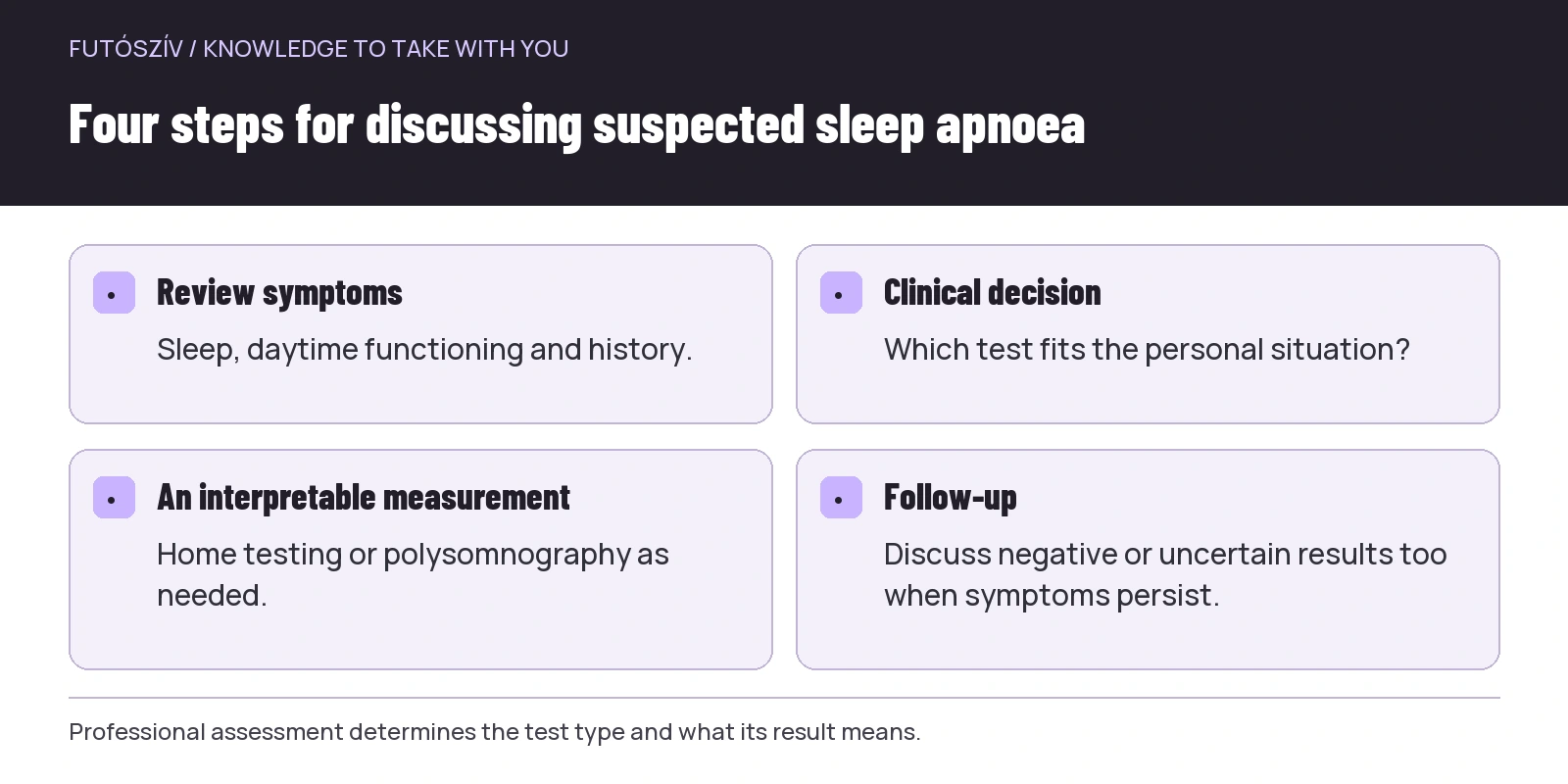 Enlarge diagram
Text version of the diagram
- Review symptoms
- Sleep, daytime functioning and history.
- Clinical decision
- Which test fits the personal situation?
- An interpretable measurement
- Home testing or polysomnography as needed.
- Follow-up
- Discuss negative or uncertain results too when symptoms persist.
Treatment is individual; running may have a supporting role
The NHS information describes several treatment options, including equipment supporting breathing where appropriate. The choice depends on the condition and individual care. Regular movement and other lifestyle changes may have a role, but do not mean prescribed treatment can be stopped independently.
If equipment or another treatment is uncomfortable, tell the treatment service. You do not have to give up silently, and copying online settings is not a good idea. Mask, use, follow-up and symptom questions can be addressed with an appropriate professional.
Feeling better is important feedback, but do not judge treatment success solely by running pace. Sleep, daytime alertness, quality of life and required monitoring matter together. Race results do not replace follow-up.
Race travel and established care
If treatment is already prescribed, consider continuing it before travelling. Arrange necessary equipment, connections, accommodation and transport conditions beforehand. For the particular device, your own clinician’s and manufacturer’s guidance applies; another runner’s packing list may not suit yours.
An early start and travel can already reduce the opportunity to sleep. Do not judge the entire sleep situation solely from that unusual weekend. Include the journey home in planning too: do not try to overcome sleepiness through willpower behind the wheel.
Do not drive with significant sleepiness; seek appropriate help and discuss the situation with a doctor. Official health requirements connected with driving must be addressed under Hungarian rules, not by adopting legal details from British information.
Questions for follow-up
A few concrete questions can help at the next appointment: what has changed in daytime alertness, do symptoms remain, is treatment usable and is further testing needed? Mention new difficulties around running or travel separately. A short description of a real situation makes a meaningful answer easier.
Also ask which signs should prompt contact before the planned appointment and whom to approach about equipment problems. A clear follow-up plan can reduce guesswork at home. Review treatment aims and sport’s role together without allowing an app score to direct every decision.
Let the community ask without judging
Snoring can easily become a joke in shared accommodation, although observations may lead to an important health discussion. Discreetly and factually explain what you noticed and let the other person decide what else to share. There is no need to circulate recordings or organise a group diagnosis.
Coaches should not regard persistent sleepiness as a lack of discipline. Alongside reviewing sleep opportunities, supporting assessment may matter too. In a good sporting community, asking for help does not threaten a runner’s place or reputation.
The aim is not for every tired runner to suspect apnoea. It is to prevent warning patterns being lost behind performance data and fitness becoming a reason to minimise persistent symptoms.
Sources
- NHLBI: causes and risk factors.
- NHLBI: symptoms.
- AASM: diagnostic guideline.
- NICE NG202: investigation and treatment.
- NHS: patient information.
How Futószív articles are prepared: our editorial guidelines.