Help begins with a question
‘Can I help?’ It is a short question, but it makes an important difference. In a running community, good intentions can easily lead someone to grab another person’s arm, rearrange their equipment or decide which distance would suit them. Support works well when it builds on participants’ actual needs and decisions. A visible or assumed disability does not, by itself, grant permission to direct someone else’s life.
A runner may want support with one specific action and prefer to act independently at other times. Accepting help once does not give continuing consent. Equally, a no need not be interpreted as personal rejection. The value of an offer lies precisely in it remaining a genuine choice.
Independence alongside support
The UN disability convention’s Article 12 sets out the principles of equal recognition before the law and support needed to exercise rights. Article 30 also addresses participation in sport and recreation. These are broad legal principles, not a complete Hungarian procedure for a particular running event.
An important approach follows for everyday organisation: support should not make the person’s own voice redundant. Independence does not necessarily mean doing everything alone. It can also mean choosing whom to ask, for which task and in what way.
The runner’s goal remains their own too. It may be a race result, a social experience, regular leisure time or getting to know a route. A helper is not obliged to make every idea happen, but cannot automatically replace the goal with their own story considered safer or more impressive.
Speak to the participant first
When someone arrives with a companion, do not automatically direct questions to the companion. Introduce yourself to the runner, explain your role and ask how they want to communicate. An answer may require more time or another format. That is no reason to exclude them from the conversation.
A companion can provide useful information if the participant wants that. Previous experience, a signal that works or an organisational need can matter. Still, do not treat a relative as the sole decision-maker in every situation. Specific questions of formal legal representation may require a separate appropriate procedure; do not infer them from a diagnosis.
Share only necessary information in front of the group. People do not need someone’s medical history to know which route they are taking or how to signal a turn. Agree beforehand what personal information will be shared and for what purpose.
 Enlarge diagram
Text version of the diagram
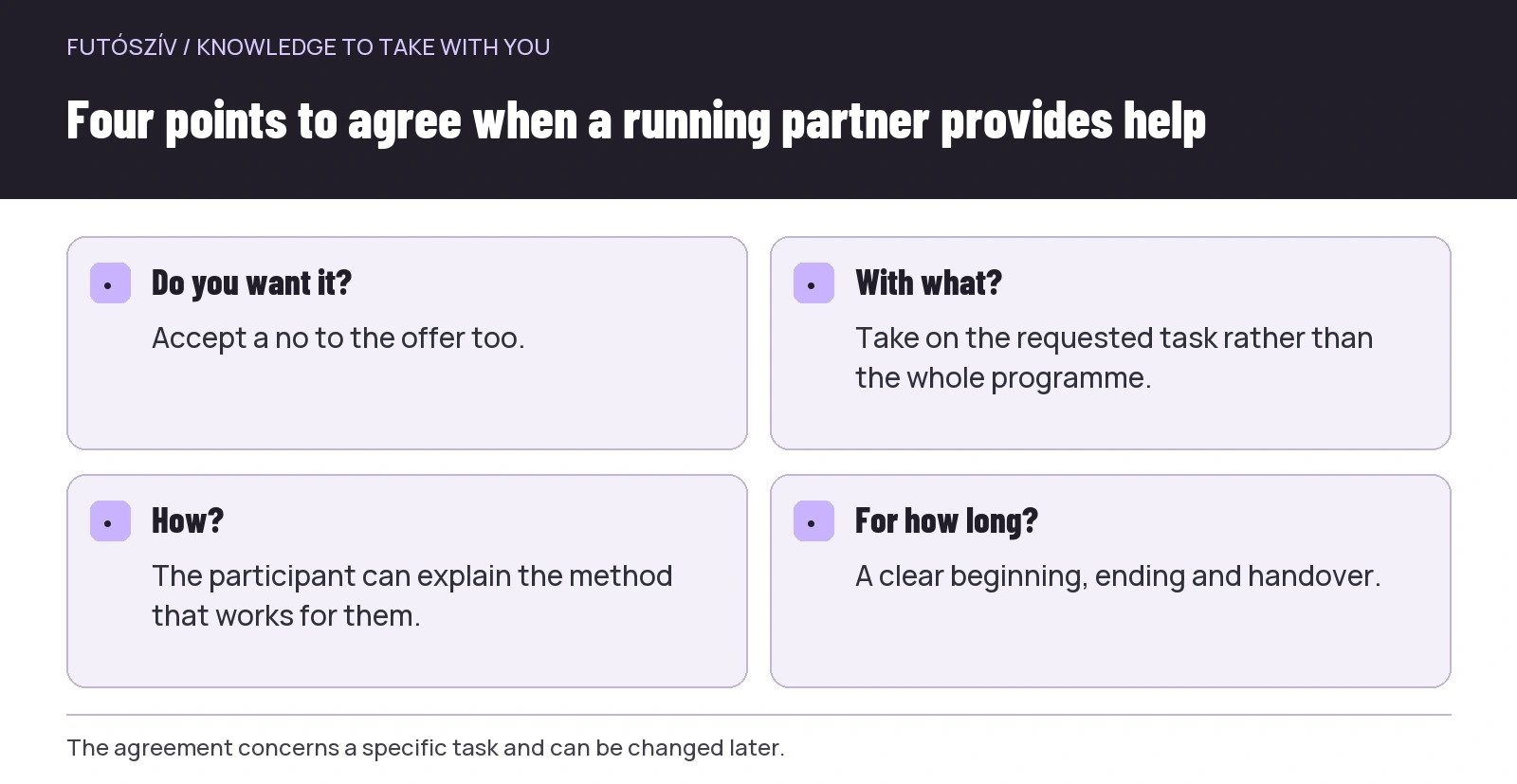
- Do you want it?
- Accept a no to the offer too.
- With what?
- Take on the requested task rather than the whole programme.
- How?
- The participant can explain the method that works for them.
- For how long?
- A clear beginning, ending and handover.
Role names are not enough: state the task too
‘Companion’ can mean many things. One person merely travels to the venue together, another helps with finding the way and another provides personal support. A running partner primarily shares movement, a coach directs sporting tasks within their qualifications and an organiser is responsible for the programme’s services and procedures. These roles can overlap, but not automatically.
State the commitment concretely. We meet at the gate, go together to collect the bib and then the runner joins their own group. Or we stay together for the whole short loop and return to the same point afterwards. Expressing the details helps both people.
Explain limits in good time. If a helper cannot assist with dressing, lifting, transport or another personal task, there is no need for shame. Finding solutions requires clear boundaries. A vague ‘we’ll sort it out somehow’ promise can easily become a real barrier on the day.
Touch, equipment and personal space
The RNIB guiding advice recommends first asking whether help is needed and how guiding should work for the person. This guidance concerns navigation for people with sight loss, not running-technique training. Its principle is useful in other support situations too: do not start from your own assumptions.
A wheelchair, stick, prosthesis or other personal device is not communal sports equipment. Do not touch, move or adjust it without permission. Discuss physical help beforehand, and recognise that some tasks require appropriate training. Good intentions do not replace competence.
Consent can be specific and time-limited. Allowing a jacket zip to be adjusted does not grant permission to handle the person’s body or other equipment afterwards. For a coaching demonstration too, explain what you intend beforehand and offer an explanation without touch.
Shared signals and the option to stop
Before running, agree how participants will indicate wanting to slow down, stop or go another way. It could be a word, hand signal, agreed short message or another personally suitable format. A signal has value when the helper notices and responds as agreed.
Avoid too many custom codes. Try important signals in a calm situation and clarify each meaning. A road crossing, obstacle or change of group may need separate attention. Nobody should have to understand complicated information hurriedly while moving.
Stopping is not an invitation to debate. If a participant wants to finish, first arrange a safe ending. Feedback can be requested later, but the person need not immediately justify the decision before the whole group. An earlier goal or entry fee does not oblige them to continue.
Do not use the helper’s workout as the benchmark
If the shared occasion primarily concerns supported participation, handle the helper’s own pace goal separately. It is not a good situation if participants go faster because they fear holding the other person up. The role undertaken needs appropriate spare capacity and attention.
Clarify beforehand whether this is an easy shared activity, route trial or race support. If the helper wants another workout too, organise that separately. Gratitude does not require the participant to accept a load that is not theirs.
Judge results against the person’s own goal too. Getting to know a new route more independently or a clearer signal system can be as important an achievement as finishing. Do not celebrate only what looks impressive to an outside observer.
Make separate arrangements with the organiser
At a race, check the event’s current rules alongside the personal agreement. Does the helper need an entry, bib or separate registration? Where can they enter, may they use aid stations and how does bag handling work? An allowance at another event does not establish the same entitlement here.
Request concrete information about accessible provision. ‘Everyone is welcome’ does not answer questions about toilets, the start zone or getting back. Organisers can respond more usefully when the necessary task is clear rather than receiving a full account of a diagnosis.
A helper’s presence does not resolve every organisational barrier. ‘They can carry the participant upstairs, lift the equipment or work out the road closure’ is not an adequate general answer. Event accessibility remains a separate organisational responsibility.
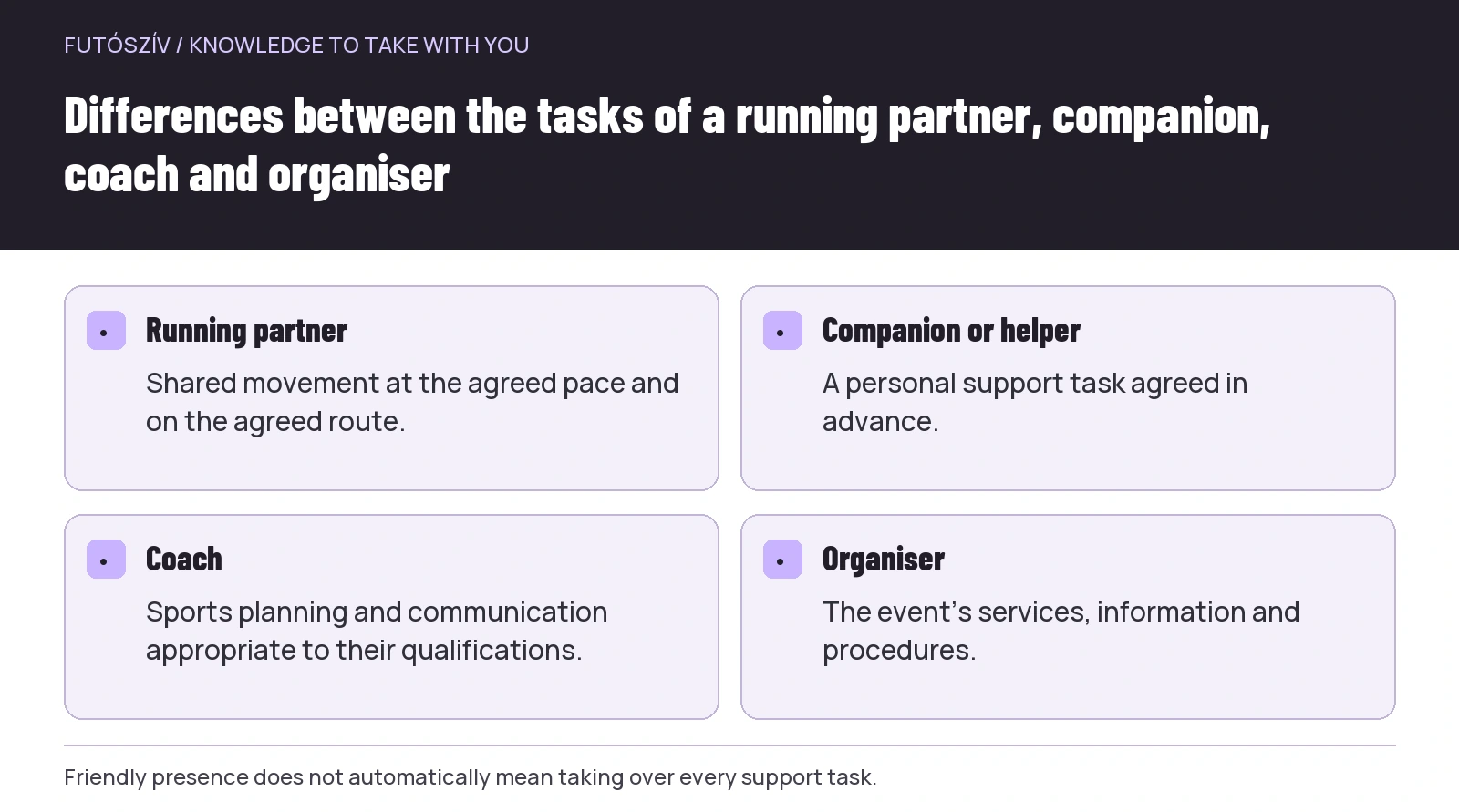 Enlarge diagram
Text version of the diagram
- Running partner
- Shared movement at the agreed pace and on the agreed route.
- Companion or helper
- A personal support task agreed in advance.
- Coach
- Sports planning and communication appropriate to their qualifications.
- Organiser
- The event’s services, information and procedures.
Photographs and stories need separate consent
Saying yes to a shared run does not automatically permit sharing a photograph or personal story. Ask whether a picture can be taken, where it will appear and with what text. If the participant declines, do not treat that as rejecting support.
Avoid hero stories centred on the helper. The person concerned is not scenery for displaying someone else’s generosity. If you prepare a shared report, they should have a say in what it reveals about them and which details remain private.
An emotional finish photograph does not show the whole day. It may reflect good cooperation, but there may also have been many unnecessary barriers. In evaluation, the participant’s experience should matter more than how many likes the story received.
Provide somewhere to turn if something is wrong
The England Athletics codes of conduct also address the behaviour and responsibilities of different roles. This is a British sports-organisation framework, not Hungarian rules, but a useful example of why clear behavioural expectations are needed alongside good intentions.
The club should have a known contact person and a usable feedback route. A participant should not be able to complain only to the person whose behaviour caused the problem. Giving feedback should not require publicly sharing sensitive information or proving in detail that their request for respect is justified.
Take it seriously if help becomes pressure, humiliation or a boundary violation. The organiser’s own rules and a procedure appropriate to the situation are needed. Working voluntarily does not exempt someone from respectful behaviour.
Make the first shared occasion predictable
When starting to work together, a short advance meeting at the venue may help. Look at the meeting point, try communication and clarify the task undertaken. There is no need to turn this immediately into a full workout or race rehearsal. Getting to know things has value in its own right.
Discuss costs in advance too if there are any: travel, admission or entry. Do not wait until arrival to discover the parties had different expectations. Time limits matter equally. A helper’s commitment is predictable when it consists of a clear agreement rather than unspoken expectations.
Closing and the next occasion
At the end, check whether the agreed handover or return has happened. Make the role’s ending clear: where will you part, who receives the equipment and is further coordination needed? This is not supervision over the participant but completing the task undertaken together.
Later, briefly discuss what worked and what should change. Ask more than ‘did I help well?’: did the participant retain choices, was there enough information and were tasks unnecessarily taken over? Helpers can also state what they can undertake next time.
Good cooperation does not depend on working everything out perfectly once. It depends on people being able to ask, modify, say no and agree again. Help then genuinely serves the runner’s participation.
Sources
- UN convention, Article 12.
- UN convention, Article 30.
- RNIB: asking and individual guiding needs.
- England Athletics: roles and codes of conduct.
How Futószív articles are prepared: our editorial guidelines.