
Organising a run is a task too
Someone can be an enthusiastic runner yet regularly get stuck because they cannot find their keys, remember departure too late or face too many decisions before even a simple session. With adult ADHD, managing time, directing attention and organising tasks can present particular difficulties. They do not appear in the same way for everyone and cannot be measured by the number of runs in an app.
A usable running routine does not necessarily need to be more complicated, stricter or more motivating than the previous one. Often, what is needed is more visible steps, fewer decisions beforehand and organisation that can be improved. The ideas below concern planning everyday sport for adults. They are not diagnostic tests and do not replace personalised ADHD treatment.
What can we expect from running, and what can we not?
The NICE ADHD guideline highlights the value of regular exercise and the importance of environmental changes suited to individual needs. Its treatment recommendations also include several forms of care. Sport being a potentially useful part of life does not mean running replaces medication or psychological treatment.
The NHS page on adult ADHD also recommends choosing enjoyable movement. Running can be one option, but it is not compulsory. If cycling, swimming, dancing or walking fits someone’s life better, choosing it is not failure. Sport should not become a punishment for the sake of meeting an imagined ‘ADHD training plan’.
Neither feeling calm after activity nor struggling to maintain a routine confirms a diagnosis. The US NIMH information emphasises reviewing earlier symptoms and different life situations in an adult assessment. New or significant difficulties with functioning warrant professional attention; a sports blog cannot establish their cause.
Identify the point where things get stuck first
‘I’m not consistent enough’ is too general to improve. Look at a specific missed session. Did you not remember in time? Did you know you wanted to run but spend too long finding the right workout? Did the actual time needed exceed what the day allowed? Or were you physically tired, making rest the appropriate choice?
A forgotten time needs a different solution from an overcrowded day. A well-placed reminder may help the first, but another notification does not create more time for the second. If every session involves a long journey, finding an accessible nearby place may change more than a new motivation app.
Reviewing a single week can be enough. There is no need for a detailed failure diary. Short sentences can record what worked and where the friction appeared. The aim is to improve the system, not prove someone is a good or bad runner.
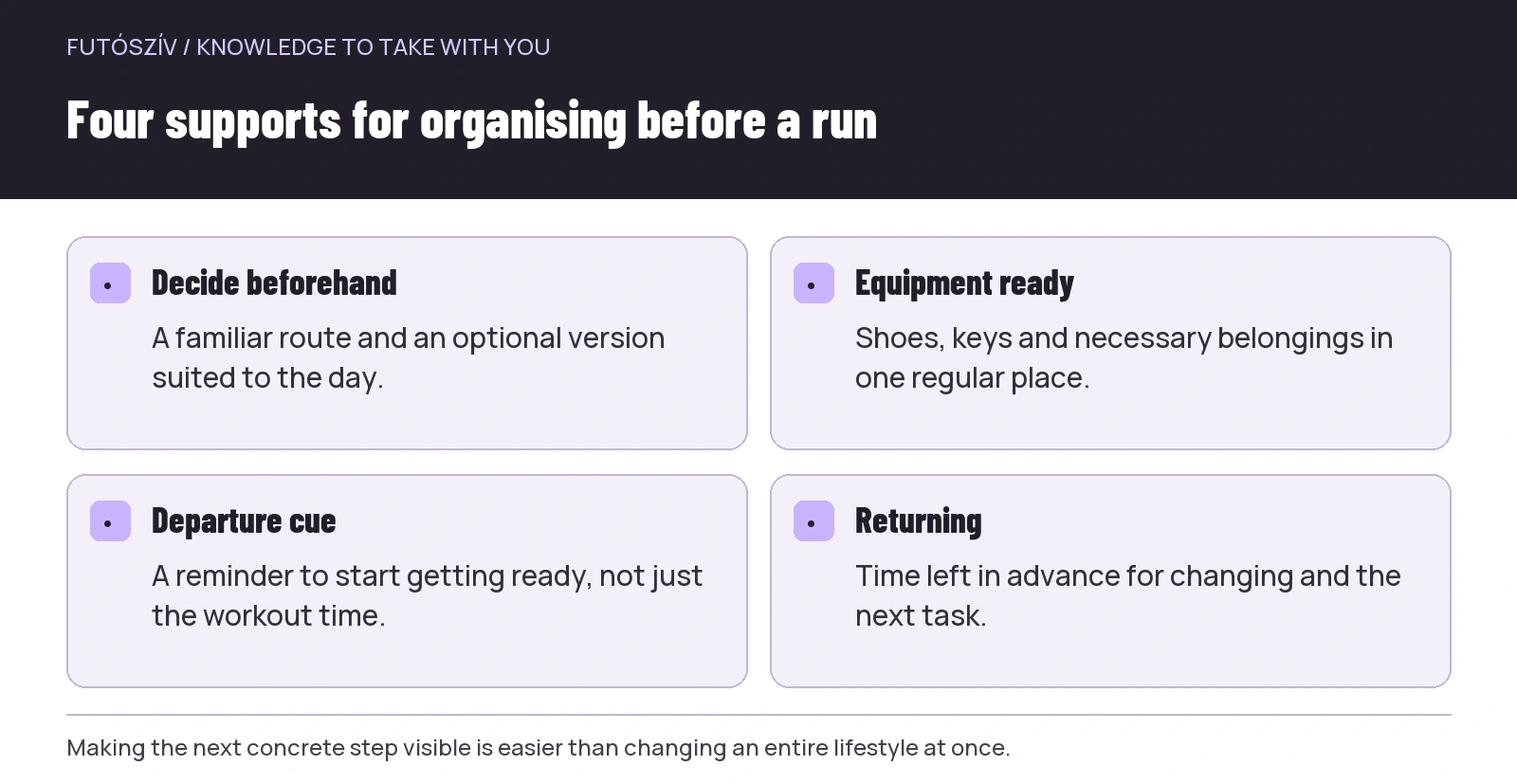 Enlarge diagram
Text version of the diagram
- Decide beforehand
- A familiar route and an optional version suited to the day.
- Equipment ready
- Shoes, keys and necessary belongings in one regular place.
- Departure cue
- A reminder to start getting ready, not just the workout time.
- Returning
- Time left in advance for changing and the next task.
Departure time is not the same as training time
If the calendar records only the group run at six, it may omit changing, using the toilet, travelling and finding the meeting point. These tasks are part of the planned run. Work backwards through the whole preparation to calculate the real departure time, using a separate reminder if needed.
Leave time free after returning too. In scheduling terms, a run does not end when the watch stops: travel home, a shower and a meal may still follow. Without room for those, the next task will repeatedly slip, and running can seem increasingly difficult to accommodate.
Refine the time needed using a few real sessions. This is not a time trial. If an earlier estimate was too short, change the calendar. Do not plan every occasion around the one day when everything happened unusually quickly.
Fewer decisions at the door
You do not have to choose the route, workout type and every item of clothing afresh before leaving. A few familiar possibilities can be prepared beforehand: a nearby easy loop, a longer planned route or a short walk. These are not universal training prescriptions but organisational alternatives already known to suit the individual.
Basic equipment can have a regular place. Shoes, keys and necessary visibility equipment are easier to find together than in three different rooms. If someone else uses the space, discuss the system with them too. ‘Please don’t put this away’ becomes more specific when you show which basket or shelf section serves which purpose.
A short checklist may help, but include only genuinely important things. If a simple park run requires ticking twenty-five boxes, the list itself can become a barrier. The system’s value is whether it makes starting and finishing the activity appropriately easier.
A reminder should name the next step
‘Be healthy’ is not an actionable task. ‘Get changed; your shoes are in the basket’ is more concrete. Timing matters too: the reminder should arrive while action is still possible, rather than during a task you cannot leave.
A phone does not help everyone. A calendar works for some, a bag beside the door or a shared departure for others. If notifications become background noise, simplify rather than add alarms. One selected cue can be more usable than parallel messages from five separate apps.
A reminder is not an instruction to override bodily signals. Illness, pain, exhaustion or another problem can change the original plan. A prewritten message can include a choice too: check how you feel and choose the activity that fits.
An interesting session without changing the physical load
Variety can bring enjoyment, but every new idea does not need a longer distance, faster pace or new race. It could mean a new photography spot on a familiar route, a different running partner or a brief, planned observation of technique. Organisational novelty and physical load are separate questions.
For someone easily excited by new challenges, allowing time before entering may help. Consider the race’s full time and financial costs, travel, training up to that point and current condition together. A night to decide does not guarantee a good choice, but it can make room for details alongside the initial impulse.
A workout someone else performs impressively is not a compulsory next step. Your own plan can include a session that simply feels good and fits. Enjoyment need not come only from a record or the intensity of something new.
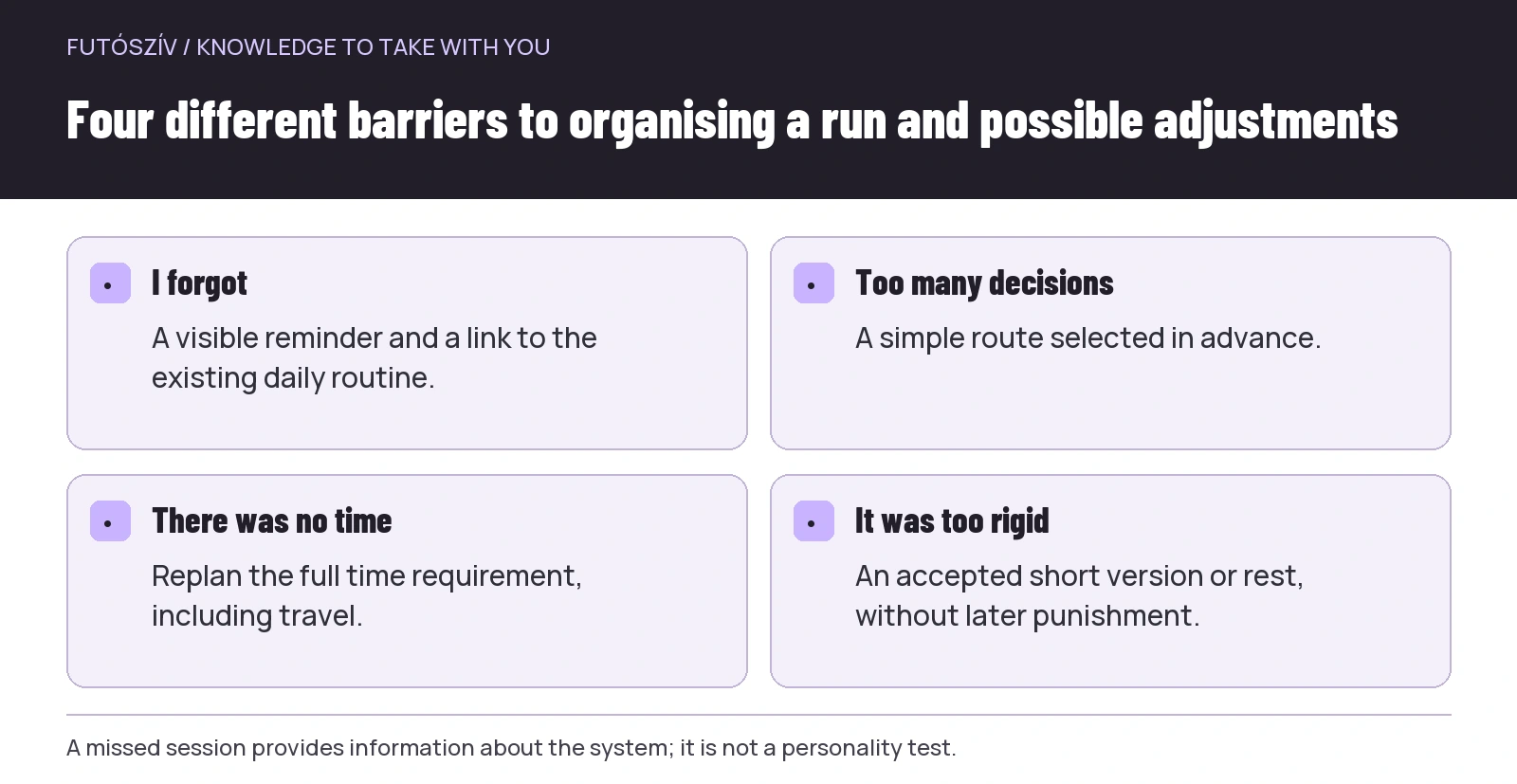 Enlarge diagram
Text version of the diagram
- I forgot
- A visible reminder and a link to the existing daily routine.
- Too many decisions
- A simple route selected in advance.
- There was no time
- Replan the full time requirement, including travel.
- It was too rigid
- An accepted short version or rest, without later punishment.
Social support with clear boundaries
A meeting arranged in advance can help you get started. Clarify with your partner how long you will wait, how to cancel and what the other person does if there is no reply. A running partner does not become a supervisor and is not responsible for holding someone accountable for ADHD treatment.
If you prepare together, discuss movement and organisational support separately. Someone may be happy to send a departure message but unable to rearrange a meeting every time. Others find it works to meet in the same place at the same time without daily coordination. Stating boundaries in advance can protect a friendship from misunderstandings.
The club leader can send basic information in writing too: precise location, start time, expected sequence and contact person. That does not treat a diagnosis; it reduces unnecessary organisational uncertainty. Such changes can also help many other participants.
Treatment, medication and sport may need separate discussion
Anyone taking ADHD medication should discuss exercise-related questions with their clinician or pharmacist. Do not independently change a dose or its timing to make running ‘go better’. The NICE guideline describes monitoring and follow-up as part of medication care; sports-watch data do not replace that.
Do not try to resolve unusual palpitations, feeling unwell, new symptoms or side effects interfering with activity through online tips. An immediately dangerous condition requires urgent care. Questions about exercise timing, activity in heat, sleep and eating also need assessment within the context of personal treatment.
An energy drink or a larger caffeine dose is not a suitable independent experiment in ‘focus treatment’ before a session you are struggling to start. Seek organisational solutions for organisational barriers and appropriate care for persistent symptoms. Both can be present together.
Make safety tasks easy to follow
Even on a familiar route, road crossings, closures or new training instructions require separate attention. Make important decisions while stopped in a safe place. Adjusting a phone route or reading messages while running can easily distract you; neither needs to be done on the move.
On a new course, learn the turning point and way back beforehand. In a group, clarify who gives the essential signal. Do not generalise personal attention needs to every runner with ADHD, but do not feel ashamed to request simple, clear rules either. Having raced before does not mean someone can infer every organisational detail at an unfamiliar place.
Review useful changes after two or three sessions. Was finding belongings easier? Was the time estimate more realistic? Did the run start with less rushing? Improvement does not need to appear in every area at once. Choose one adjustment for the next trial that genuinely relates to the barrier observed.
After a missed session, replan instead of imposing make-up punishment
A missed run does not automatically create a training debt. Squeezing a longer or faster workout into the next day may cause more problems than it solves. First examine why the session was missed and adapt the next step to your current condition.
Notice two kinds of success: did the activity happen, and did the system leading to it work? If you did not run but recognised in time that you were ill, that may have been a good decision. If you went out but returning home again disrupted every other task, improve the full time allowance.
The right system can change with work, family circumstances or the season. You do not need to maintain the same routine forever. Running becomes a usable part of the week when its organisation is clear, enjoyment has room and asking for help is not treated as a sign of failure.
Sources
- NICE NG87: environmental adjustments, lifestyle and ADHD care.
- NHS: adult ADHD and everyday support.
- NIMH: assessment and treatment of adult ADHD.
How Futószív articles are prepared: our editorial guidelines.