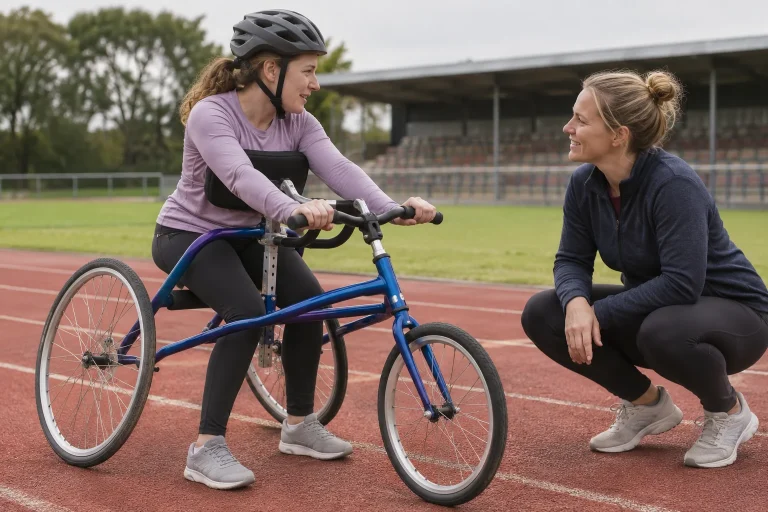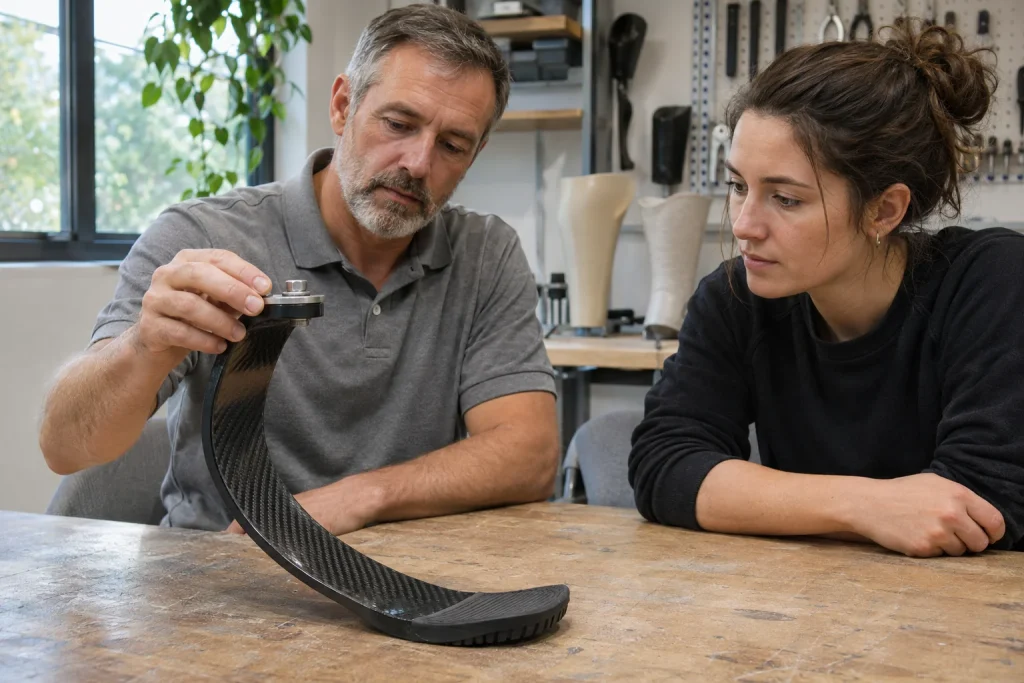
A striking race photograph often comes to mind when we think of a running prosthesis. Starting your own running involves far more than choosing equipment, however. Your current physical condition, fit, learning movement and later follow-up together shape what is manageable. The question is not merely which foot component appears in a picture, but which complete system supports your goal.
This article provides a framework for a first professional discussion about running with a lower-limb prosthesis. Limb differences, amputation levels and health circumstances vary, and the same sport is not appropriate for everyone. It does not determine individual suitability or give a running-instruction protocol to follow at home. The aim is informed preparation based on your own needs.
First put your own goal into words
Taking a few running steps at a group outing, jogging easily on a regular basis and preparing for a race are different tasks. Distance, terrain, speed and frequency all support the professional discussion. You do not need a large goal immediately for your question to deserve serious consideration.
The NELFT prosthetics information also asks for a list of your own goals at the first visit. This is a useful starting point: the professional should see not only the equipment, but the life situation you want it to support. Daily mobility and a sporting goal can coexist, but one solution does not necessarily serve both.
Your goal may change over time. Initial attempts can tell you what you enjoy and which support is needed. You do not have to know beforehand whether you want to compete. Getting to know running is a valid sporting goal in its own right.
Assessment should consider both the body and surroundings
The NHS information on amputation emphasises rehabilitation and preparation for prosthesis use. Suitability does not depend only on equipment characteristics. Individual health, movement abilities and necessary support all matter.
At consultation, describe known illnesses, pain, previous injuries and current daily activity. The reason for amputation and the limb’s condition may be relevant, but a professional need not answer every question solely from a diagnosis label. Assessing current function is a separate task.
Your environment also includes where you can practise, what help is available and how you reach professional appointments. A programme that sounds excellent can still be difficult to use if follow-up and equipment checks are inaccessible. Name these conditions early.
Who helps with which questions?
The NELFT information describes collaboration between several professionals: reviewing medical history, assessing prosthetic options and fit, and rehabilitation support may all be involved. The exact local team may differ. What matters is knowing whom to ask about which question.
The professional making and fitting the prosthesis assesses the relationship between equipment and body. An appropriate physiotherapist or rehabilitation professional can help with learning movement and its demands. Medical follow-up considers overall health. The roles connect, but are not completely interchangeable.
Ask for a clear plan identifying who coordinates the next step. If a running coach joins, they should know the framework relevant to them and how to coordinate. You should not have to relay contradictory, uncertain instructions between people alone.
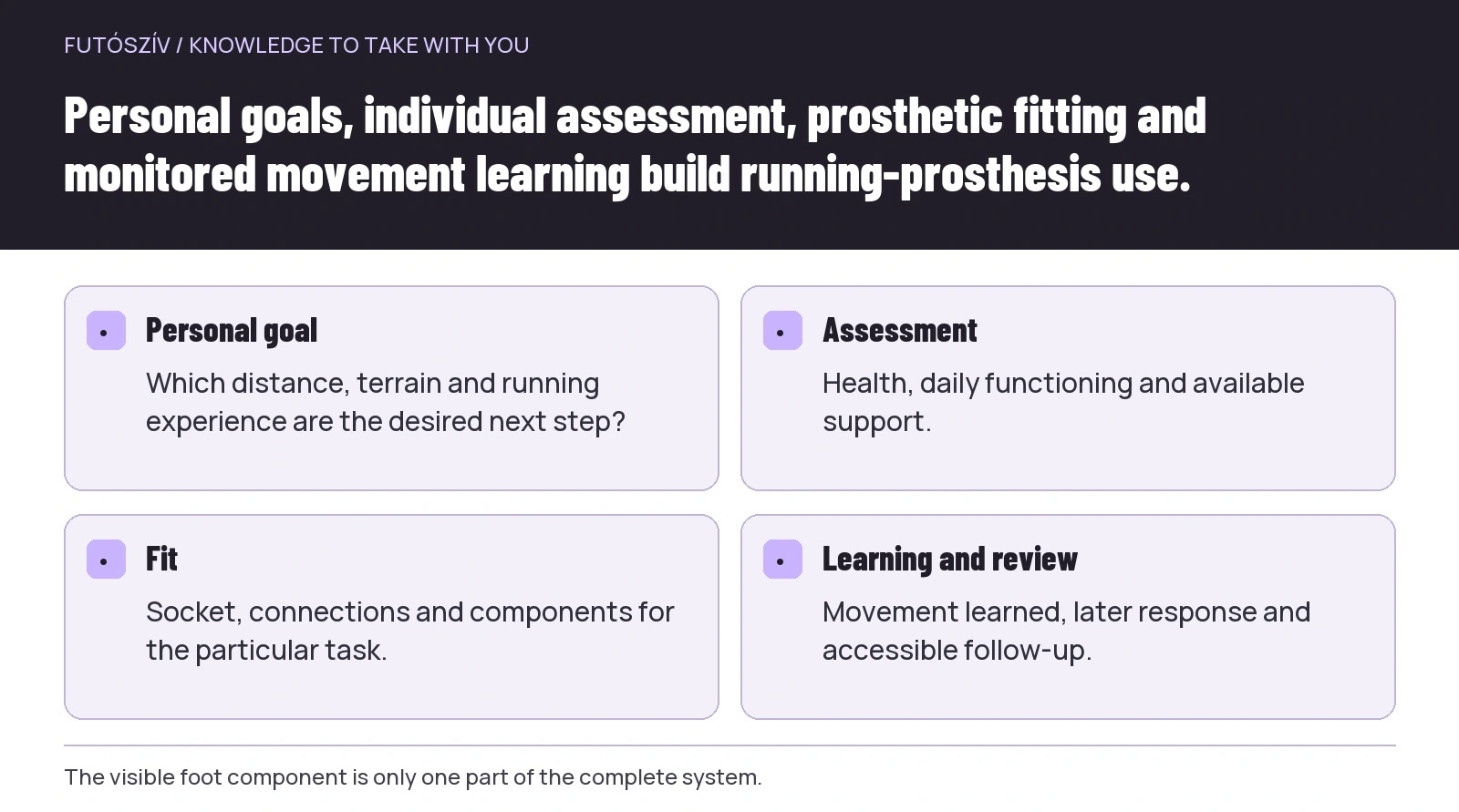 Enlarge diagram
Text version of the illustration
- Personal goal
- Which distance, terrain and running experience are the desired next step?
- Assessment
- Health, daily functioning and available support.
- Fit
- Socket, connections and components for the particular task.
- Learning and review
- Movement learned, later response and accessible follow-up.
A prosthesis is a complete system, not just the visible foot
The socket, connecting elements, suspension and foot together determine use; at some levels, other joint components may also be included. The VA/DoD clinical guideline also discusses several prosthetic components and activity-related considerations. Do not choose for running from a single photograph.
The University Hospitals Dorset information says component selection involves individual ability, expected mobility and future goals. This is not running clearance for every part. Clarify your own equipment’s intended use and limits with the provider.
Do not assume a system working in daily life automatically suits every running demand, or that a running-specific component suits every other situation. Ask about the intended task, instructions for use and necessary checks.
Assess fit alongside the movement task
Comfortable standing or walking provides important information, but running involves a different kind of repetitive movement. During a trial, the professional should assess fit and function for the particular task. Your feedback is essential: where do you feel pressure, uncertainty or discomfort?
Do not accept pain as the inevitable price of serious sport. Describe discomfort precisely rather than merely saying it feels strange. When does it arise, during which movement and how does it change afterwards? These details support an interpretable next step.
Do not technically modify the socket, attachment or another setting yourself from an internet tip. Resolve fit questions with a professional familiar with the equipment. An improvised fix can conceal a problem or introduce new uncertainty.
Movement learning should not begin on a long loop
Choose a first running-practice setting suited to your condition and appropriate professional guidance. Controlled surroundings, short tasks and a clear stopping signal help learning. You do not need to test every movement immediately over long, varied terrain.
Strength, balance and running-related movement tasks may be involved in preparation, but the particular programme needs assessment. An exercise used by someone with another amputation level or different equipment is not automatically your starting task.
Clarify with the professional what needs learning, what shows appropriate execution and when to move forward. The aim is not to resemble a race video on the first day. Build movement experience you understand and can repeat.
Daily use adds to running demands
Alongside sport come work, travel and other daily movement. Explain your daily prosthesis-use demands when starting running too. A short practice means something different on a quieter day than after prolonged standing or much travel.
The VA/DoD patient summary places rehabilitation goals within the broader context of daily functioning and quality of life. A running plan is not successful merely because one session works if familiar tasks then remain difficult. The later response needs monitoring too.
Note the type and duration of practice and any discomfort or comfort experienced. You need not measure every step, but a specific account can support follow-up. A training diary assists professional discussion; it is not an independent suitability assessment.
Take skin and pain warnings seriously
Skin condition and limb comfort are part of monitoring use. Ask for individual guidance on what to check, what is acceptable and which changes should prompt contact. Redness and pain do not always mean the same thing, so do not diagnose yourself from a photograph.
The NHS information also emphasises monitoring the limb and changes suggesting infection. With an open wound, worsening skin symptoms, discharge, spreading inflammatory signs or significant pain, do not continue running to ‘break in’ the equipment. Arrange necessary assessment and an equipment check. Serious illness or rapid deterioration warrants urgent healthcare help.
Report new symptoms in the other limb, back or elsewhere too. Do not consider only the prosthetic area relevant to sport. Review the relationship between movement and equipment alongside whole-body function.
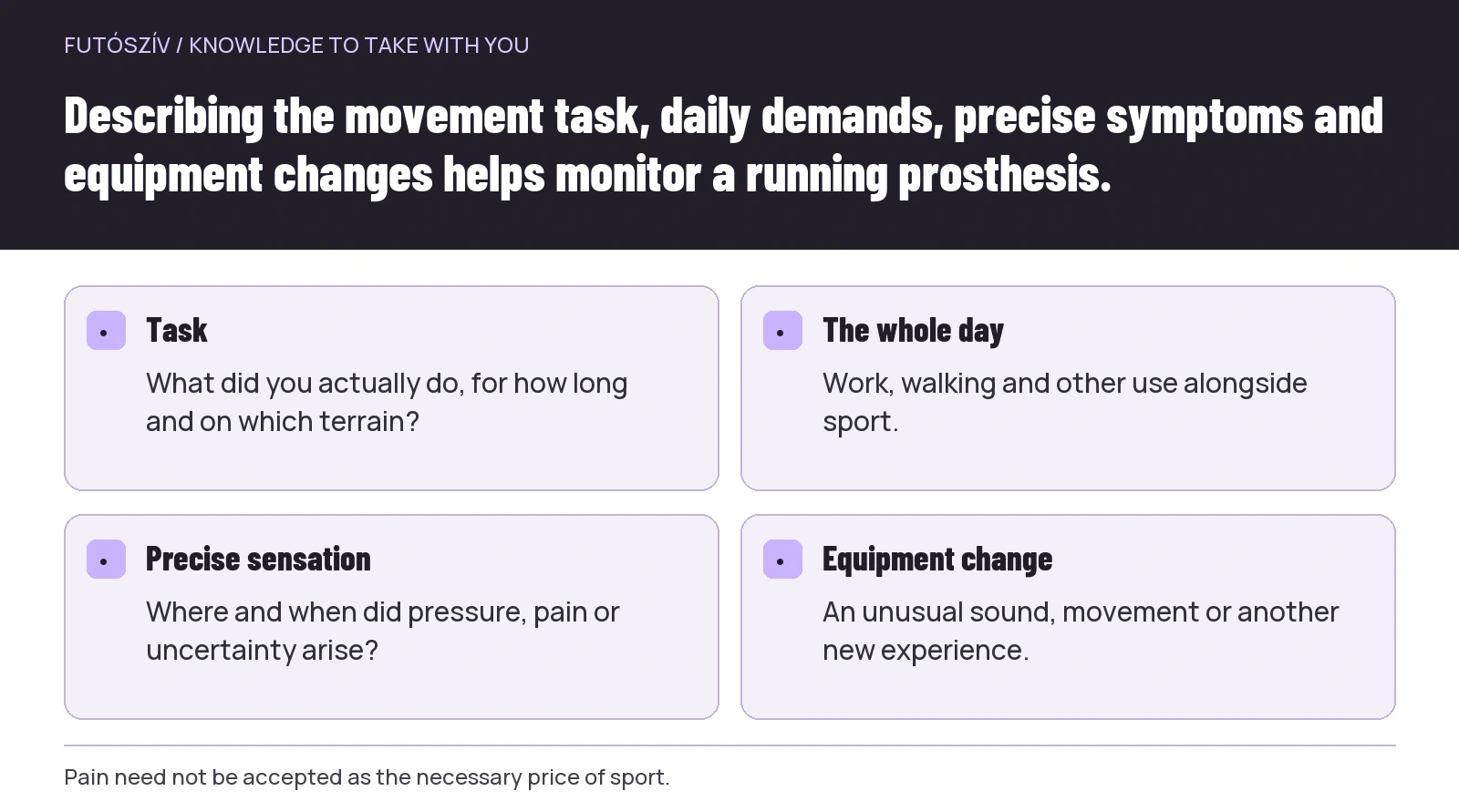 Enlarge diagram
Text version of the illustration
- Task
- What did you actually do, for how long and on which terrain?
- The whole day
- Work, walking and other use alongside sport.
- Precise sensation
- Where and when did pressure, pain or uncertainty arise?
- Equipment change
- An unusual sound, movement or another new experience.
Know maintenance and follow-up arrangements beforehand
When receiving equipment, clarify use, checks, cleaning and servicing. What may you do, and what requires the maker or another appropriate professional? Which contact can you use for unusual sounds, shifting or uncertainty?
An expanding running goal may also call for equipment review. Do not record new demands only in the training programme; tell the provider too. A successful short trial does not automatically establish suitability for every later distance or terrain.
Prepare a few targeted questions and observations for follow-up. If you do not understand a setting’s purpose, ask for an explanation. Your experience is important information, and you need not be merely a passive equipment user in the professional discussion.
Access and funding are separate planning elements
Equipment, instruction, travel and follow-up costs matter together. Clarify specific Hungarian care and support conditions with the relevant provider; overseas guidance does not create automatic Hungarian funding. Ask for understandable information on what is available and through which steps.
An appropriate assessment and a trial where possible may help before making an expensive decision. A product demonstration and individual healthcare recommendation are not the same. An offer should also state the goal, follow-up and further conditions that arise.
The size of a sporting goal need not depend on selecting the most expensive solution. Personal suitability and a manageable path matter. If another activity or smaller goal is available now, that can still provide a valuable connection to sport.
The community should support independence
A running companion should ask what help is wanted: route information, meeting point, shortening or another practical detail. Do not touch equipment or try changing settings without the user’s consent. Support should not become constant supervision or unsolicited advice.
Let the athlete’s own goal guide the conversation. Every group outing need not become a heroic story or inspirational post. Discuss sharing photos, videos and personal stories separately with the person concerned.
Before a race, check its particular participation and equipment rules. Medical suitability, everyday use and official competition classification are different questions. None can be decided automatically from another.
Questions for a first discussion about a running prosthesis
- Which personal conditions need clarifying for the desired running task?
- What is my current equipment suitable for, and should another solution be considered?
- How will we assess the socket and complete system’s fit during movement?
- Who helps with learning, and what is the next manageable goal?
- Which symptoms or equipment changes mean stopping and contacting someone?
- How will follow-up, servicing and access be arranged?
Getting to know a running prosthesis brings technology and human cooperation together. Suitable equipment alone is not a complete sports programme; your own goal, assessment, instruction and monitoring make it usable. Build running’s place gradually from that foundation.
Sources
- VA/DoD: Rehabilitation of Individuals with Lower Limb Amputation – Patient Summary, 2025
- NHS: Amputation
- NELFT NHS: Your first visit to the Prosthetics Service
- University Hospitals Dorset: Guide to a trans-tibial prosthesis
- VA/DoD: Clinical Practice Guideline for Rehabilitation of Individuals with Lower Limb Amputation, 2024
How Futószív articles are prepared: our editorial guidelines.