
A trans runner’s healthcare question may begin with heel pain, persistent fatigue or plans for a longer race, just like anyone else’s. Good advice about sport should address the current concern and goal while taking personal history into account. Knowing someone’s identity does not automatically tell you their anatomy, medications, surgeries or sporting background.
This article addresses practical questions in healthcare for adult trans and nonbinary runners. It is not a guide to hormone treatment and does not determine race eligibility. The aim is a clear, respectful consultation that makes room for both necessary health information and the runner’s own decisions.
Start with the specific running question
Explain why you have come: to investigate a symptom, discuss activity after surgery, ask about sport during treatment or seek general advice about preparation. Describing the goal precisely helps prevent the appointment from drifting unnecessarily into details of identity.
It can help to give a brief account of your current training, recent changes and what has become difficult. Alongside distance covered, daily functioning, sleep, eating and previous injuries may matter. You do not have to decide beforehand whether a symptom is related to hormone treatment or running.
The professional’s task is to consider possible causes appropriately. An ankle problem does not automatically become a consequence of transition, nor do you need to conceal a treatment-related circumstance for your sporting goal to be taken seriously. Both can be assessed together and accurately.
Respectful forms of address are part of care
The UCSF examination guide considers using the correct name, appropriate forms of address and terms for body parts accepted by the person to be part of supportive care. In Hungarian too, you can say which name and terms you would like used. This does not detract from the clinical question; it supports clear communication.
If administrative records show a different name, you can agree beforehand on how you will be addressed in the waiting room and during the appointment. The discrepancy can be handled discreetly, without an explanation in front of everyone. You can ask for a setting where you can calmly explain the relevant history.
You do not owe everyone in a running community your health history either. A fellow runner often needs only to know the pace, route or assistance required. Details shared with a healthcare professional and information given to the group are not the same set of information.
Match the examination to the question and anatomy involved
According to UCSF, a physical examination should be based on the anatomy present and the reason for the visit, without assumptions. An acute respiratory concern, for example, does not automatically justify an intimate examination. The purpose and process of a necessary examination can be explained in advance.
You can ask why examining a particular body part is necessary, what will happen and what alternatives exist if you do not feel ready for a step. You can say if you want to stop. You do not need to recount a previous distressing healthcare experience in detail to request more explanation or time.
Sharing relevant anatomical history can support accurate care, but it does not give unlimited permission to explore every detail. The purpose is to answer the particular healthcare question. There is a clear distinction between professional curiosity and an examination necessary for the patient.
 Enlarge diagram
Text version of the illustration
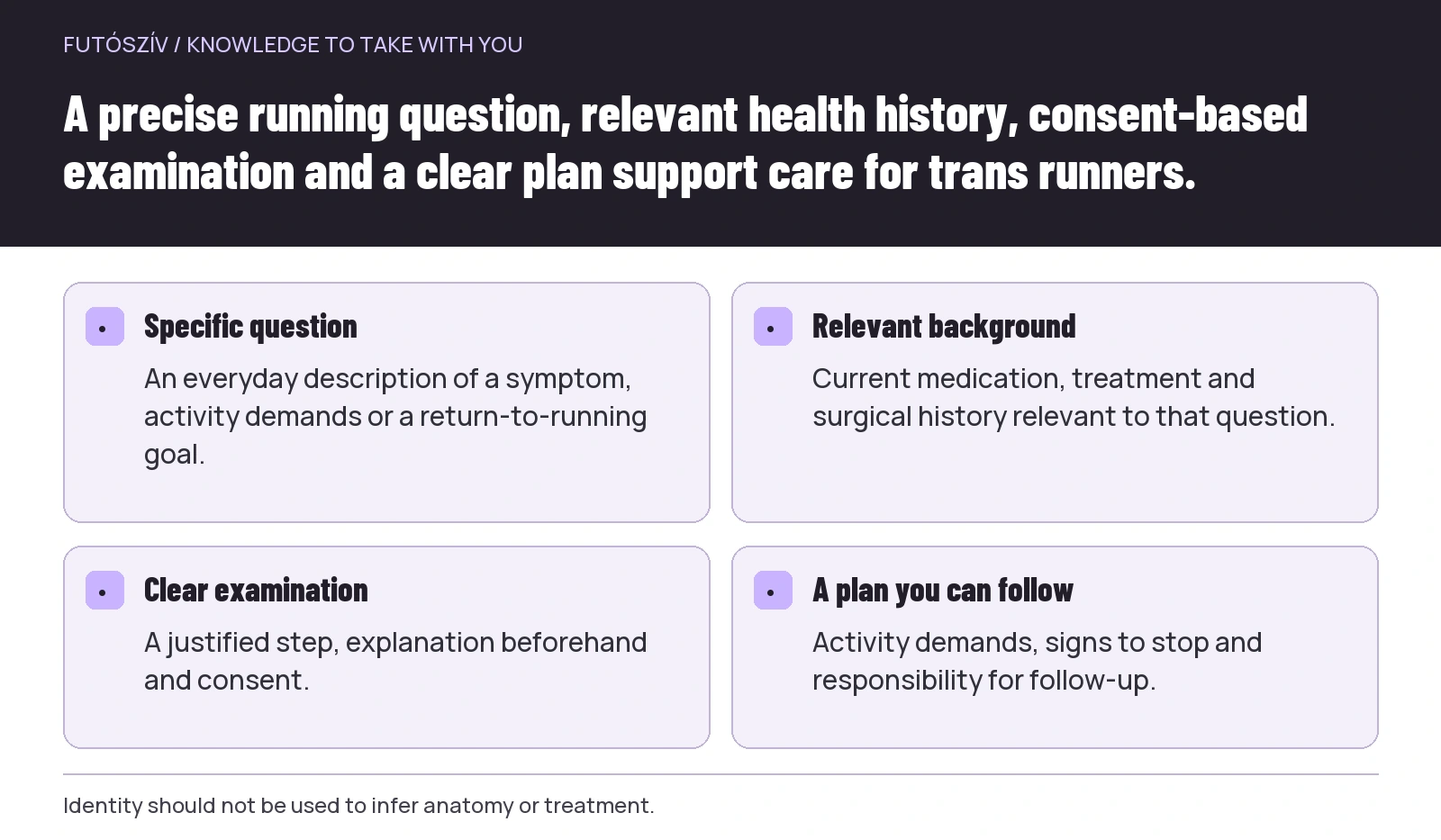
- Specific question
- An everyday description of a symptom, activity demands or a return-to-running goal.
- Relevant background
- Current medication, treatment and surgical history relevant to that question.
- Clear examination
- A justified step, explanation beforehand and consent.
- A plan you can follow
- Activity demands, signs to stop and responsibility for follow-up.
Connect the sports plan with monitoring during hormone treatment
Not every trans or nonbinary runner uses hormone treatment, and treatments differ. If you receive this therapy, explain the preparation, how it is administered and any recent change. The Endocrine Society guideline recommends regular clinical and laboratory monitoring during hormone treatment; the precise plan is an individual healthcare matter.
If you experience new fatigue or difficulty exercising, do not change your dose independently based on running performance. Your treating clinician and, where needed, a sports physician can help clarify the relationship. Skipping, increasing or changing the timing of medication because of a race or training goal is not an appropriate experiment to undertake alone.
At follow-up, explain what sport you actually do. Short, easy runs and high-volume endurance training create different activity contexts. Advice becomes more precise when the clinician knows more than simply that you are active.
Do not let the app interpret laboratory results
Interpreting a result may require considering the treatment, its duration, the particular test and your health history. The ACOG professional guidance, for example, discusses monitoring hormone levels and haematocrit during testosterone treatment. This does not mean that one result highlighted by a system can determine fitness to participate in sport.
If you are unsure about a flag on a result or the reference range selected, ask someone familiar with your treatment to interpret it. The same rule does not apply to every test. A precise question might be what this particular result means in your treatment and sporting situation, and whether further assessment or a change is needed.
Starting iron, hormones or another preparation independently is not an answer to a red flag on a report. The data tracking you are accustomed to as an athlete may help, but clinical interpretation of laboratory results is a separate task. Bring both the trend and your symptoms to the consultation.
Preventive care is individual, not based on a label
ACOG guidance emphasises considering organs and tissues that remain when planning screening. A name or gender marker in administrative records does not by itself establish which screening may be needed. An appropriate plan should be based on personal history, age and treatment.
During a sports medicine consultation, you can ask who coordinates general preventive care. Good endurance does not remove the need for appropriate checks, and healthcare should not be confined to hormone treatment. Blood pressure, previous injuries and other concerns deserve attention too.
If a screening procedure or examination feels particularly difficult, you can say so. You can request an explanation beforehand and a supportive setting. It is worth preserving the purpose of care while making your own comfort and decisions visible too.
Binding and running: pain is not a measure of comfort
A chest-flattening garment can matter to some people’s comfort and appearance. However, UCSF also lists restricted breathing, pain and skin problems among possible consequences of binding. Seek individual advice about using one while running; an arrangement that works for everyday wear is not automatically suitable for intense activity.
Do not rely on eventually getting used to pain or difficulty breathing. If the garment makes movement uncomfortable, stop and address the situation. Do not dismiss significant chest symptoms or breathlessness as merely a clothing issue without assessment.
While seeking an appropriate solution, physical safety and comfort related to dysphoria can be discussed together. One need does not have to be set against the other. The goal is an individual arrangement that preserves both opportunities for movement and serious attention to symptoms.
 Enlarge diagram
Text version of the illustration
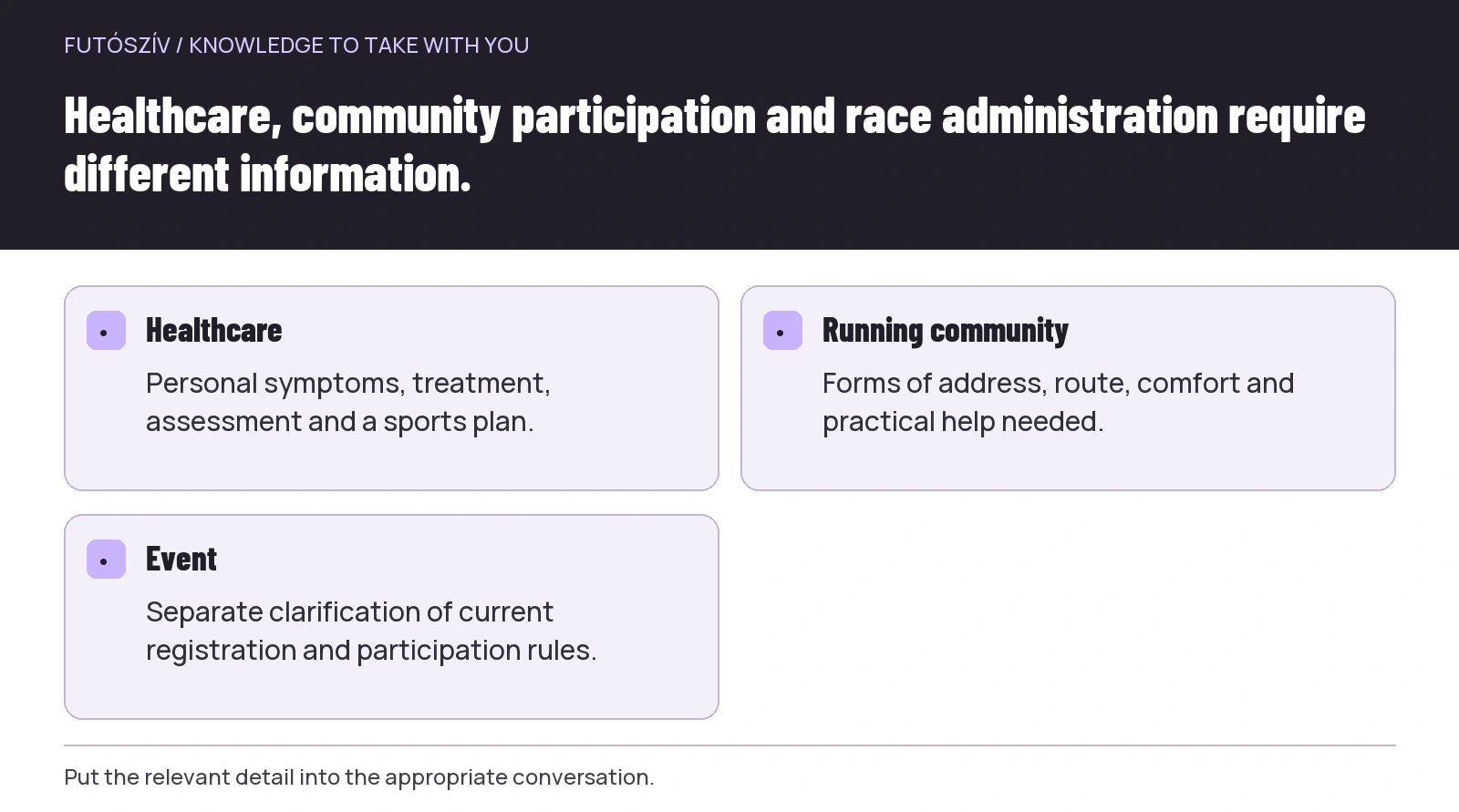
- Healthcare
- Personal symptoms, treatment, assessment and a sports plan.
- Running community
- Forms of address, route, comfort and practical help needed.
- Event
- Separate clarification of current registration and participation rules.
Tucking, equipment and skin stress
If you use a clothing arrangement that changes the position of the genitals, explain the details needed to assess a concern. The UCSF guide also discusses skin, urinary tract and local pain issues. Repetitive movement and moisture during running may create a different situation from everyday wear.
Do not try to conceal chafing, pain, changes in urination or persistent skin symptoms with tighter securing. Appropriate healthcare advice and a rethink of equipment may be necessary. Your description can be factual and brief; it does not require an explanation of your private life.
Do not first try new equipment on a long run or one that is difficult to interrupt. A shorter outing suited to your own condition can help you notice discomfort. Clothing should not create a situation where taking part in sport requires hiding pain.
After surgery, the particular procedure matters
The ACOG information for adults emphasises discussing care after surgery and the return to activity. No single running deadline applies to every gender-affirming procedure. The wound, surgical area, any complications and individual condition may require different plans.
Clarify with the surgical team what movement you can do, what preparations are needed and which symptoms should prompt contact. If running is the goal, explain the planned distance, terrain and equipment. General clearance for daily activity is not necessarily the same as clearance for long or intense training.
Do not measure your return to movement against another person’s surgical story. The appearance of a visible scar is not a complete functional assessment either. Ask for a clear link between clinical follow-up and the sports plan, with appropriate physiotherapy or sports medicine help if necessary.
The community’s role is not to conduct a medical interrogation
As a running group leader, ask what is needed for participation: forms of address, changing facilities, a discreet conversation or another practical detail. Do not assume treatment, surgery or particular physical abilities from identity. Learn about the runner’s current pace and goal individually, just as you would with anyone else.
Share health information only to the extent that the person has approved for that purpose. Do not use a group introduction or social media post to tell their story without consent. Support can also take the form of simple, predictable arrangements.
For eligibility or administrative questions, clarify the particular event’s current rules separately. This is not the same as healthcare advice about sport and does not replace respectful community participation. A running group should not try to settle a category question from a clinical report.
A useful consultation summary
- What is my current concern or specific running goal?
- What training have I actually done, and what has changed recently?
- Which medication, treatment or surgical history is relevant to this question?
- What examination is needed, and how will a clear, consent-based assessment take place?
- What should I change about my activity demands, and which signs should prompt further help?
- Who will follow up the treatment, results and further development of the sports plan?
Care for trans and nonbinary runners rests on the same individual attention required for all good advice about sport: a precise question, relevant history, appropriate assessment and shared decisions. Respect is not simply politeness added to clinical expertise. It helps ensure necessary information is shared and the runner leaves with a genuinely usable plan.
Sources
- UCSF: Transgender patients and the physical examination
- Endocrine Society: Gender Dysphoria/Gender Incongruence Guideline Resources
- UCSF: Binding, packing, and tucking
- ACOG: Health Care for Transgender and Gender Diverse Individuals
- ACOG: Health Care for Transgender and Nonbinary Adults
How Futószív articles are prepared: our editorial guidelines.