
Choosing between two good races can be harder than finding one suitable event. One is closer, another more spectacular; friends attend one, while the other better fits your original goal. It is easy to leave the decision to the latest advert or next price increase. Instead, ask the same questions of both events and state beforehand which considerations you will not compromise.
The method below organises the decision’s practical side. It does not determine which closely spaced races you can physically undertake. Appropriate spacing also involves preparation, experience and health; a scoring table cannot replace these. Here we examine which programme better meets what you seek and how two attractive options need not become two ill-considered commitments.
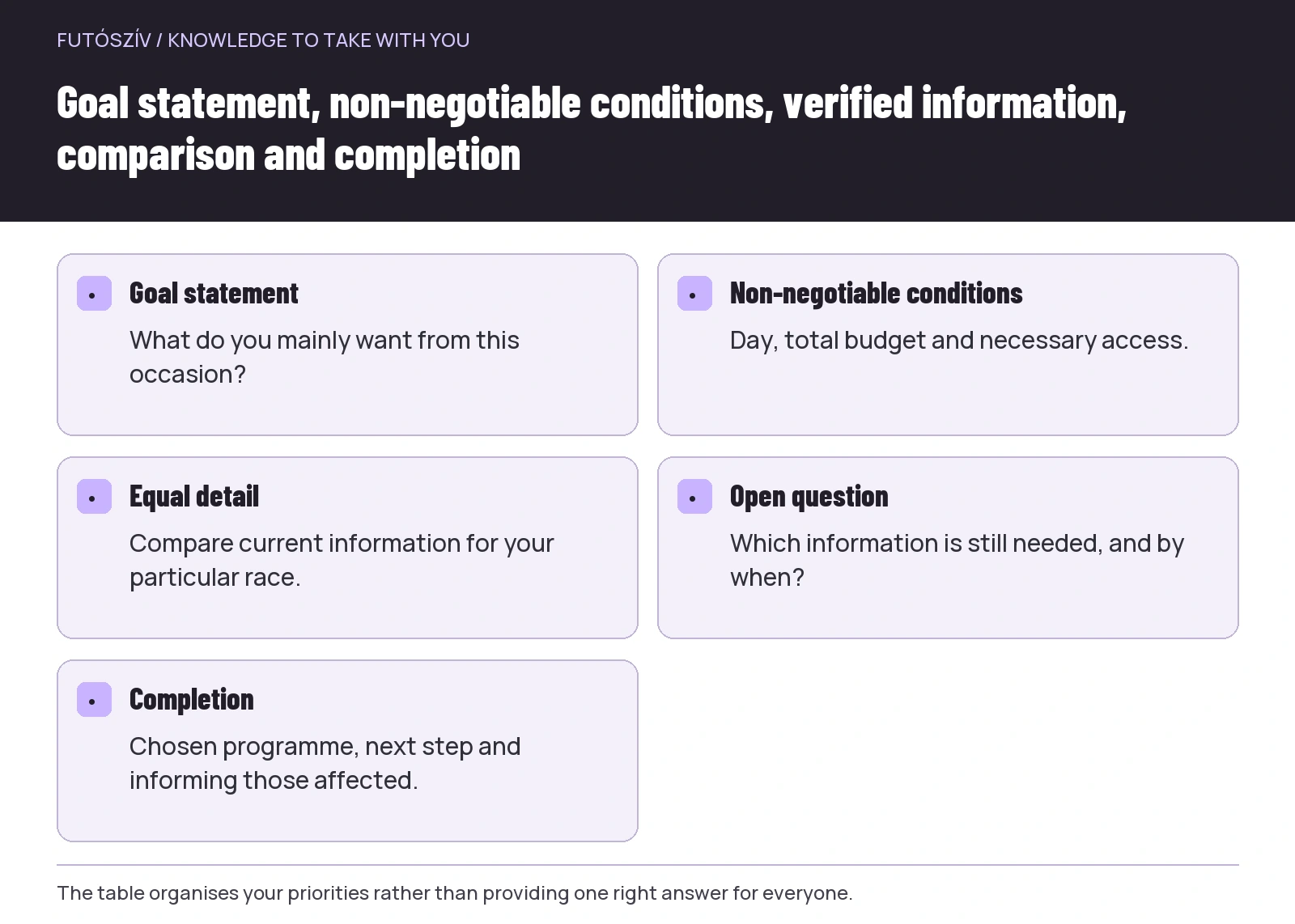
State the current goal in one sentence
Before opening either registration page, finish this sentence: ‘At this spring or autumn event, my main aim is…’ Be specific enough to exclude some options. A shared relay experience, a well-organised completion of a familiar distance, discovering a city and a first race day near home are different goals. Each is valid, but they do not necessarily favour the same event.
Expecting everything at once means more information will not clarify the decision. State the primary goal and two additional benefits you would welcome. For example, joining a friend may come first, with simple travel and an enjoyable afternoon together as benefits. Within this framework, the prettiest medal cannot outweigh whether your friend can actually reach the start.
Do not copy the goal statement from a desired race’s advertising. Beginning with a particular venue name can mean merely finding arguments for a decision already made. Clarify your needs first, then place the two events within that framework.
Do not score non-negotiable conditions
Some considerations cannot be traded away for a few pleasant advantages. If you cannot be free that day, the event is out. The same may apply to your maximum total budget, necessary access or actually reaching a mandatory collection time. List these separately from desirable features.
Access means more than an event appearing on a map. Check your race’s starting conditions, travel both ways, movement on site and any companion’s needs. Ask the organiser about unclear essential conditions. Do not automatically turn missing information into a yes because you otherwise like the event.
| Question | Could it be non-negotiable? | An appropriate check |
|---|---|---|
| Can you reach your race’s start? | Yes | Compare the specific day and start time with travel |
| Is the whole expense manageable? | Yes | Travel and necessary lodging alongside entry |
| Can you manage required collection? | Yes | Current collection times and authorisation rules |
| Do participation conditions suit you? | Yes | Your distance’s own rules and an organiser’s answer where needed |
| Do you like the medal or T-shirt? | Usually not | It can be an additional benefit |
 Enlarge diagram
Text version of the illustration
- Goal statement
- What do you mainly want from this occasion?
- Non-negotiable conditions
- Day, total budget and necessary access.
- Equal detail
- Compare current information for your particular race.
- Open question
- Which information is still needed, and by when?
- Completion
- Chosen programme, next step and informing those affected.
Compare your particular race rather than the event name
A multi-day festival’s name does not automatically specify your start. Different distances may begin on different days under different arrangements. The 2027 Telekom Vivicittá schedule, for example, shows separate Saturday and Sunday programmes. The half-marathon’s own page gives an 11 April start. This illustrates why entering only the event weekend on a comparison sheet is insufficient.
The official half-marathon information contains conditions for that specific race. Seek a source with the same level of detail for the other event. Do not contrast one event homepage’s atmospheric introduction with another’s detailed regulations: different detail levels can make one seem more attractive or difficult simply through presentation.
A distance name is not a complete description either. Surface, placement of climbs, course turns, relationship between start and finish and organiser time limits are separate information. Do not fill gaps from an earlier year’s video or another distance’s map. A decision sheet can state that something remains unchecked.
Calculate total time with the same breakdown
Draw a simple timeline for each programme. When would you leave home? When must you arrive? When and where would you collect your pack? How long would you stay and how would you get home? Do not use the optimistic version catching every connection just in time as the baseline. Waiting around travel belongs to participation time too.
A nearby late-starting race may require less organisation than a more distant race of similar length. Elsewhere, a distant venue may already form part of a planned shared trip, reducing the actual extra commitment. Use the same starting point: count identical time elements for both options, not only the one whose disadvantages you currently seek.
Time requested from others can have its own column. If someone must leave earlier, drive more or cover a task for you, that needs agreement. It is not automatically a reason to exclude the event, but not free organisational reserve either. Record their actual commitment rather than what you hope they will gladly handle.
Compare total costs at the same level of certainty
Give entry fees their own line and other expenses separate groups. Travel, parking, accommodation, necessary meals and a companion’s associated costs may affect the choice. Not everyone pays the same: use amounts relevant to your situation. Split shared car costs among confirmed travellers only when the journey is genuinely agreed.
Present two amounts as totals only when similarly complete. If lodging is known for one but not yet researched for the other, a smaller number alone does not establish the latter is cheaper. Label amounts known, estimated or unknown. Unknown cost is an open question, not zero.
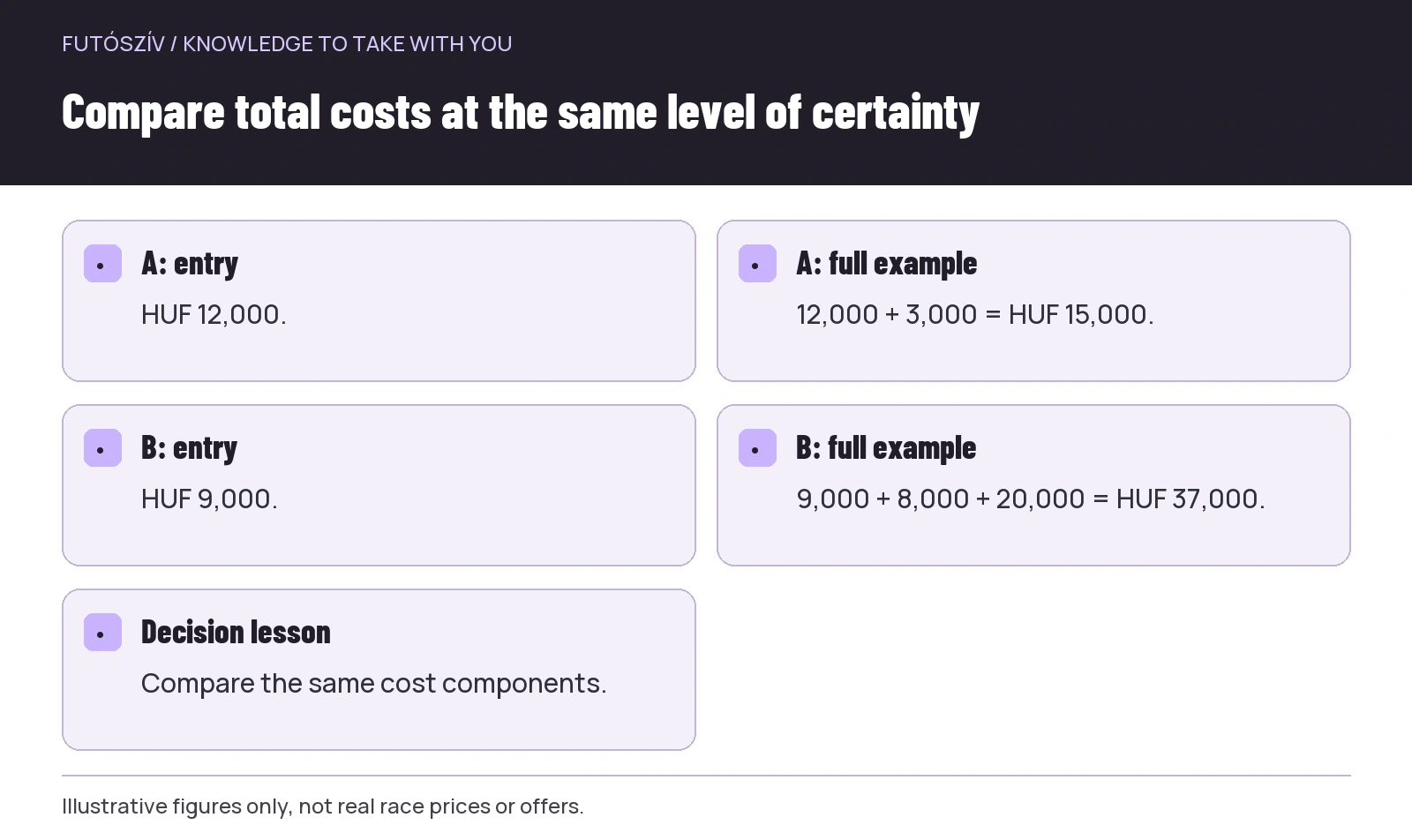
The following figures are fictional comparison examples, not real entry offers. For local event A, assume 12,000 forints entry and 3,000 forints transport. Distant event B would cost 9,000 forints entry, 8,000 travel and 20,000 lodging. Entry alone makes B look cheaper, while the listed total is 15,000 forints for A and 37,000 for B. The calculation does not judge the experiences; it makes the decision’s cost visible.
 Enlarge diagram
Text version of the illustration
- A: entry
- HUF 12,000.
- A: full example
- 12,000 + 3,000 = HUF 15,000.
- B: entry
- HUF 9,000.
- B: full example
- 9,000 + 8,000 + 20,000 = HUF 37,000.
- Decision lesson
- Compare the same cost components.
Choose what is worth scoring beforehand
Once events pass non-negotiable conditions, a simple comparison can help. Choose a few important considerations and define what a favourable assessment means to you. For social participation, the issue is not how many friends clicked ‘interested’, but with whom you have a real plan. Predictability may mean accessible current information and logistics already resolved.
Scoring should not disguise preference as objective truth. If easy travel matters twice as much as spectacular scenery now, say so openly. Do not pretend nature or a city course deserves the same points for everyone. The method applies your own priorities consistently.
A useful trial is removing medals, T-shirts and promotional photos from the comparison. Does the same event remain preferable? If not, consider whether those extras genuinely appeal most or stronger visual impressions distracted you. A memento can be a pleasant consideration, provided it does not conceal participation’s essential conditions.
Leave room for uncertainty
One race lacks a final route, another transport details. You need not reject both, but missing information does not always carry equal weight. If a particular connection is essential to reach the start, transport information may be decisive. If a minor course adjustment does not affect your goal, it may remain a smaller uncertainty.
Write the final information needed and when it should be available. For example: I will enter once Sunday travel is arranged and my teammate confirms participation. That creates a specific task. ‘I will wait a little longer’ can become aimless delay, while a conditional decision knows what it awaits.
An approaching price deadline does not confirm missing information. Weigh a later higher fee against early uncertainty, but do not call it guaranteed savings when you do not yet know whether you will use the entry. Check transfer, withdrawal and distance-change conditions in the organiser’s current information. Not every payment can be moved freely.
A fictional decision: the social goal and spectacular course
Suppose Nóri considers two events close together. Her friend is definitely available for A, both can stay locally and travel is settled. She prefers B’s course, but the friend cannot yet commit, and its early start would require separate accommodation. Nóri’s original goal was a shared day that could be organised calmly.
Within that framework, A seems stronger. Not because the distant programme is bad or travel always undesirable, but because more essential details fit the primary goal. Nóri can retain B’s location on a later ideas list without paying now. Keeping a second option does not necessarily require a second entry.
If Nóri’s goal had instead been a dedicated trip and exploring somewhere new, she could reach a different conclusion. The table does not manufacture one right answer for everyone. It makes the connection between stated goal and choice open to checking. The decision can then feel more like your own later, even when spectacular pictures arrive from the other race.
Complete the decision with a few specific steps
Once chosen, do not leave both events in the same calendar state. Mark the next task for the selected event and set the other aside as an idea or remove its near-term reminders. If others expected you, state clearly which programme you accept and where they cannot count on you. Silence is not reliable team-assignment information.
Keep a brief reason too. Two sentences suffice: the main goal and conditions making this programme more suitable. When the other event’s promotional video appears later, this helps recall that the choice involved more than images. Missing a good option does not necessarily mean deciding badly. More appealing activities may exist than you should undertake in one period.
After entering, keep checking organiser updates. Completing a decision does not freeze information: locations, collection or transport can change. What you can release is constantly rescoring both events after every advert. If essential conditions have not changed, a thoughtful choice need not pass another exam daily.
How Futószív articles are prepared: our editorial guidelines.