Choosing between drink powder and a ready-bottled sports drink is more than a contest between a smaller pack and a convenient sip. Powder needs suitable water, measuring, mixing and a container, while a ready-made drink requires managing the whole bottle, handling after opening and any transfer to another container. A comparison makes sense when it concerns the same prepared state and the same situation of use.
This article helps adult recreational runners interpret labels and organise preparation. It does not prescribe a particular sports drink, rank brands or determine personal fluid, carbohydrate or electrolyte intake. A product’s instructions are not an individual sports nutrition plan. With illness, medication or a prescribed diet, suitability needs deciding alongside personal professional advice. The numerical examples below are fictional educational figures.
The format does not tell you the composition
The Australian Institute of Sport sports-drink overview describes ready-to-drink and powder forms with differing carbohydrate and electrolyte contents and additional ingredients. This does not mean all powders are alike or a ready-made drink automatically contains the same ingredients as a powder carrying the same brand name. Start from the exact product and variant’s information.
Flavour, pack colour and a sporty name can at most help identification. A full ingredient list, nutrition table and preparation instructions provide different information. Two products can differ substantially even with the same flavour name. If you have used one version, check the label again for a new pack size or reformulation. Do not automatically copy old notes onto the pack just purchased.
First state the basis of comparison
The European Commission nutrition-labelling information distinguishes values per hundred grams or hundred millilitres from optional additional values per portion. Comparing a powder and liquid therefore needs more than finding the same number on each label. First clarify which state and amount it refers to. A hundred grams of dry powder and a hundred millilitres of prepared drink are not the same quantity basis.
If a label also gives information for the drink prepared as instructed, check the associated recipe. If only powder values are shown, interpretation requires both the amount of powder used and the actual amount of finished drink. Do not assume ‘one serving’ highlighted on the front applies to your whole bottle or run. It may be a quantity unit defined by the manufacturer that needs comparing separately with your own use.
A fictional example: the same value in different bottle sizes
The imaginary drink A’s label shows six grams of carbohydrate per hundred millilitres of prepared drink. In five hundred millilitres, that is five times six, or thirty grams; in seven hundred and fifty millilitres, seven and a half times six, or forty-five grams. Concentration is the same, but total quantity differs. Neither bottle size nor number is a personal recommendation. They illustrate only label-based proportional arithmetic, without testing a real product or measuring physiological effects.
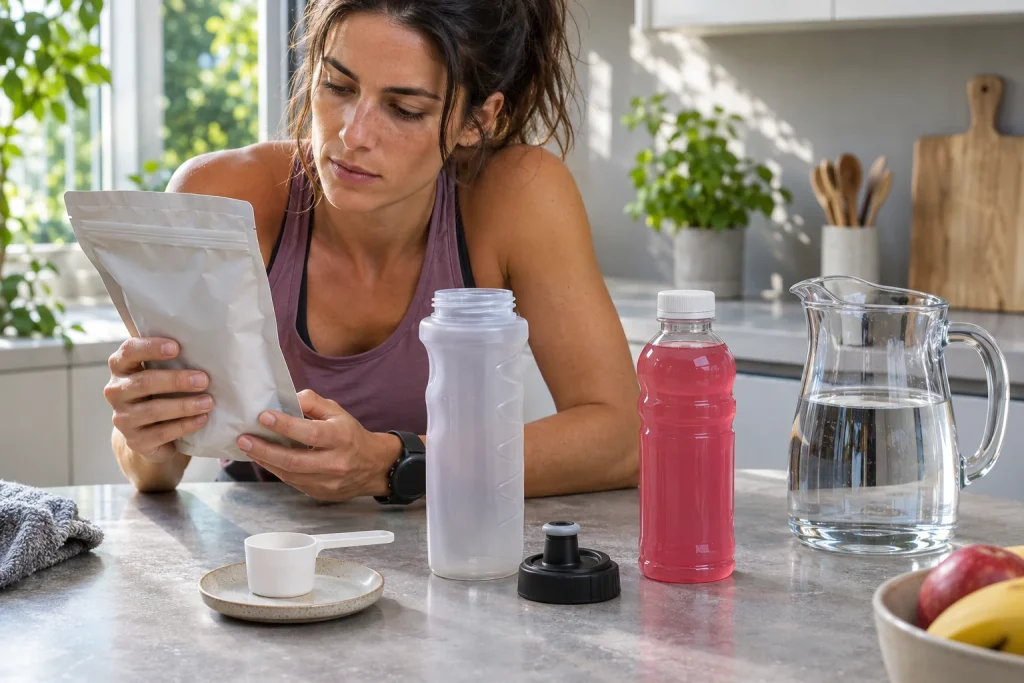
Now imagine comparing drink A prepared from powder according to the specified recipe with a bottled ready-made drink B. First compare relevant values for the same prepared volume, then for the actual total amount you carry. The two drinks may still differ in other ingredients. Identical carbohydrate figures do not prove identical recipes, usability or personal suitability. Calculation remains only one part of comparison.
| What does the label show? | What needs clarifying? | Common mistake |
|---|---|---|
| Value in 100 g of powder | The amount of powder actually weighed and the preparation method | Comparing directly with values for 100 ml of finished drink |
| Value in 100 ml of prepared drink | Which recipe was used, and what is the total quantity? | Mistaking concentration for the entire bottle’s contents |
| Value per serving | How much powder or finished drink does the manufacturer call a serving? | Treating one serving as the needs of your entire run |
| Value for the whole bottle | Does the statement really refer to the entire bottle? | Applying it unchanged to another pack size |
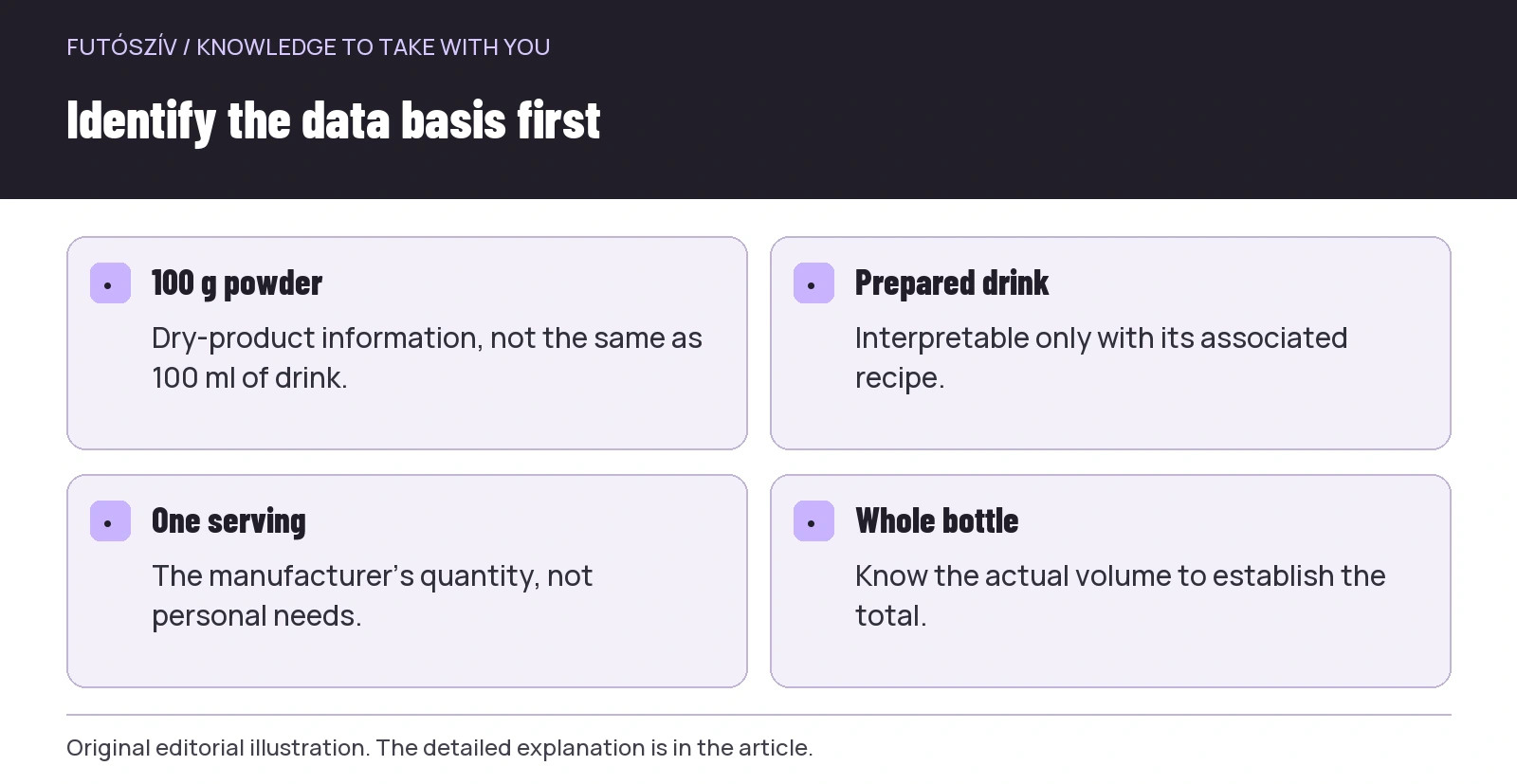 Enlarge diagram
Text version of the illustration
- 100 g powder
- Dry-product information, not the same as 100 ml of drink.
- Prepared drink
- Interpretable only with its associated recipe.
- One serving
- The manufacturer’s quantity, not personal needs.
- Whole bottle
- Know the actual volume to establish the total.
Read mixing instructions literally
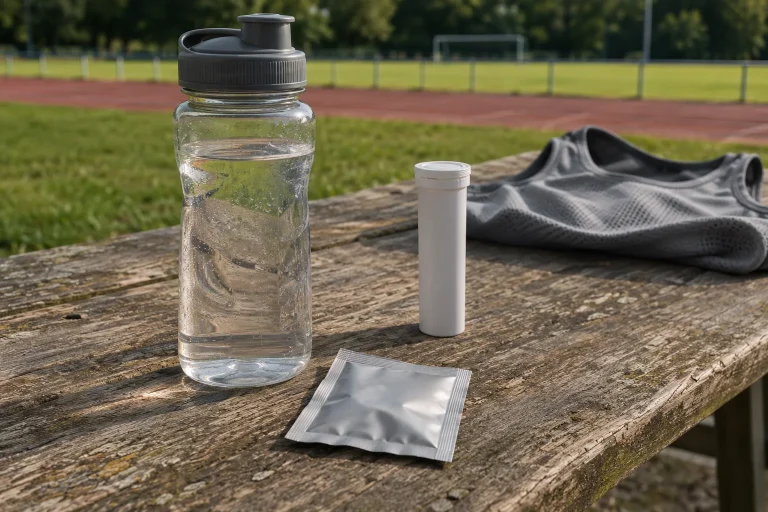
Adding powder to a specified amount of water is not the same instruction as making ingredients up to a specified final volume. Follow the product’s own wording. Do not change it from memory into another brand’s recipe or automatically use a bottle’s nominal full capacity as a measured water quantity. Weight and volume in the instructions are different units; grams do not become millilitres because a similar number appears on the same measuring device.
For an included scoop, read how the manufacturer defines the amount. Heaped and level scoops may differ, and another product’s scoop may not be the same size. When measuring by weight, tare the clean container and use the scale appropriately. The aim is repeatable preparation of the specified recipe, not claiming unjustified precision to many decimal places from kitchen measurements.
Water is an ingredient to arrange beforehand
For drink powder, plan an appropriate drinking-water source in line with product instructions. A ready-made drink of unknown composition offered at a race is not automatically water for another mixture. Adding powder without knowing its contents no longer produces the original recipe. Colour or flavour cannot identify every ingredient appropriately. If planned preparation conditions are unavailable, do not substitute an improvised concentrate.
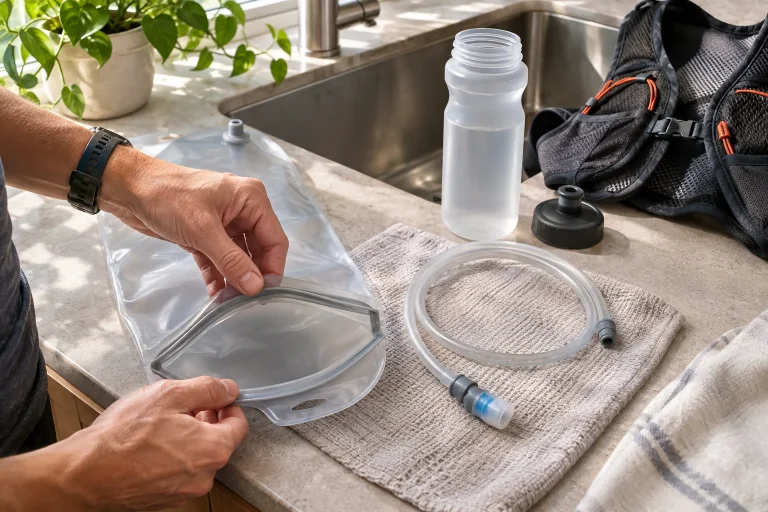
For mixing at home, set out the necessary clean tools and a container suitable for the product. While measuring powder, keep wet or contaminated tools out of the whole supply. Close and store an opened pack as instructed. Keep the original label legible, particularly when packing smaller portions. An unnamed pouch of the same colour provides insufficient information to identify the right product and amount later.
For ready-made drinks, read the conditions after opening too
Conditions for an unopened bottle can differ from required storage after opening. Check the label for refrigeration, the period for use and whether these can be maintained on your route. Transferring a drink does not restart a deadline. Do not automatically treat the remainder of an opened large bottle like an unopened one just taken from a shop shelf. The specific product’s instructions determine what to do.
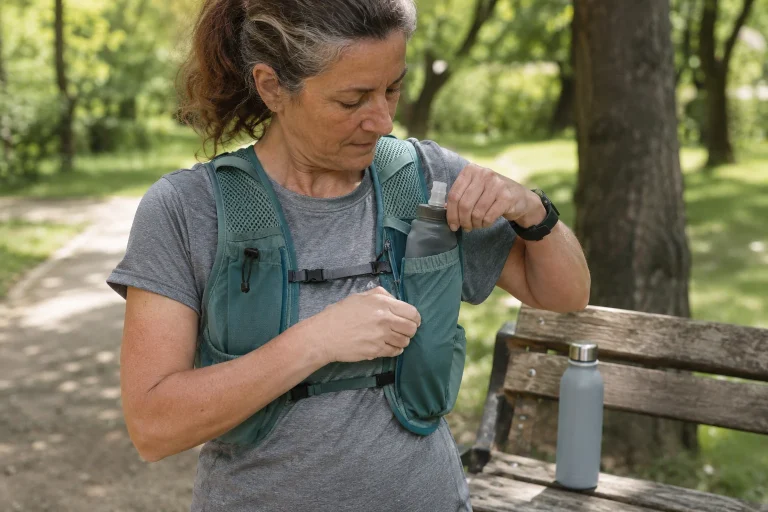
Transferring introduces another item and operation. You need a clean, suitable bottle, clean surroundings and reliable identification. If you cannot carry the original packaging alongside your own bottle, consider how to preserve necessary information. The recipe, opening time and storage conditions must not disappear because a differently shaped container fits a running vest. Solve convenient carrying and appropriate handling together.
Clarify the container’s own limits
The HydraPak manufacturer guidance specifies drinks intended for its products and materials requiring more careful handling or avoidance. This concerns one manufacturer’s equipment, not general proof of compatibility for every bottle. Your own model’s use and cleaning instructions apply to your bottle. Temperature and container-material limits may matter alongside the liquid’s name.
Do not use hot water simply to dissolve powder faster if neither the drink nor container instructions permit it. Match closure and mixing methods to the particular equipment too. Not every open cup is suitable for shaking, and a badly fitted lid does not make it safe. If the equipment and product instructions cannot be reconciled, choose another appropriate solution.
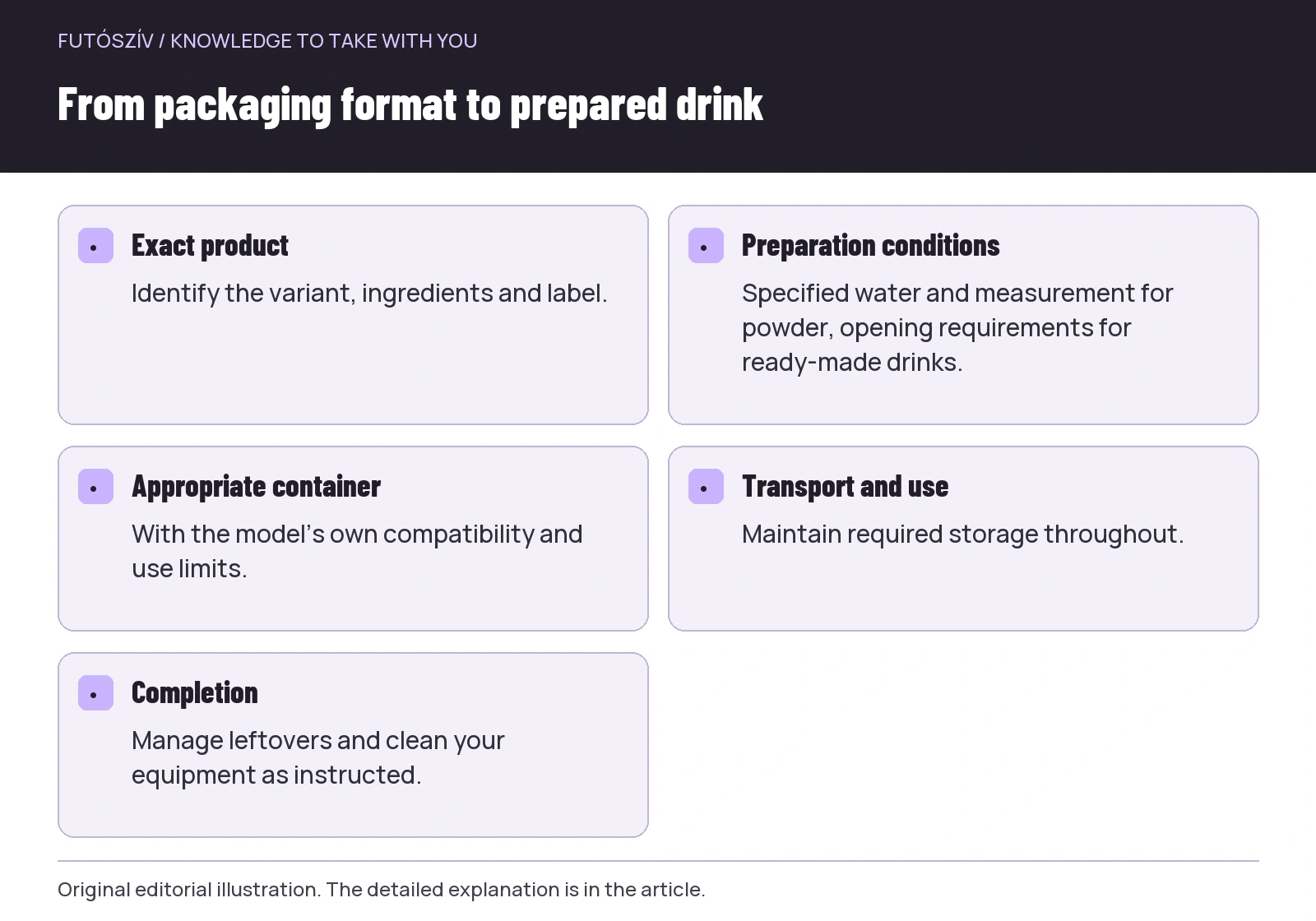 Enlarge diagram
Text version of the illustration
- Exact product
- Identify the variant, ingredients and label.
- Preparation conditions
- Specified water and measurement for powder, opening requirements for ready-made drinks.
- Appropriate container
- With the model’s own compatibility and use limits.
- Transport and use
- Maintain required storage throughout.
- Completion
- Manage leftovers and clean your equipment as instructed.
Compare the whole transport task
Powder may fit in a smaller dry pack, but needs water and preparation facilities where used. A ready-made drink removes powder measuring, while you carry the liquid’s weight and bottle-handling needs. Neither advantage creates a winner for every situation. Your journey, accessible water, time, refrigeration and carrying equipment together determine which process you can complete appropriately.
Make two short packing lists for the same task. For powder, include the precisely identified product, necessary measuring or premeasuring, water, appropriate container and label. For a ready-made version, include the particular bottle, conditions after opening, any transfer and leftover handling. Lists reveal the real work. A small pack volume alone does not show every item needed.
Compare costs only for the same prepared task
A tub of powder’s price and a ready-made bottle’s price cannot be compared directly when quantities and compositions differ. If calculating cost, state the amount prepared according to instructions, actual use and leftovers. Water and necessary access do not involve the same task in every situation either. Do not create a general cheaper-versus-dearer ranking from different recipes and unknown amounts used.
Treat environmental comparisons just as carefully. Smaller powder packaging or a refillable bottle alone cannot determine a precise product footprint. Within your own arrangements, however, you can observe how much remains, how much packaging you use and how you clean equipment. Record these without asserting unverified percentage savings or a sustainability ranking valid everywhere.
A short preparation card for next time
A useful card contains the exact product, label mixing instructions, the state and quantity basis of the information, your container and storage tasks. It does not replace original packaging, but helps prevent swapping units from memory during a repeated operation. Update it for a new product or changed label too. Appropriate preparation means following specific information repeatably.
You can then choose between powder and ready-made drinks from actual use. Identify what is in the pack, understand what the figures refer to and follow tasks from preparation to cleaning. The personal sports-nutrition role still needs establishing separately. Good label reading does not promise optimal performance on your behalf, but helps avoid poor decisions from information that looks identical while describing different things.
Sources and further reading
- Australian Institute of Sport: Sports drinks – What does it look like?
- European Commission: Nutrition labelling
- HydraPak: What can I put in my HydraPak?
How Futószív articles are prepared: our editorial guidelines.