Your own cup and bottle relate to similar aims, but do not necessarily do the same job. You may drink from a cup at a refreshment station, while a closable container lets you carry your planned drink onward. Race rules may require one or both functions. Preparing before the start therefore takes more than thinking ‘I have something to drink from’: understand the equipment’s role and the full refilling process.
This guide concerns competitors’ practical tasks. It gives no identical fuelling dose for everyone, does not replace an individual nutrition plan and does not override current organiser rules or station staff instructions. The named events’ official pages illustrate differing conditions; before your next start, read the current rules for your own race and distance. Old habits are insufficient for a new event.
First separate the requirements in the rules
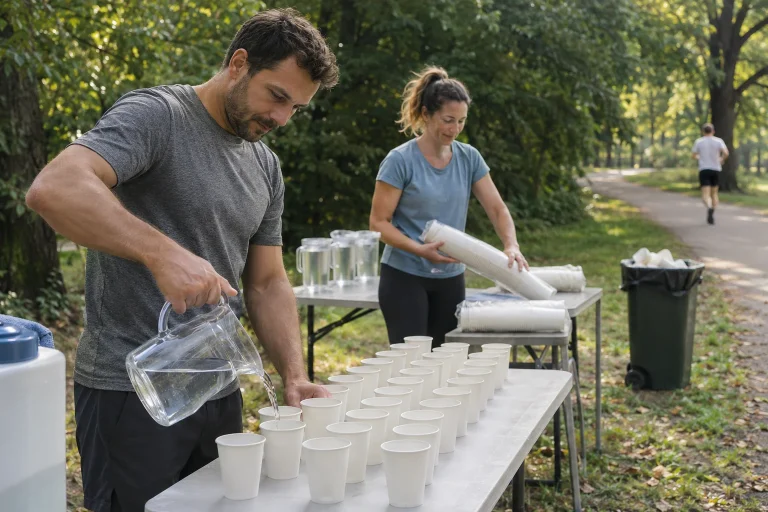
The Ultrabalaton Trail mandatory equipment page draws attention to a personal cup, flask or bottle because disposable cups are not used at relay and refreshment stations. It also distinguishes equipment requirements by distance. In your own preparation, separately check what you need for drinking on site and the required fluid-carrying capacity. Their names are not necessarily interchangeable.
A mandatory container capacity may be a technical minimum, not a personal drinking dose. Capacity says how much the equipment can hold under the requirement; it does not alone say how much you should drink on that section. Your own appropriate plan may need more equipment than the minimum. Keep meeting rules and meeting personal needs as two separate checks on your list.
Know what to expect at each station and why you will use it
The official Salomon Ultra-Trail Hungary event page also emphasises responsibility for adequate supplies between refreshment stations within its semi-self-sufficient format. It limits where personal assistance is allowed too. Personal supplies, organiser-provided drinks and refilling your own container are therefore different organisational options. Do not assume anyone may hand over any extra item at an arbitrary roadside location; follow your own event’s rules.
Alongside distances in the station list, check services and intended use. A quick drink needs a different sequence from filling a container, mixing powder or collecting your own pack. The plan should not require every task to happen in the same second. Treat queuing and actually stopping as ordinary parts of the race, not faults to eliminate at any cost.
Try your equipment in its filled state
At home or during calm training, check whether the container comes out of its designated pocket, how the cap opens and whether you can put it back full. An empty soft flask has a different shape from a filled one. Fitting it into a tight pocket after the station may therefore be harder than a dry trial suggested. An access check is not a race simulation or hydration assessment: it shows whether the particular sequence of movements works.
Choose the cup’s storage place too. You should not need to open every pocket at the station while your phone or keys might slip out. Keep a collapsible cup accessible in a way you can manage when taking it out and putting it back. If a pocket is awkward, choose another position in advance. Another fastener or accessory helps only if you also understand its use and safe attachment.
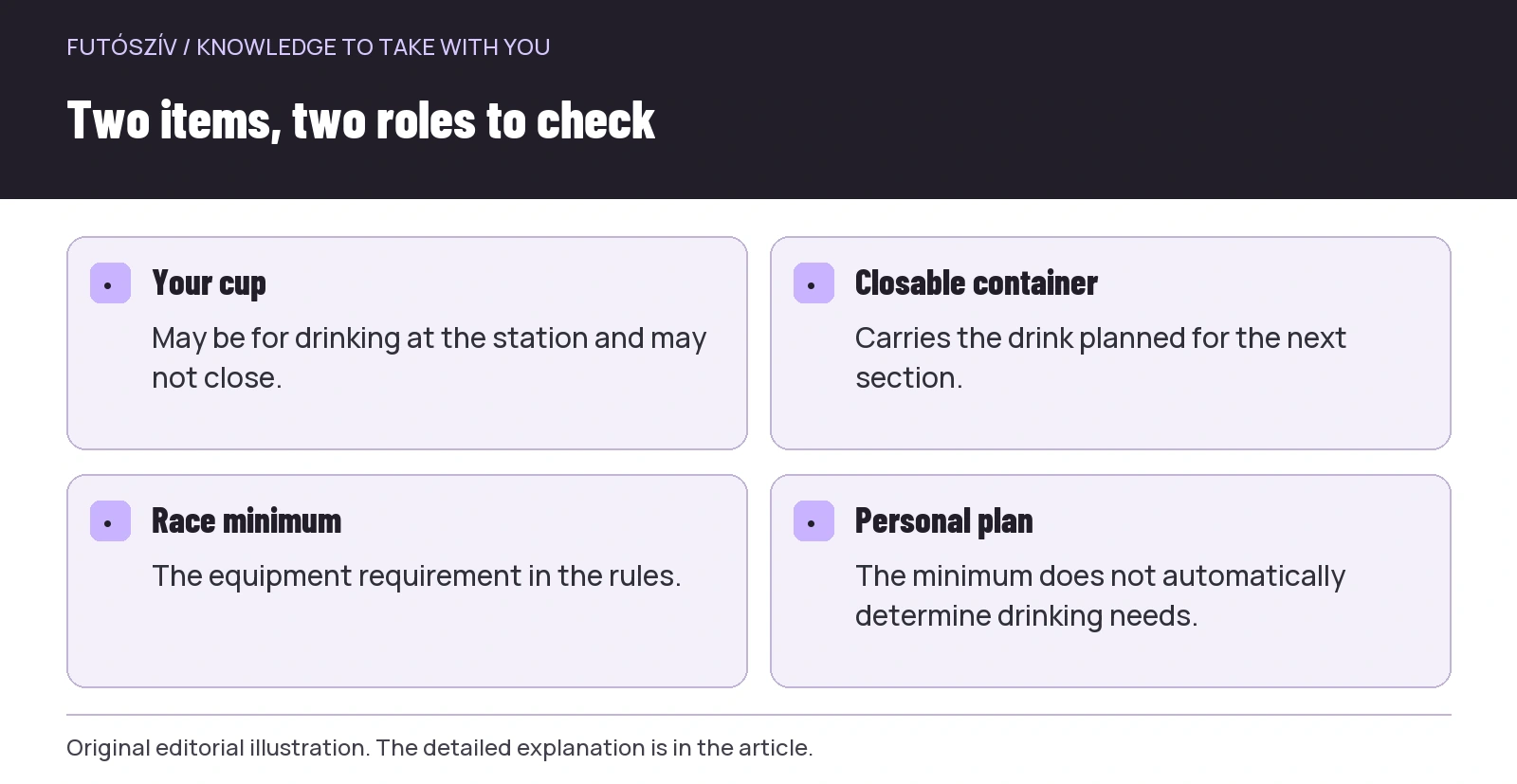 Enlarge diagram
Text version of the illustration
- Your cup
- May be for drinking at the station and may not close.
- Closable container
- Carries the drink planned for the next section.
- Race minimum
- The equipment requirement in the rules.
- Personal plan
- The minimum does not automatically determine drinking needs.
Organise tasks before the station, but in a safe place
As you approach, check signs and staff signals. If taking equipment out requires stopping, do so where you do not obstruct traffic. Do not dismantle your vest in the middle of the running line or try to reach the front with an open container while searching for a dropped cap. Good preparation means orderly movement, not doing everything on the move at any cost. Adapt to on-site arrangements.
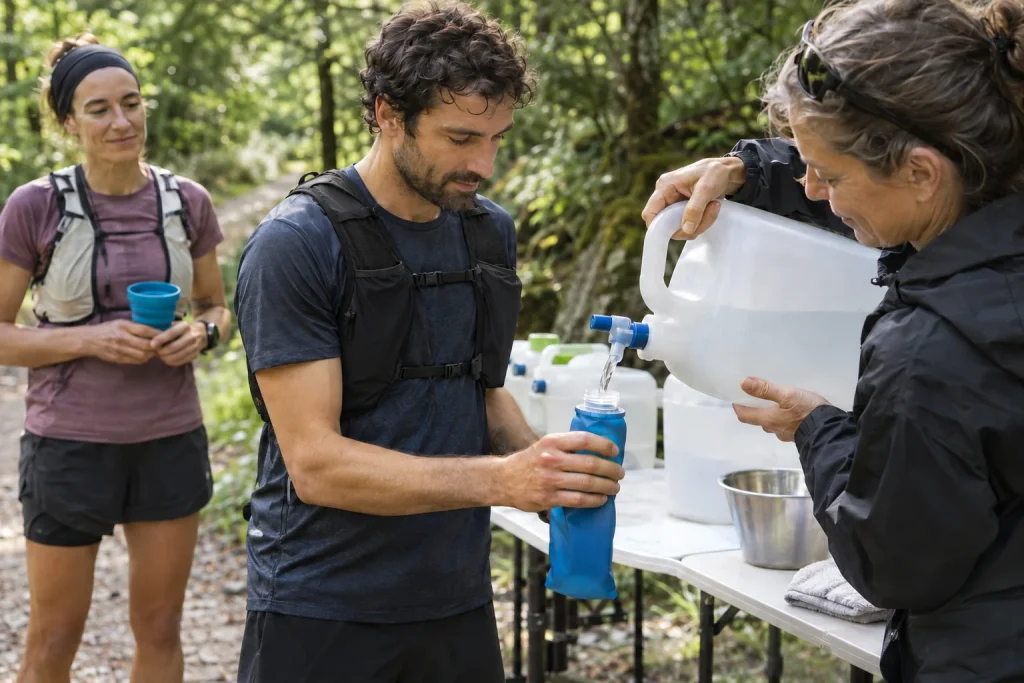
With two containers, name their roles beforehand. One might hold water under your own plan and another a different drink, where appropriate and available at the station. Labels or different mounting positions may help identification. An uncertain colour or cap recognised from memory is not always enough. Tell the person filling clearly what you want in which container, and listen to what is available.
A queue supports clean and predictable handover
Choose the queue for the drink you want according to local signs. If unclear, ask before filling or having someone fill the container. Station staff determine how to use shared jugs, taps or dispensers. Do not press your mouthpiece against shared equipment or put a cap’s inside on a contaminated surface. If asking for help, explain the task in a short, precise sentence.
The Nébih food safety guidance highlights clean hands and equipment and protecting ready-to-eat food from contamination. This principle also matters when handling your own cup and bottle. Do not put the mouthpiece on the ground or a surface of uncertain cleanliness for speed. If contamination occurs, ask what suitable solution is available at the station; do not treat a quick splash of water as complete cleaning.
A cup is not necessarily a suitable mixing vessel
A soft collapsible cup should be used according to its design. Suitability for drinking does not necessarily make it closable, a measuring device or designed for vigorous mixing or other uses. If your plan includes a drink made from powder, use an appropriate container and follow the product instructions. A race is not the place to improvise checking mixing proportions with equipment meant for another function.
Do not automatically mix a drink of unknown origin or composition with powder measured at home. First clarify what you are receiving and the next operation under your own plan. A prepared drink at a station and drinking water are not identical ingredients for a new mixture. Familiar flavour or liquid colour does not replace information. If the planned operation cannot be completed appropriately, discuss it with station staff and reconsider continuing from actual conditions.
Make checking the closure a separate step
After filling, move to the designated place without obstructing others and check the cap or closure fits properly. Cross-threading, material caught in a closure or an incorrectly secured valve can cause leaks during use. Check closure according to your own equipment’s instructions. You do not need to squeeze every container hard or overtighten it; checking as intended matters.
Then put the container back and check its attachment. Is the drinking part accessible? Is the cup in its designated pocket? Have you left neither rubbish nor the cap on the table? Leaving the station is a good time to compare supplies needed for the next section with your plan too. Fixing a badly closed flask can become harder a few steps later, with others following on a narrow trail.
| Operation | An observable check | Typical misunderstanding |
|---|---|---|
| Taking equipment out | The appropriate cup or container is at hand. | Having any drinking item covers every role. |
| Requesting a drink | You understand what each dispenser puts into it. | Similar colour means identical composition. |
| After filling | The particular item’s closure fits properly. | A screwed-on cap must be sealed correctly. |
| Leaving | Equipment is secured and the next section’s plan is workable. | Everything will sort itself out after leaving the station. |
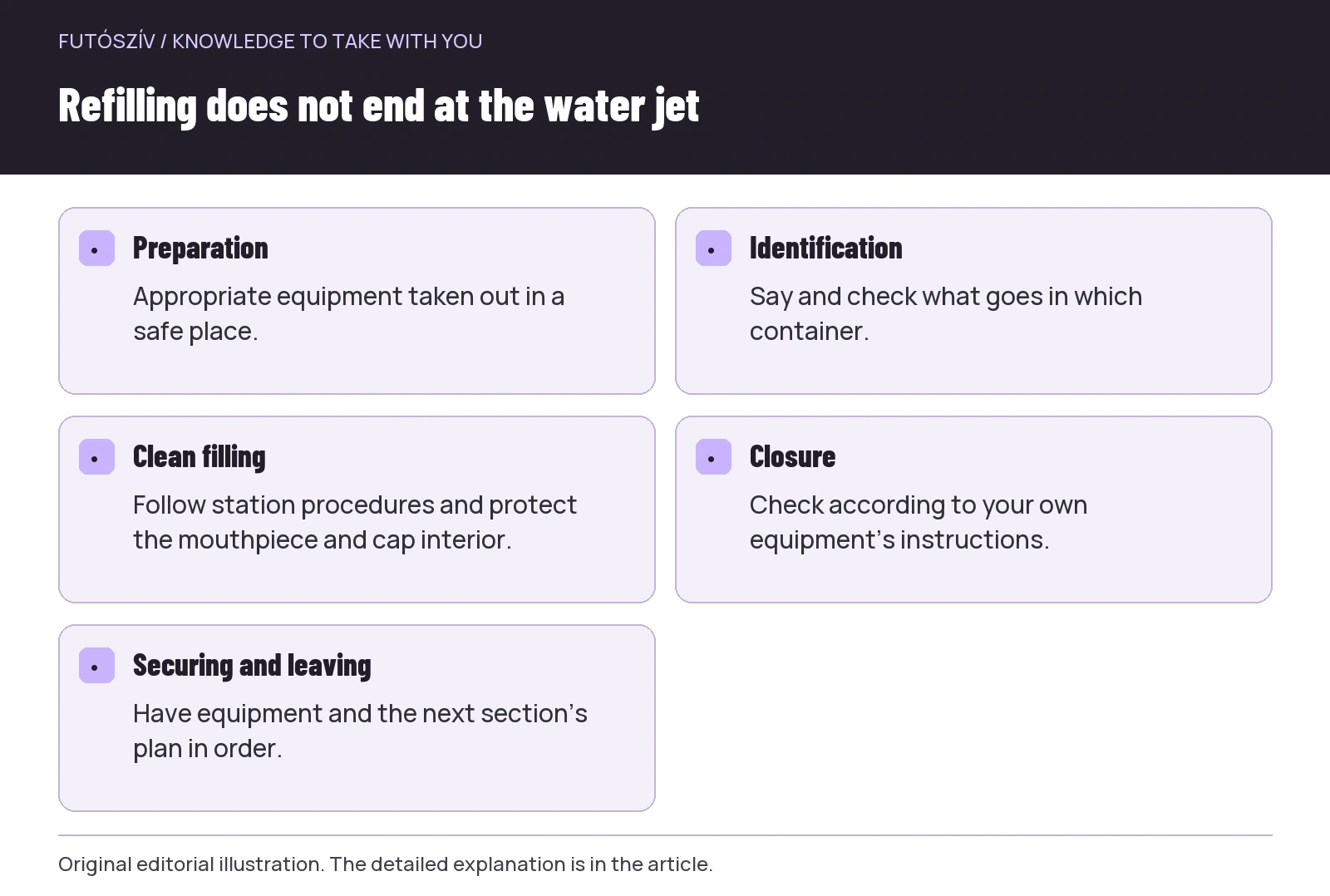 Enlarge diagram
Text version of the illustration
- Preparation
- Appropriate equipment taken out in a safe place.
- Identification
- Say and check what goes in which container.
- Clean filling
- Follow station procedures and protect the mouthpiece and cap interior.
- Closure
- Check according to your own equipment’s instructions.
- Securing and leaving
- Have equipment and the next section’s plan in order.
With personal assistance, agree location and handover too
Even if race rules permit personal help, know where and under which conditions you may receive it. Tell the helper the container’s precise role and requested task. An agreed label is clearer than a rushed ‘fill the other one’. Helpers should not change your drink composition independently or put unidentified caps in shared storage with another competitor’s equipment. The individual plan should stay clear during handover too.
If several spare items arrive at a station, separate used supplies from those ready for use. Labels with your name or race number may prevent swaps within the team where the event system permits. Dropping off personal refreshments offered under the rules may be a separate process with its own packaging and delivery conditions. Do not first try to work these out at the station, where volunteers have many other tasks.
Do not solve congestion by skipping a necessary station
If the queue is longer than expected, stay predictable and follow staff directions. Do not abandon access to needed fluids simply for fear of losing time. Plan the next section from actual circumstances; an earlier optimistic schedule does not create supplies. If unwell or unable to arrange continued progress appropriately, ask for help at the station. Position in the results or the stop’s duration does not override this.
Leave the space before the dispenser free while reorganising after the queue if the station layout requires this. Securing equipment, choosing food and adjusting clothing are easier elsewhere. This does not mean the same layout everywhere: check where runners may wait and do not obstruct entry or exit. A clear personal sequence can help the station work without reducing the attention refilling needs.
After finishing, cleaning and the next use follow
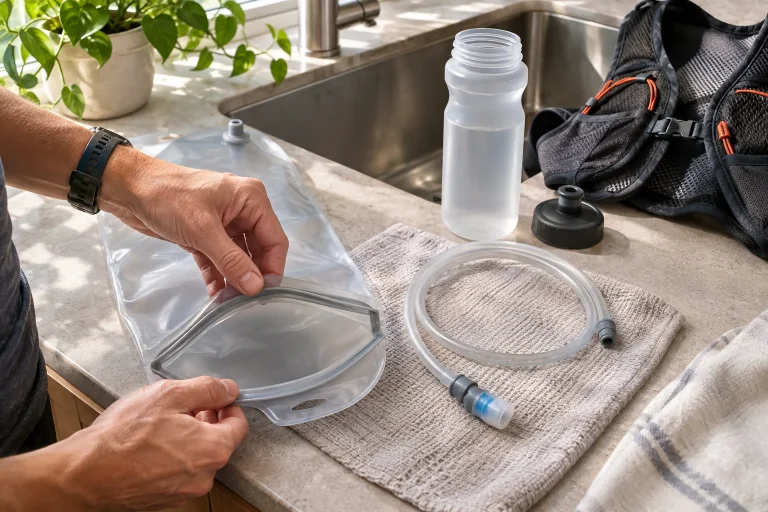
At home, empty equipment and clean, rinse, dry and store it according to its own manufacturer instructions. A cap, valve and drinking tube may need different care from the container, so look beyond the large interior surface. Resolve cleaning or damage problems before the next race. A refreshment station is not the place to maintain a neglected container, and refilling is not complete cleaning.
Briefly note which operation was difficult: removal, holding the cap, positioning for filling or putting the container back. The next change should target that specific point. Using your own cup then becomes a learnable sequence suited to your equipment and race rules, rather than a general equipment-shopping task. The best preparation is something you can repeat accurately at the station.
Sources and further reading
- Ultrabalaton Trail: Mandatory equipment
- Salomon Ultra-Trail Hungary: Official event information and semi-self-sufficiency
- Nébih: Preventing foodborne illnesses
How Futószív articles are prepared: our editorial guidelines.