A visually impaired runner and guide do more than have one person run while another leads with good intentions. They need jointly developed signals, clear roles and practice. The runner is best placed to explain which information helps; the guide’s task is to provide it reliably and in time.
Not every visually impaired runner wants or uses the same support. Independent movement, partial sight and guiding needs are individual. This article offers an organisational framework for learning communication as a pair, not a substitute for practical guide training or individual instruction. Learn a new technique in a calm environment with appropriate expertise.
Ask first, then suggest a solution
The RNIB guide says to ask first whether the person would like help and how they prefer to be guided. This is fundamental in running too. Do not infer the support needed from a cane, glasses or the name of a visual impairment.
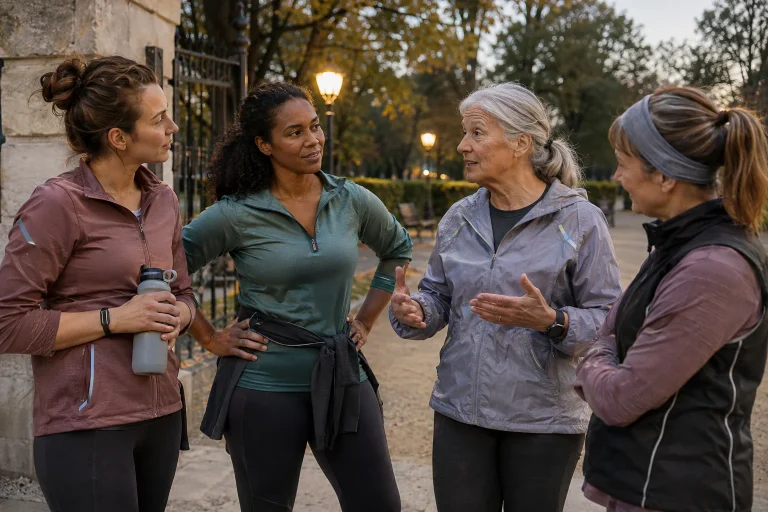
A few specific questions are enough for an initial conversation: which side is comfortable, which signals are already familiar, what routes they normally use and today’s goal. You do not need their entire health history to be a considerate running companion. Focus on information needed for movement.
The guide should explain their experience too. If they have not guided a runner before, they should not present themselves as experienced. Learning is an acceptable starting point; concealing uncertain knowledge makes shared decisions harder.
Guiding is a skill that can be learned
The England Athletics sight-loss awareness and guide-running training addresses understanding visual impairment and practical guiding separately. The Vision Sports Ireland and Athletics Ireland 2026 material also highlights communication, spoken description and an accessible training environment. Adequate running fitness alone is not the same as guiding proficiency.
An overseas training system is not a Hungarian licensing rule. The lesson is to seek knowledgeable organised support and practical instruction. The shared arrangements developed with a partner cannot be fully learned from an article.
Learning should not begin with someone trying to run fast, blindfolded, along an unfamiliar route. A manageable situation, appropriate supervision and consent matter more than a dramatic experience. The goal is a workable partnership, not acting out visual impairment.
Give the first outing a simple outline
Meet at an easily identifiable, quiet location. Explain beforehand where you are, what the surroundings are like and what will happen. The runner should receive information before the moment of movement too; make the starting point and return arrangements known.
You can begin by agreeing signals while stationary or walking, followed by brief movement suited to your abilities and appropriate instruction. The partner, connection method, fast pace and route should not all be new at once. Simpler circumstances make learning easier.
Agree a stop signal beforehand and provide opportunities for feedback. The runner should be able to say at any time that they need different information, to slow down or to finish. The guide should likewise be able to say when they cannot assess a situation appropriately.
 Enlarge diagram
Text version of the illustration
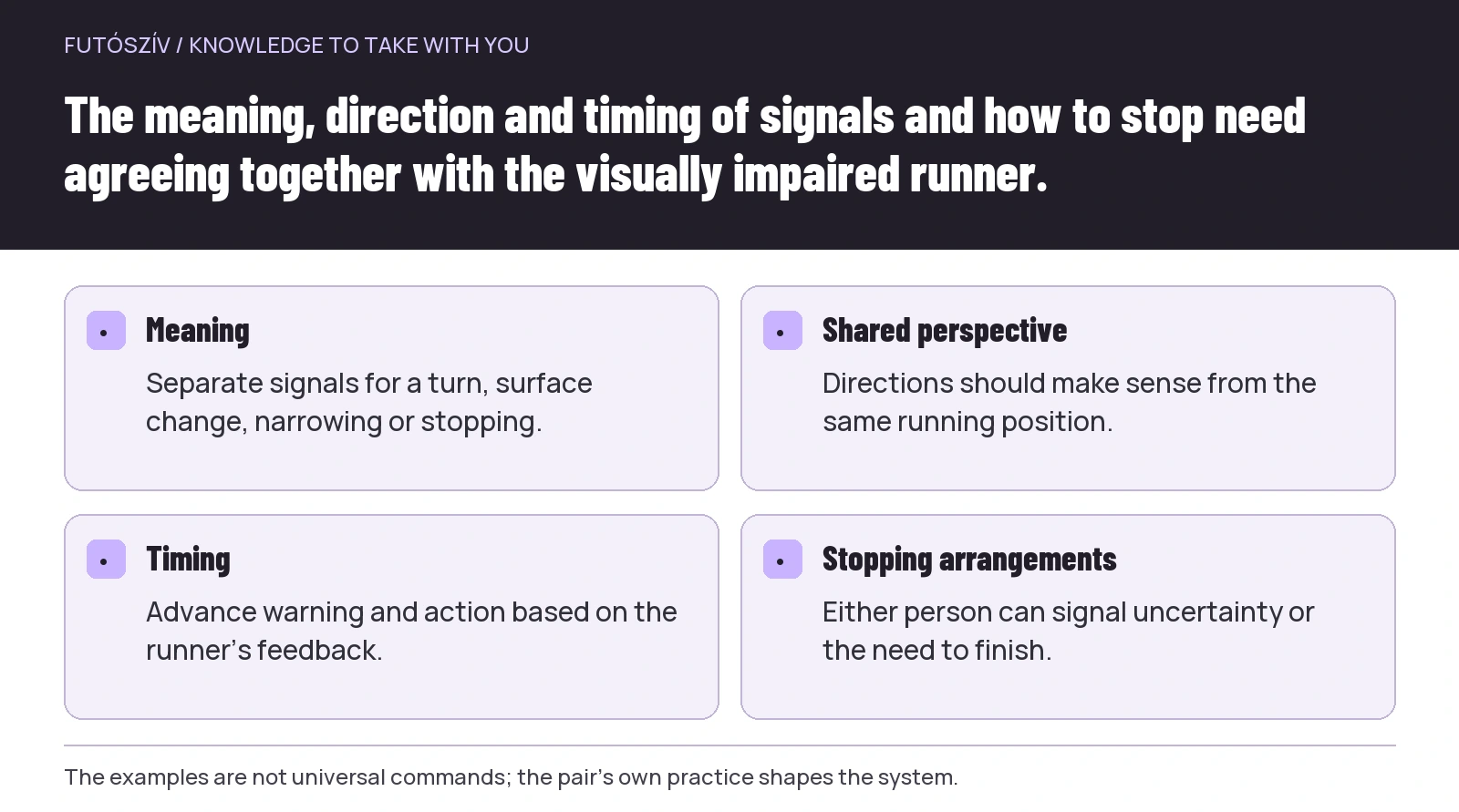
- Meaning
- Separate signals for a turn, surface change, narrowing or stopping.
- Shared perspective
- Directions should make sense from the same running position.
- Timing
- Advance warning and action based on the runner’s feedback.
- Stopping arrangements
- Either person can signal uncertainty or the need to finish.
Keep shared vocabulary brief and clear
‘Careful’ alone provides little information. What is ahead, where do you need to move and when? A shared vocabulary can have separate signals for turns, surface changes, narrow sections and stopping. The pair chooses the exact terms; no single set of phrases works for everyone.
A practice example might be an advance warning of ‘right turn coming’, followed by a turning signal at the agreed moment. Another is describing a ‘kerb down’ if that is genuinely a situation to handle together. These are examples for discussion, not sufficient guiding instructions in themselves.
Use directions from the same perspective and clarify timing. What is too late for one runner may suit another. Adapt from feedback rather than trying to solve uncertainty with volume.
Choose the amount of information together too
Some runners want a more detailed description of the surroundings; others prefer concise signals needed for movement. Ask what helps and what distracts. Keep an identifiable distinction between conversation and important route information.
Do not talk continuously simply because silence makes you uncertain. Equally, do not omit a change the runner asked to be warned about. The appropriate balance develops through practice together. You can also occasionally ask whether the signals are easy to follow.
Speak to the runner, not about them to someone standing beside them. Visual impairment does not mean decisions should pass to another person. Agree the day’s goal, pace and necessary support with the person concerned.
Do not improvise the connection method
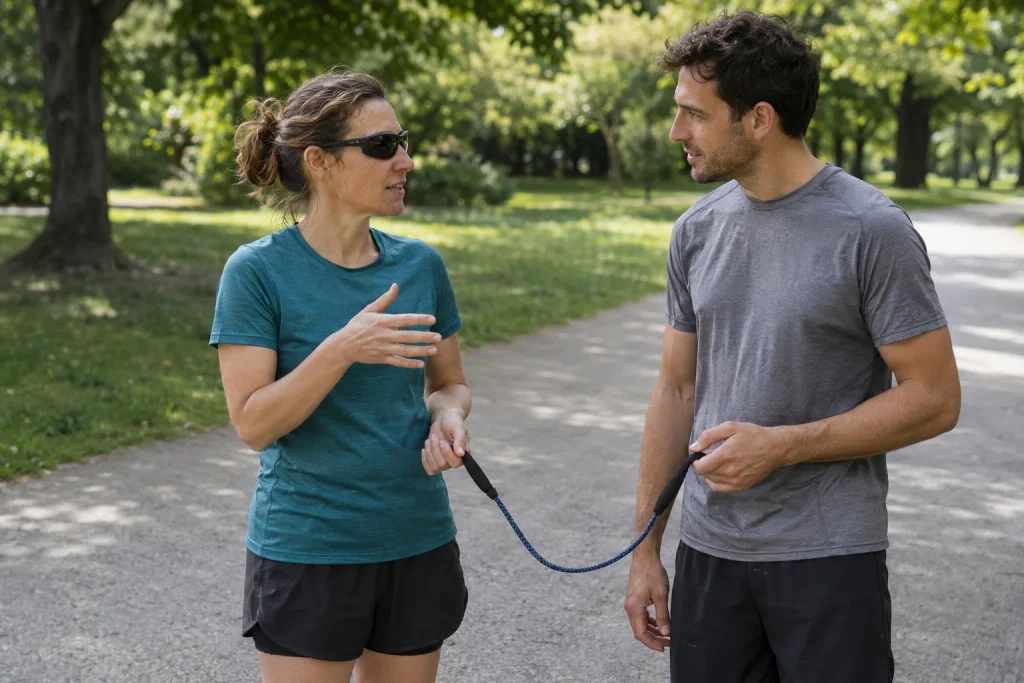
A physical connection, such as using a guiding tether, may require practical instruction. The appropriate arrangement and position depend on the runner’s needs, environment and activity. Do not randomly choose an attachment that causes unexpected pulling or a difficult situation.
The England Athletics guide-running materials also prioritise preparation and partnership. The connection is not there for a guide to forcefully steer or accelerate the runner. Running requires a shared rhythm and ongoing communication.
Agree before touching or helping. Under the RNIB principle, the helper should not unilaterally decide the guiding method. Even a familiar method can be discussed again when the partner, route or day’s circumstances change.
Leave capacity for guiding within the pace
The guide should consider more than whether they can run the same distance. They must also watch the route, surroundings and responses to shared signals. Running at their own limit throughout may leave less attention for this task.
Agree today’s goal beforehand: an easy outing together, technical practice or another task? A guide should not use the situation to substitute for their own intense training. If the desired pace requires another partner or more help, that can be stated honestly.
The rhythm need not be fixed on the first outing. You can slow down, switch to walking or practise shorter sections. A successful brief partnership provides a better foundation than an overlong outing in which both become uncertain.
Consider the pair’s width when choosing a route
A pavement comfortable for one runner can be narrow for two alongside each other. Surface, bends, overhanging branches, posts and traffic affect the pair’s movement together. A route check should examine actual movement space, not only distance.
A suitable first route should be familiar, predictable and easy to interrupt. Unless needed for the outing, the most complex traffic situation should not form part of practice. At a new obstacle or uncertain section, you can stop, discuss the situation and choose another solution.
Ask the runner about light conditions and environmental noise too. Do not assume the same thing helps everyone. Visual impairment can involve different experiences; personal feedback may matter more than the map when judging usability.
 Enlarge diagram
Text version of the illustration
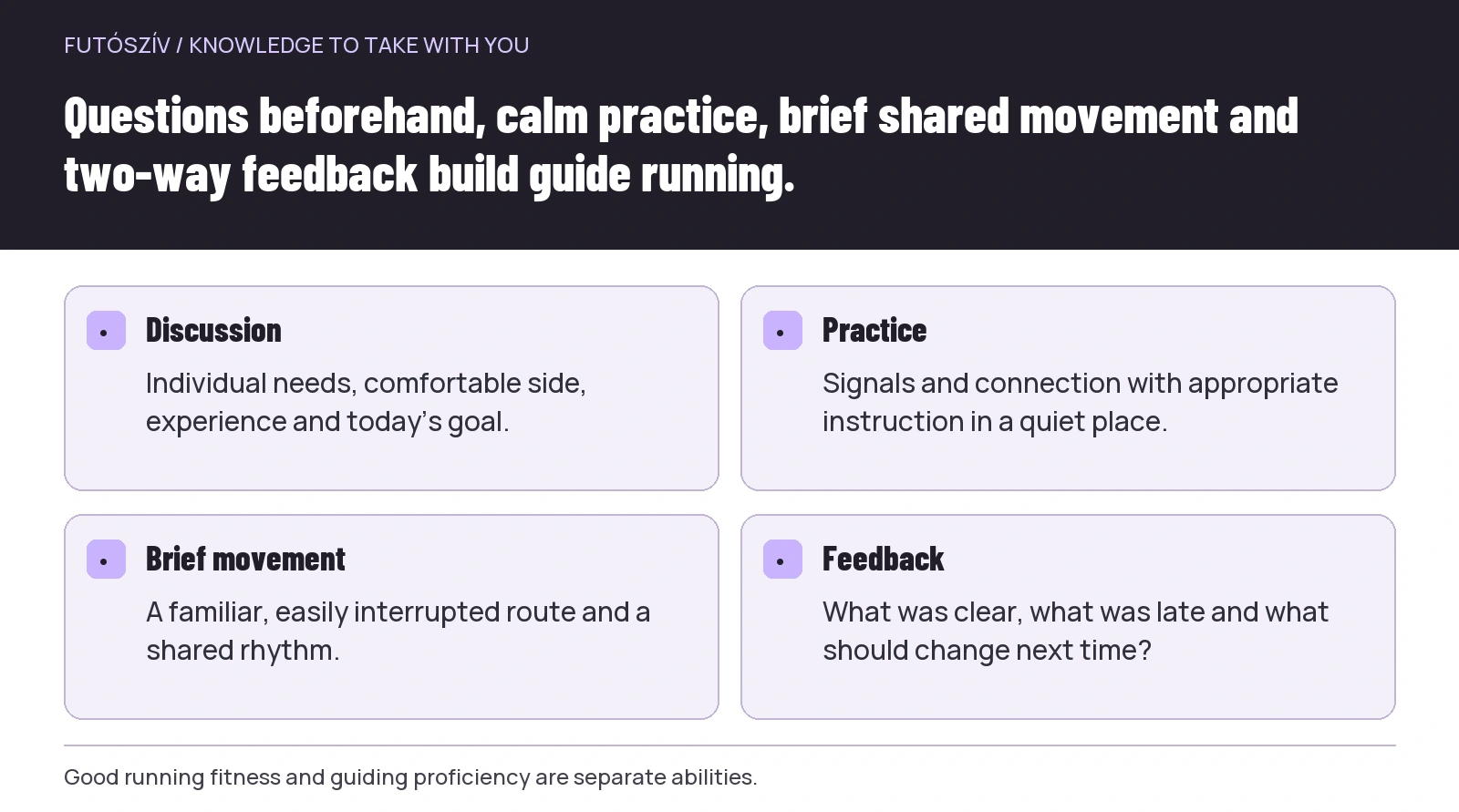
- Discussion
- Individual needs, comfortable side, experience and today’s goal.
- Practice
- Signals and connection with appropriate instruction in a quiet place.
- Brief movement
- A familiar, easily interrupted route and a shared rhythm.
- Feedback
- What was clear, what was late and what should change next time?
Make the pair’s arrangements known within a group
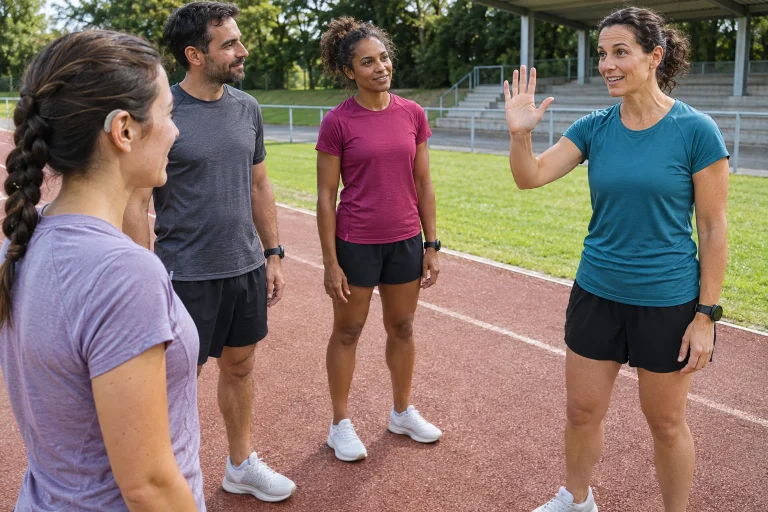
Others should know the runner and guide move together and should not cut unexpectedly between them. When overtaking or situations change, give clear information agreed beforehand. The group should not compete over who can offer more help at once.
Make clear who provides the signals needed for movement. Many instructions from different directions can confuse the situation. Companions can offer practical support by providing enough space, following stopping points or giving advance notice of route changes.
Do not turn the pair into a touching social media story without consent. The visually impaired runner participates as an athlete with their own goal. The guide’s work matters, but should not obscure the runner’s independent decisions and performance.
A new guide means a new discussion
An established vocabulary may provide a useful starting point, but do not assume a new partner understands it in the same way. Let the runner explain what they want to retain from existing arrangements. A previous guide should pass on personal information only with consent.
The new pair should try signals in simple circumstances first. Even a familiar route does not remove the task of learning a shared rhythm. If a guide would change with another person during a longer outing, agree the method beforehand too; an unexpected handover should not force the runner to improvise.
A short note for next time can be simple and shared: which side you use, which word signals stopping and which situation still needs practice. This supports memory but does not replace a personal conversation. The runner can continue shaping how support works.
A race needs separate preparation
Everyday running together and race participation rules are not necessarily the same. Clarify entry, guide participation, the start, refreshment arrangements and results under the particular event’s current rules. Do not derive every local condition from a general recollection of para sport.
It is worth practising race-like situations beforehand with appropriate professional guidance: waiting, crowds, turns and refreshment stations may need different communication. The start should not be the first shared outing if the partnership is new.
Plan meeting and getting back after the finish area too. Guiding does not automatically end at the distance measured on a running watch. Let the runner explain where and how they would like to conclude moving together.
Three specific pieces of feedback afterwards
- Which signal was timely and easy to understand?
- Where should something have been said earlier, more precisely or more briefly?
- What should be the one change for the next shared outing?
Feedback works both ways. The guide should also say which situation felt uncertain and what they still need to learn. If a signal did not work, do not automatically explain it as the runner failing to pay attention. The shared system can change.
Trust in the partnership grows through small, consistent experiences. A good visually impaired runner–guide pair does not know everything beforehand: they ask, practise and communicate in time. The aim is shared arrangements that give the runner information, choices and a real sporting experience.
Sources
- RNIB: Guiding a blind or partially sighted person
- England Athletics: Sight Loss Awareness and Guide Running workshop
- England Athletics: Become a Guide Runner
- Vision Sports Ireland: Vision Impaired Athletics Guides, 2026
How Futószív articles are prepared: our editorial guidelines.