
When you care for someone, running time is often missing for reasons beyond not having thirty empty minutes. Tasks arise unpredictably, someone has to remember appointments, and you remain the first person called even after leaving. This may be familiar when supporting a young child, an older relative, an ill partner or someone else. Making time for sport therefore requires a real handover, not just an empty calendar slot.
The aim is not to fulfil another obligation by performing care more efficiently. You need a system in which personal time, rest and movement can all be manageable options. The framework below offers ideas for everyday organisation. Throughout, respect the supported person’s needs, decisions and any professional care instructions.
Lack of time is not always a personal time-management failure
The ILO’s 2024 global estimate describes the substantial and gender-unequal burden of unpaid care. Labour-market data cannot directly establish Hungarian runners’ time for sport, but provide important background: distributing care responsibilities is also a systemic question, not merely a matter of personal discipline.
The Eurofound 2025 EU report examines different caring situations, from looking after children to supporting older relatives or relatives with disabilities. Planning sport also benefits from distinguishing these. A task with a known time and one requiring continuous availability create different organisational problems.
Do not begin assessing your own difficulty by assuming someone else would surely manage. First map the actual tasks and available help. Let the plan’s size follow from those, rather than another runner’s ideal week.
Make a visible task map
The list should include more than hands-on work. Booking appointments, arranging prescription collection, transport, shopping, coordination and preparing equipment for the next day can all require time and attention. Mark which tasks recur, which have fixed times and which are unexpected.
Separately identify what can be handed to someone else, what requires training or professional help, and what genuinely can be done only by you at present. The aim is not to put an accounting value on care. What matters is preventing the obstacle to sport from remaining one vague feeling.
If several people are involved, review the map together. Often the question is not who would generally help, but who will take responsibility for a task from start to finish. If every small decision still requires a call to you, the handover is incomplete.
Make help a specific commitment
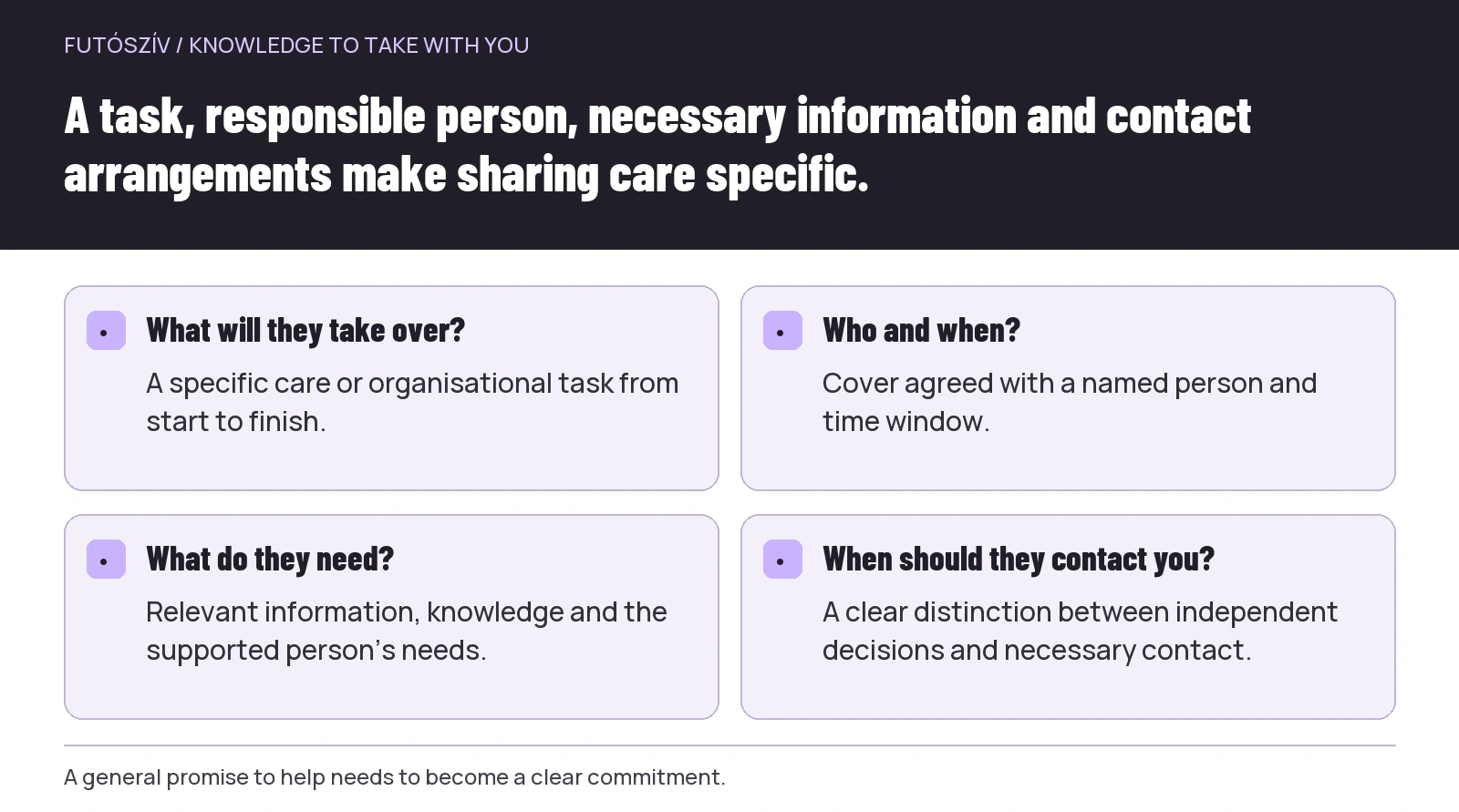
‘Go for a run, do not worry’ is less useful when nobody is clear about who stays with the person needing care or what they can handle independently. A precise agreement is better: which period and task someone takes over, and with what information. Knowledge needed for safe care must be passed clearly to the appropriate person.
The NICE quality standard on supporting carers emphasises the importance of reliable, consistent opportunities for a break. The British care system cannot automatically be interpreted as entitlement to a Hungarian service. Its organisational principle is useful, however: help that becomes uncertain at the last minute can place another burden on the carer.
Include when and for what reason someone needs to contact you in the shared plan. Not every question is urgent, but contact arrangements should be clear in a genuinely important situation. Time for sport should be an agreed, manageable absence rather than a secret escape.
 Enlarge diagram
Text version of the illustration
- What will they take over?
- A specific care or organisational task from start to finish.
- Who and when?
- Cover agreed with a named person and time window.
- What do they need?
- Relevant information, knowledge and the supported person’s needs.
- When should they contact you?
- A clear distinction between independent decisions and necessary contact.
Personal time is valid even when you do not exercise
If help is offered only for running, you may easily feel that every freed minute must involve achievement. Yet on a particular day you may need sleep, an unhurried meal or quiet time. Choosing movement and choosing rest can both meet personal needs.
The NHS information on respite care treats a break from caring as a purpose in its own right. Specific local options and conditions need investigating separately, but you need not justify a break’s value through a sporting result. Asking for help does not have to depend on a productive activity.
In family discussions, therefore, you can talk about a window of personal time whose contents are flexible. If you run, enjoy it; if you would rather rest today, that does not waste the help offered. Sport is then less likely to become another compulsory test of achievement.
Three organisational situations, three frameworks
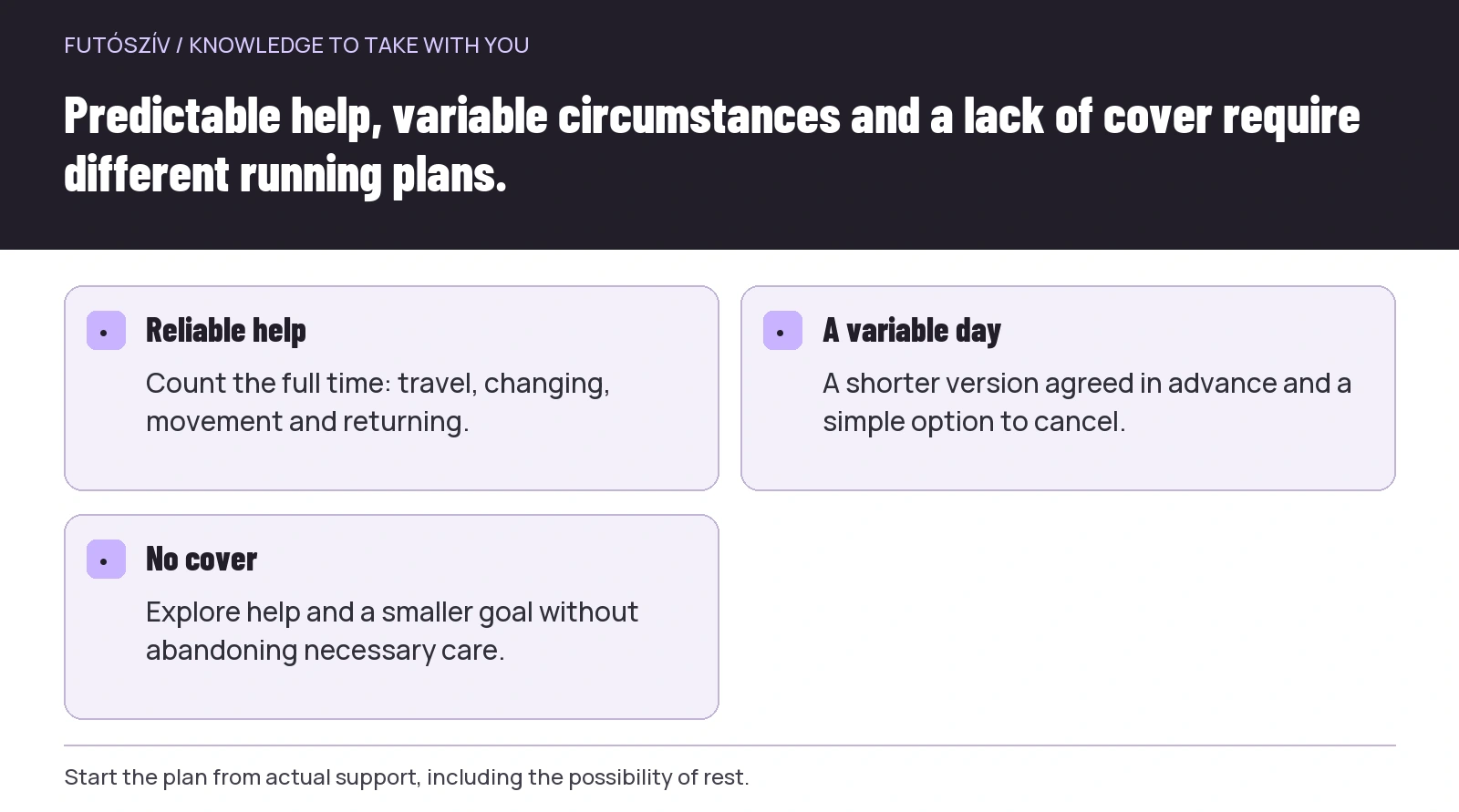
In the first situation, predictable help is available in advance. A running session can then have a more stable time, but account for travel both ways, changing clothes and eating too. Do not equate the full period of help solely with minutes spent moving.
In the second situation, help exists but the day’s circumstances vary. Plan a longer and shorter version beforehand and accept that the outing can be cancelled. Make the adjustment simple, without requiring a fresh family negotiation every morning.
In the third situation, suitable cover is not currently available. Someone saying ‘you just have to want it’ does not solve this. The next goal may be exploring help, reducing the plan or postponing a race goal. Do not leave the supported person without necessary assistance for the sake of a window for sport.
Include unpredictability in the running plan
Prepare a standard version, a shorter outing and an option without running. These should respond to different circumstances rather than form a ranking. An unexpected task then does not automatically make the entire week a failure.
A shorter outing should have a purpose too. It might be an easy nearby loop or another movement option appropriate for your condition. You need not compensate for less time with greater intensity. Choose activity demands from current preparation rather than frustration over lost minutes.
Do not automatically add a missed run to the following day. Reconsider the week’s possibilities and choose what matters most. A plan that turns every change into another training debt is particularly difficult alongside caring responsibilities.
The route can help with organisation too
If time away must be limited, a nearby loop you can interrupt easily may fit the day better than a distant running location. Count travel time as part of sport. A prettier or more popular route is not necessarily better if its arrangements impose too great a burden.
Agree contact arrangements beforehand, but do not turn every run into continuous on-call work. If the caring situation requires constant, immediate responses, genuine cover may be necessary. Carrying a phone does not solve every care question.
If running with others, explain the practical framework: how long you can stay, whether shortening is possible and exactly when you need to be back. You need not share private or health details about the person you support. The time limit alone may provide sufficient organisational information.
A running community can reduce or increase the burden
A flexible group communicates a precise starting time, distance and finish. For someone running alongside caring responsibilities, this often helps more than a general motivational message. Regular lateness, unexpected extensions and disapproval afterwards can make participation difficult.
As an organiser, offer a shorter version or an easily exited loop where suitable for the outing. Do not label cancellation unreliable without knowing the circumstances. Someone can have a varying rhythm of participation while still taking the community seriously.
Support should not be reserved for someone preparing for an impressive result. The need for personal time and movement has value in itself. Smaller, predictable outings make running accessible to many people unable to commit to an all-day activity.
 Enlarge diagram
Text version of the illustration
- Reliable help
- Count the full time: travel, changing, movement and returning.
- A variable day
- A shorter version agreed in advance and a simple option to cancel.
- No cover
- Explore help and a smaller goal without abandoning necessary care.
Financial and accessibility conditions are real limits too
Travel, entries, equipment and replacement care costs all count together. If a sport plan would work only with paid support you cannot afford, it is not simply a question of willpower. Adapt the goal to actual access and look for available local support options.
Informal help needs clarifying too. A neighbour’s or relative’s goodwill does not automatically mean appropriate preparation for every care task. The person’s needs, trust and safety should remain the agreement’s foundation.
If seeking a service, the current local provider can give accurate information about its conditions. Do not infer Hungarian entitlement or funding from a foreign article. For a sport plan, first understand which help you can actually use.
Do not try to resolve guilt with another achievement
Even during running time, you may feel you ought to be elsewhere. You do not have to justify that time through harder training, as though absence were valid only with a major result. Personal time’s value does not come from energy burned or distance covered.
A clear agreement may help: care is arranged, someone else has accepted the task and you can choose freely during this time. If the situation nevertheless remains difficult, discuss it with an appropriate supportive or professional contact. You do not have to manage every feeling alone.
Within the family, it is worth dropping jokes about selfish exercise if they hurt someone. Sharing care need not be a favour to the person wanting to move; it can be one of the organisational tasks of life together. Specific possibilities naturally differ between households.
A race goal needs more than race-day help
If a race becomes a later goal, examine conditions during the preparation weeks too. A companion arranged for race day does not make up for having no regular opportunity beforehand for training and recovery appropriate to your condition. Choose a distance from a process you can actually manage.
Include travel and time after the finish in the care plan too. Allow changes if the supported person’s condition or available help changes substantially. An entry’s financial or emotional weight should not force a decision that is unmanageable under the real conditions.
You can remain part of an event or community in another role: a shorter nearby outing, a later race or simply a shared run can be a goal too. Your sporting life does not depend on one start date.
A weekly discussion with five short questions
- Which tasks have fixed times, and what might change unexpectedly?
- Who takes full responsibility for what, and what information and preparation do they need?
- Which window of personal time should be genuinely protected, including the option to rest?
- What is the shorter version, and how can the outing be cancelled simply?
- Which one organisational detail can we improve for next week?
The short discussion does not aim for a perfectly utilised calendar. It should show how responsibility is shared and where too many uncertain tasks remain with one person. A system that works well enough can be adjusted over time.
Personal time for sport becomes more manageable alongside caring when it rests on real support, clear roles and flexible goals. Running need not compete for the minutes left after every task. You can seek space for it while taking rest and the supported person’s needs seriously too.
Sources
- ILO: Unpaid care work prevents 708 million women from participating in the labour market, 2024
- Eurofound: Unpaid care in the EU, 2025
- NICE: Supporting adult carers – quality standard QS200
- NHS: Carers’ breaks and respite care
How Futószív articles are prepared: our editorial guidelines.