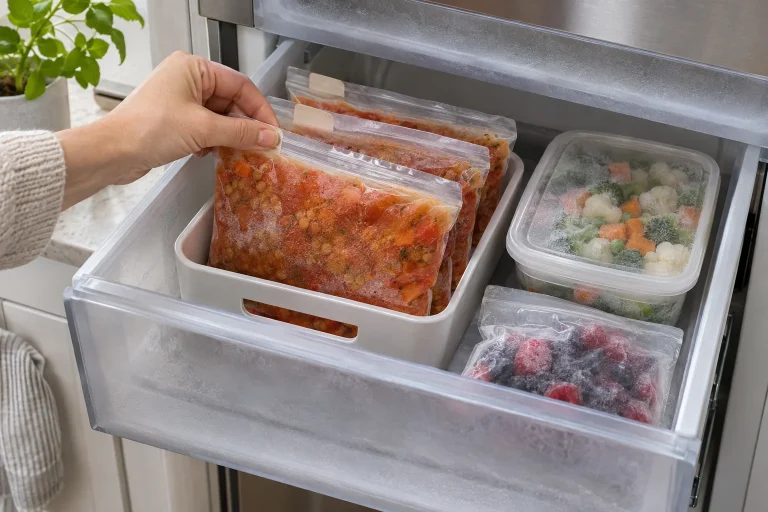
The food budget for a running week is shaped by more than the price on the shelf. It also matters how much food the purchased product produces, what is eaten in an appropriate condition and what remains unused. A large pack’s attractive unit price can easily lose its advantage without a realistic menu and storage arrangements. Budget-conscious shopping therefore starts with meals suited to your needs and quantities you can actually use.
This article is a household planning aid for adult recreational runners. It is not a personal diet, a weight-loss recommendation or a current shop price list. The numerical examples are entirely fictional educational figures, not comparisons of specific products or retailers. The aim is to reduce unnecessary purchases and disposal while maintaining adequate food quantities, your personal diet and food safety. If you have an illness or a prescribed diet, do not change necessary conditions for the sake of price.
First identify which meals you need
Make a short list of occasions when you will eat at home or take food with you. A working day, a late run and weekend cooking may present different situations. There is no need to choose a special recipe for every day. A few familiar, appropriate dishes and a realistic backup can provide a good foundation. Connect your shopping list to these rather than simply to whichever products happen to be on offer.
Work out appropriate quantities from your own needs and the household’s actual meals. Reducing waste does not mean deliberately buying too little food for an active week. Unnecessary excess and necessary meals are different things. If you are unsure about amounts or composition suited to your training demands, seek individual help from a dietitian. The kitchen budget should help you put that adequate eating plan into practice.
Pack price and unit price tell you different things
The unit price helps compare products on the same quantity basis, while the pack price shows what you pay for that particular size. Check that the unit really is the same: is it a kilogram, litre, item or another defined basis? Comparing products in different forms and with different compositions raises further questions. A kilogram of a dry ingredient does not represent the same practical use as a kilogram of ready-to-eat food that also contains liquid.
The National Trade and Consumer Protection Authority information on promotions also warns shoppers to check actual price differences thoughtfully rather than relying on striking discount signs. In your own decision, therefore, consider what you are buying, how much and for what actual use. A special-offer label does not make a product necessary when you have no suitable meal plan for it.
A fictional example of the limits of a large pack’s advantage
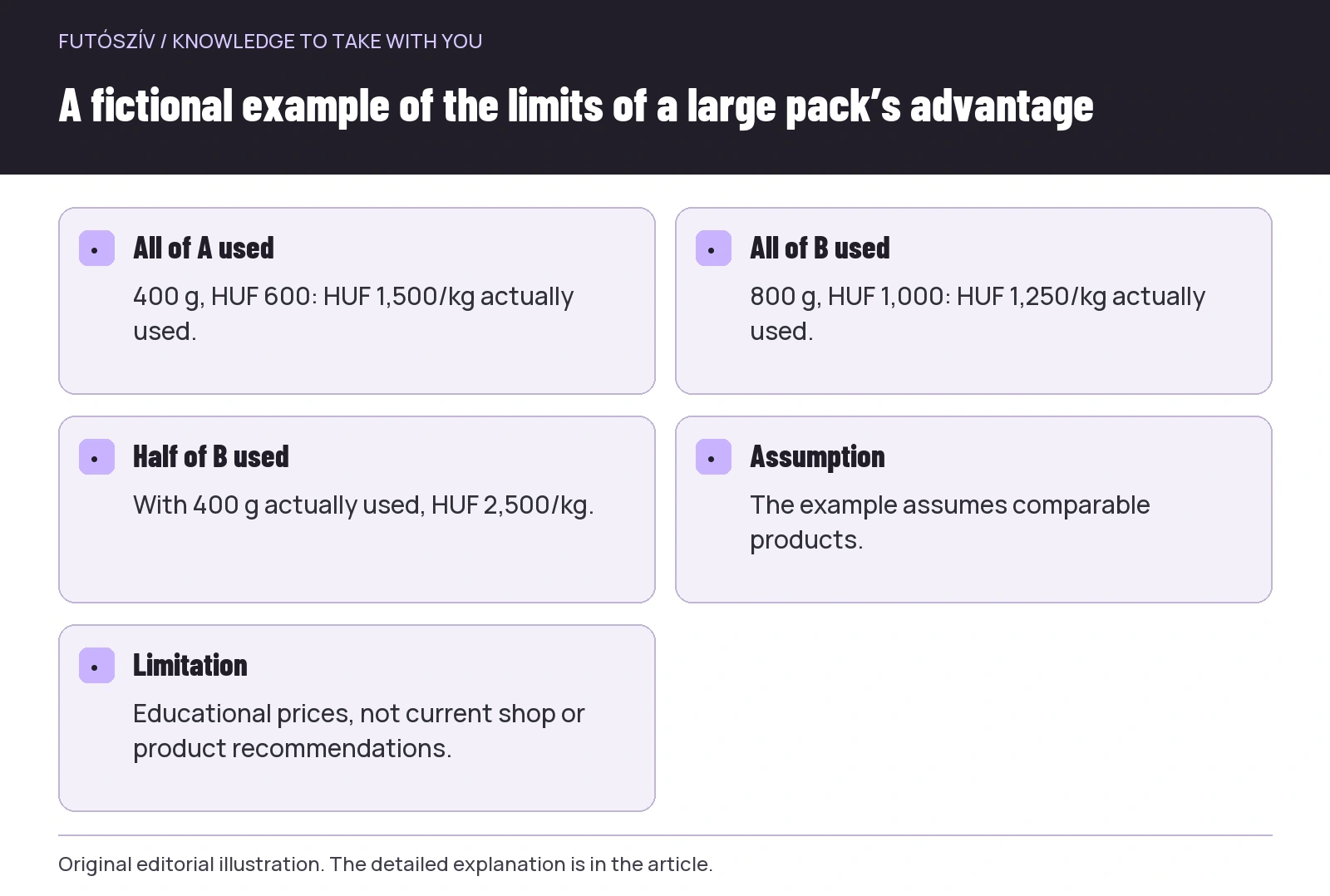
An imaginary 400-gram pack of product A costs 600 forints, while an imaginary 800-gram pack of product B costs 1,000 forints. The example assumes comparable products and identical conditions of use. A’s unit price is 1,500 forints per kilogram, and B’s is 1,250. Judged by the unit price on the shelf, B is better value. This does not yet show whether the household will actually use the whole pack appropriately.
If all 400 grams of A are eaten, the purchase cost per kilogram used remains 1,500 forints. If you use only 400 grams of B and cannot use the remainder appropriately, so throw it away, the 1,000 forints is spent on 0.4 kilograms actually used. That is 2,500 forints per kilogram. The calculation illustrates only the effect of the wasted portion; it does not include every household cost and is not a real product recommendation.
If, however, you use all of B appropriately, its lower unit price may retain its advantage. The lesson is not that every large pack is a poor choice. What matters is the actual plan for using it, the product’s own handling limits and the household’s capacity. The calculation makes that relationship visible. You need not buy a quantity you cannot manage through appropriate storage simply for the sake of the calculated unit price.
| Fictional situation | Purchase price | Quantity used | Purchase cost per quantity used |
|---|---|---|---|
| All of pack A is used. | HUF 600. | 400 g. | HUF 1,500/kg. |
| All of pack B is used. | HUF 1,000. | 800 g. | HUF 1,250/kg. |
| Half of pack B cannot be used. | HUF 1,000. | 400 g. | HUF 2,500/kg. |
 Enlarge diagram
Text version of the illustration
- All of A used
- 400 g, HUF 600: HUF 1,500/kg actually used.
- All of B used
- 800 g, HUF 1,000: HUF 1,250/kg actually used.
- Half of B used
- With 400 g actually used, HUF 2,500/kg.
- Assumption
- The example assumes comparable products.
- Limitation
- Educational prices, not current shop or product recommendations.
Match the pack size to your plan after opening
An unopened product’s longer storage life does not necessarily apply after opening. Check the instructions on its own label and connect them to an actual occasion for using it. If a large tub or jar repeatedly goes unfinished in an appropriate condition, a smaller pack or another meal plan may be more practical. Do not wait until after buying the apparently cheaper large pack to work out the extra meals needed to use it.
The practical advice from Nébih’s Wasteless programme also recommends checking existing supplies, planning a menu around the real demands of the week and considering large packs carefully. Put the particular dish and occasion beside each ingredient on your list. Check existing supplies before buying another pack too. A full cupboard and a dinner you can prepare are not automatically the same thing.
Food can remain unused for four different reasons
The summary of Nébih’s 2025 household survey highlights overbuying, cooking more than necessary and forgotten food among recurring causes of waste. This is household research, not a dietary study specifically of runners. Naming the causes in your own supplies can help identify the next practical change.
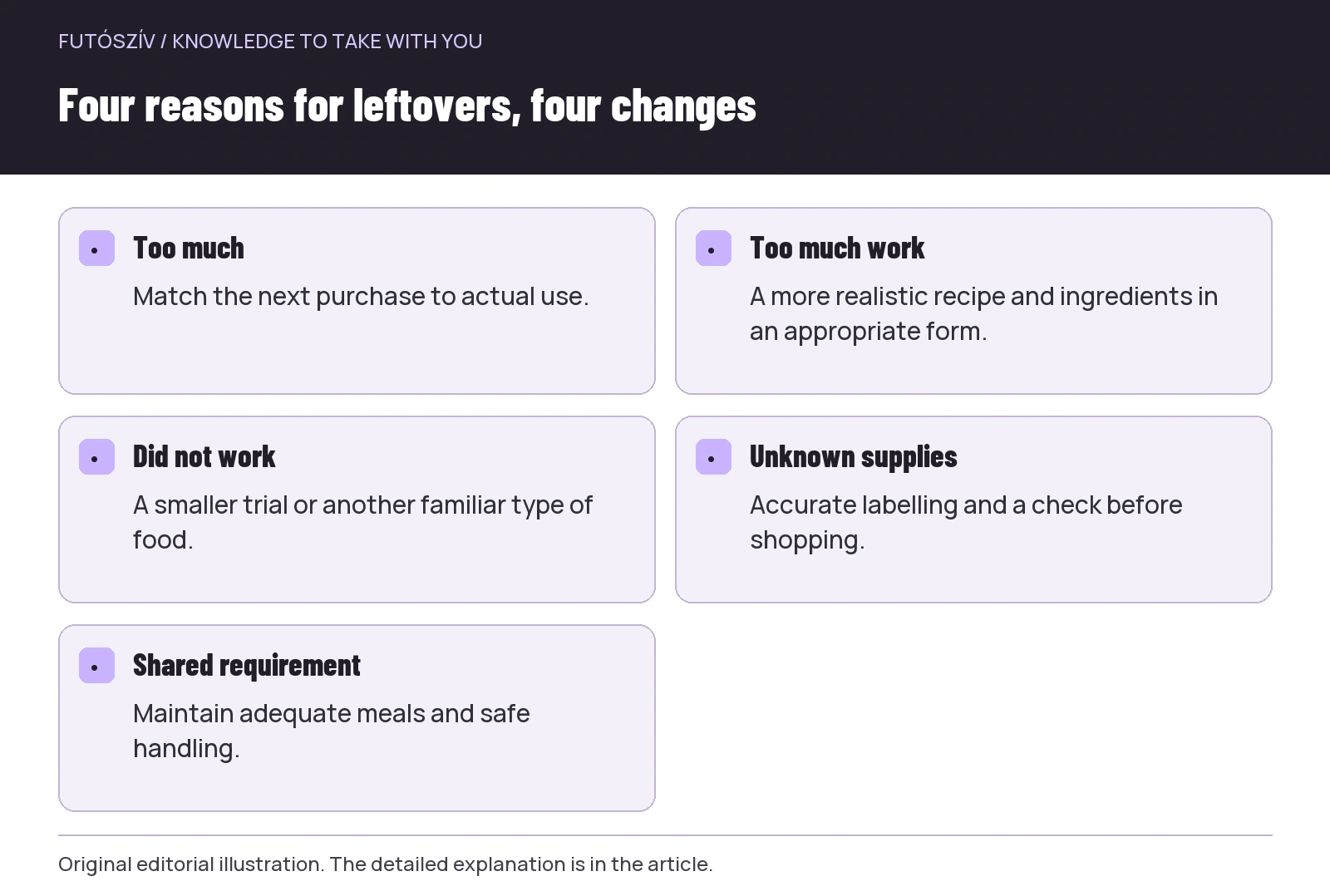
The first reason is buying too much. The second is that the recipe planned for an ingredient requires too much work for the time you actually have. The third is that the food or product’s texture or taste did not work for you. The fourth is unknown contents or a poor overview of supplies. These require different solutions. A new recipe will not necessarily correct a quantity error, and a smaller pack will not help if there is still no appropriate preparation plan.
Briefly note what remained and why. Use the reason when you next shop: the change might be a smaller quantity, another familiar dish, a more suitable product form or better labelling. The note should not become an exercise in blame. The aim is to fit the list to how the household really works. If there is regularly no time for elaborate cooking on late training days, a more realistic menu is a kitchen solution, not a failure.
Perishable supplies and longer-lasting stores have different jobs
For a refrigerated product with a shorter window for use, plan a real occasion in the near future. Suitable dry, canned or frozen ingredients can provide a longer-term reserve, according to their own labels and handling conditions. Have a familiar meal idea for reserve items too. Endless stockpiles that are never used tie up money and space while the week’s dinners may still remain unresolved. Supplies are valuable because you can use them.
If a product’s form requires more preparation, include that work in your choice. Dried pulses and a ready-to-eat can create different kitchen situations. You do not need to choose the same form every time. The version you can prepare appropriately and actually use may be more practical that day. Alongside price, safe preparation, time and equipment are part of the decision.
Ingredients shared across recipes can reduce scattered purchases
You can choose a few suitable ingredients used in several favourite dishes. Buying them together and preparing separate fresh meals can work, provided the product’s own storage and after-opening conditions are met. This avoids buying a new large pack for every recipe and using it only once. In your menu plan, however, identify the specific occasion for use rather than merely promising that it will be useful for something.
An ingredient substitution is not automatically nutritionally equivalent. A cheaper component may work for flavour and its culinary role, while changing the composition of the whole dish. Your personal diet and needs should remain decisive. Checking a suitable substitution is particularly important with allergen requirements or a prescribed diet. The budget should not seek savings by abandoning a necessary health condition.
 Enlarge diagram
Text version of the illustration
- Too much
- Match the next purchase to actual use.
- Too much work
- A more realistic recipe and ingredients in an appropriate form.
- Did not work
- A smaller trial or another familiar type of food.
- Unknown supplies
- Accurate labelling and a check before shopping.
- Shared requirement
- Maintain adequate meals and safe handling.
Understand date labels rather than guessing
Interpret the different meanings of use-by and best-before labels in relation to the product and appropriate official guidance. Necessary storage and instructions after opening matter with both. Do not turn waste reduction into a taste-based safety test. A discounted purchase price and the wish to save food do not resolve known uncertainty or inappropriate handling.
Buy a discounted product approaching its use date only if appropriate use is actually manageable. Freezing is not automatically an option for every product in every condition either. Follow the specific instructions and keep the food’s previous history in mind. The storage capacity required to make a good price worthwhile must already be available when you buy. Do not base your shop decision on an uncertain search for space later.
The shopping trip can be part of the cost too
If you shop in several places, weigh travel, time and appropriate chilled transport alongside the savings. This is not a precise financial model, but part of the real household decision. A small price difference can mean something different depending on whether a shop is on your way or requires a long detour. Appropriate arrangements for products requiring refrigeration must be maintained while you search for prices too.
You can organise the shopping list around the actual menu and storage. Where appropriate, you can plan to try unfamiliar products separately in small quantities. There is no need to build an entire running week around unknown discounted ingredients. Familiar, available staples can reduce the chance of a new pack ending up unused. Trying something new and maintaining dependable weekly supplies can have different roles.
Sporty packaging is not a reason to buy on its own
A product intended for runners may serve an appropriate role in your personal plan, but a sporting name alone does not tell you whether you need it. Know which specific situation it addresses, how much your own appropriate plan uses and how it can be stored. Everyday food and specialist sports products are not interchangeable for every task. Choose according to your personal goal and circumstances, rather than packaging category alone.
If you want to get to know a new product, make the first purchase a realistic quantity for actually trying it. A large multipack’s advantage can be assessed only if the product is suitable and genuinely used. Personal tolerance, composition and instructions matter too. A discount does not make it necessary to try an unfamiliar food for the first time at an important event. Budget-conscious planning considers timing as well.
A simple personal savings sheet
The sheet can have three fields: product purchased, actual use and the reason any remained. Add one specific change for next time. You do not need to calculate the price of every mouthful continually. Recognising a few recurring problems may be enough to make the next shop fit your real days better. A calculation like the fictional cost example is useful only when the quantity it refers to is clear.
Budget-conscious eating for runners maintains adequate personal meals while identifying unnecessary excess in the system. Unit price, a plan for use and safe storage together support a sensible shopping decision. Realistic quantities connected to achievable recipes may be easier to manage over time than a basket built from occasional discounts that are hard to use.
Sources and further reading
- National Trade and Consumer Protection Authority: How can we recognise misleading promotions?
- Nébih Wasteless: What you can do
- Nébih Wasteless: Results of the 2025 Hungarian Household Food Waste Survey
How Futószív articles are prepared: our editorial guidelines.