A freezer can help during a busy running week when stored food has a specific use plan. Anonymous boxes and bags hidden behind one another can instead make dinner harder. You do not know their contents, when they arrived or the form from which to prepare them. A clear freezing system starts with appropriate food handling and readable labels, then becomes complete by planning removal and use.
This is general household guidance for adults, not one freezing deadline for every food. Specific labels, proper preparation and the appliance manual take precedence. With allergies or prescribed diets, contents and handling must remain appropriate too. Examples illustrate stock organisation rather than personal portions. Freezing food already in an uncertain condition or handled incorrectly does not repair food safety.
Start with suitable food, then plan freezing
Clarify the earlier journey: ingredients, preparation time and handling. Entering a freezer does not erase incorrect storage or give an unknown-age dish a fresh start. Appropriate decisions begin with original preparation. If cooking for later, know necessary rapid-cooling and freezing conditions beforehand. Wanting to rescue leftovers alone does not establish a method’s suitability.
The Food Standards Agency chilling and freezing guidance describes checking label suitability, appropriate cooling beforehand and a freezer operating at around minus eighteen degrees Celsius. Follow any product-specific requirements too. Appliance capacity and proper use belong in the plan alongside which food you want to retrieve later.
Let labels distinguish cooked food from raw ingredients
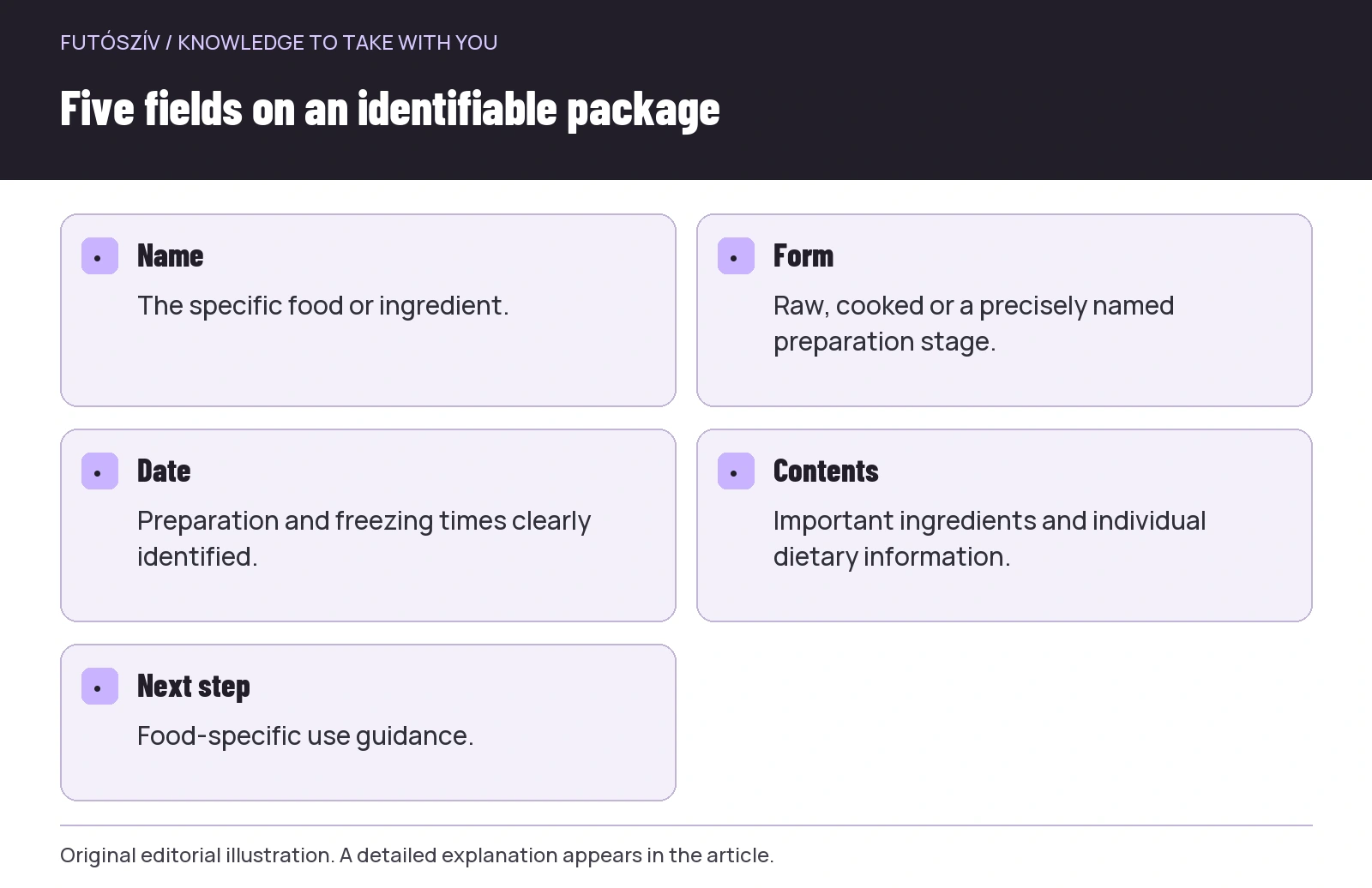
Write more than sauce or dinner on a box. Identify the actual food and form: raw ingredient, properly cooked dish or another preparation stage. The next operation may depend on this. A partly prepared component is different from cooked food needing thorough reheating. If the label loses that distinction, the next user may start with a mistaken assumption.
Keep ingredients identifiable too, particularly for several people or special diets. Add a short important description or retain recipe and product information. Similar-looking plant-based and meat sauces should not depend solely on memory when frozen. Known contents and suitable handling, rather than box colour, can establish your allergen requirement.
Identify dates precisely
Freezing and preparation dates are not necessarily identical. If both matter to history, label both appropriately. A number alone can become ambiguous: day, month or year? Use a consistent complete format and state what each date means. Freezing date is not automatically the final day of safe use.
The BfR guidance on preparing meals for several days recommends dates alongside frozen-food names because foods do not all have identical storage lives. Retain food-specific requirements rather than giving everything one universal number of months. Labels preserve identification and history; appropriate use limits come from the food and its guidance.
| Label field | What should it contain? | What might it prevent? |
|---|---|---|
| Name. | The specific food or ingredient. | Confusing similar-looking packages. |
| Form. | Raw, cooked or a precisely described preparation stage. | An inappropriate next step. |
| Date. | Preparation and freezing dates where necessary. | Unknown food history. |
| Contents. | Important ingredients and necessary individual information. | Unsuitable dietary assumptions. |
| Next step. | Where to find use instructions for the specific food. | Random thawing or preparation. |
 Enlarge diagram
Text version of the illustration
- Name
- The specific food or ingredient.
- Form
- Raw, cooked or a precisely named preparation stage.
- Date
- Preparation and freezing times clearly identified.
- Contents
- Important ingredients and individual dietary information.
- Next step
- Food-specific use guidance.
Portioning serves later use
Choose storage units that allow the required amount for a planned meal to be used appropriately. This does not mean identical meal portions for everyone. A larger meal can consist of several units. Avoid having to remove and thaw an entire block for a smaller amount. Packaging size and personal nutrient needs are separate decisions worth coordinating deliberately.
Individual and shared units can have different roles when several people eat together. A shared sauce may receive freshly prepared suitable accompaniments, while a personal special meal remains separate. Contents and preparation stage should be clear in both. A large common box is not necessarily more practical if people eat at different times under different conditions. Match packaging to actual use.
Choose packaging suitable for the food and freezer
Check manufacturer conditions for containers, bags and lids. Not every food container works identically in a freezer, for later heating or with liquids. Follow instructions for filling and sealing too. An available empty container should not be the only deciding factor. Appropriate protection and readable identification both matter.
Air contact can affect frozen-food quality; select packaging according to food and container instructions. Do not confuse freezer burn with every other safety question. Package condition, appropriate storage temperature and food history need separate assessment. A neat, ice-free surface alone does not prove complete safety, just as a quality change does not provide a general diagnosis.
Stock map: a few fields, real information
Keep a short list on the freezer door or in a personal digital note. Package identifier, food name, storage location and remaining unit count may suffice. Retain date and form on the package too. The list supplements labels and avoids long searches with an open door. A brief current note is more valuable than a detailed outdated spreadsheet.
For example, drawer A might hold properly prepared sauces and section B identifiable ingredients if this fits appliance instructions and necessary separation. This is an organisational sample, not a compulsory compartment map. Name actual locations so others in the household can find them. Update the list when removing a package rather than waiting for the next major reorganisation.
Use order means more than taking the oldest box
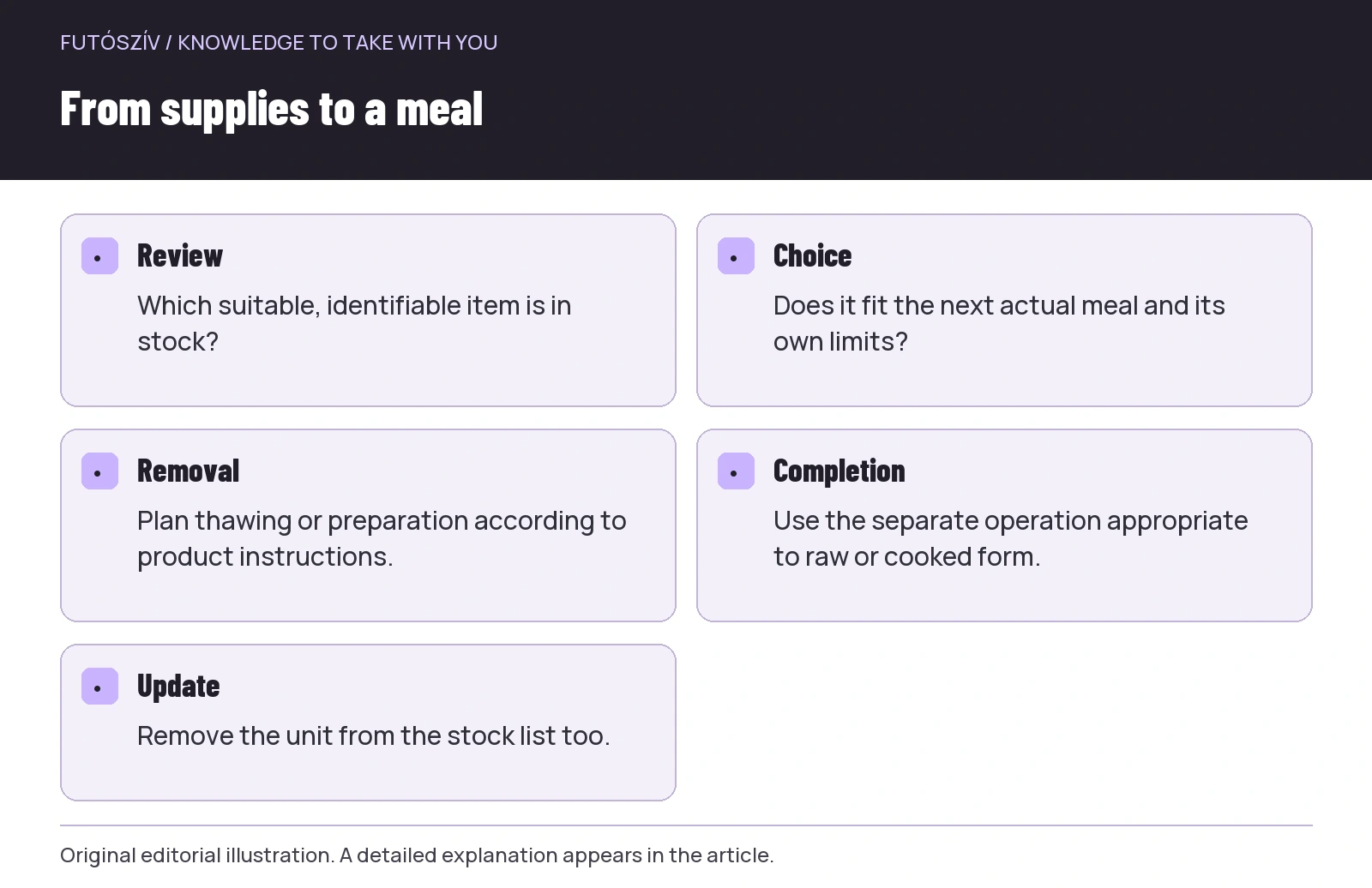
Using earlier stock first can be sensible, but only with suitable food within its own limits. The earliest date does not override suitability or specific storage conditions. Choose something identifiable, appropriate and genuinely suited to the next meal. Do not use an uncertain package merely because the list says it comes next.
The Nébih Wasteless programme also recommends reviewing the freezer and incorporating stored foods into weekly menus. Before cooking, check which existing component needs fresh accompaniments. The freezer then becomes a starting point for meals rather than only the final destination of leftovers. Suitable stock gains a specific occasion for use.
 Enlarge diagram
Text version of the illustration
- Review
- Which suitable, identifiable item is in stock?
- Choice
- Does it fit the next actual meal and its own limits?
- Removal
- Plan thawing or preparation according to product instructions.
- Completion
- Use the separate operation appropriate to raw or cooked form.
- Update
- Remove the unit from the stock list too.
Time removal around the next operation
Know in advance whether a food needs thawing or its label and recipe specify another preparation method. Commercial frozen products and your own cooked food may need different processes. Appropriate thawing in a fridge can require planning, so do not start guessing when arriving home hungry. Retain the instructions for the actual product and dish and arrange the day around them.
Position thawing food so it cannot contaminate others. Appropriate closed or covered containers, trays and separation depend on the situation. Leaving food on a counter is not a general shortcut. Follow food-specific guidance on use after complete thawing too. Removal time and the plan to eat are two parts of one process.
Do not confuse reheating with cooking
Previously cooked food needs appropriate reheating; raw ingredients need complete appropriate cooking. These operations differ, which makes labelling form important. Frozen appearance does not establish how much work remains. Partly thawed, dense or large blocks may need particular attention for even preparation. Follow the actual procedure rather than copying another dish’s minutes.
Further handling of reheated or thawed food is not unrestricted either. Follow product and official guidance rather than improvising repeated thawing-and-refreezing chains. If you regularly remove too much, freeze smaller suitable units next time. That is the useful lesson, rather than storing uncertain leftovers again.
Three fictional stock entries for learning the method
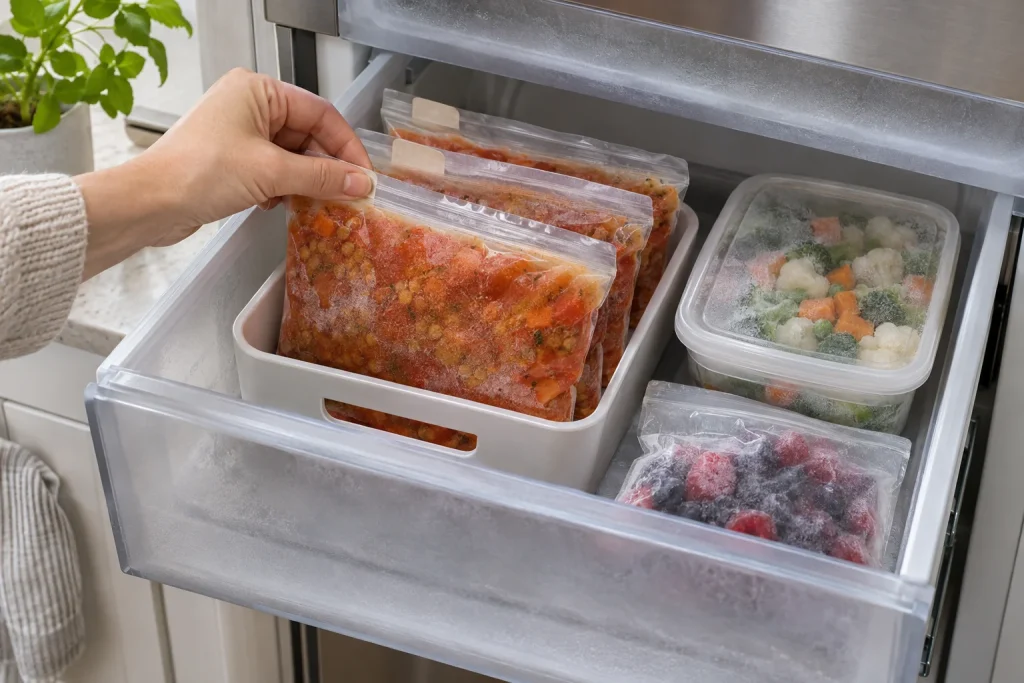
The first could be an identifiable cooked tomato sauce with preparation and freezing dates separately labelled. The next meal needs suitable fresh accompaniments and an appropriate use procedure. The second is shop-bought frozen vegetables kept with their label, whose cooking instructions apply. The third is an individually named personal meal with important ingredient information.
No universal final date is assigned to these examples. Different forms, compositions and products require their own conditions. The stock map preserves precisely these distinctions: name, form, date and next step do not merge into a generic frozen-dinner category. The method helps when you can match the right package to the right operation on an ordinary evening.
Do not let new stock hide the old
Before shopping or cooking, briefly review existing identifiable reserves. Does a suitable item need only a few fresh ingredients? Is a package too large and worth changing next time? Freezer capacity is finite, so match new quantities to usable space and real meals too. More packages do not automatically mean better preparation for the week.
A useful freezing routine preserves food history and the next step. Suitable ingredients become properly handled food in appropriate packaging, clearly labelled and later used correctly for a specific occasion. The freezer can then genuinely support running days: it holds reserves connected to known, workable meals rather than forgotten boxes.
Sources and further reading
- Food Standards Agency: How to chill, freeze and defrost food safely
- BfR: Pre-cooking for several days — what should I bear in mind?
- Nébih Wasteless: What you can do
How Futószív articles are prepared: our editorial guidelines.