Around menopause, advice to add strength training to running often remains a vague slogan: lift weights for your bones. A more useful question is which task suits your current condition, what preparation it needs and how it fits your running weeks. Supporting bone health is not about winning one spectacular workout, but developing a loading system you understand and can follow.
This article concerns planning strength training individually. Known osteoporosis, a previous low-trauma fracture, new pain or another health circumstance may require a separate professional assessment before loading. Menopause is not an identical state for everyone and does not automatically make every runner fragile. Clarifying the starting point helps avoid unnecessary fear and unjustified jumps in activity.
Bone health, muscle strength and balance are separate goals
The NICE menopause guideline highlights advice on bone health and the importance of maintaining muscle mass and strength through physical activity. Alongside running, examine which other capacities your weekly programme addresses. Running kilometres do not describe the whole movement system.
The UK expert consensus Strong, steady and straight discusses resistance and impact loading for bone strength, developing balance and strength, and exercises supporting spinal posture as separate tasks. This framework was developed for osteoporosis, so it should not produce an identical starting programme for everyone.
Separate goals help explain why one activity does not necessarily replace another. A comfortable walk, a strength task and a balance exercise may have different roles. They can coexist in a weekly plan, with amounts and difficulty adapted to the individual situation.
What background should you bring to the first discussion?
List your current activities, previous fractures, known bone-density results and long-term medication. Report new or recurring pain, previous falls and movements you are afraid of too. This helps the professional understand which assessment is appropriate.
If you have a report, bring more than one number from it. The full document, history and treating clinician’s interpretation are useful together. Good running results do not replace fracture-risk assessment, just as one lower value cannot establish every permitted activity on its own.
Experience is part of the starting point too. Someone who has strength-trained regularly for years faces a different learning situation from someone holding a weight for the first time. When restarting, knowing a movement from before does not mean immediately returning to the old load.
What did LIFTMOR show, and what did it not show?
The LIFTMOR randomised trial compared eight months of professionally supervised, high-intensity resistance and impact training with light home exercise in postmenopausal women with low bone mass. The studied programme produced more favourable results on several bone-density and functional measures. Participants were screened beforehand and training was closely supervised.
This is important evidence that loading is not inherently something to avoid, but not a general invitation to try heavy weights independently. Study conditions, selection and execution all belong to the result. Improved bone density is also different from proving that a particular individual certainly will not sustain a fracture.
If a method is promoted using this research, ask how exercises are taught, supervision provided and individual adjustments made. Adding the study’s name to a programme is not enough. Your condition and the actual professional support also shape its usefulness.
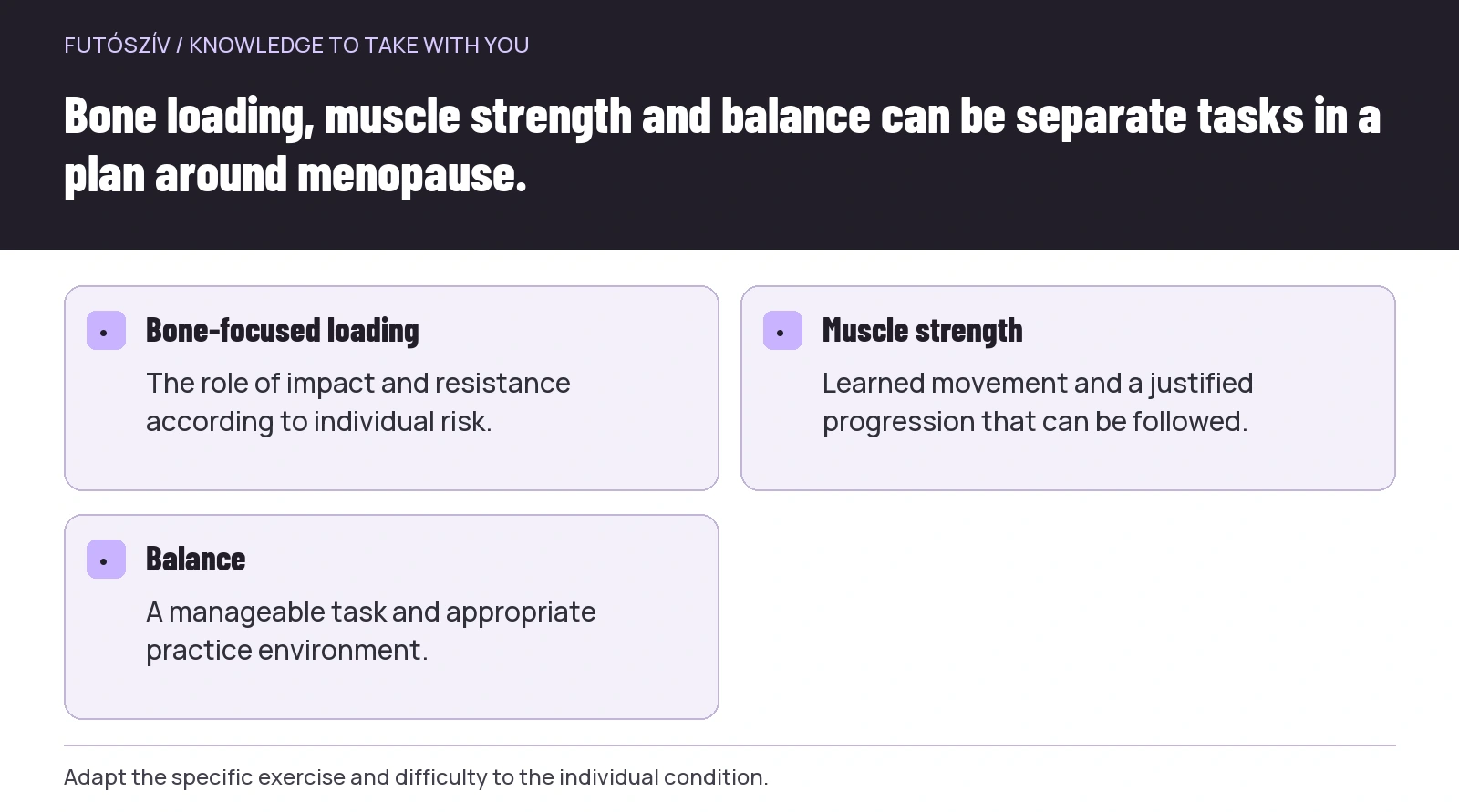 Enlarge diagram
Text version of the illustration
- Bone-focused loading
- The role of impact and resistance according to individual risk.
- Muscle strength
- Learned movement and a justified progression that can be followed.
- Balance
- A manageable task and appropriate practice environment.
A good starting programme is understandable and workable
The first strength-training goal may be learning movements confidently. Beyond the task’s name, understand position, range of movement, effort and signs for stopping. Ask for demonstration and feedback if something is unclear. Greater willpower is not a solution to uncertainty about technique.
Exercises can be adapted to current ability. The same movement family can have several versions: support, a smaller range or different equipment may help learning. An easier version should also have a specific purpose, rather than represent indefinite caution.
Home and gym programmes can both offer useful settings, but need different conditions. Consider space, safe equipment handling and whom you can ask questions. If you cannot properly follow the task alone, the next step is clarification rather than progression.
Bone loading does not mean doing as many jumps as possible
The NOGG guideline recommends a combination of weight-bearing and muscle-strengthening activity adapted to needs and abilities within its target population. Individualisation is essential rather than a minor qualification. Independently adding large amounts of hopping to running is not automatically a better bone-health plan.
If you already run, a new impact exercise adds to the existing workload. If you do not run, a sudden intense jumping programme may be an even larger change. Clarify the purpose, preparation and timing for reviewing your response.
Individual risk can change the choice too. With known osteoporosis or a vertebral fracture, do not choose loading from a generic video. An appropriate professional may help find modifications that retain opportunities for movement while considering your circumstances.
Where should strength training fit in the running week?
Start with the actual calendar. Which runs matter, which days are full of work or care, and where is there time to learn new movements? Do not automatically put strength work at the end of an already crowded day. Rushed practice produces less useful feedback.
Keep the system simple in the first weeks. Do not substantially increase running volume, introduce new strength exercises and change every other habit simultaneously. It is then easier to understand what a symptom or excessive fatigue may relate to.
Session arrangement belongs to the individual plan. The right day or sequence is not identical for every runner. If strength work regularly makes an important daily task or the next run difficult, bring that information back to the professional to help adjust loading.
Give progression a reason
The programme should not stay in the same place for ever merely because the first exercise is comfortable, but progress should not become a competition over equipment numbers either. Before the next step, establish what you can already perform with appropriate technique and the purpose of changing it.
Resistance, task complexity, repetitions or another factor can change, but increasing every variable at once makes the response difficult to follow. Record the version used and your response, rather than only noting that strength training happened.
Pain is not necessary proof of a beneficial stimulus to bone. Do not interpret new localised pain recurring under load, or sudden back symptoms, as evidence that the programme works. Seek appropriate assessment before the next progression.
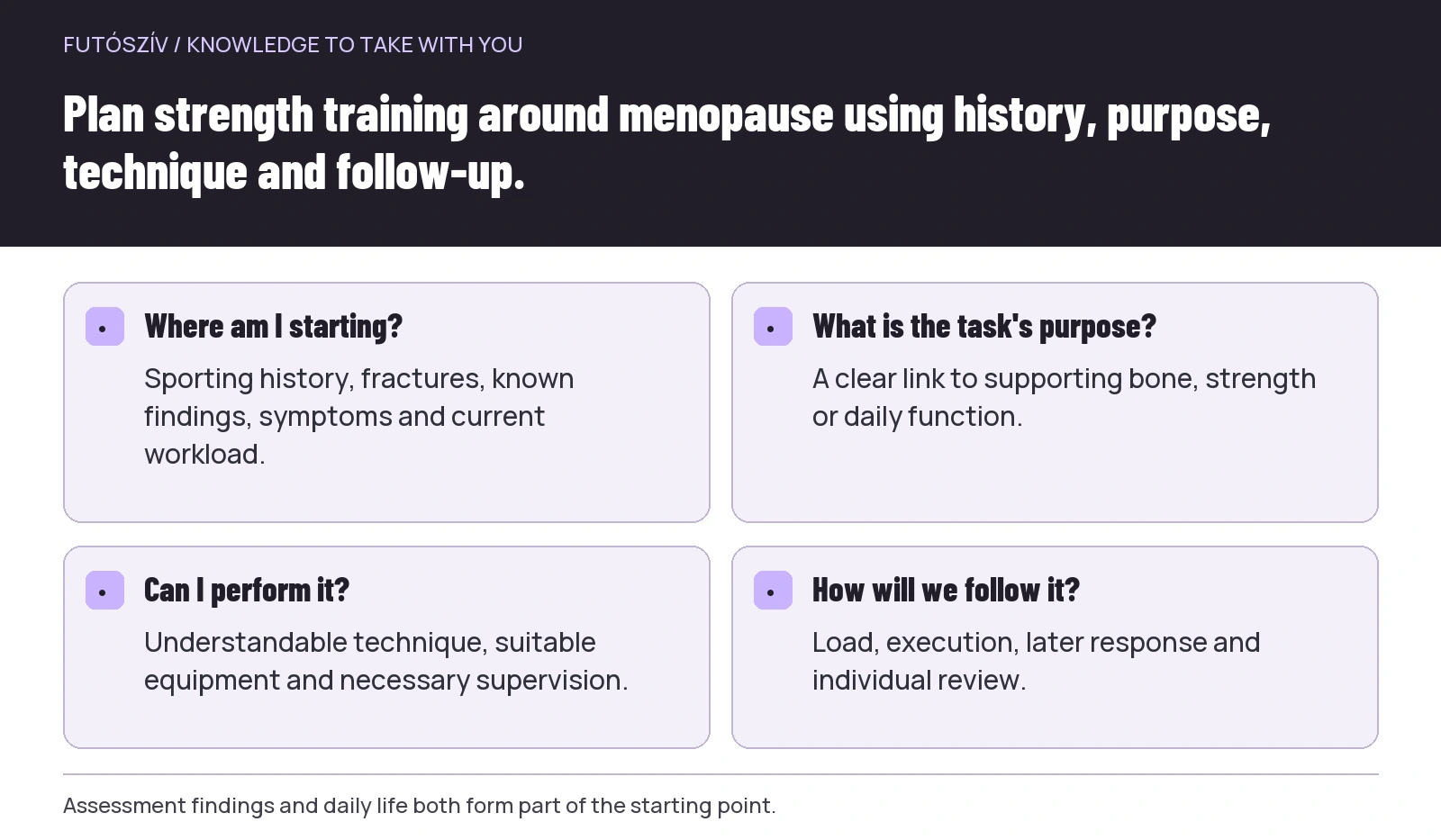 Enlarge diagram
Text version of the illustration
- Where am I starting?
- Sporting history, fractures, known findings, symptoms and current workload.
- What is the task’s purpose?
- A clear link to supporting bone, strength or daily function.
- Can I perform it?
- Understandable technique, suitable equipment and necessary supervision.
- How will we follow it?
- Load, execution, later response and individual review.
Nutrition and medical care are part of the picture too
The NOGG guideline discusses adequate nutrition, calcium and vitamin D status, and movement. Reviewing diet and, if needed, supplementation individually matters more than every runner starting the same product. A supplement does not replace missed meals or provide clearance for sport.
Report it if training leaves regular days with too little food. Weight loss should not become a condition for successful strength training. Energy and access to daily meals are real questions in a plan supporting bones and muscles.
If you receive medical treatment, do not change it yourself based on the programme’s results. A better fitness test or sense of wellbeing does not replace treatment review. Discuss menopause-related treatment questions in the context of your complete medical history too.
Balance and the environment are not minor details
The UK consensus separately addresses strength and balance work intended to reduce falls risk. Runners need not regard this as someone else’s concern. Lighting, shoes, routes and an uncluttered home practice area are practical conditions worth assessing.
Balance tasks also need appropriate difficulty and secure support where necessary. A risky situation should not prove the exercise’s seriousness. Report fears arising from previous falls or instability so the plan can be genuinely useful.
An outcome here may be moving more confidently in an everyday situation. Not every important improvement is measured in running pace. Function linked to your own goal helps retain the exercise’s meaning even when striking sporting results change more slowly.
How should you assess progress?
Choose a few observable aims: more accurate technique, appropriately increased loading, more comfortable daily functioning or a weekly rhythm that is easier to follow. Review these regularly together. The treating clinician decides whether and when bone-density checks are needed; a short training period does not automatically justify another measurement.
Record the conditions that work too. Did supervision, a shorter programme or another time of day help? What prevented consistency? Individualisation concerns not only health risk but feasibility as well.
If the plan becomes too much, simplify it around the most important goal. Build a long-term place for movement rather than trying to win an intense few-week experiment. Around menopause, strength training offers useful support when you understand its purpose, receive appropriate help and can manage it alongside running.
Sources
- NICE NG23: Menopause – identification and management
- NOGG: Non-pharmacological management of osteoporosis
- Watson and colleagues: LIFTMOR randomized controlled trial, 2018
- Brooke-Wavell and colleagues: Strong, steady and straight – UK consensus on exercise for osteoporosis, 2022
How Futószív articles are prepared: our editorial guidelines.