If you eat gluten-free on medical advice, access to food is an important part of planning a race trip. It is not enough that suitable bread or a restaurant theoretically exists in the destination city. You need to know when and under what conditions a suitable meal will actually be available. Departure, arrival, an early breakfast and travelling home after the race are separate situations. A clear plan gives each a specific solution while retaining your individual medical and dietetic guidance.
This article is for adult runners already following a prescribed gluten-free diet. It does not suggest independently excluding foods because of a poor training session or digestive symptoms, and it does not replace assessment. Follow the requirements associated with your own diagnosis and instructions. Wheat allergy, coeliac disease and other conditions should not automatically be treated as identical. If you have several restrictions, name each separately when making arrangements. Quantities and sports nutrition plans need to be developed individually.
Start with your own prescribed diet
The NHS information on treating coeliac disease discusses the role of a long-term gluten-free diet and dietetic support. Necessary avoidance still applies while travelling; the absence of symptoms is not a reason to suspend it. Clarify individual details with your healthcare provider, especially when preparing for a new situation or a multi-day sporting event. A general travel tip does not override your personal plan.
Prepare a short, precise description of the dietary requirement a provider needs to know. A request for gluten-free food may also require clarifying preparation and shared utensils. You do not need to send full medical records with every booking. What matters is that the person providing food understands the necessary conditions and can explain the specific solution they can offer.
Divide the journey into eating stages
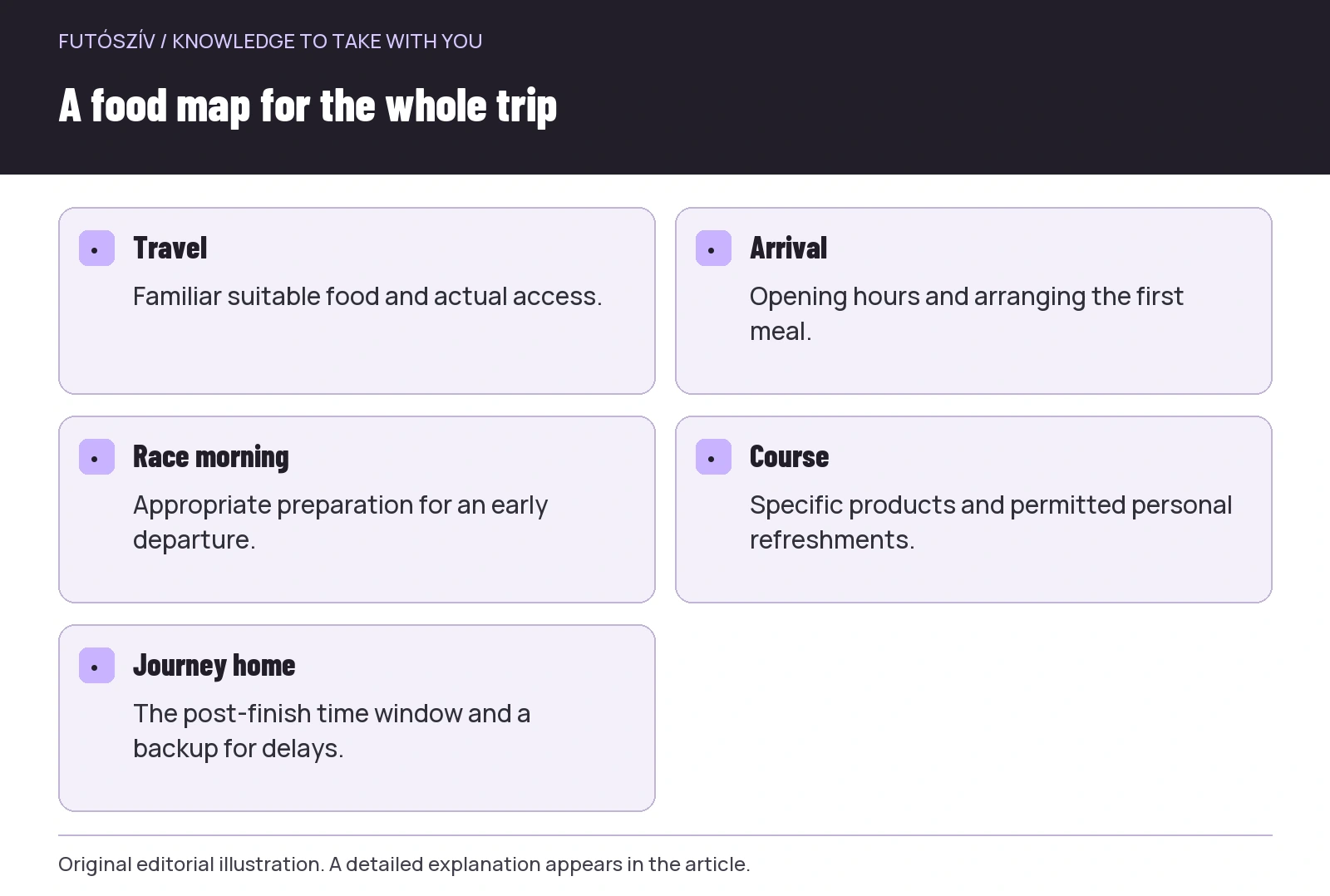
The first stage runs from departure to arrival. The second is the first suitable meal after arrival, the third the day or evening before the race, and the fourth race morning. List refreshments on the course and the period after finishing separately. You do not need to pack your own food for every stage, but each needs a reliable access plan. A good solution for one meal does not automatically resolve the next.
Add a time or time window, a location and actual availability. A shop may be close to your accommodation but closed when you arrive. A breakfast venue may offer suitable choices but open later than you need to leave for the start. Make the usable occasion, rather than merely a venue name, the key to your map. Check unfamiliar opening hours and services through current sources before travelling.
| Journey stage | Main question | Type of suitable backup |
|---|---|---|
| Travel. | Where and when will familiar, suitable food be available? | Your own checked option suitable for the journey and its storage conditions. |
| Arrival. | Will the shop or meal actually be available? | An option fitting your plan that covers the first few hours. |
| Race morning. | Will breakfast be available in time and appropriately prepared? | An agreed breakfast or your own suitably stored option. |
| Course. | Which specific products and serving conditions are known? | A personal refreshment arrangement that follows race rules. |
| Journey home. | Will suitable food still be available after finishing? | An alternative planned for possible delays too. |
 Enlarge diagram
Text version of the illustration
- Travel
- Familiar suitable food and actual access.
- Arrival
- Opening hours and arranging the first meal.
- Race morning
- Appropriate preparation for an early departure.
- Course
- Specific products and permitted personal refreshments.
- Journey home
- The post-finish time window and a backup for delays.
Ask how breakfast works at your accommodation too
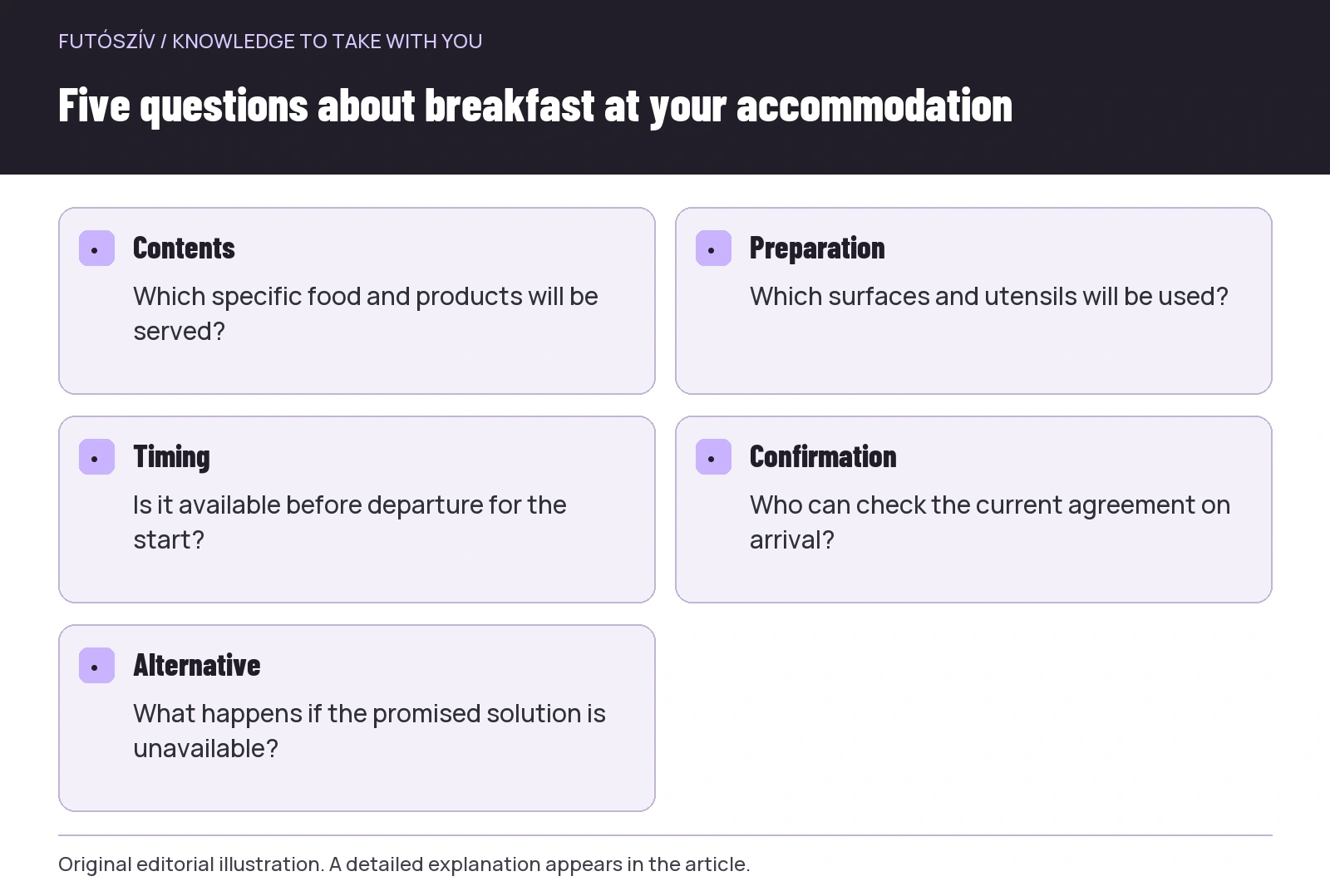
The Coeliac UK travel guidance recommends making arrangements in advance, confirming them on arrival and checking how contamination during serving is avoided. Ask your accommodation about more than gluten-free choices. Clarify the specific food, where it is prepared and separate serving utensils. How a shared buffet works is a different question from the original composition of an unopened product.
Ask when breakfast is served and what earlier arrangement is possible if you need to leave for the start. If a package will be prepared in advance, know its contents and appropriate storage too. The mere availability of gluten-free bread does not establish that a complete breakfast suitable for you will be provided. Discuss your prescribed diet and sports nutrition plan at the level of specific practical arrangements.
If staff are uncertain, ask to contact someone who actually knows the food preparation. A note saved in the booking system and information reaching the kitchen are not necessarily the same thing. Briefly confirm the agreement on arrival and check that the same service is available that day. Clarify any change before eating, rather than trying afterwards to establish suitability from the original promise.
With your own kitchen, equipment and surfaces matter too
At self-catering accommodation, obtaining ingredients is not enough. Check which clean work surfaces, pans and utensils are available and whether they can be used under your dietary requirements. In a shared kitchen, you may encounter other people’s food and equipment. Establish an arrangement consistent with your own management routine. Having a kitchen can be convenient, but does not automatically confirm that every special dietary requirement is met.
Store your ingredients clearly identified and appropriately separated. Do not put a product you have checked into a shared container of unknown contents. If you receive something without a label, the original package information becomes harder to check later. Labelling your own container also helps in shared household use. Alongside the food’s name, its ingredients and necessary handling conditions should remain identifiable.
The gluten-free claim has a defined condition
Under EU Implementing Regulation 828/2014, the gluten-free claim is linked to a gluten content of no more than twenty milligrams per kilogram in food as sold. This is a condition for product labelling, not a personal serving size or a limit to measure at home. Choose products suitable for your diet by checking their actual labels. General descriptions such as natural or light do not replace the necessary information.
Gluten-free and very low gluten are not identical terms. Do not interchange them while reading, or try to establish suitability from the package image alone on a foreign-language product. Learn about the destination’s labelling system and important terms in advance from reliable sources. If information is unclear, seek reliable help; quick guesses are not a sound basis for a prescribed dietary decision.
Treat oats and oat products according to your medical and dietetic guidance too. The general term oats is not the same as a specific product appropriately labelled for your diet. Consider both the label and your personal instructions rather than automatically copying another runner’s experience. A product substitution can look minor while making a significant difference to your own plan.
Make your packed backup purposeful
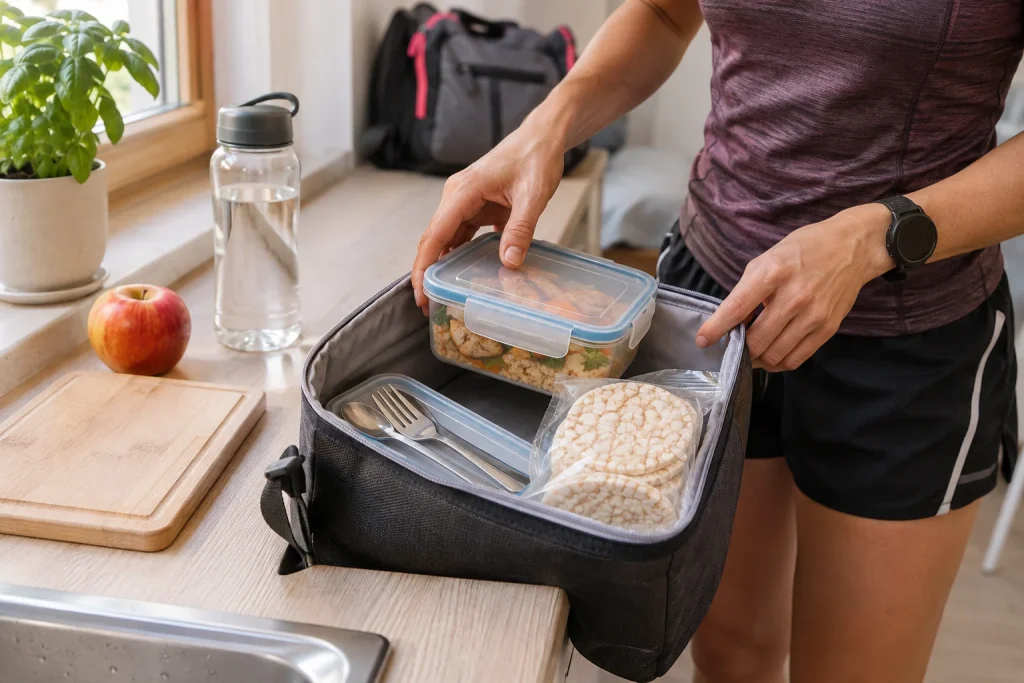
Choose a backup you know, that suits your diet and can be stored safely under the journey’s conditions. Keep the package identifiable and the information needed for use close at hand. You do not have to carry all the ingredients for every meal. The aim is a workable solution for a known gap in access, especially with delays, closed venues or an agreed meal that falls through.
If you carry food across borders, check current import and transport rules through official sources from the destination country and carrier. A special diet does not automatically make every product unrestricted for transport. This article does not list country-by-country rules. Check the chosen route before packing and travelling. A backup is real only if it reaches the destination with you legally and in suitable condition.
 Enlarge diagram
Text version of the illustration
- Contents
- Which specific food and products will be served?
- Preparation
- Which surfaces and utensils will be used?
- Timing
- Is it available before departure for the start?
- Confirmation
- Who can check the current agreement on arrival?
- Alternative
- What happens if the promised solution is unavailable?
Check the race refreshment list separately
Ask for specific product names and variants, current ingredient information and the serving method on site. A general brand page or last year’s photograph may not show the product currently offered. Individually packaged food and pieces served from a shared bowl may require different information. Clarify preparation and serving conditions as well as the product’s suitability.
If you rely on your own refreshments, plan quantities, access and permitted use in advance. Package drop-off, outside assistance and on-course handovers differ between events. Your arrangement needs to fit both the race rules and your diet. If a product runs out on site, do not automatically switch to an unfamiliar alternative. A suitable backup and individual plan should address uncertainty too.
A short message for your accommodation
I follow a medically prescribed gluten-free diet and would like to arrange meals for my race trip in advance. Please let me know which specific breakfast can be provided, how contact with gluten-containing foods and utensils can be avoided, and with whom I can confirm this on arrival. Because of the race start, I will leave before normal breakfast hours: what suitable arrangement is possible within this time window?
Add the actual time, number of people and your own necessary conditions. Name any additional restriction separately; a gluten-free request does not communicate every allergen or dietary need. Divide the reply into three parts: confirmed information, open questions and the next step. A partially positive response does not necessarily confirm the whole breakfast plan or its timely availability.
The arrival check is brief but important
Find out who knows the agreement, where your products are and which preparations will be done fresh. If another person is working that day or kitchen conditions have changed, clarify the plan before eating. Reliable advance discussion helps greatly, but it must connect with the current situation. A calm, brief check may be less burdensome than rushed replanning just before departure.
Keep a specific food plan for the journey home too. The race may not end at the expected time, and the finish-line food may not suit you. A previously checked option and an accessible backup can cover this stage as well. Gluten-free race travel then consists of clear food decisions throughout the journey while maintaining medical instructions and your own needs.
Sources and further reading
- NHS: Coeliac disease — treatment
- Coeliac UK: Travelling with coeliac disease
- EUR-Lex: Commission Implementing Regulation (EU) No 828/2014
How Futószív articles are prepared: our editorial guidelines.