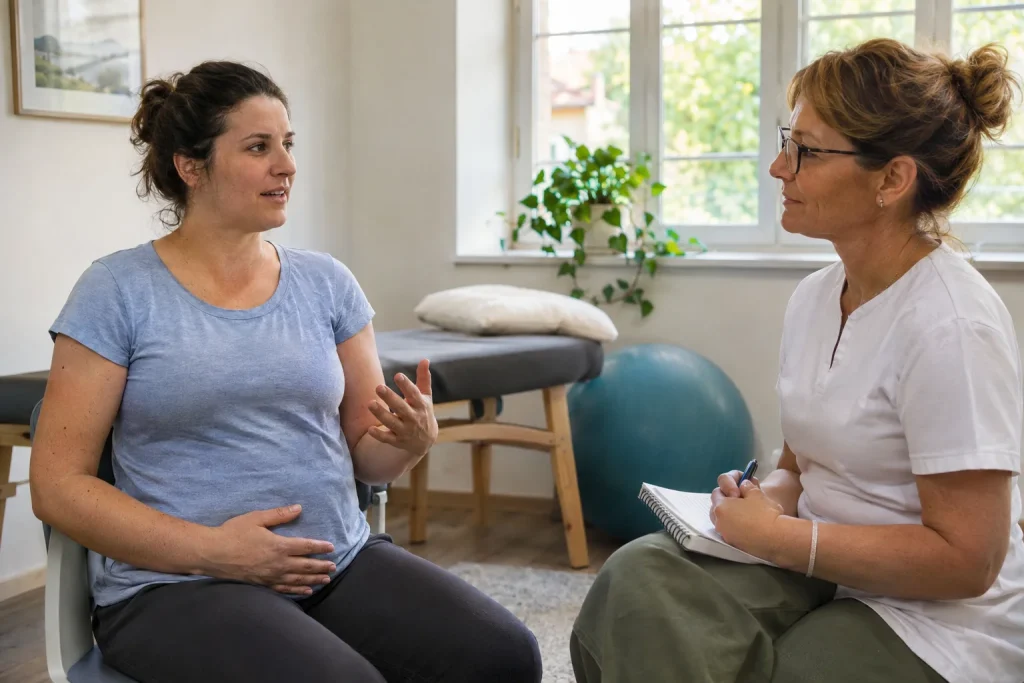
After childbirth, many people first hear about abdominal separation when a photograph or home test alarms them. A gap described in finger widths can easily become the one decisive number: a large gap means running is forbidden; a small one means everything is fine. The real question is more complex. Alongside the condition of the abdominal wall, pain, everyday movement, exertion and the response to activity all matter.
Assessing diastasis recti is not simply a cosmetic issue, but neither does it automatically mean severe dysfunction. The aim is to understand what is being measured, which problem you want to address and how running relates to it. This article does not offer a home diagnosis or a universal abdominal exercise programme. It helps connect a professional assessment with your own goal in a useful way.
What separates, and what does the term mean?
The NHS information on bodily changes after pregnancy uses diastasis recti to describe separation of the rectus abdominis muscles along the abdominal midline. The everyday phrase ‘split abdominal muscles’ can easily suggest that a muscle itself has torn in two. An explanation of abdominal-wall structure and changes in the midline is more useful for understanding the term than an alarming picture.
An appropriate assessment can clarify the diagnosis and what to do. If you are unsure what you can feel, do not try to find the answer through repeated, forceful pressing. Following a movement in a social-media video can still leave questions about the measurement location, body position or meaning of the result.
Ask the professional for a simple anatomical explanation: which area you are discussing, how it is assessed and whether an associated finding needs separate attention. Accurate information can reduce the feeling that your abdomen behaves unpredictably.
Centimetres are a measurement, not a complete description of a person
The European Hernia Society guideline discusses definition, measurement, clinical features and care options together, highlighting the limited quality of available evidence. It does not establish that one measured distance represents the same function or sporting capacity in every person.
When you receive a measurement, ask where, in which position and by what method it was taken. Comparable measurements matter for follow-up. A standing photograph, a home estimate with fingers and ultrasound at a specified location are not interchangeable sets of data.
Alongside the result, describe practical changes. Is getting out of bed easier? Does an everyday lift feel more confident? Are there fewer symptoms after a walk? Tracking size and function separately helps avoid attributing every improvement or difficulty to that one number.
Research does not always find the gap and strength changing together either
In a 2023 randomised trial a programme including curl-up exercises improved abdominal muscle strength, while the distance between the muscles neither improved nor worsened compared with the control group. This is not a prescription for everyone to do sit-ups. It is a useful example of how a change in function and a change in gap size are not necessarily the same outcome.
In a 2026 randomised trial a professionally supervised hypopressive programme also showed no between-group improvement in the primary distance outcome, while some functional and self-reported measures improved. The study does not establish this as the only method or the best one for everyone. Instead, it shows the importance of defining in advance what improvement means.
When a programme promises to close the gap, ask what study was conducted, with which participants and which outcome was measured. A secondary functional improvement may be valuable, but it is not the same as a demonstrated reduction in the gap. Honest discussion of uncertainty does not diminish physiotherapy; it supports realistic goals.
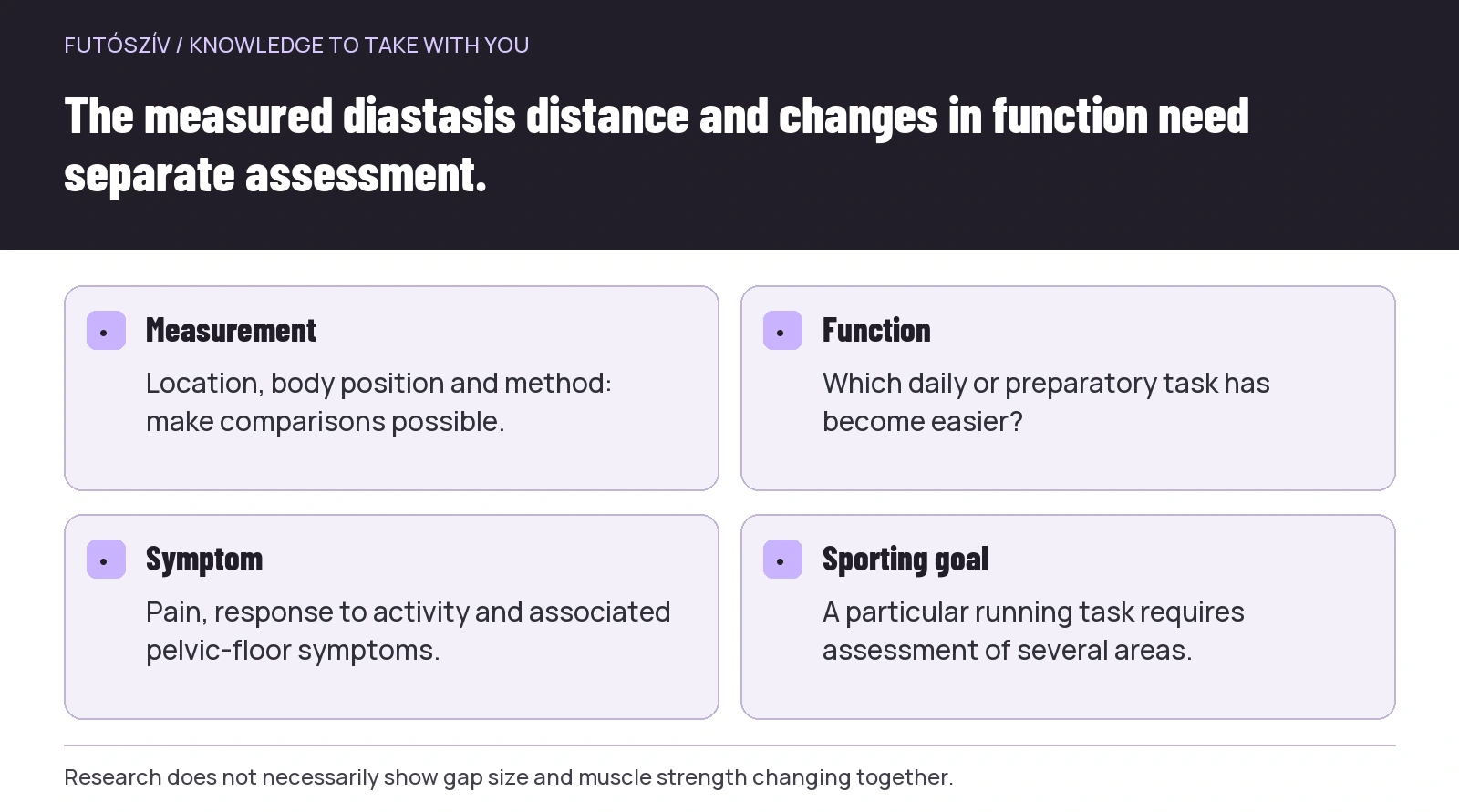 Enlarge diagram
Text version of the illustration
- Measurement
- Location, body position and method: make comparisons possible.
- Function
- Which daily or preparatory task has become easier?
- Symptom
- Pain, response to activity and associated pelvic-floor symptoms.
- Sporting goal
- A particular running task requires assessment of several areas.
A picture of the abdomen cannot establish readiness to run
The international Delphi consensus on readiness to run after childbirth did not accept the distance between the abdominal muscles as a standalone pre-running milestone applicable to everyone. Experts emphasised assessment across several areas and did not establish universal performance thresholds. This is expert consensus, rather than a safety test established by one study.
Running-related assessment also needs to ask about postpartum healing, pelvic-floor symptoms, musculoskeletal problems and daily demands. Focusing on abdominal width can easily overlook issues such as urine leakage or pressure during prolonged standing.
A good assessment also understands the goal. A short, easy jog may need different preparation and follow-up from fast training or a long trail run. Readiness to run is not a stamp earned once; it involves considering the particular task and the response to it.
Describe the problem before looking for an exercise
Think in three columns. First, record what you feel: pain, tension, uncertainty or mainly concern about appearance. Second, describe the situation in which it happens. Third, state what you want to do again. This makes the conversation more precise than simply calling your abdomen weak.
For example, discomfort while lifting the baby is a different question from feeling bothered by a midline bulge even without pain. Both can be discussed, but they may not have the same answer. Functional difficulties and feelings about body image do not need to be pitted against each other.
Do not deliberately take on a large workload just to ensure you can demonstrate symptoms at the assessment. Everyday experience is a valid starting point. If a symptom persists, changes or involves pain, clarifying its cause comes before comparing online programmes.
What makes an exercise useful?
Its purpose, technique and amount should be understandable. Know which sensations are acceptable, which signs mean stopping and how the task will change later. If an exercise has only been prescribed as ‘abdominals’, ask for clarification. Body position, range of movement and effort can make a difference.
Breathing guidance can help you learn a movement, but it should not become a rule suggesting that every other breath causes damage. If you become dizzy, feel pain or cannot follow the task while practising, report it. A progression is not good simply because you have to struggle through it.
Your programme can be simplified if your routine does not allow lengthy practice. Ask which two or three elements matter most for the current goal and when you will review the results. A workable plan can teach you more than a long list that creates constant guilt.
Do not build a complete movement ban around one label
The 2023 trial is an important counterpoint to the blanket claim that every curl-up necessarily worsens diastasis. However, its results do not mean someone should independently follow the same programme after recent surgery, with pain or in any postpartum condition. The exercise’s name alone is insufficient to judge the load.
If you have been advised to avoid a movement, ask why and when it will be reassessed. A temporary modification may help, but it is important to understand the conditions under which it can change. A clear plan can make everyday bending, lifting or turning less frightening.
The same applies to equipment. A belt, taping or another aid may have a comfort role worth discussing, but buying a product does not constitute a full functional assessment. Wearing it is not proof that any workout is appropriate.
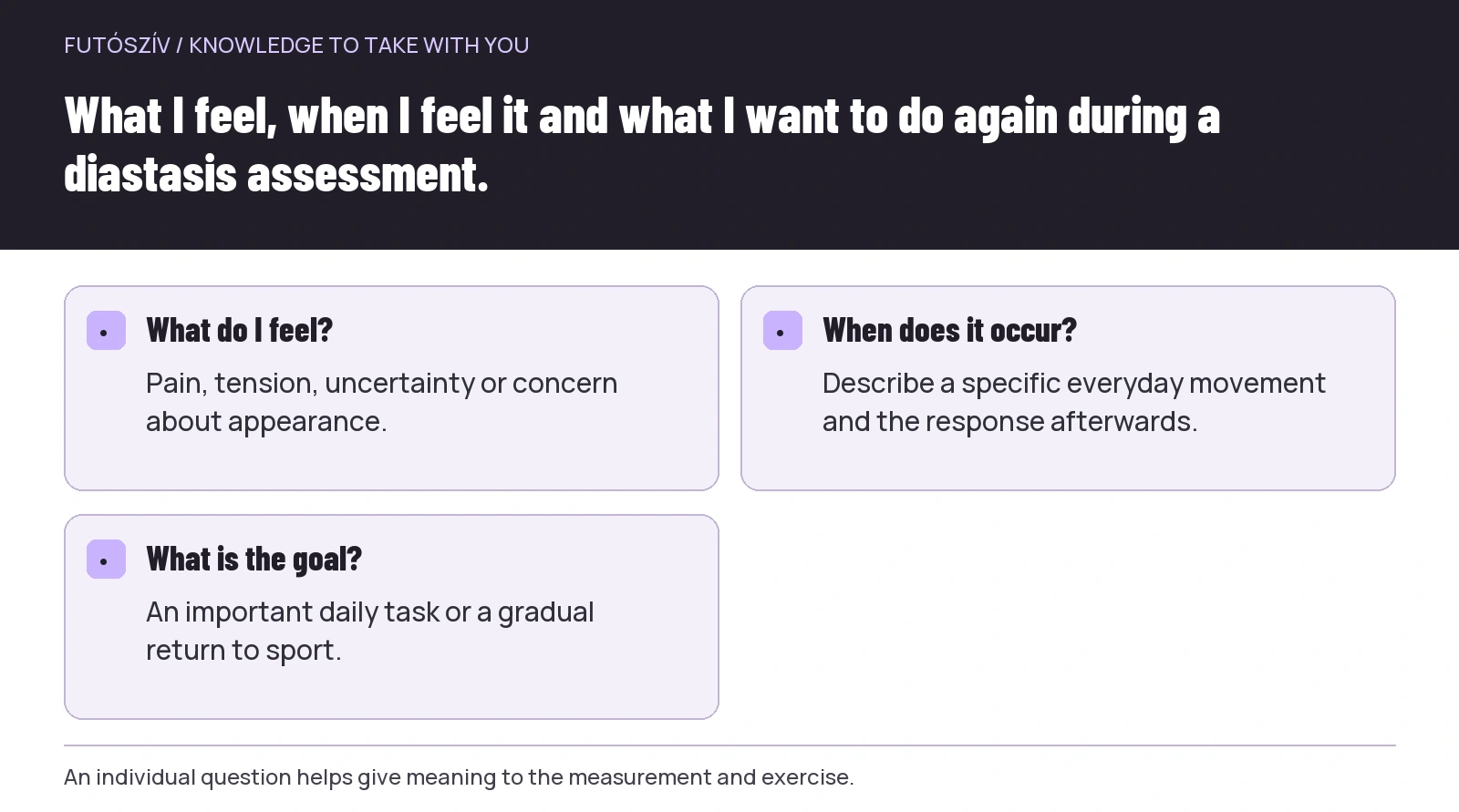 Enlarge diagram
Text version of the illustration
- What do I feel?
- Pain, tension, uncertainty or concern about appearance.
- When does it occur?
- Describe a specific everyday movement and the response afterwards.
- What is the goal?
- An important daily task or a gradual return to sport.
Preparing for running involves more than abdominal exercises
Future running is not solely the abdominal wall’s task. The legs, muscles around the hips, balance, pelvic floor and general endurance are involved too. Preparation based on an individual assessment can therefore include several types of tasks. Attending to the abdomen does not mean placing every other area on a waiting list.
Choose a goal with the professional that relates to running but can also be followed in daily life. Better tolerance of light everyday activity or more confident execution of a preparatory strength exercise is more specific than ‘fixing’ the whole abdominal wall. Assess the result against your own starting point.
Keep the whole day’s demands in mind too. Carrying a child and climbing many stairs may not feel like training, yet they can create a different starting point for afternoon practice. A sports plan becomes realistic when it includes these circumstances.
What should happen during the first trial run?
If individual assessment and healing indicate that jogging is appropriate, start in simple conditions. A route that is easy to cut short, a restrained workload and agreed signs for stopping can help. Your plan may alternate walking and running; do not try to calculate the ratio from a home measurement of the abdominal gap.
Look beyond visible changes in your abdomen. Pain, pelvic-floor sensations, comfort while moving and how you feel that evening or the next day also matter. If symptoms appear, describe them together with the circumstances: how long you moved, the terrain and when you returned to your starting condition.
Even after a good session, you do not need to increase speed and duration at the same time. Modest changes make follow-up easier. The aim is to build running that is manageable alongside the rest of the day, rather than to achieve a particular distance in one trial.
Not every abdominal bulge is the same
Distinguishing diastasis from a hernia requires assessment; the two can also coexist. Do not automatically treat every new lump as part of an already known abdominal separation. The EHS guideline also considers the possibility of an associated hernia when discussing care.
Show a new or painful bulge to a doctor. The NHS Wales information on hernias lists sudden severe pain, vomiting, and a firm or tender hernia swelling as urgent signs. Do not test such a situation with abdominal exercises or try to resolve it through forceful pressure; urgent care is needed.
Considering surgery does not follow from a single home measurement either. Symptoms, function, possible associated findings and personal goals all belong in professional decision-making. The guideline also discusses physiotherapy without stating that everyone needs an identical programme.
What should you ask at the next assessment?
- What has been found, and is there another issue that needs separate assessment?
- Alongside the measured distance, which functions and symptoms are we following?
- Which personal goal is the exercise designed for, and how can I perform it correctly?
- What signs should prompt a change in activity, and when should I seek another assessment?
- Which areas beyond the abdominal wall are we addressing to prepare for running?
- How will we know whether the plan helps in everyday life too?
Monitoring abdominal separation is informative when measurements are accompanied by your own functioning. Centimetres, body-image feelings and running goals can each be discussed separately. Movement can then become less about constantly checking the abdomen and more about gradually regained possibilities.
Sources
- European Hernia Society: Guidelines on management of rectus diastasis
- NHS: Your post-pregnancy body
- Gluppe and colleagues: Curl-up exercises improve abdominal muscle strength without worsening inter-recti distance, randomised trial, 2023
- Moreira and colleagues: Hypopressive exercises for diastasis recti and pelvic floor symptoms, randomized trial, 2026
- Christopher and colleagues: Return-to-running readiness after childbirth, Delphi consensus, 2024
- NHS Wales: Hernia
How Futószív articles are prepared: our editorial guidelines.