
A fuelling product’s packaging fits much information into a small space. A highlighted carbohydrate amount, per-serving value and per-hundred-gram table may describe the same food yet show different numbers. Meaningful comparison therefore begins not with choosing the largest number but understanding the basis. What does the figure refer to, in which unit, and how much do you actually use? Once this is clear, a label looks much less like a collection of competing numbers.
This article teaches label reading to adult recreational runners. It prescribes no intake during running, personal carbohydrate target, salt or caffeine dose. Products and figures here are imaginary educational examples, not specific market recommendations. Develop a personal fuelling plan for your exercise demands and health circumstances, with a sports dietitian if necessary. Good data reading helps follow that plan but does not itself determine your needs.
Read the table heading first
The official Your Europe EU nutrition-labelling information presents figures expressed per hundred grams or hundred millilitres as part of the basic labelling system and discusses additional per-serving declarations too. Always look at the heading before the value. One column may concern an entire package and another a stated weight. With differing bases, the numbers cannot directly be treated as the same quantity.
Energy and nutrients use different units. Kilojoules and kilocalories describe energy; grams describe mass. A larger number on a packet alone does not mean equivalent nutrients. Take care with conversion between milligrams and grams too. Make the first check simple: exactly which row and column are you reading? A table’s layout makes it easy to jump a row or to another serving size.
The NHS label-reading guide separately presents detailed nutrition information on the back or side of packaging and front-of-pack highlights. A readily visible number can help, but read the detailed label for a complete comparison. A highlighted property is not a personal recommendation. A product containing more or less of something does not yet identify which fits your purpose.
From a hundred grams to a whole packet: simple multiplication
Suppose imaginary product A comes in a forty-gram packet and lists sixty grams of carbohydrate per hundred grams. The packet is forty per cent of a hundred grams, so contains the same fraction of the stated carbohydrate: sixty multiplied by forty, then divided by a hundred, giving twenty-four grams. This is an educational calculation for understanding the label’s basis, not an intake recommendation. You can apply the same operation to another nutrient row with appropriate units.
Imaginary product B comes in a sixty-gram packet and lists fifty grams of carbohydrate per hundred grams. The calculated whole-packet value is therefore thirty grams. Per hundred grams, A has the higher value; per whole packet, B does. Neither figure contradicts the other: the comparison basis differs. This does not mean either product is better, only that the same question needs the same basis.
| Invented product | Packet weight | Carbohydrate per hundred grams | Calculated value in the whole packet |
|---|---|---|---|
| A | 40 g | 60 g | 24 g |
| B | 60 g | 50 g | 30 g |
The example’s formula is value per hundred grams multiplied by packet grams, then divided by a hundred. Check units before calculating. If the product declares values per millilitre, mass cannot automatically be treated as the same number of millilitres. For denser food, grams and millilitres may describe different quantities. Find the appropriate data on the specific packaging rather than substituting an assumption from another product.
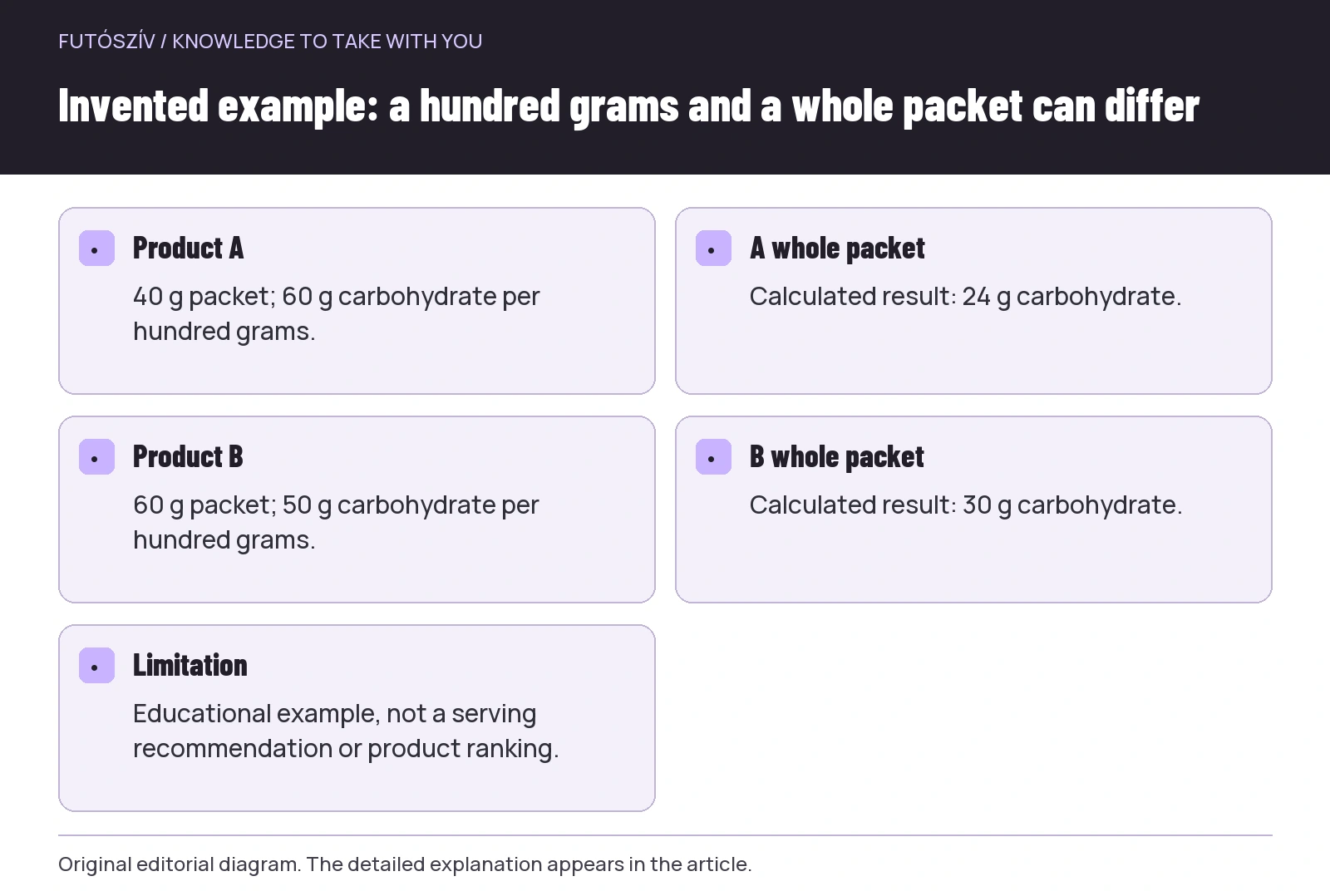 Enlarge diagram
Text version of the diagram
- Product A
- 40 g packet; 60 g carbohydrate per hundred grams.
- A whole packet
- Calculated result: 24 g carbohydrate.
- Product B
- 60 g packet; 50 g carbohydrate per hundred grams.
- B whole packet
- Calculated result: 30 g carbohydrate.
- Limitation
- Educational example, not a serving recommendation or product ranking.
One serving is not necessarily one package
Check how many servings the pack contains and what quantity the manufacturer calls a serving. A larger resealable pack may declare information for several occasions. If using only part, the whole-package value is not your actual use. Equally, a small packet is not always a personalised sports-dietetic serving. Packaging unit and personal need are two separate concepts.
Establishing the portion actually consumed may be limited. Contents can remain in a pouch, leak from a bottle, or you may consume an imprecisely known part of a multi-serving product. Record such information as an estimate. A long decimal calculated from the label’s average and an uncertain quantity does not become more accurate because a table displays it neatly. The underlying data determines calculation certainty.
If your personal plan requires more precise tracking, agree an appropriate method with a professional. Consistent recording of product data, units used and preparation may be needed. Label-reading knowledge helps but does not prescribe necessary intake. Implement your plan appropriately for the product rather than inventing a personal target from the available packet size. Information and decision-making then remain separate levels.
Of which sugars is a subcategory, not another amount to add
In a nutrition table, carbohydrate and of which sugars are not two independent quantities to add together. Sugars provide a breakdown of the stated carbohydrate figure. If an imaginary packet lists twenty-four grams of carbohydrate, of which twelve grams are sugars, this does not become thirty-six grams of carbohydrate. The row’s name indicates the hierarchy. Of which therefore matters as much as the number.
The Nébih nutrition-labelling information also distinguishes carbohydrate, sugars, fibre and salt. In the labelling system, fibre is not part of the declared carbohydrate value, while sugars appear as a separate subcategory. Read the product table within this structure. The ingredients list serves a different task: it shows what the food consists of, rather than repeating the same table.
Do not automatically infer a product’s suitability for your sporting purpose from its sugar figure. Circumstances of use, the full fuelling plan and individual tolerance matter too. Nor does a seemingly lower subcategory value imply an advantage in every situation. Label reading first aims to understand actual contents. Link personal dietary decisions to this information rather than building an entire ranking around one highlighted nutrient.
Salt and sodium: do not compare them as identical numbers
Nébih describes salt equivalent as two and a half times the sodium amount. A label’s salt figure therefore does not mean the same amount of sodium. In an invented educational example, one gram of salt equivalent corresponds to four hundred milligrams of sodium using the factor of two and a half. This explains units and concepts, not recommended replacement during running. Assessing your own need remains a separate professional question.
For comparison, establish both a common basis and identical units. Salt per hundred grams cannot be directly compared with sodium per whole packet. First clarify the package quantity, then the appropriate conversion. If the label and product page differ, do not automatically choose the seemingly preferable figure. Start with the actual packet you have and manufacturer clarification if necessary.
This detail is particularly important when viewing product pages from different countries. Labelling format and declared units can differ, and an identical brand name does not guarantee a fully identical product in every market. Read your packet’s exact version. Name, flavour, pack size and local information together identify the food. An online comparison table is interpretable when these source details are visible too.
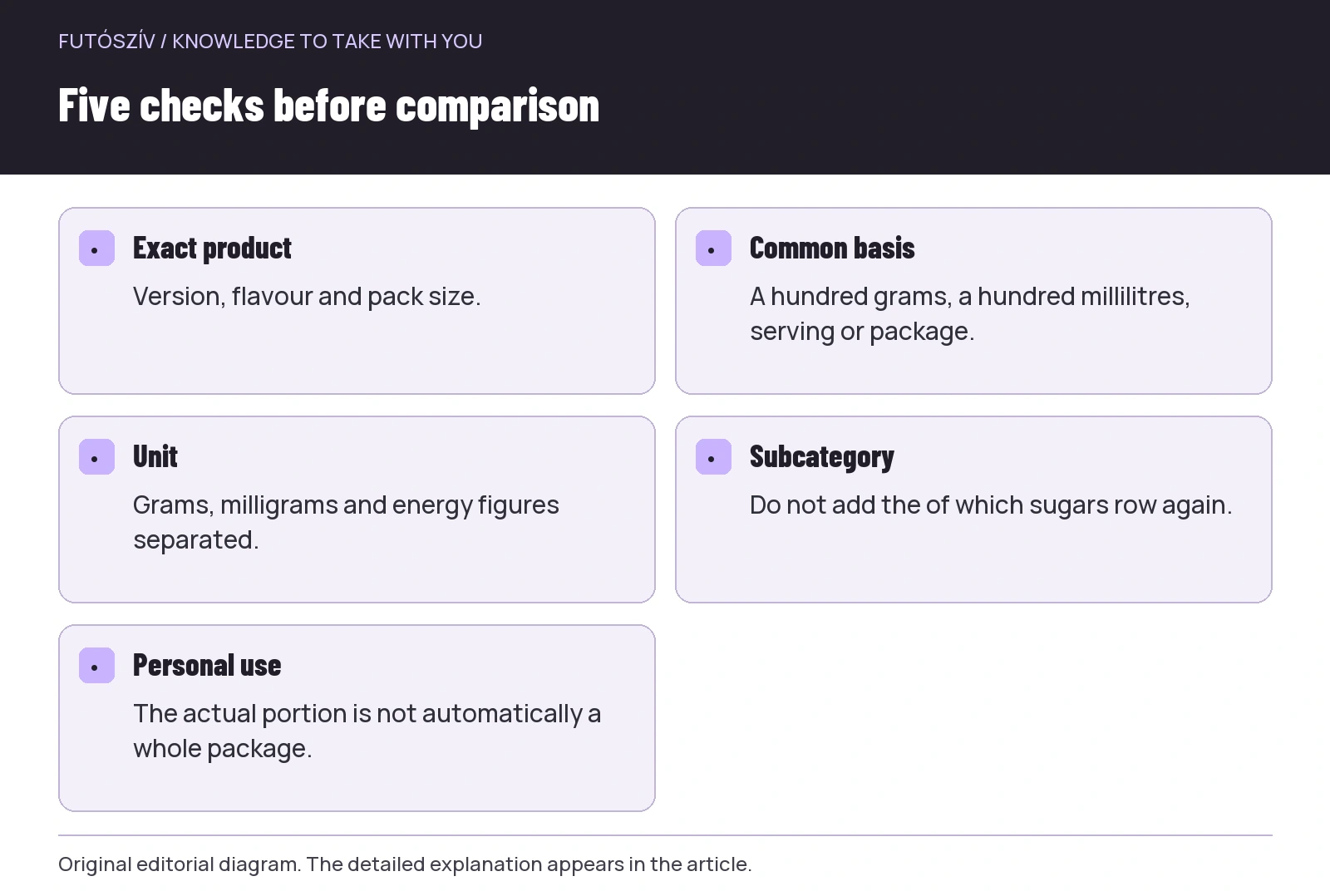 Enlarge diagram
Text version of the diagram
- Exact product
- Version, flavour and pack size.
- Common basis
- A hundred grams, a hundred millilitres, serving or package.
- Unit
- Grams, milligrams and energy figures separated.
- Subcategory
- Do not add the of which sugars row again.
- Personal use
- The actual portion is not automatically a whole package.
For a prepared drink, water quantity is part of the information too
For powders or mixing products, check whether the table concerns the dry product or a drink prepared according to instructions. They do not have the same concentration. If mixing with a different quantity of water, values for the prepared drink cannot be used unchanged. Follow the specific product’s instructions and your personal plan. A more concentrated mixture is not automatically better, and dilution is not solely a taste question in every sporting situation.
For mixing, know the actual volume and the product’s specified measuring unit. An arbitrary kitchen spoon or bottle filled by eye may introduce uncertainty if your plan requires more precise preparation. Read label information together with preparation instructions. Storage after opening and mixing is separate information too. Do not automatically transfer unopened powder’s storage arrangements to a prepared drink.
An average value is information, not an individual laboratory certificate
Your Europe explains that nutrition declarations provide average values which may rest on analysis or accepted calculation data. This supports comparison and dietary understanding, but is not a separate measurement of each packet. Rounding and the nature of underlying data make unjustifiably precise conclusions unhelpful. In your own table, units and appropriate magnitude may matter more than numerous decimal places.
Composition does not fully describe usability. Opening packaging, texture, storage, available water and individual comfort remain separate questions. Two products with identical nutrient values may handle differently for you without establishing a general quality ranking. Relate personal experience to its specific circumstances. Treat the label as one important information source for personal decisions, not the final answer to every question.
Make a short comparison sheet
A few columns suffice: exact product, pack size, basis per hundred grams or millilitres, whole-package value, relevant ingredient and conditions of use. Preserve the source or date of the actual label photograph alongside data if useful. Mark missing information as missing. A number borrowed from another product or an uncertain pack size could create an apparently precise but actually incorrect comparison.
For the conclusion, state your personal question. Are you seeking an easier-to-identify serving unit, assessing packaging or checking an ingredient important to your diet? These are different decisions. You need not rank everything with one total score. If personal fuelling needs are the question, clarified label information provides a useful basis for discussion with appropriate professional help.
You read a fuelling label accurately when each number brings its meaning with it: which nutrient, what unit, how large a basis and which specific product. Your own use connects to this as a separate step. This avoids confusing packet size, serving and per-hundred-gram information, and incorrectly adding subcategories. Clearer information can support calmer decisions while personal needs and the limits of individual experience remain in place.
Sources and further reading
- Your Europe: Nutrition declaration
- NHS: Food labels
- Nébih: Nutrition labelling – concepts and presentation
How Futószív articles are prepared: our editorial guidelines.