Having to adapt your route to bleeding is an important symptom too
You hesitate to run a longer loop because you cannot manage changing menstrual products. You wake several times at night, worry about leaking and search for the nearest toilet instead of focusing on the race. Assessing heavy menstrual bleeding involves more than millilitres measured at home: its effect on life matters too.
The NICE NG88 guideline prioritises improving quality of life during assessment and treatment. Missing running, work, school or social life is therefore not incidental information. You need not first prove your condition sufficiently severe compared with someone else’s experience before discussing it with a doctor.
This article does not diagnose a bleeding disorder or provide medicine or iron-supplement doses. It offers pointers for seeking help, describing symptoms usefully and temporarily reconsidering a running plan. Even alongside previously successful sporting life, a bleeding change may arise that requires individual assessment.
What might heavy bleeding mean in practice?
The NHS information identifies very frequent pad or tampon changes, prolonged bleeding, leaking onto clothes or bedding, larger clots and avoiding everyday activities as concerning patterns. If menstruation regularly prevents you living as you wish, discuss this with a doctor.
The ACOG information similarly discusses bleeding lasting more than seven days, requiring nighttime product changes or soaking through a product hourly for several hours. These are signals supporting help-seeking, not a home scoring system below which no problem can exist. Change from your own usual pattern matters too.
Product capacity and usage habits differ. One change count cannot calculate precise blood loss, and uncertainty need not make you stay silent. Explain what you use, how full it becomes, whether it leaks and how often you must interrupt your day because of it.
When does urgent help come before the planned appointment?
With very heavy or unremitting bleeding, fainting, feeling faint, chest pain, severe difficulty breathing, confusion or substantial weakness requires urgent medical help. In Hungary, call 112 if a life-threatening emergency is suspected. Do not wait for the next routine gynaecology appointment, and do not drive when unwell.
A pattern of soaking through a product hourly for several hours warrants prompt professional discussion, particularly if wellbeing deteriorates too. You need not first try running to discover whether you are really weak. Everyday condition and bleeding may themselves be sufficient reason to seek help.
If pregnancy is possible, bleeding and abdominal pain need assessing with that knowledge. Do not automatically call it menstruation because it roughly matches the calendar date. Bleeding soon after childbirth and bleeding after menopause are also separate healthcare situations, not part of a general runner’s menstrual routine.
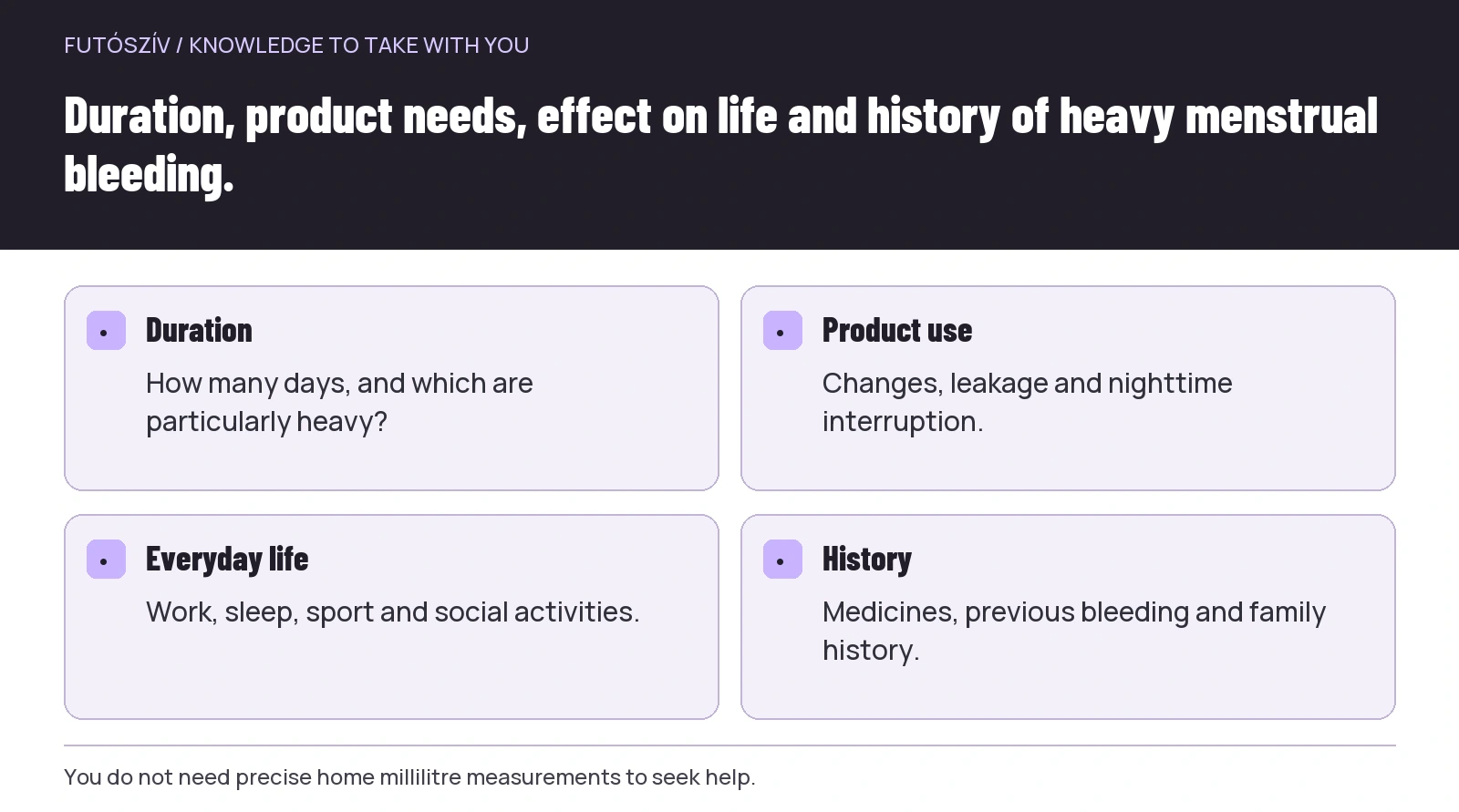 Enlarge diagram
Text version of the diagram
- Duration
- How many days, and which are particularly heavy?
- Product use
- Changes, leakage and nighttime interruption.
- Everyday life
- Work, sleep, sport and social activities.
- History
- Medicines, previous bleeding and family history.
Iron deficiency and anaemia: fatigue is a clue, not a laboratory result
The CDC material on heavy menstrual bleeding explains that prolonged or substantial blood loss can lead to anaemia. Fatigue, weakness and exertional breathlessness may arise for this reason too. Symptoms can also have other causes, however, so slower running cannot establish a definite iron-deficiency diagnosis.
NICE recommends a full blood count for heavy menstrual bleeding. Clarify further assessment of iron status according to individual circumstances. The current guideline’s 2026 update information also indicates withdrawal of the previous recommendation against routine ferritin testing; do not therefore derive a present-day prohibition on investigation from old online summaries.
This change does not mean an identical laboratory panel or treatment for every runner either. Ask what is being investigated in your symptoms and history, how results will be interpreted and when follow-up will occur. Addressing bleeding and treating any deficiency are two connected tasks; resolving only one may be insufficient.
Why is buying iron independently insufficient?
If a deficiency has actually developed, treatment may require an individual plan. Preparation, administration and monitoring follow neither a race calendar nor another runner’s laboratory target. More iron is not a general performance-enhancement strategy, and a supplement does not clarify why bleeding is heavy.
Bring details of supplements and medicines you already use to the consultation. Do not leave a multivitamin, separate iron preparation or previous treatment plan unmentioned. Explain side effects or difficulty following the recommendation too; feasibility is part of appropriate care.
For recurring deficiency, reviewing causes and monitoring is particularly important. I am a runner, so this must be normal is not a sufficient explanation. Another bleeding source, an absorption question or another health factor may arise for the doctor to consider. Training data is part of the history, not a substitute for complete investigation.
Your bleeding history may say more than a single cycle
The CDC information on signs of bleeding disorders identifies unusual nosebleeds, easy bruising and heavy bleeding after procedures alongside heavy menstruation as important signals. Do not omit such history simply because you are currently seeking an appointment about menstruation.
Explain if bleeding has been heavy since your first periods or someone in the family has had bleeding problems. NICE also describes considering investigation for coagulation disorders with such personal and family history. A family resemblance does not necessarily mean the symptom should be accepted without further attention.
This is no reason to diagnose yourself with a bleeding disorder. The purpose of history is to help the doctor consider appropriate directions. Experience from a previous tooth extraction, operation or birth may be information you would not think relevant to running assessment but which matters in the healthcare discussion.
Discuss medicines and contraception too
The CDC and NHS also discuss medicines affecting bleeding. With anticoagulant treatment, for example, reporting the symptom is particularly important. Do not independently omit prescribed medicine to make menstruation or a race easier. Coordinate treatment changes and bleeding assessment with your provider.
Contraceptive method and when use began are also important history. Methods do not all affect bleeding identically, and interpretation of the same change may depend on how long you have used it, other symptoms and previous patterns. Bring the specific product name or earlier report where helpful.
Do not automatically attribute new bleeding to a preparation or exclude other causes merely because its information mentions breakthrough bleeding. Seek advice for persistent, heavy or changed symptoms. A suspected side effect is also a healthcare question requiring assessment.
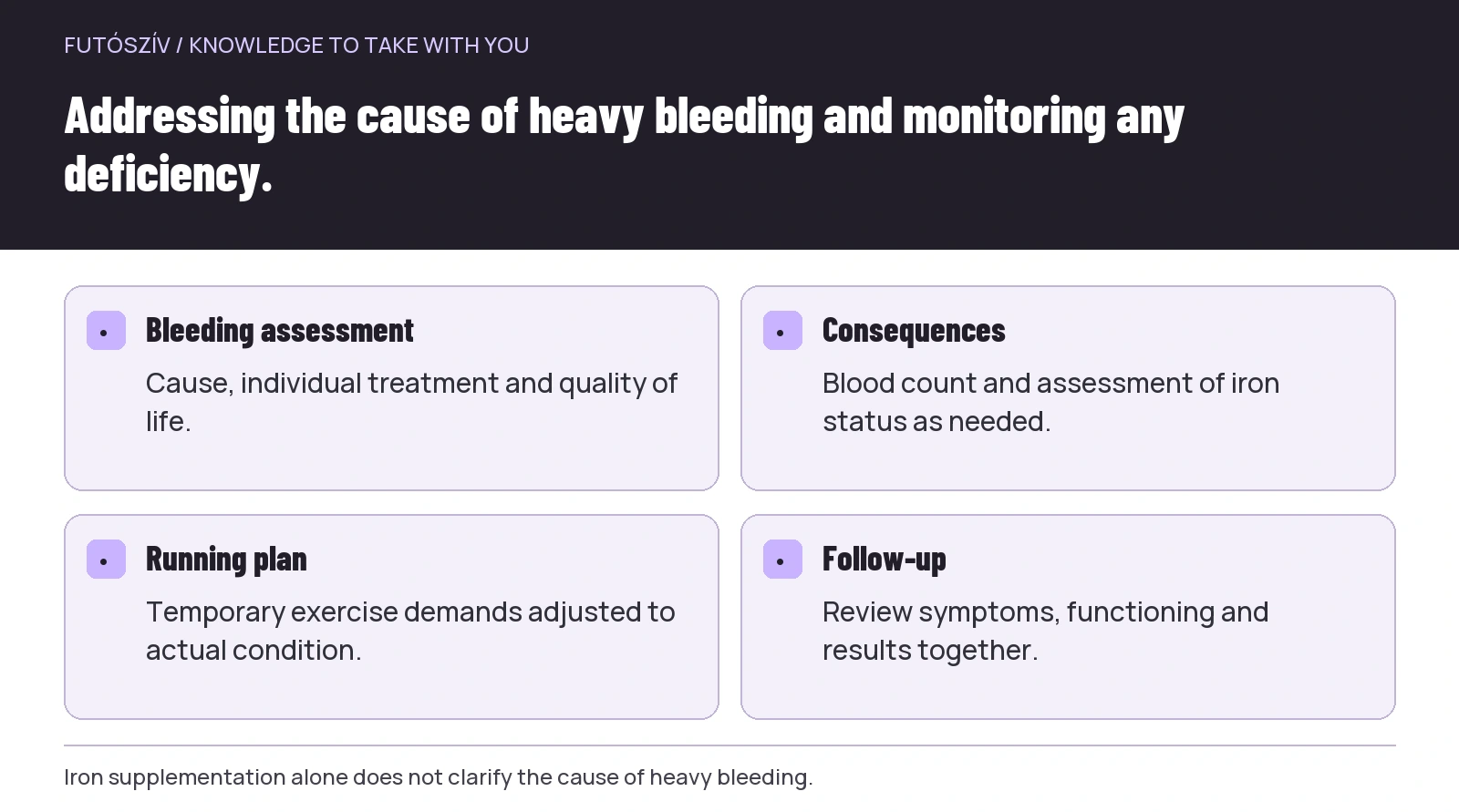 Enlarge diagram
Text version of the diagram
- Bleeding assessment
- Cause, individual treatment and quality of life.
- Consequences
- Blood count and assessment of iron status as needed.
- Running plan
- Temporary exercise demands adjusted to actual condition.
- Follow-up
- Review symptoms, functioning and results together.
What might happen during investigation?
Alongside medical history, symptoms and physical examination where needed, laboratory, ultrasound or other gynaecological investigations may be considered. Heavy bleeding does not have the same cause in everyone, so the sequence differs too. NICE also recommends choosing further investigation according to history and examination findings.
Ask which question each investigation can resolve and how it affects the next step. Bringing earlier reports may help avoid unnecessary repetition, but old results may be insufficient for new symptoms. Appropriate investigation aims to clarify important questions rather than collect the most data possible.
Personal plans matter in the discussion too: whether you want children later, need contraception, value predictable bleeding and which symptom troubles you most. State these when considering treatment options. You need not describe the problem solely through missed training.
Running while it is being addressed: previous pace should not be the only measure
If dizzy, weak, unusually breathless or bleeding heavily, do not test yourself with hard training. Medical advice matching the severity of the condition comes first. Comfortable easy movement on a less symptomatic day is different from a long run during unexplained illness.
The temporary programme may include a shorter loop, easier stopping options or fewer fixed sessions. If anaemia or another condition has been diagnosed, follow individual guidance on exercise demands. Do not independently tie returning to an online laboratory value or the proximity of the next start.
It may be enough to tell your coach that temporary modification is necessary for health reasons. Your full gynaecological history is not community information. A supportive training environment accepts that some details remain between you and your provider while the training plan is adjusted appropriately.
Toilets, product changes and spares: practical support, not treatment
For races and longer runs, check toilets, water and discreet changing opportunities beforehand. Familiar menstrual products and spare clothing can reduce the organisational burden. Do not exceed product usage times or hygiene requirements for a long distance.
A companion can help access your bag or arrange a safe journey home. You need not explain the problem fully to everyone; share what feels acceptable to you and is necessary for help. Fear of leaking is a real quality-of-life burden you can also describe in the medical discussion.
Good logistics do not replace assessment of heavy bleeding, however. If you already organise every route and activity around the symptom, that itself is an important signal. The aim is not to hide the problem more skilfully but obtain an appropriate professional solution.
Discuss more than laboratory results at follow-up
- Do you interrupt your day or nighttime sleep less often?
- Have leakage and anxiety about bleeding decreased?
- Has wellbeing improved, and has any identified deficiency or anaemia been addressed?
- Is treatment manageable, and are there side effects?
- Are further follow-up and conditions for seeking prompt help clear?
Running results are an important but not exclusive source of feedback alongside these. Planning workdays more freely, sleeping more peacefully or feeling less afraid of a group activity are substantial improvements too. Heavy menstrual bleeding has both healthcare and everyday dimensions; both deserve attention.
Sources and further reading
- NICE NG88: Heavy menstrual bleeding, assessment and management
- NICE NG88: Current guideline PDF and update information, 2026
- CDC: Signs and Symptoms of Bleeding Disorders in Women
- CDC: About Heavy Menstrual Bleeding
- NHS: Heavy periods
- ACOG: Heavy Menstrual Bleeding
How Futószív articles are prepared: our editorial guidelines.