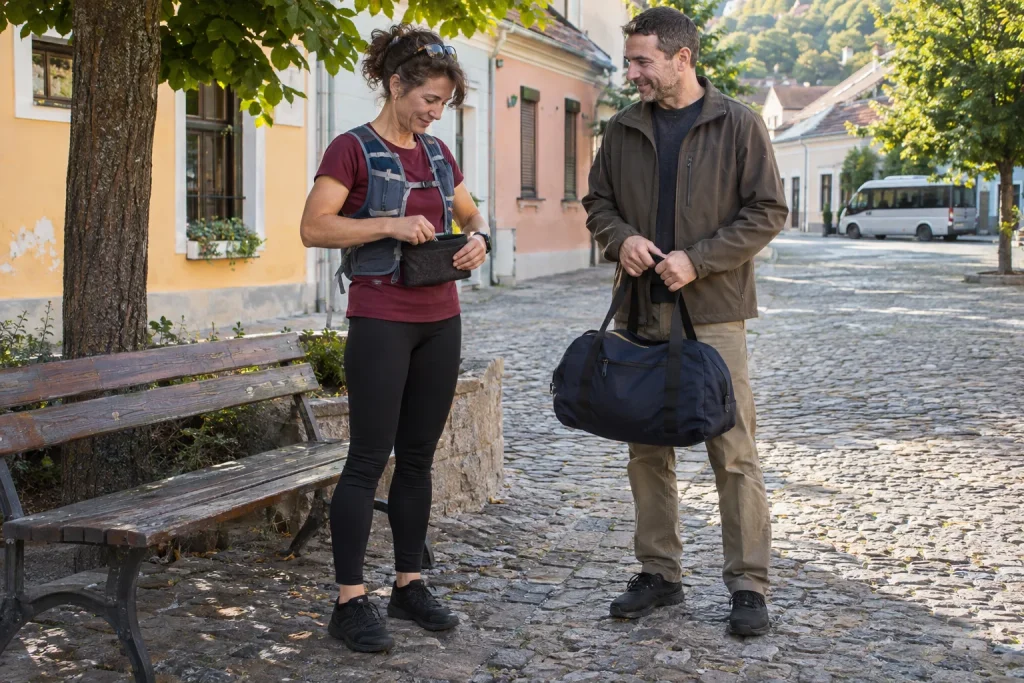
Preparing for a trail race with separate start and finish points means your journey and your equipment’s journey diverge. You travel from one place to the other on the course; your car, larger bag and companions do not follow automatically. The central organisational question is therefore where you want to be at the end of the race and how, from there, you will access everything needed for the journey home.
For the Szentendre examples, we used official Salomon Ultra-Trail Hungary information, checked on 18 November 2026. The event has several races with different starting locations and schedules; always find the information belonging to your own entry. This article is a logistics decision method, not the complete race regulations or a personal trail-running preparation plan.
Do not treat the start as the centre of the entire day
At a loop-course event, you may be used to returning to where you began. With different start and finish locations, that habit can mislead. If you take everything to the start in the morning, you may finish in another town while your car or belongings needed for the return journey remain at the starting point. Resolve this beforehand rather than working it out at the finish.
The Twin Peaks Trail race page identifies the 2027 start as Pilisszentlászló Hegytető. The event’s Programme and venues page places the finish in Szentendre’s Templom tér. These two places alone show why entering only the start address into your phone is insufficient.
Build your plan from the finish end too. What will you have there? Where are your dry clothes, larger bag, key or ticket for getting home? Whom will you meet, and where will you go next? With workable answers, deciding how best to reach the start becomes easier.
Distinguish five locations even when they are close together
The race centre, bag storage, start-transfer departure point, start and finish serve separate functions. Two may be close together without becoming interchangeable. If you put a single large marker over the town on your map, you will still have to find where each task can be done on arrival.
The organiser’s programme page lists separate venues, including the start-bus stop and service points in Szentendre. Do not replace these with a general search result. Put the exact function beside each location on your own sheet: I leave my bag here, board the bus there and go here after finishing. An address alone is insufficient if you do not know what you are using it for.
| Point | Which task belongs here? | What must I take onwards or arrange? |
|---|---|---|
| Race centre | Your collection tasks and official information. | Identification and equipment required for your race. |
| Bag location | Handling eligible belongings according to the rules. | Clarified collection method and access at the end. |
| Transfer departure | Reaching the separate starting point. | Everything that stays with you from start to finish. |
| Starting location | Joining the race’s starting arrangements. | No assumed return for something left here. |
| Finish | Completing the race and moving onwards. | Connection to your bag, companions and journey home. |
The table is a planning framework. Check actual services and eligibility conditions in the regulations for your own race. Do not infer, for example, that you receive the same bag transport or entry arrangements from the options available to another distance’s participants.
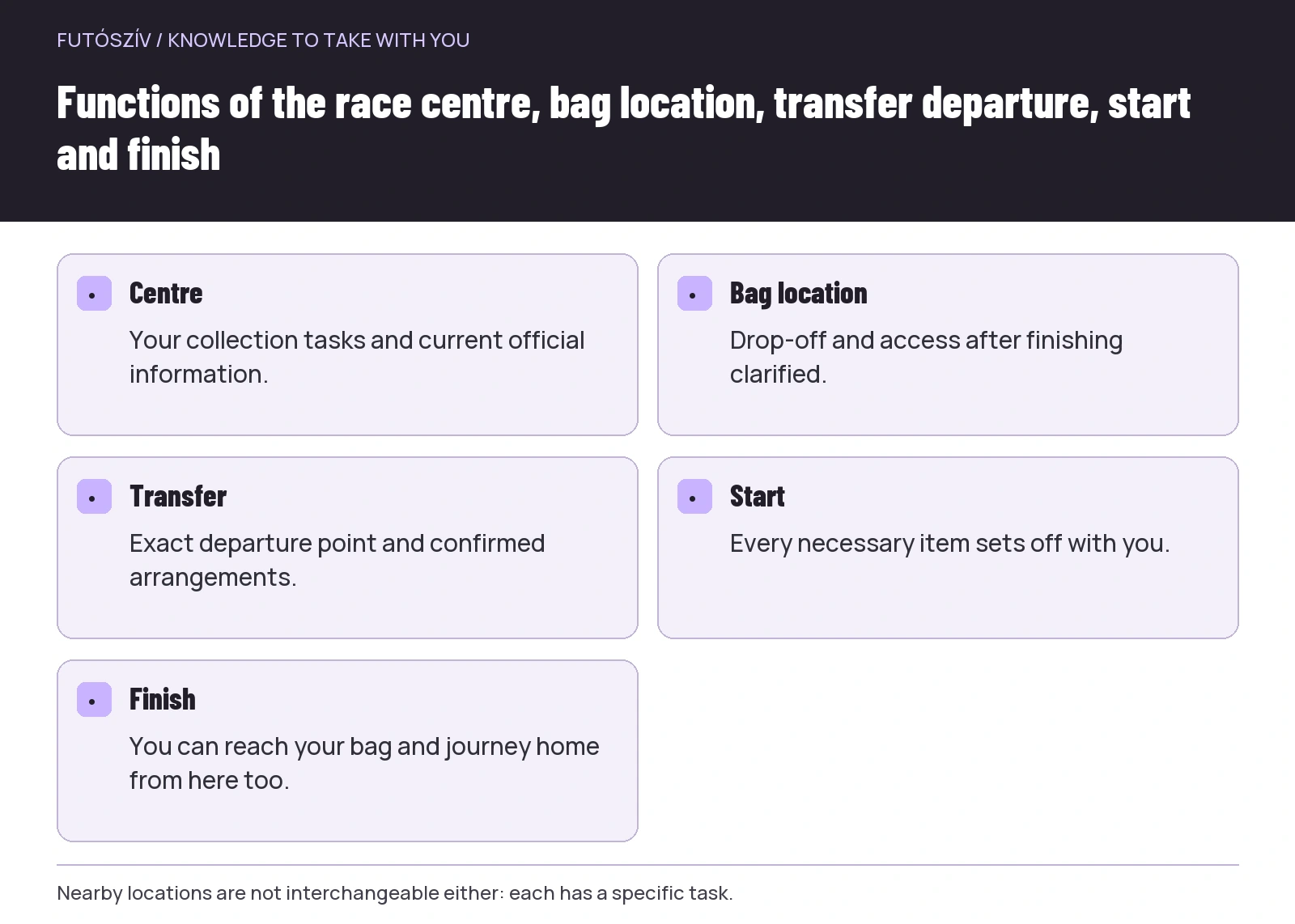 Enlarge diagram
Text version of the diagram
- Centre
- Your collection tasks and current official information.
- Bag location
- Drop-off and access after finishing clarified.
- Transfer
- Exact departure point and confirmed arrangements.
- Start
- Every necessary item sets off with you.
- Finish
- You can reach your bag and journey home from here too.
Reaching the start transfer is a separate task
If the organiser provides a transfer, it is not the same as general local transport available at any time. Learn its own departure location, schedule and conditions of use. Entry including some transport does not resolve the route between the race centre and bus or the tasks required beforehand.
The Twin Peaks page mentions transport from Szentendre to the starting location among the entry inclusions. This requires your own sequence of tasks in which collection, bag organisation and reaching the transfer departure can actually be completed in order. Do not work solely from the race’s starting time. A deadline associated with the bus may come earlier than the race itself.
If companions are handling tasks in different places, do not begin searching for each other at the transfer at the last minute. Agree a meeting beforehand and what happens if someone gets delayed with another task. Where possible, someone’s race number, key or necessary equipment should not remain with a companion moving separately from them.
A real example of why several official pages need reading together
At the November 2026 check, the top of the race page already stated a start on 15 May 2027, but the start-bus paragraph further down still said 23 May. The separate programme page listed the Twin Peaks transfer under 15 May 2027. This is not a situation in which you, as a reader, should independently replace the old date with an arbitrary new one.
For such a discrepancy, mark the question in your own plan and use the current programme for that year as the basis requiring verification. Confirm final start-bus arrangements from current organiser information. This article deliberately does not turn a page mixing different years into a certain, unchanged transfer promise. Recognising the date discrepancy helps avoid booking travel around an outdated detail.
The same method works for other races. Check the event year, dates on individual subpages and recent news. If two primary sources contradict each other, do not conceal the uncertainty in a shared group message. State exactly which detail awaits confirmation. Others will then avoid treating something you do not yet know as settled fact.
Distribute your belongings item by item
Create three groups: things that remain with you throughout, a bag eligible for official drop-off, and items left at accommodation or another verified place. Form these groups around actual use. A key or ticket needed for the journey home may be safe but useless if you can only access it in the other town after finishing.
Handle mandatory kit according to your race’s current rules, recognising that requirements may also relate to conditions. A travel guide cannot exempt you from race requirements. Check the journey of items needed at the start before boarding the transfer, because returning to the town’s bag storage may no longer be straightforward.
Choose the contents of the drop-off bag deliberately too. What do you need immediately after finishing, what can wait and what is better left at home? Do not treat the existence of one large bag as resolving every access question. If several people’s onward travel depends on an item, everyone concerned should know its location.
Choose where the car stays in the context of the whole day
Three basic questions help: who drives, where do they finish their programme, and who can access the vehicle while the runner is on the course? If the only driver is racing, companions’ movements cannot be planned as though that person remains continuously available. If a companion takes the car, their journey and the meeting at the finish also form part of the shared plan.
Returning to a car left at the start is a separate task requiring verification. Do not assume the organiser’s bus to the start automatically takes you back after the race. A service’s direction and schedule matter. If the regulations mention only a pre-start transfer, they do not establish post-finish return transport.
Choosing parking near the finish is not merely a map marker either. Check access to the specific location, race-day restrictions and conditions for waiting there. Parking close to the finish does not necessarily make the journey home easier if traffic arrangements or access remain unclear. A usable solution works throughout the chain.
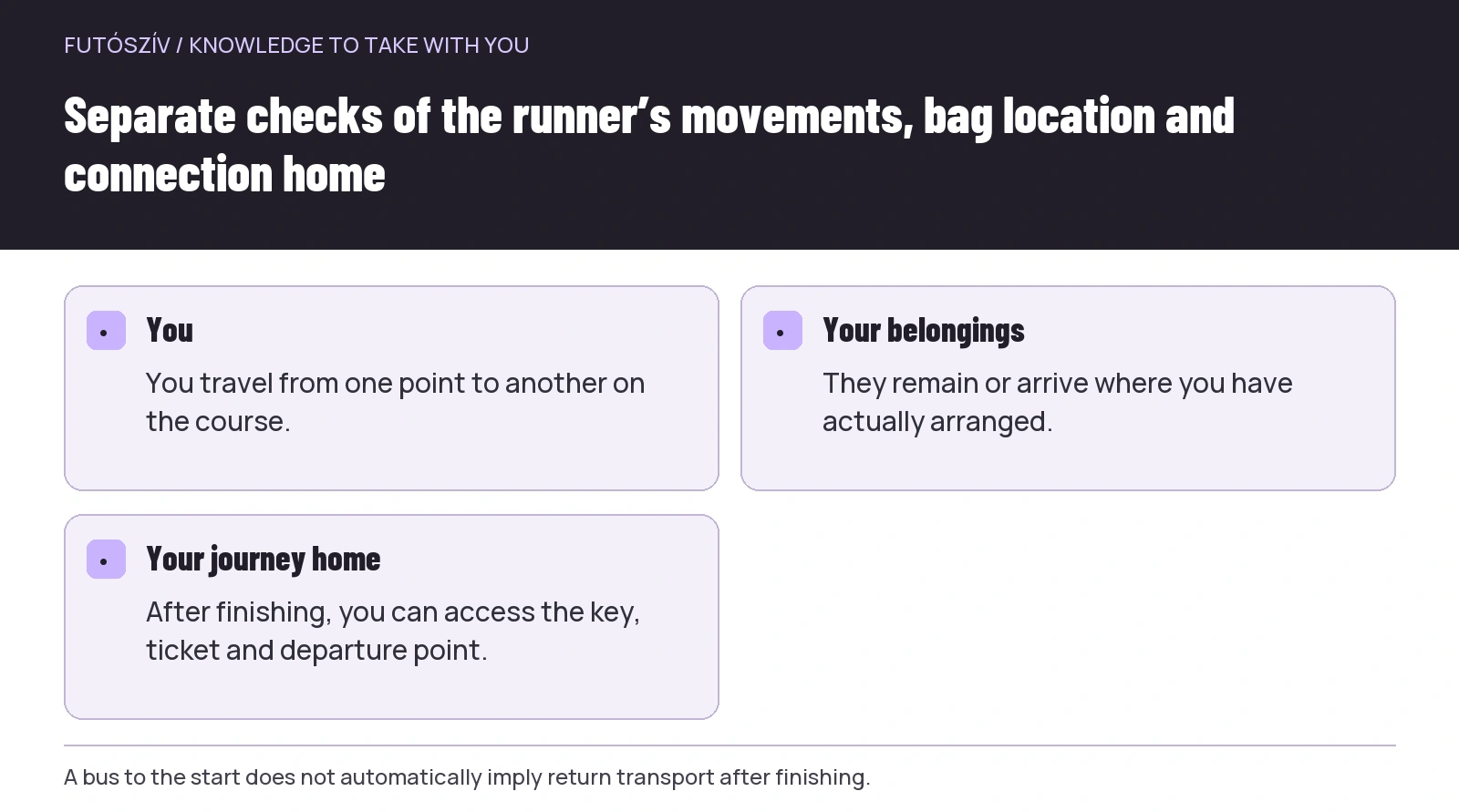 Enlarge diagram
Text version of the diagram
- You
- You travel from one point to another on the course.
- Your belongings
- They remain or arrive where you have actually arranged.
- Your journey home
- After finishing, you can access the key, ticket and departure point.
A fictional case: two runners and one non-running companion
Three friends arrive for the race weekend. Two enter different races; the third supports them and wants their own town programme. They have one car. The example contains no specific parking place or booking: it concerns coordinating roles.
First, both runners write down their own collection and transfer tasks. They then check whether they truly share a window at the start of the day. The non-running companion is not automatically a bag carrier or all-day driver; discuss what they are happy to undertake too. If they can reach the finish at a particular time alongside their own programme, that is a specific agreement. You will come and get us is not.
They choose the key’s location so different finishing times do not unnecessarily hold everyone in place. If one runner finishes later, the other should know where to wait and how to access their own bag. They agree the shared departure home based on the entire post-finish process, not the most optimistic estimated running time.
If the agreement involves too many dependent lifts, they can simplify it. For example, the supporter uses separate transport, or the runners wait for each other at a previously agreed point in Szentendre. The value of the simpler solution is that fewer people’s movements depend on one runner’s arrival time.
Do not derive the companion’s route from the course
A trail race course is not a general transport corridor for companions. Decide on spectator locations, access and support rules from the organiser’s information. The road network visible on a map does not establish that a point is accessible by car or lawful to use for waiting.
A companion should have an independent programme they can complete. Missing you at one location should not force them to reorganise the whole day riskily. Make the shared post-finish meeting the primary connection, with viewing points remaining conditional possibilities. Someone who does not run has no obligation to watch the same table of estimated split times all day.
Agree what information you can actually share too. The runner may not continuously read their phone. Estimated arrival is not a promise to the minute. A clear meeting rule and specific location are more useful than expecting everyone to be instantly reachable at any moment.
Withdrawing from the race is part of the organiser’s process too
When planning the day, know where to find the official procedure if your participation ends somewhere other than the finish. Learn the rules for notifying the organiser, leaving the course and any transport from the regulations. A lift from a friend does not automatically replace required race administration.
For logistics, consider how your companion will know at which point you are meeting and on what confirmed information. Do not designate an unfamiliar trail location beforehand as a guaranteed collection point. Availability, access and organiser requirements matter together. Personal safety or healthcare decisions must not be adjusted to suit the convenience of a car or travel booking.
The aim of this plan is clear responsibility. Know where official information comes from, while your companion knows they will not have to decode your situation independently from an imprecise message. You need not create a separate route for every possible case, but must know where the official procedure is and the basis of shared communication.
The final check: can both your route and your belongings’ routes be followed?
Draw your own movements, your larger bag’s journey and the location of the car or other connection home separately. If a line ends at the start while you are at the finish, a solution is still missing. If a key or ticket is accessible only through a companion finishing later, consciously accept that dependency or find a simpler distribution.
The finished plan should contain your race year, the locations for all five functions, confirmed or still-to-be-confirmed transfer arrangements, bag handling and the post-finish meeting. Record the check date too. With separate start and finish points, a well-organised day means your next step is already known when you finish, and your important belongings arrive in the same day as you do.
How Futószív articles are prepared: our editorial guidelines.