A relay changeover does not have one certain time
A relay team spreadsheet often lists arrivals to the second. The plan still remains an estimate. Actual running times, access to the changeover and event arrangements are separate factors. A useful plan shows not only when you expect a teammate, but the range in which this can vary and when the next runner must be ready within the rules.
This article uses original invented calculation examples. Distances and times shown are not route data for an existing event, and paces are not training recommendations. The method helps a team detect arithmetic errors, separate travel from running and use official leg details at the real race.
Give official information and personal estimates different columns
Leg length, changeover name and start time may come from organiser information. Expected running pace and the arrival buffer planned are team estimates. Do not confuse them. If everything has identical colouring and precision, guesswork can easily resemble official fact.
The description of the Ultrabalaton Trail leg calculator uses start time, team members, paces and leg allocation to calculate expected changeovers and summaries, for example. It shows the relationship between inputs and results clearly. A calculator works through entered assumptions; it does not measure future running times beforehand.
In your table, distinguish at least four data types: information from the organiser, personal running estimates, logistical assumptions and actual measured event data. You can then tell why arrival changes during updates. Does a new leg length require recalculation, or was one runner’s earlier estimate inaccurate?
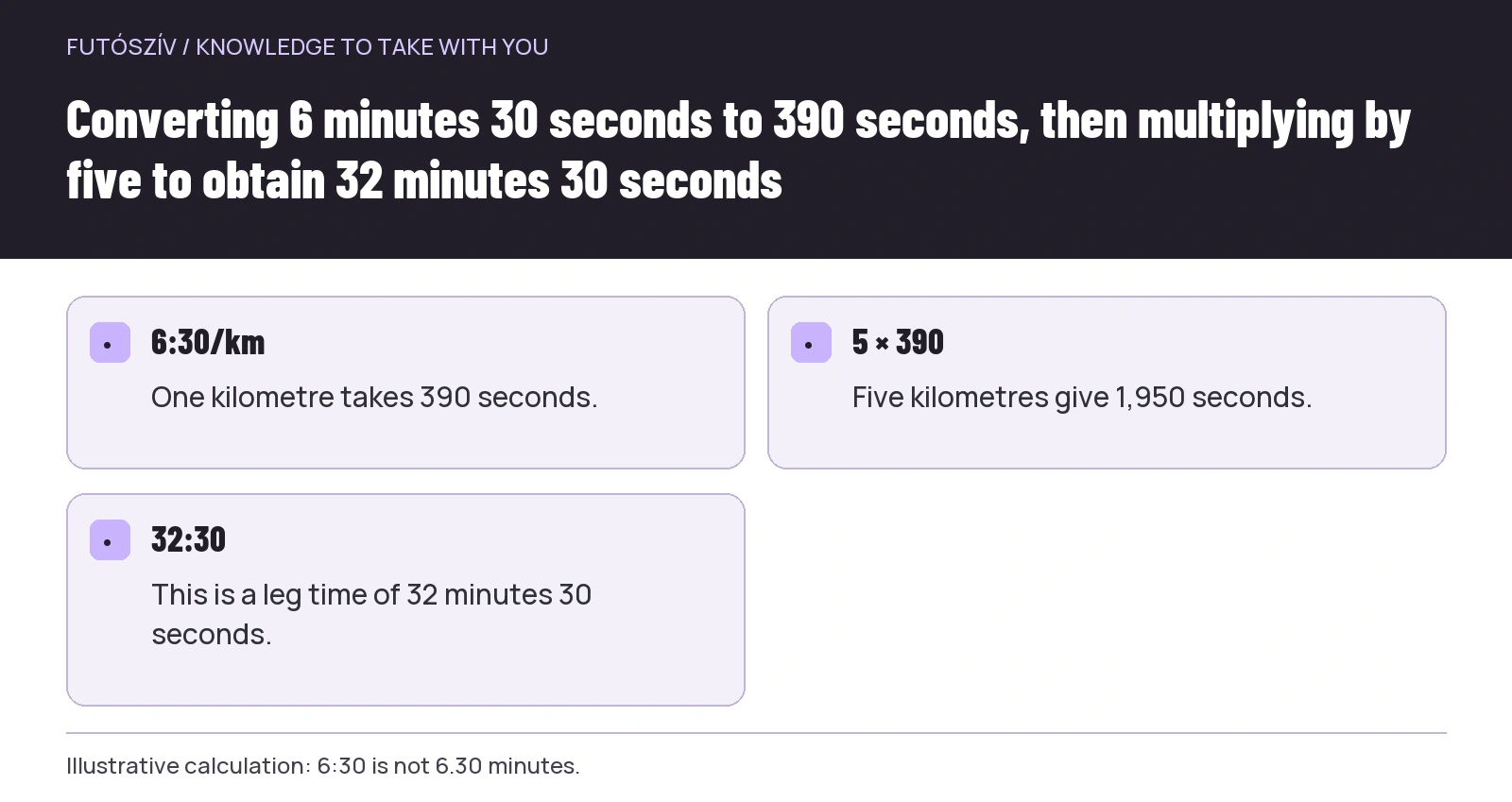 Enlarge diagram
Text version of the illustration
- 6:30/km
- One kilometre takes 390 seconds.
- 5 × 390
- Five kilometres give 1,950 seconds.
- 32:30
- This is a leg time of 32 minutes 30 seconds.
Convert pace to time rather than treating it as decimal minutes
6:30 minutes/kilometre means six minutes thirty seconds, or 390 seconds per kilometre. It is not 6.30 minutes. Resolve this distinction at input when using a spreadsheet. Most misunderstandings begin with an incorrectly interpreted time format rather than a long route.
The basic operation is simple: multiply leg length in kilometres by expected seconds per kilometre. Convert the result back to hours–minutes–seconds. For five kilometres estimated at 6:30, 5 × 390 = 1,950 seconds, or 32 minutes 30 seconds.
Check a new spreadsheet with an example you can follow mentally too. Two kilometres at six-minute pace should produce twelve minutes. This does not test the whole model, but quickly reveals whether the app interpreted input as hours, a decimal or plain text.
An illustrative three-leg example
The imaginary team starts at 9:00. The first runner has 5 kilometres, the second 4 and the third 6. For clarity, the example has no separate stationary changeover time. At a real event, clarify what your pace estimate includes and what you add separately.
| Leg | Distance | Personal pace estimate | Expected leg time | Cumulative arrival |
|---|---|---|---|---|
| First | 5 km | 6:30/km | 32:30 | 9:32:30 |
| Second | 4 km | 7:00/km | 28:00 | 10:00:30 |
| Third | 6 km | 6:00/km | 36:00 | 10:36:30 |
The third runner cannot know their starting time from their own 36 minutes. They need the sum of preceding legs too. This is cumulative time: changes to earlier legs affect every later changeover. If the first runner arrives two minutes early, all else unchanged, subsequent estimated points move two minutes earlier too.
Keep duration and clock time in separate fields. The second changeover in the example occurs after 1:00:30, at a clock time of 10:00:30. Mixing the two in identically formatted cells can lead participants to base departure on the wrong time.
Use a justified range instead of one number
Do not add a range merely for an arbitrary sense of safety. The runner’s experience on comparable tasks, course character and current programme matter. New situations may have greater uncertainty. The aim is not a scientific probability forecast, but showing that one pace is not a certain future fact.
Keeping the previous example, now estimate 6:20–6:50 for the first leg. Over five kilometres, this gives 31:40–34:10. Estimate 6:50–7:20 for the second, giving 27:20–29:20 over four kilometres. The simple extreme-input range for the second changeover is therefore 59:00–1:03:30 after the start, or 9:59:00–10:03:30.
This does not prove arrival will certainly fall within the range. It shows the result of the lower and upper inputs supplied. An exceptional event, stop or different route requires new conditions. Do not confuse a calculated range with a guaranteed organiser timetable.
Plan changeover readiness backwards
The estimated arrival moment is not the only important time for the next runner. They must reach the correct place, find their way and be ready under event rules. Plan those tasks backwards from the earlier arrival possibility. Choose the buffer from the venue and organiser procedure, not a generic number of minutes online.
| Task | Which information is needed? | Where should it go? |
|---|---|---|
| Travel near the point | Current access, closures and journey estimate | Separate logistics column |
| Reaching the actual changeover | Official pedestrian route and entry procedure | Your own arrival task |
| Mandatory preparation | Current event requirements | Readiness deadline |
| Expected runner arrival | Cumulative running estimate | Arrival range |
Do not add driving time to the runner’s leg duration. The two people may travel simultaneously on different routes under entirely different restrictions. Team running timelines and support logistics connect at the changeover but remain separate calculations.
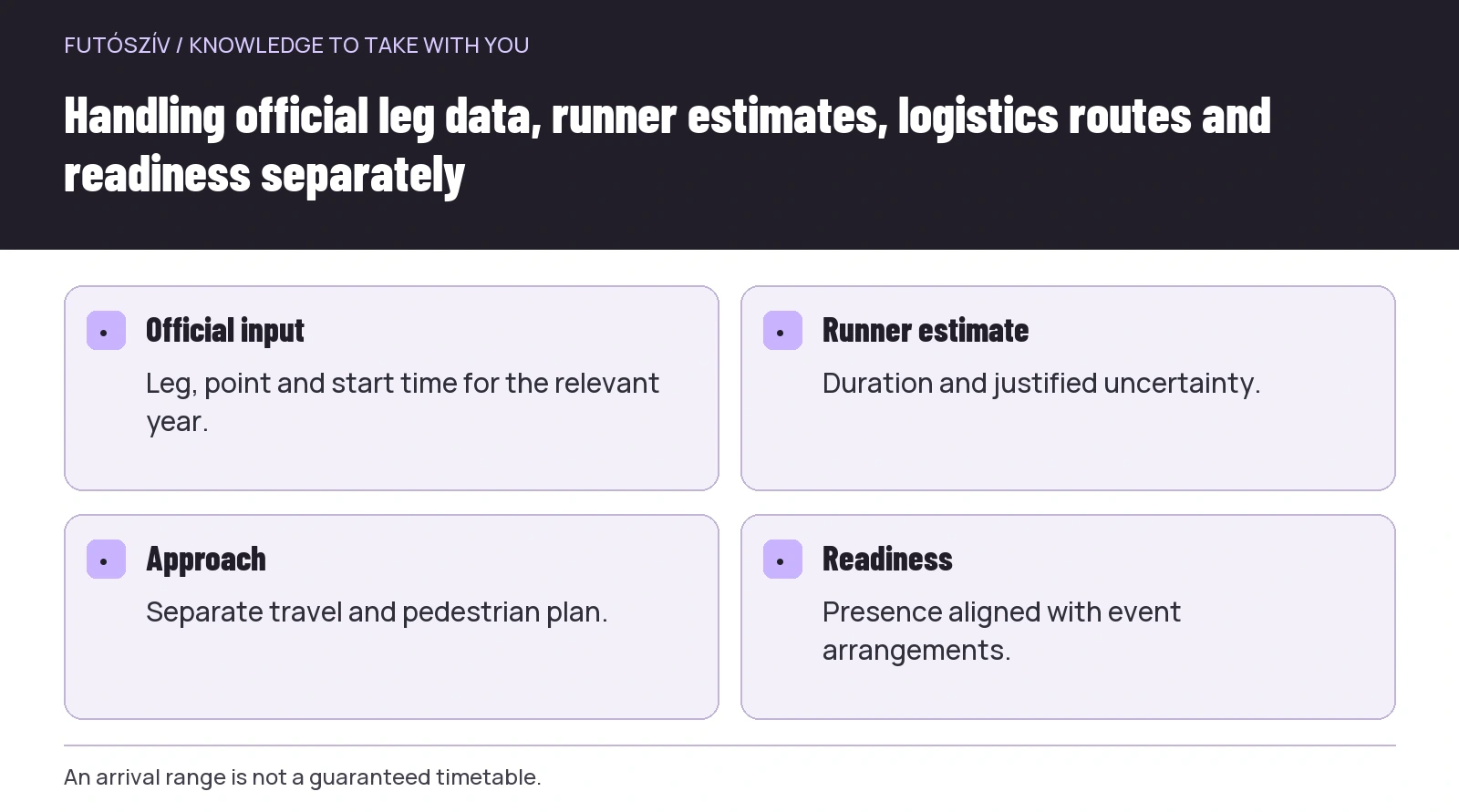 Enlarge diagram
Text version of the illustration
- Official input
- Leg, point and start time for the relevant year.
- Runner estimate
- Duration and justified uncertainty.
- Approach
- Separate travel and pedestrian plan.
- Readiness
- Presence aligned with event arrangements.
Both late and early arrivals are organisational questions
Many prepare only for a slower-than-expected runner. Early arrival can cause just as much trouble if the next member is not in position. Do not time presence against the middle estimate with every minute consumed. Consider both ends of the usable window.
Have an orderly waiting plan for getting there early too. You need not occupy the changeover zone or running corridor before entry is appropriate under event arrangements. Know where to wait, where information is available and how to identify your arriving teammate. Organiser information provides the precise local rule.
For delays, avoid every member calculating another version in the same chat. Assign responsibility for updating the shared table. A short clear message should state which actual information prompted the revised window and when. Even somebody unable to read the entire history should understand the next step.
Update from actual partial information
When an actual time arrives from an official or agreed checkpoint, mark it separately. Do not erase the earlier estimate without a trace. Keep visible that the first leg, estimated at 32:30, actually took 33:10, for example. The difference is forty seconds; unchanged later assumptions shift the new prediction by that amount.
Phone location sharing or following a social activity is not necessarily the official race time. Check what the system shows, when it updated and which point it concerns. Do not calculate a new changeover to the second from a stale map position.
The NN Ultrabalaton team page also describes event information and StafétApp use. For such systems, always follow current instructions for the year and team category. Your own calculation does not replace mandatory registration, timing or changeover operations.
Do not assume one fixed pace across terrain and repeated runs
The same runner may receive several different relay legs. Route character, time of day and their position in the whole programme may differ. You need not assign identical estimates simply because the same name appears beside them. Use an assumption justifiable for that leg.
Checking overall distance and leg allocation matters too. If one person runs consecutive parts, do not automatically insert changeover or travel tasks that will not happen. Conversely, if a real person change occurs, do not remove the event-required process from the model for a prettier result.
Include a checking row: does every official leg have a responsible runner, is the order correct and does total distance match the official version used? An omitted row can cause more harm than a pace estimate differing by a few seconds.
Five quick checks when finalising the shared plan
First examine units and time format. Then check start time and calendar day; crossing midnight in a long event must remain visible. Third, test one leg with a simple manual calculation. Fourth, separate runner arrival from the next member’s readiness. Finally, name who updates the plan.
Not everyone needs to handle the complete spreadsheet during the event. Give each a short extract: which point, which task, what estimated range and where updates come from. The long plan can remain shared background while on-site information is easy to use.
After the race, retain estimates and actual data together. They may reveal that next time you should refine parking assumptions or communication rather than running pace. A relay plan is good not because every cell appears precise to the second, but because it supports the next participant’s task despite uncertainty.
How Futószív articles are prepared: our editorial guidelines.