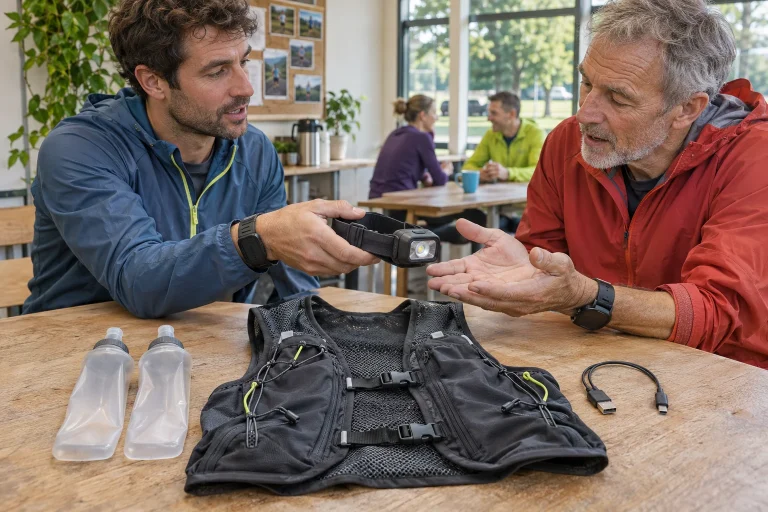
At a relay race, the handover looks like a matter of seconds, yet many earlier decisions come together in it. The right person must be waiting in the right place, know which item to receive, and the arriving runner’s next steps must be clear too. A quick movement alone is not enough. A well-prepared changeover consists of clear tasks and brief, factual communication.
Events may use different timing devices and changeover procedures. There may be a chip attached to a bib, a separate device or another solution chosen by the organiser. The following guide therefore helps you understand the process; it is not a universal technical instruction. Your own race’s current rules determine what must be handed over or detected, where and how.
Do not wait until the changeover point to discover which item matters
When collecting the race pack, distinguish between items used for individual identification and those enabling the team to continue. Check the markings and the organiser’s description. If one bib stays with the team member while another must be passed on, everyone needs to know. Similar-looking items do not necessarily serve the same purpose.
The Budapest Half Marathon information for pairs describes separate individual and relay bibs, for example. This is a specific organisational example whose precise wearing and handover requirements must be checked for the relevant edition. The key is that every member understands the role of the item being passed on in the same way.
If a fastening, belt or other accessory accompanies the device, examine its use according to the instructions. An improvised arrangement of your own may not be suitable. Ask the timing or organising staff if you have questions. Do not modify, dismantle or subject the device to tests outside its intended use.
A changeover location may involve three separate points
The place where you arrive from a vehicle or transport stop, the designated waiting area and the actual handover zone may not be the same. Check this in advance on the site plan or in the organiser’s instructions. Standing in the car park is not the same as being ready to change over in the correct place. Allow separate time for the approach.
The arriving runner’s route matters too. Where will they appear, where can they be identified, and in which direction does the next runner continue? Follow the designated arrangement rather than a shortcut that appears shortest for your team. The positioning of waiting runners and supporters also affects other teams and local people.
At a longer event, the NN Ultrabalaton team information also explains the separate tasks associated with the timing system and supporters’ journeys. The runner and vehicle do not necessarily follow the same route. Reaching the changeover location therefore needs checking as a logistical task in its own right, using the current event arrangements.
Two people have two different sets of preparations
The arriving runner knows whom to look for and where, which item to pass on and where to go afterwards. The outgoing member is already waiting with the right equipment, knows the handover process and the next route decision. Brief identifying information can connect the two: team name, bib number, the member’s name and the designated place. Use the agreed details consistently.
The outgoing member should not start personal preparations only when the arriving runner comes into sight. Clothing, phone, bottle and other necessary equipment should be ready in line with the current requirements. If a supporter carries an item, clarify when and where the runner receives it. The handover moment should not become a complete packing operation.
Arrange the arriving runner’s clothing and onward transport too. If they keep their phone or keys, they should know where these are. If the next member takes the team device onward, the arriving member may still need their own means of communication. Agree these details around the specific circumstances of the event and team.
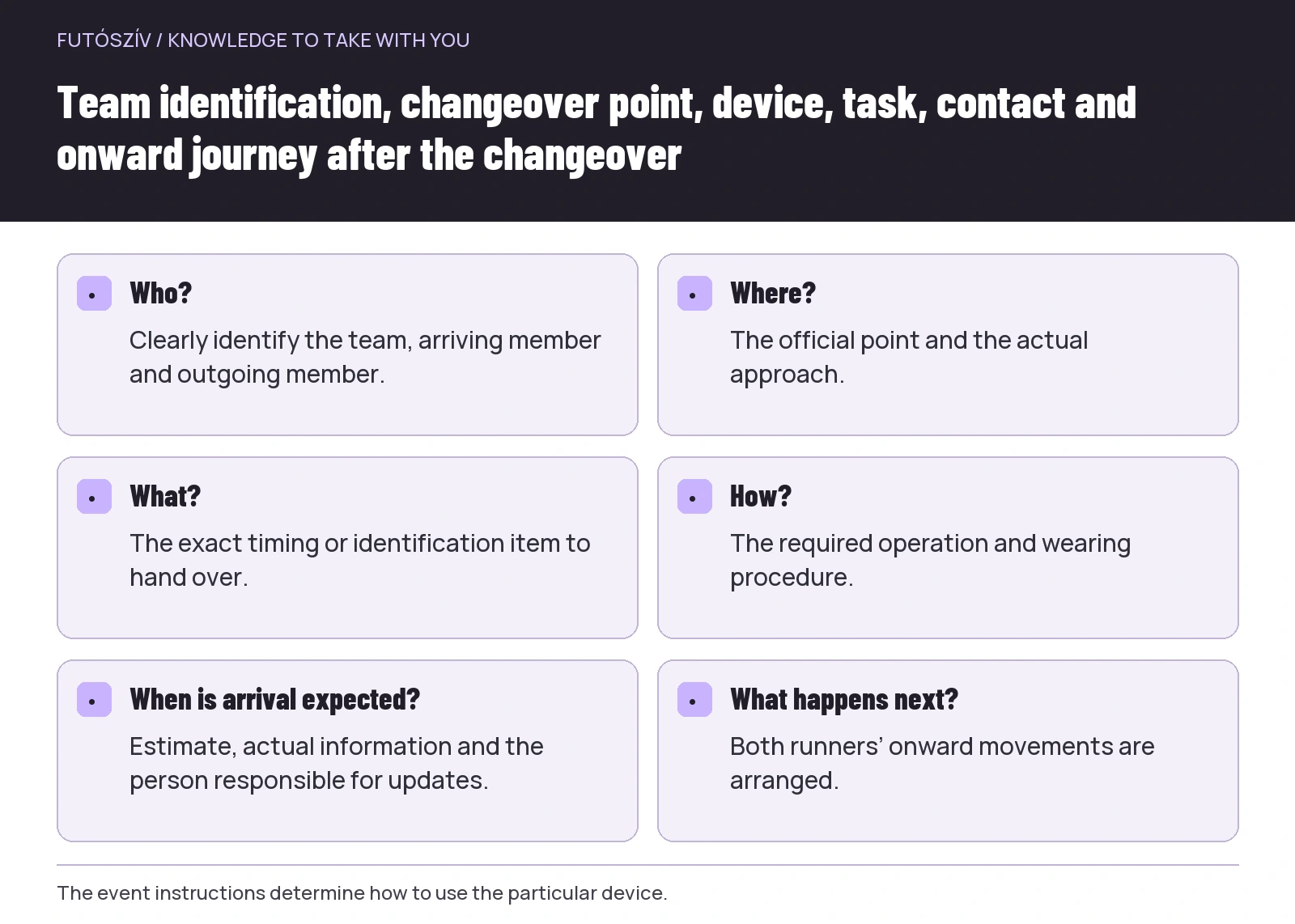 Enlarge diagram
Text version of the illustration
- Who?
- Clearly identify the team, arriving member and outgoing member.
- Where?
- The official point and the actual approach.
- What?
- The exact timing or identification item to hand over.
- How?
- The required operation and wearing procedure.
- When is arrival expected?
- Estimate, actual information and the person responsible for updates.
- What happens next?
- Both runners’ onward movements are arranged.
A short changeover card
| Field | What should it contain? |
|---|---|
| Team and members | Clear identification, arriving and outgoing people |
| Point | Official changeover location name and approach |
| Device to hand over | The exact item required by your race |
| Task | Required wearing, timing or handover procedure |
| Contact | Who updates the expected arrival? |
| After the changeover | The arriving runner’s onward journey and the outgoing runner’s next task |
The card can be a short extract from your shared plan. Not every participant needs to memorise every detail of the whole event, but each should know the complete sequence for their own changeover. Keep the official source and the plan’s date traceable too. If something changes, update the relevant card.
Use the expected time as an estimate
The next member should prepare in good time, but do not treat an arrival prediction as a guaranteed second. The race start time, actual departure and estimated leg duration can help together. Knowing the runner’s current location is a separate piece of information. “The spreadsheet says they should be here” does not prove exactly where they are.
The description of the Ultrabalaton Trail leg calculator also explains changeover arrival times calculated from legs, paces and start time. Actual information can refine such a plan. Make it clear within the team who communicates a revised estimate and which channel the waiting member monitors. Several parallel messages can easily spread conflicting numbers.
The time buffer must suit the location. There is no single number of minutes for every changeover. The approach, parking, walk, personal preparation and local procedure together determine the time needed. The aim is to avoid making the arriving runner wait for their own teammate because the others planned too tightly.
Pass on only the next necessary piece of team information
There is no need to recount the whole previous leg at the handover. The official device transfer and the conditions for the next member’s departure come first. Give any important route or organiser information briefly and factually. Anything that is not urgent can be discussed later through the shared channel.
Distinguish facts from impressions. “The organisers have moved the next point; here is the new announcement” is verifiable information. “I think we need to go somewhere else” is an uncertain signal that needs clarification. For route changes, follow current organiser instructions rather than guesses exchanged between runners.
Do not rewrite the next member’s plan on the strength of one person’s experience of pace. The arriving runner’s leg and circumstances may differ. A useful handover concerns what truly affects the next step. An enthusiastic account can still become a shared experience after the changeover.
Rehearse slowly, focusing on the correct sequence
Before the event, walk through the handover sequence using the organiser’s instructions. Which item is where? Who fastens it to themselves? Is a separate action required at the point, and how will you know it has been done? The rehearsal aims to clarify the tasks. Speed becomes meaningful only once the right sequence is clear.
Do not operate or test the technical system according to your own ideas. If the device is available only at the venue, prepare from the documentation beforehand and ask questions when collecting it. Practice does not justify removing a chip or modifying a bib. Handle the official device as instructed.
You can rehearse the spoken part too. One person identifies the member, the correct handover takes place, the outgoing runner confirms readiness, and the arriving runner continues to the designated place. This internal agreement does not replace the organiser’s rules. It helps everyone understand each step in the same way.
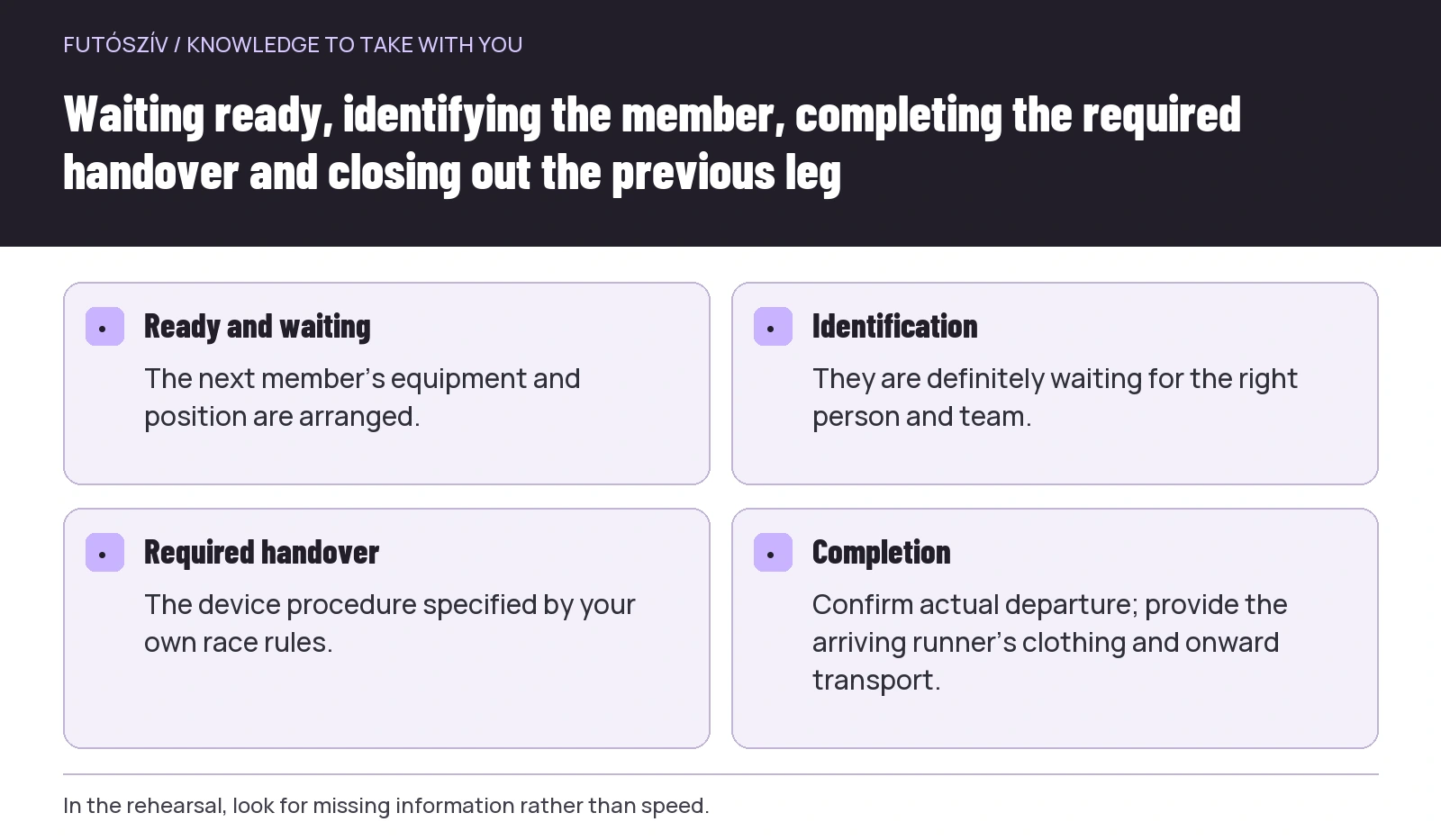 Enlarge diagram
Text version of the illustration
- Ready and waiting
- The next member’s equipment and position are arranged.
- Identification
- They are definitely waiting for the right person and team.
- Required handover
- The device procedure specified by your own race rules.
- Completion
- Confirm actual departure; provide the arriving runner’s clothing and onward transport.
If the arriving runner comes early
This is why the waiting member’s readiness cannot depend on one optimistic minute. If the runner arrives earlier than estimated, handle the situation according to the designated procedure. Do not try to find every item while rushing through the crowd. The team can improve its preparation and arrival process afterwards, but at that moment, a compliant, clear procedure matters.
If the outgoing runner is not yet in position, the arriving member should not invent rules about the exchange location or sequence. The race’s current instructions and on-site staff can help. The team’s internal time goal does not override the changeover procedure. If time is lost, handle it factually in subsequent planning.
Keep equipment intended for the next member separated in advance. Searching through bags mixed together in a car can take a long time. Simple labels by name or leg can help if everyone understands them. Storage arrangements are part of preparing the changeover, not a separate aesthetic task.
If the runner arrives later than estimated
Clarify the information first. When did they actually start, is there a recent update, and who maintains the agreed contact? Lateness alone does not reliably explain what happened. Instead of guessing, use the team’s previously agreed communication arrangements in accordance with the race rules.
The waiting member’s available time and equipment matter too. If the situation changes substantially, they need to know when the next update will come. Assign responsibility for communication within the team. This prevents everyone trying to call the same runner at once, and avoids waiting in a complete information vacuum.
In a genuine emergency, the appropriate procedure for seeking help comes first, based on the organiser’s information and the actual situation. Sporting results or the chip’s location become secondary. This article does not replace first-aid or rescue training; the team must learn the organiser’s required contact and reporting procedures in advance.
If the device or a detail is not right
For a missing chip, wrong bib, damaged fastening or uncertain timing detection, contact the responsible on-site staff. Do not try to continue using another team’s device or an improvised arrangement. Identification and timing belong to the race’s official system. The responsible staff can clarify the appropriate action.
Note where and when the problem arose and what instructions you received. Factual information may help with later administration. A supposition posted in a community group does not replace notifying the organiser. For any question about results, use the official channel and deadline.
Briefly tell other team members about changes relevant to their next task. Clarify if you will arrive later or need a different meeting arrangement. You do not need to give everyone a complete technical explanation, especially if the cause is still unknown. Keep confirmed facts separate from open questions.
After the changeover, close out the previous leg
The arriving member should receive their own clothes and know where to go next. The designated person can record the next leg’s actual start in the team plan. If using the event’s official system, follow its instructions. Your spreadsheet is only an organisational supplement for the team.
Checks on the people and items travelling onward should also be brief and consistent. Who stays at the point, who continues, where are the keys, and which bag belongs to the next runner? Closing out a changeover properly reduces searching at the next point. The arrangements agreed at the start of the day become practical help here.
After the whole event, review where information was missing or unnecessary rushing occurred. Improvements may involve simpler labels, earlier preparation or more precise arrival updates. The fastest movement does not necessarily characterise a good changeover. Rather, everyone knew their task, the device moved onward as required, and the next leg began in an orderly way.
How Futószív articles are prepared: our editorial guidelines.