
Choosing accommodation for a Szekszárd running weekend takes more than filtering by town and booking the nearest available room. Your race’s start, the route to the trails, companions’ plans and post-finish luggage handling together determine convenience. An attractive panorama or short straight-line distance does not tell you how the morning begins.
This guide offers a comparison method rather than specific accommodation recommendations. Official sources for local examples were checked on 18 November 2026. An event date mentioned here does not mean entry or any accommodation remains available. Base booking decisions on your own participation status and current conditions.
Choose the race before searching for a room
The Borvidék Half Marathon home page already listed 8 May 2027 for the next event, while earlier news and results remained on the site. This confirms the date but does not automatically transfer every detail of an earlier edition to next year. Find the start centre and collection arrangements in current information for your own event.
Another local example is the organiser’s 2027 Bodri Trail announcement, placing start and finish at Bodri Winery in Faluhely-dűlő. At the check, the top of that same page showed the event as full. This matters for accommodation: an announced date and enthusiasm for a race do not together guarantee a starting place.
Clarify your own entry status before making a non-refundable booking. Even after paying or submitting an application, organiser confirmation and applicable conditions provide the useful answer. You can keep searching for rooms without confirmed participation, but include change and cancellation arrangements separately in comparisons. Do not align every irreversible decision with a hoped-for vacant starting place.
Being near the town centre and being near the start are separate advantages
A central property may ease different connections from a room near the start. The former may simplify a shared evening or interurban arrival connection; the latter may shorten race-morning travel. These are possibilities to examine at the particular address, rather than general promises for every urban or vineyard-area property.
Mark at least three points: accommodation, your start and where you arrive. If number collection is elsewhere, add a fourth. Compare actually usable routes next. Do not treat straight-line distance as pedestrian access; gates, road layout and the race entrance influence the connection too.
Mark which journeys involve luggage, which running clothes and which a non-running companion. The same section may not be equally comfortable in all three situations. If accommodation connects to the start only through an uncertain lift, closeness alone is insufficient. Clarify the person, timing and capacity involved too.
 Enlarge diagram
Text version of the diagram
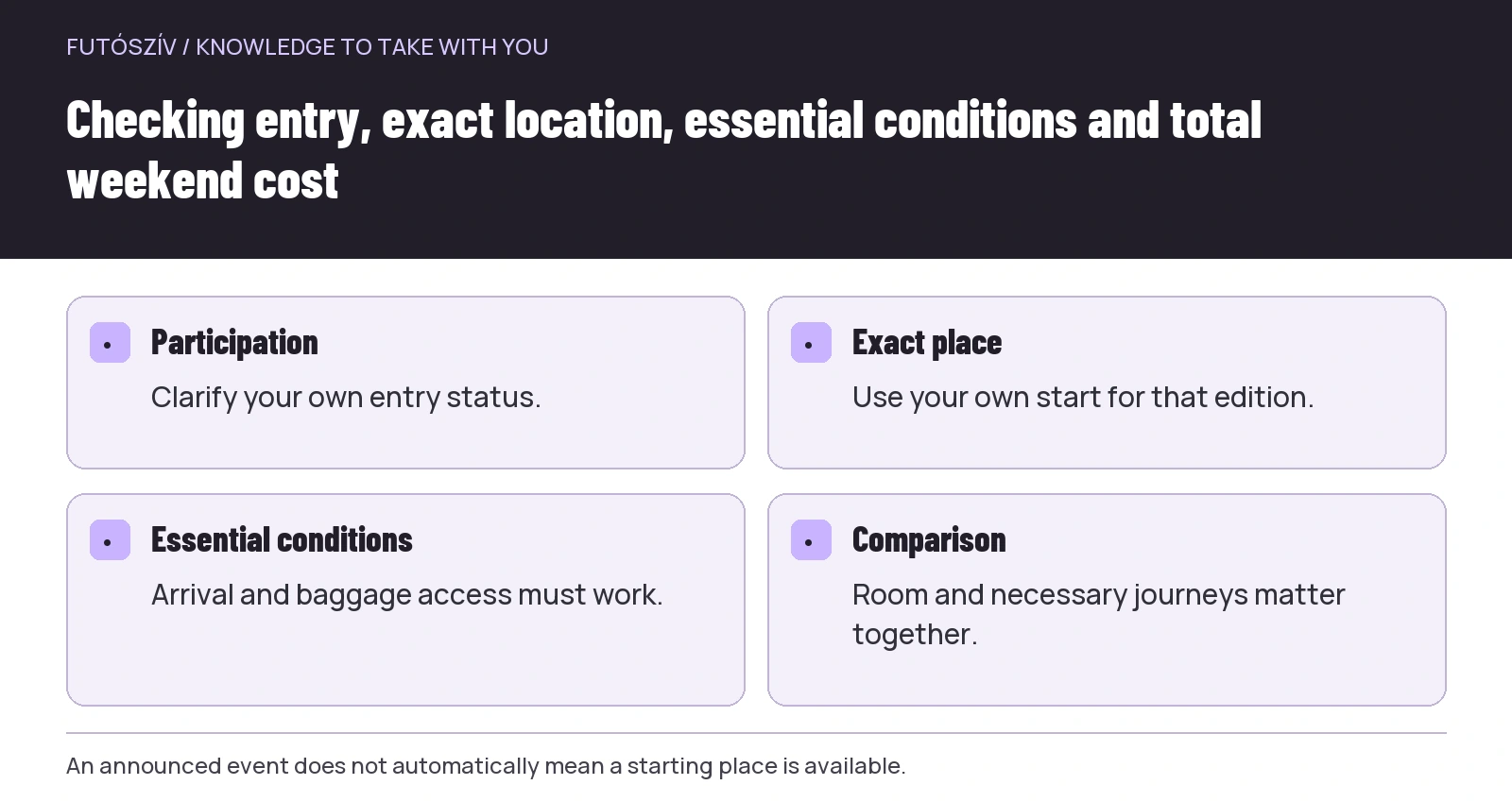
- Participation
- Clarify your own entry status.
- Exact place
- Use your own start for that edition.
- Essential conditions
- Arrival and baggage access must work.
- Comparison
- Room and necessary journeys matter together.
Score options only after exclusion criteria
Rating accommodation is useful only after naming what must be fulfilled. These might include your budget, genuinely usable arrival arrangements or necessary accommodation for the travelling group. If a place fails these, attractive photographs or a low price cannot fill the gap.
Then compare advantages. A simple assessment can be enough: good, acceptable, needs clarification. You do not need a seemingly scientific total with decimal places. What matters is seeing the extra travel accepted beside a cheaper room or what you give up for a closer location.
| Consideration | Useful question | Which answer leaves the decision open? |
|---|---|---|
| Race morning | Exactly how do I reach my own start? | It says only that it is nearby. |
| Arrival | When and how do I access the accommodation? | There is no arrangement for my actual arrival time. |
| Departure | What happens to luggage during and after the race? | Access after checkout is not clarified. |
| Shared programme | Can a non-running companion travel independently? | Every movement depends on the only car. |
| Total cost | What do accommodation and necessary travel cost together? | Only the nightly price is known. |
“Needs clarification” does not mean bad accommodation. It simply shows missing information needed to decide. It also helps you contact the provider with a short precise question rather than generally asking whether the place suits runners.
Ask about details that can receive actual answers
“Can we leave early in the morning?” compresses too much. Ask separately how to return the key, whether you can access the car or luggage and whether departure needs prior notice. If a roommate leaves later, clarify key use so you are not forced into one shared time.
Do not describe post-finish use vaguely either. Baggage storage, late checkout and a separately usable room are different things. If a service is absent from confirmation, do not expect it merely because it would be convenient on a race weekend. Clarify any extra charge and availability period beforehand too.
For food, opening hours and access are the accommodation questions. If breakfast begins late relative to your start, know that before choosing. It does not make the service poor, but may mean you need another arrangement for your schedule. Do not derive personal eating habits and needs from generally sporty wording in an accommodation advert.
With a car, accommodation parking is only one link
The town’s official useful-information page offers starting points for transport and parking. For specific paid-area conditions, the Szekszárdi Vagyonkezelő parking tariff provides primary information. Information available in November 2026 showed different arrangements by zone, so do not build on an assumption that all parking must be free at weekends.
First clarify what parking availability means at your property. Is there a reserved space, a shared courtyard or public-street parking? A booking mentioning parking still requires knowing when and how it is usable. Late arrival, an early Sunday departure and return after racing can each involve different situations.
Then consider the race venue. Do not assume a parking space at accommodation also resolves parking at the start. Plan according to organiser parking arrangements and on-site signs, adapting the route to current information. Open land near a running event is not automatically a usable car park.
If several people share a car, include the driver’s programme too. Someone racing cannot continually be available to drive companions. If a supporter wants a separate activity, discuss who holds the key and how everyone returns to accommodation. Location then becomes a shared decision factor rather than only serving the runner’s morning convenience.
 Enlarge diagram
Text version of the diagram
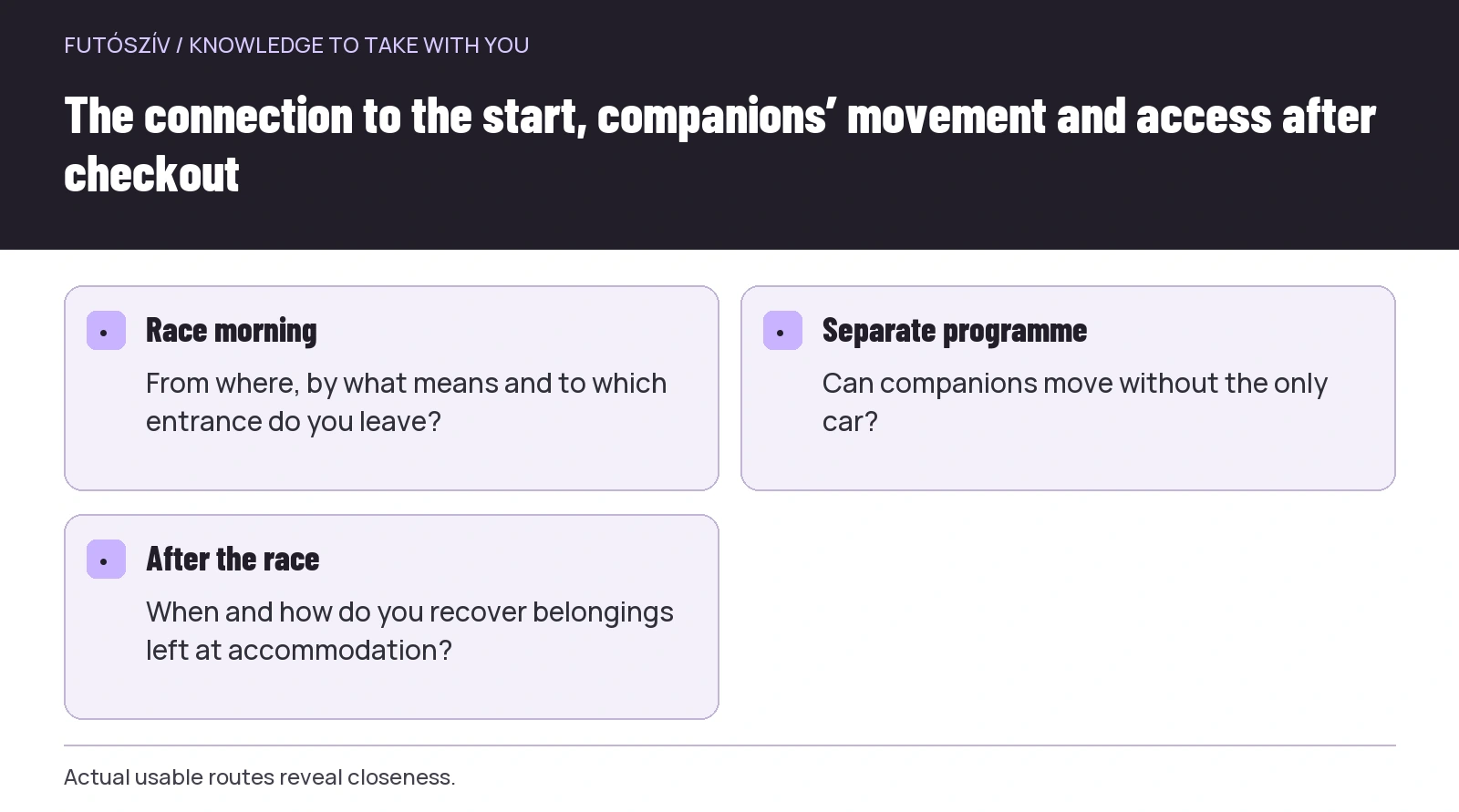
- Race morning
- From where, by what means and to which entrance do you leave?
- Separate programme
- Can companions move without the only car?
- After the race
- When and how do you recover belongings left at accommodation?
Without a car, test the local connection before booking
After interurban travel, examine the arrival-to-accommodation connection. Reaching the town does not mean every outlying property is equally accessible. Start from a timetable checked for the travel day and the actual address. If several transfers are needed, moving luggage and waiting are part of comparison too.
Do not leave the final connection to an unconfirmed local ride. If you want that solution, clarify availability, numbers, bags and desired departure specifically. A provider’s name on a local information page is not a booking or guarantee of immediate spare capacity on race morning.
Check the homeward connection from the actual post-finish starting place. If returning to accommodation, you also need the journey from there to the departure station. If checking out in the morning, luggage travels differently. These two versions can favour different accommodation, so the first evening’s arrival alone should not decide.
An imagined comparison: three properties, different hidden tasks
Suppose you examine three options. A is inexpensive for your budget but its local connection to the start remains unclear. B costs more, but the organiser’s entrance is comfortably accessible and baggage-storage conditions are known in writing. C seems pleasant for a shared weekend, but all participants could move independently only using one car. These are fictional options, not actual Szekszárd properties.
For A, do not immediately call the room rate the final cost. First establish how much travel and which solution are needed. B’s advantage is real only if access is confirmed for your date and booking. For C, examine the group schedule: does everyone want to leave at the same time, and what happens while the runner is on the course?
The question is not which letter wins. A correct outcome may be that no decision exists yet, because A cannot be compared without missing transport information. Recognising this supports a targeted enquiry. Ranking only by price and pictures can leave you discovering during the weekend that a seemingly favourable choice brings more constraints.
Discuss differences when several runners share accommodation
Before choosing a shared apartment, list everyone’s race, arrival and departure. A shared group does not mean identical wake-up, collection or homeward times. If one person leaves early, others should not have to discover on site whether they can access key, bags or car.
Discuss cost sharing too. Staying one night differs from two, as does a non-running companion joining only part of the weekend. Instead of automatically splitting a shared sum equally, choose an arrangement accepted beforehand. Keep the decision simple and known to everyone rather than revealing it through a last-minute payment request.
Naming different needs is not being difficult. Independent travel home may matter to one person, shared dinner to another and room layout to a third. If these can be stated before booking, finding a place that does not force the whole group around one person’s programme is easier. The weekend then remains a genuinely shared choice.
Leave a checkable agreement at the end of booking
Save your confirmation and written answers behind the decision. Arrival, checkout, baggage and parking conditions are particularly important. Send companions the extract necessary for shared arrangements: address, access method, common times, payment agreement and who contacts accommodation.
In the final check, read Sunday from room to start and from finish to travel home. Wherever it says only “nearby” or “surely possible”, a question remains. A good Szekszárd accommodation choice gives a place with known connections to your event, group and travel. That connection is worth buying alongside the room.
How Futószív articles are prepared: our editorial guidelines.