The word “wear” does not decide about sport on its own
The expression joint wear and tear can easily evoke a worn-out machine best left unused. Yet individualised movement can be an important part of care with osteoarthritis. That still does not justify one general yes to running for every person, distance and condition. Your own symptoms, function and goals matter.
The NICE osteoarthritis guideline recommends therapeutic exercise tailored to individual needs, such as local muscle strengthening and general aerobic activity. This is an important difference from a complete ban on movement. At the same time, therapeutic exercise is broader than continuing familiar race-pace running unchanged.
This article helps distinguish research statements from personal questions. It does not diagnose knee pain or decide individual fitness to run. The aim is to help you request an understandable care and activity plan that considers your own circumstances and choices.
First clarify whether this really is the condition being discussed
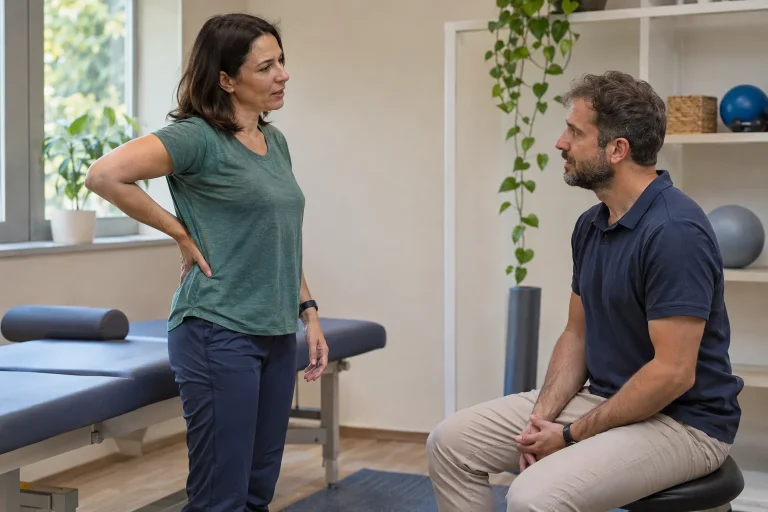
An osteoarthritis diagnosis is not made solely from one painful day or one word in a report. Describe the location and timing of symptoms, stiffness, swelling and changes in function. Previous injury and known conditions matter too. Do not automatically treat a new kind of symptom as part of old osteoarthritis.
NICE considers situations including recent injury, rapid deterioration or a hot, swollen joint atypical; they may need a different assessment. With a hot, swollen joint accompanied by fever or feeling generally unwell, seek urgent healthcare help. You do not need to identify the exact cause at home to report a change promptly.
Distinguishing familiar symptoms from a new event matters because individual movement advice always relates to a particular condition. A previous “you may exercise” is not permission covering every later injury. Equally, clarify the duration and meaning of an earlier instruction to “take it easy” if it is unclear.
What does research following runners show?
An observational analysis from the Osteoarthritis Initiative examined self-selected running in people aged at least 50 with knee osteoarthritis. It found no association indicating worse symptomatic or structural progression among runners during the period studied. The cohort study therefore does not support the simple claim that all such running should be banned from the outset.
Its observational nature matters: participants were not randomly instructed to run. Those for whom movement felt more suitable may have been more likely to choose it, and intensity or duration may also have adapted to symptoms. The findings do not mean someone who cannot currently run comfortably must be made to run.
The study does not describe every joint, severity or racing load. At an individual level, its conclusion opens a question: which movement is appropriate in my condition? Research is important background, but does not replace individual examination and specific discussion of the desired task.
A concrete goal might be: I would like to reach the park from home while keeping subsequent daily tasks manageable. The outward journey, activity and return belong together. Planning only time spent in the park may omit a substantial part of the outing. A goal description helps the healthcare provider understand which function matters to you.
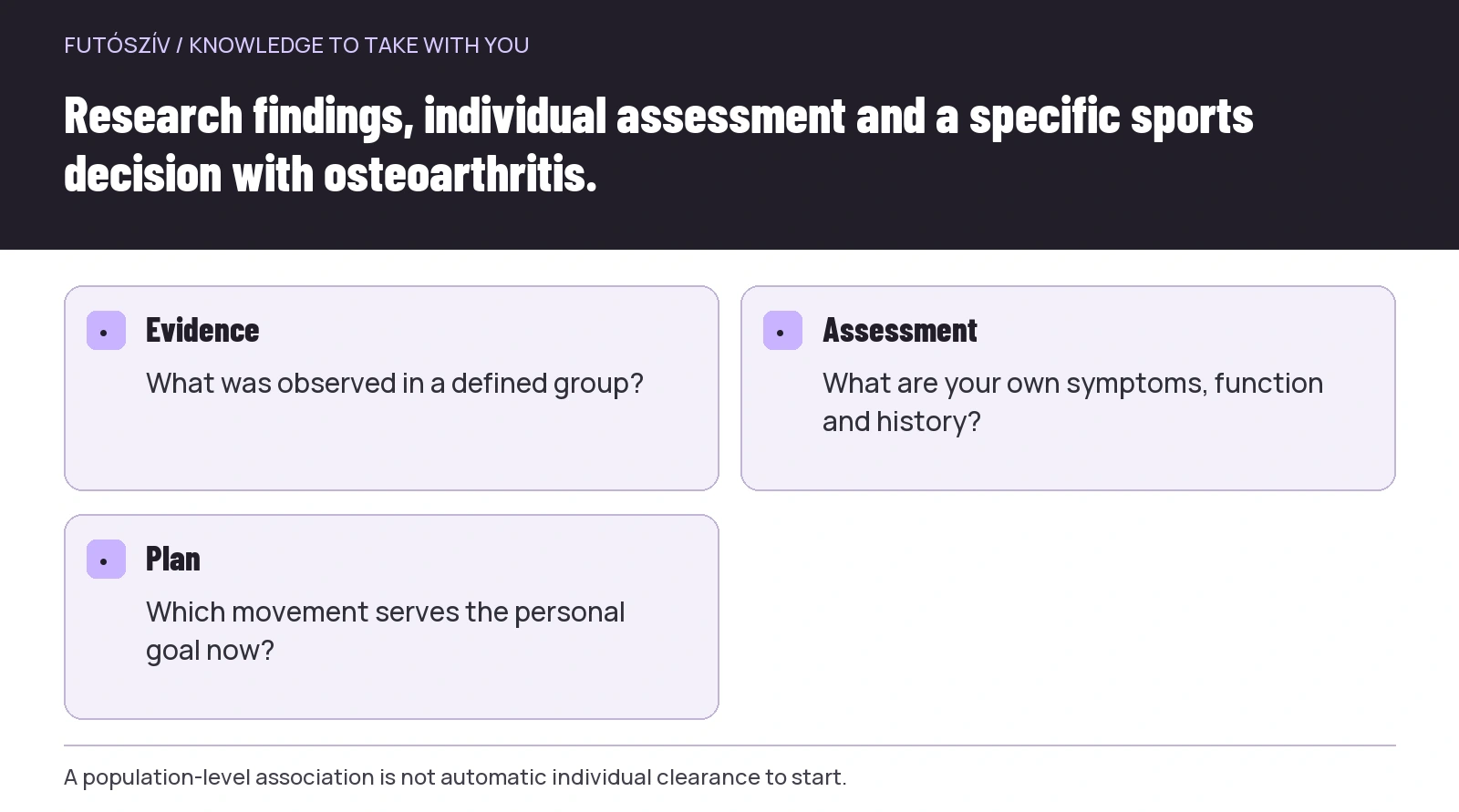 Enlarge diagram
Text version of the diagram
- Evidence
- What was observed in a defined group?
- Assessment
- What are your own symptoms, function and history?
- Plan
- Which movement serves the personal goal now?
Why do strengthening and aerobic movement both have a role?
The NHS treatment guide considers both muscle-strengthening movement and activity developing general fitness important with osteoarthritis. They may serve different purposes and need adapting to the individual condition. One does not necessarily replace the other, but not every task has to be introduced in the first week either.
The 2026 VA/DoD patient information likewise discusses an individual exercise programme, walking and balance tasks, education and a self-management plan in non-surgical hip and knee care. This is a more useful framework than designating one compulsory sport. The activity should connect with personal goals and access.
For exercises, ask which ability you are aiming to develop and which everyday task it supports. Goals might include getting up more easily, walking more confidently or running appropriately later. A good goal is important and trackable for you, rather than simply a general promise of becoming stronger.
Initial discomfort and a worsening condition are different questions
According to NICE, pain or discomfort may temporarily increase when therapeutic exercise begins, while a regular programme can improve pain and function over the longer term. This must not be translated into an obligation to tolerate every new or worsening symptom. Agree in advance within your plan which response to observe and when modification is needed.
Do not use a general online pain score to decide that load is definitely appropriate. How walking goes afterwards, how much swelling changes and what you experience the next day may matter. Prescribed monitoring helps the clinician adapt the programme. Seek assessment for a new or concerning symptom.
Make feedback specific: which task, under what circumstances and with what later effect? “It felt bad” matters, but can be refined. The aim is not to dispute the symptom but to understand how the next occasion could be more manageable in your situation.
Why does every review not need a new image?
NICE does not recommend routinely repeating imaging to monitor non-surgical care. Changes in symptoms and function are often more important for daily decisions than comparing another image. This does not mean imaging is never needed: a provider may consider it in a new or unusual situation.
Ask which question the examination would answer and how its result would change the plan. Discuss wording in earlier reports in the same way. You do not need to set yourself a permanent performance limit from one image. Link the personal activity decision to the whole assessment.
Instead, bring a short description of important tasks to review: how much walking is manageable, how are stairs and what is the greatest daily obstacle? If running is a goal, explain what kind. “I would like to do sport” may involve different demands for a short jog and a long trail race.
If you want to run, plan the real task together
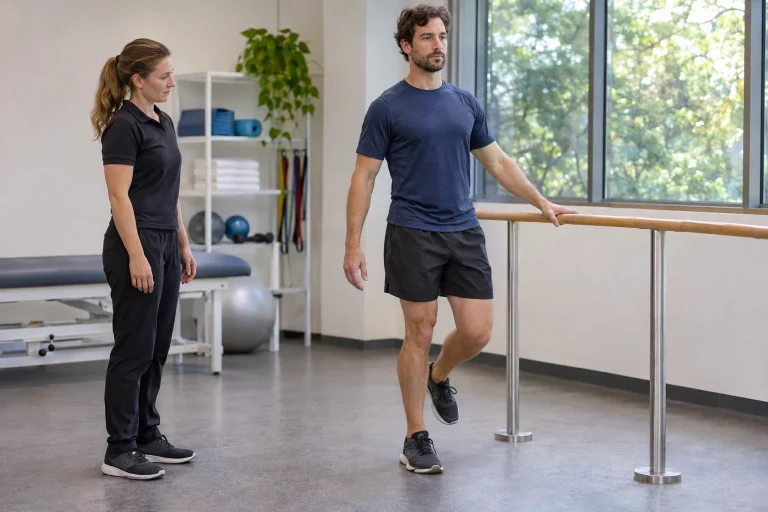
If assessment and individual advice suggest running may be an option, name the desired format. Distance, pace, terrain, elevation gain and frequency together describe the task. A previous race time is not a compulsory starting dose. Build an outing from your current condition whose response can be monitored.
The AOSSM exercise information emphasises starting slowly and adjusting duration and intensity gradually. Do not increase every element simultaneously in your own programme. A familiar route that is easy to shorten can offer an organisational advantage if your condition requires a change.
Walking, another aerobic activity or strengthening is not an inferior substitute. It may be the appropriate form on certain days or at certain stages. The goal is sustainable participation in activity important to you. You do not have to prove through running that you take your health seriously enough.
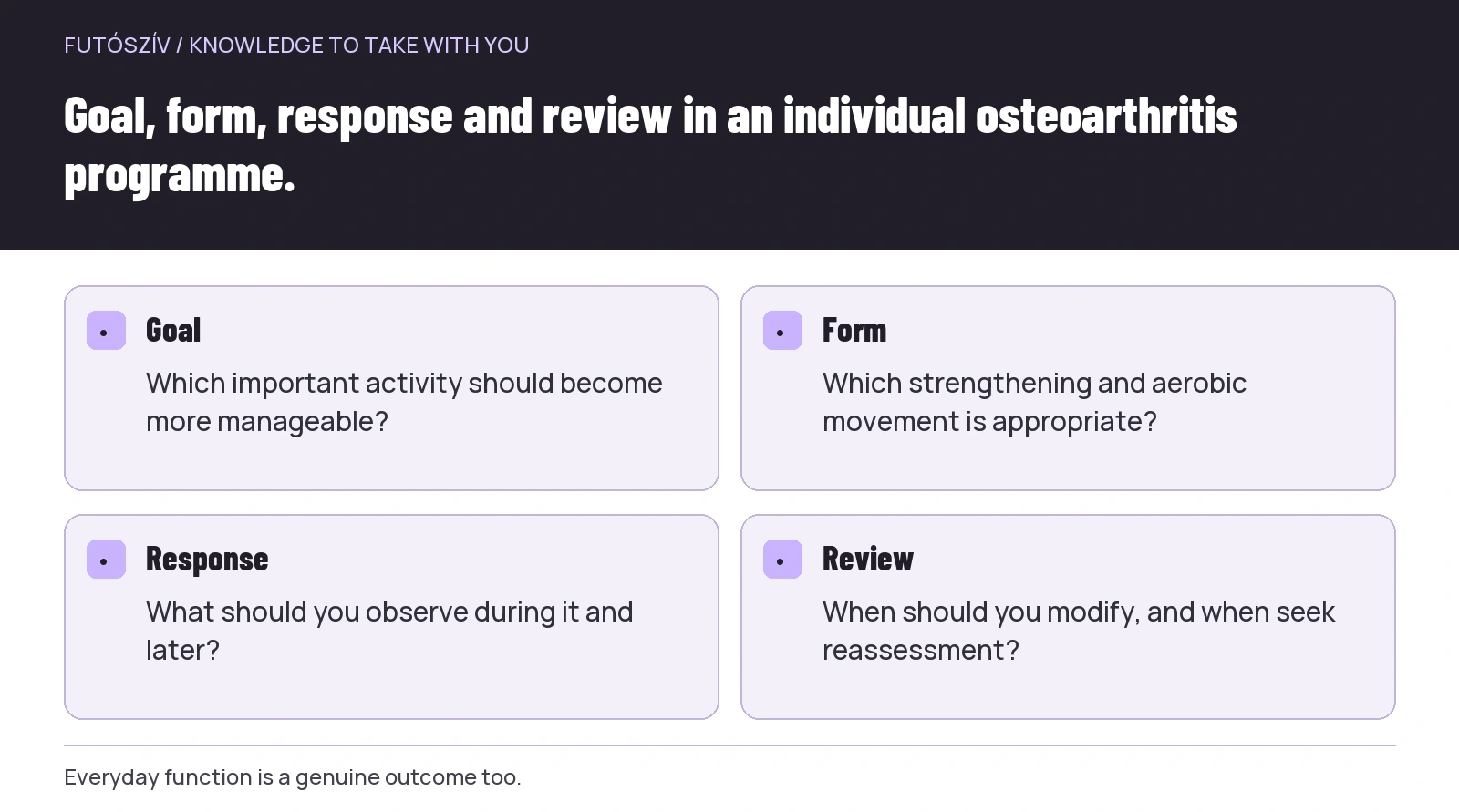 Enlarge diagram
Text version of the diagram
- Goal
- Which important activity should become more manageable?
- Form
- Which strengthening and aerobic movement is appropriate?
- Response
- What should you observe during it and later?
- Review
- When should you modify, and when seek reassessment?
Discussions about body weight should be respectful too
If weight comes up in care, ask for individual advice considering your condition, possibilities and goals. Supporting movement should not be suspended until a future number appears on the scales. Becoming stronger, function and quality of life can be important outcomes in themselves.
Do not let body size become the sole explanation for every new symptom. Precise symptoms and any new injury still need assessment. The care plan should contain next steps based on diagnosis and function, rather than only a general instruction to lose weight.
If you would like nutrition support, an appropriate professional can help create a realistic plan. This article does not provide an individual weight-loss diet or energy prescription. Running and eating should not become two parts of a punishment system in which painful training must compensate for a day.
The plan can change during a flare-up
The condition may have better and harder periods. Ask your clinician which changes fit the familiar pattern and which need reassessment. Agreed modifications help avoid reinventing the entire programme on every harder day.
In your diary, separate the task, symptom response and daily function. Choosing another movement or lower load after a worse day according to the plan does not erase previous development. At the same time, do not automatically regard sudden severe deterioration as a usual flare-up. The nature of the change matters too.
Include work and transport demands as well. If obligatory daily tasks are substantial, there may be less room for sport or exercises. A programme is not personal because it has your name on it, but because it can adapt to your real day and condition.
A good next step is understandable and checkable
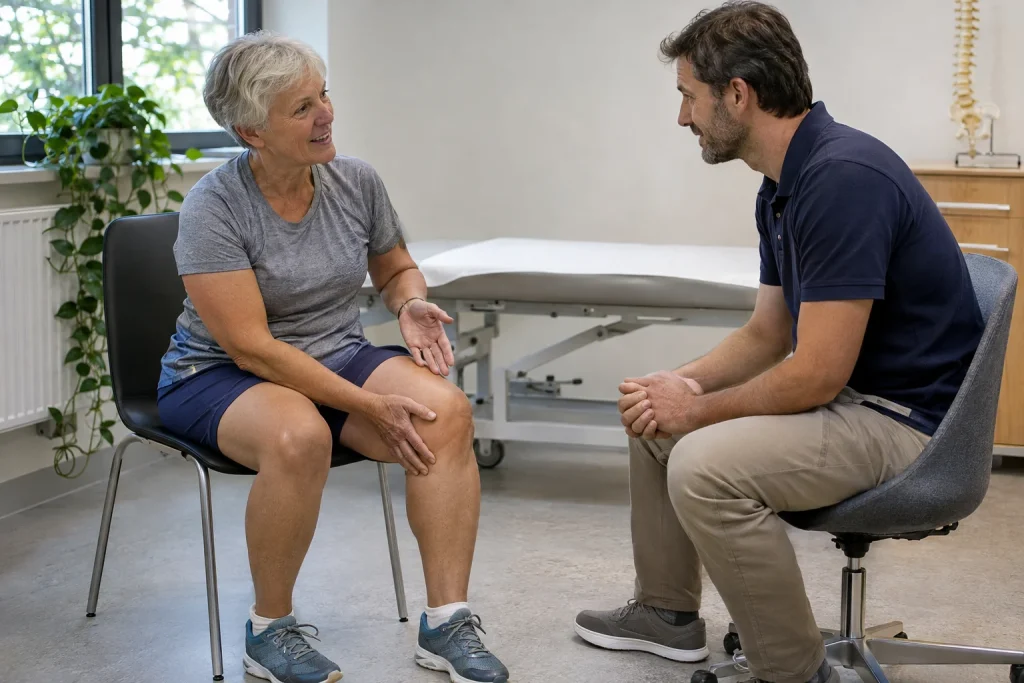
At the end of the consultation, repeat the plan in your own words: which movement, which goal and what feedback comes next? Ask for a demonstration if the exercise is unclear. If time, cost or location makes the programme unworkable, report that too. Accessibility is part of treatment.
Share the individual healthcare framework with your coach. Interpreting imaging or changing medication is not their role, but they need to know activity conditions to structure running. A community can also help through a flexible route and acceptance of your own pace.
Evidence on osteoarthritis and running is more nuanced than a simple wear-and-tear analogy. Research is not individual clearance to start, and diagnosis is not an automatic ban on movement. A plan tied to your own function and goals supports a meaningful choice of the next activity.
Sources
- NICE NG226: Osteoarthritis in over 16s, recommendations
- Osteoarthritis Initiative: Running and symptoms or structural progression in knee osteoarthritis
- VA/DoD: Hip and knee osteoarthritis guideline, patient summary, 2026
- NHS: Osteoarthritis treatment and support
- AOSSM: Osteoarthritis and exercise
How Futószív articles are prepared: our editorial guidelines.