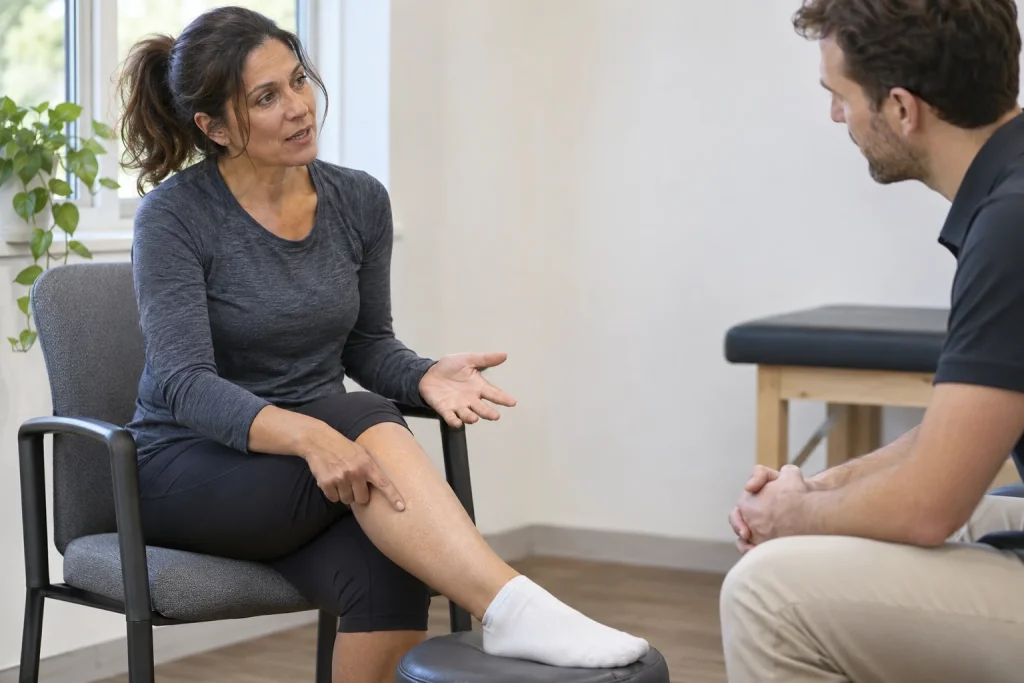
Pain around the shin is a broad description
Pain along the front or inner side of a runner’s lower leg is often called shin splints. That does not make every such symptom the same. Gradually developing pain along the inner shin, bone pain concentrated in a small area, and a tight, numb feeling associated with activity can involve different situations. A useful first step is to describe the symptom accurately, rather than choose a label quickly.
The AAOS information on shin splints discusses activity-related symptoms along the inner border of the shinbone, but also notes the need to distinguish other causes, such as a stress fracture. Symptoms beginning in connection with running training do not automatically mean the problem can definitely be resolved with stretching at home.
This article does not diagnose from a pain map or prescribe individual treatment. Sudden severe pain, substantial swelling, injury, or changes in sensation or movement may require prompt healthcare assessment; call 112 for a life-threatening medical emergency. Seek individual help for recurring, worsening symptoms or those interfering with walking as well.
Urgent situations and symptoms recurring with activity need separate consideration
Compartment syndrome is a condition involving increased pressure within tissues; its sudden-onset form may require emergency care. The NHS information discusses severe pain and associated symptoms separately. With severe, rapidly worsening symptoms, do not continue running or wait on the assumption that they will certainly disappear by the next day.
Pain, numbness, swelling or difficulty moving that recurs during activity also warrants assessment even if it settles with rest. Improvement alone does not establish the precise cause. You do not need to decide at home whether chronic exertional compartment syndrome or another condition is responsible.
Mention associated changes in sensation separately, rather than absorbing them into a general statement that your shin hurts. Describe which area feels numb, whether there is loss of strength and when it happens. These are not details to test through more forceful foam rolling. They help an individual examination and may, where relevant, affect how urgent it is.
What does MTSS mean, and why is it not a ruler test at home?
Medial tibial stress syndrome, or MTSS, is the clinical name for activity-related symptoms along the inner-back border of the shinbone. The history and a professional assessment of whether familiar pain can be reproduced are important in examination. This is not the same as pressing hard all the way along the lower leg and measuring how many centimetres hurt.
In a study conducted at several sites, two examiners showed high agreement in the clinical diagnosis of MTSS in 46 athletes. The study reported by Winters and colleagues shows that an organised history and examination can be useful in a professional setting. It does not demonstrate that a layperson’s self-check is equally reliable.
Other lower-leg problems also occurred at the same time in the study. This is an important reminder that one label may not explain every sensation. If the pattern changes, symptoms appear in a new place or another symptom accompanies them, report this even if you have previously been diagnosed with MTSS.
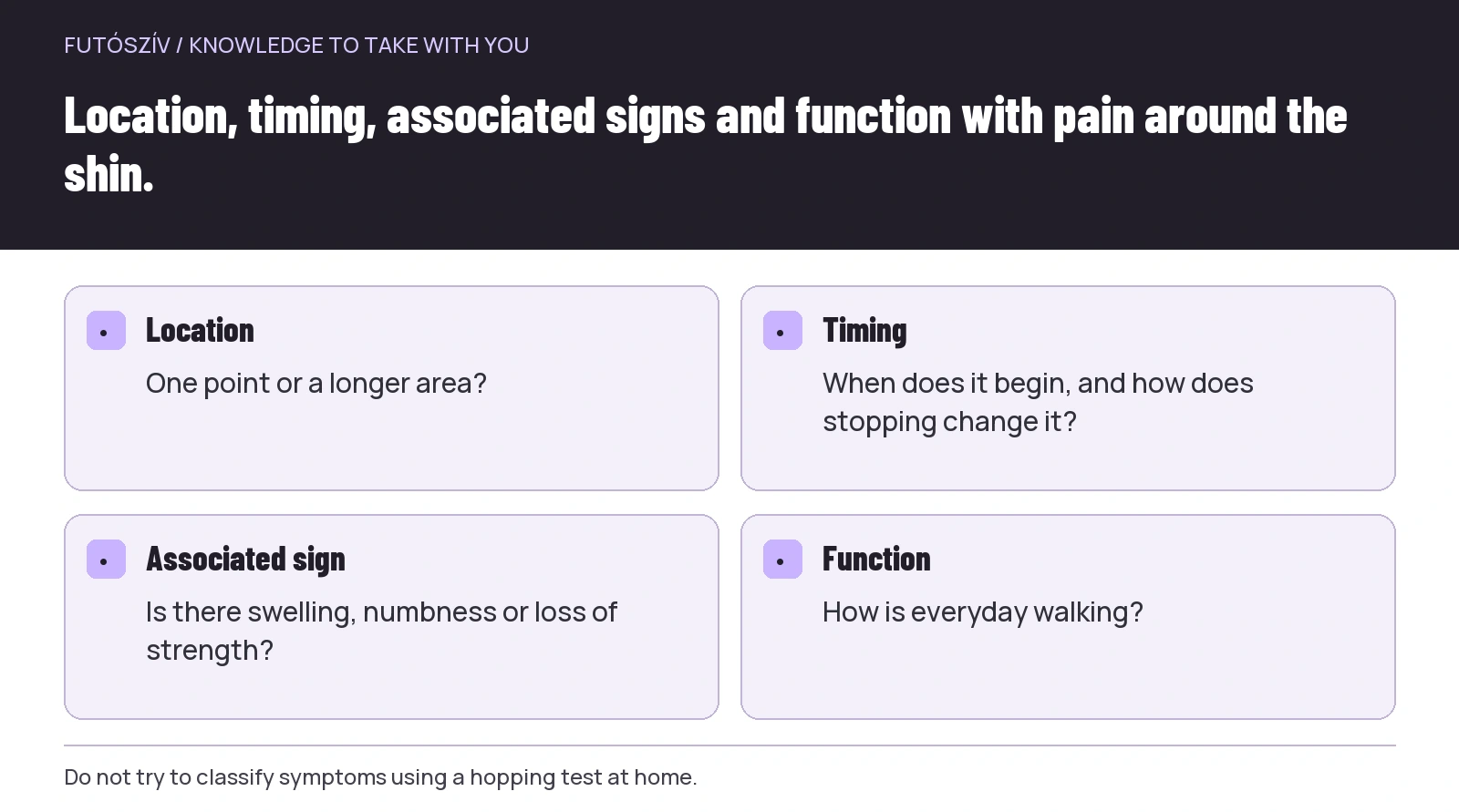 Enlarge diagram
Text version of the diagram
- Location
- One point or a longer area?
- Timing
- When does it begin, and how does stopping change it?
- Associated sign
- Is there swelling, numbness or loss of strength?
- Function
- How is everyday walking?
What symptom history should you bring to the appointment?
Describe the location and timing first. Do you feel it at one point or along a longer area? Does it appear at the start of a run, after a certain time, when accelerating or only later? What happens when you stop, and how is everyday walking the next day? If the location is unclear, say so; do not shape your account to match an online diagram.
Describe the onset separately: was there a single moment of injury, or did it develop gradually? Any swelling, numbness and loss of strength matter as well. You do not need to deliberately provoke every symptom each day to provide an accurate account. The sequence of events you have already experienced is the useful information.
Before the examination, collect details of previous similar episodes and the treatment you received. What helped, for how long and under what loading circumstances? If you tried only one product but also reduced running at the same time, mention that. This avoids attributing a change definitely to one component when it occurred alongside several things.
Do not rule out bone involvement simply because the pain is tolerable
According to the AAOS, persistent symptoms may make it important to rule out a stress fracture or another condition. How bearable pain is does not reliably indicate that bone is definitely uninvolved. Specifically report if walking becomes painful, symptoms begin progressively earlier or they interfere with your usual activities.
Do not use a hopping test to prove that it is “just shin pain”. Neither a painful nor a symptom-free test at home establishes a definite diagnosis. The examiner decides whether imaging is needed, and which type, on the basis of the whole history. If uncertainty remains after the first assessment, ask for an understandable next step.
By the end of the appointment, know which activities are permitted while matters are being clarified. If symptoms worsen in the meantime, communicate the new information rather than simply repeating earlier general advice. A recurring symptom does not become harmless because many other runners have had a similar experience.
Training changes: consider what happens beyond running too
A new programme, more accelerations, more frequent runs or strength training involving more jumping can all form part of the history. Military-style marching, hiking and walking to work can also impose a different load from your previous routine. You do not have to find one single mistake; it is worth mapping the full picture of changes.
Describe specifically what increased and when. Mention it if several factors changed together. Weekly mileage alone does not show pace, surface or how closely sessions are spaced. Following a general percentage-increase rule does not rule out symptoms or replace attention to your individual response.
The role of footwear and ground surfaces can also be explored, but hard paving or a new shoe model should not become an automatic explanation. Treatment first requires assessment of the symptoms and condition. Changing shoes alone does not give permission to continue your previous load with the same symptoms.
What do we know about common additions?
A randomised trial assigned 74 athletes to three groups: all followed a structured running programme, with some groups also receiving calf exercises or compression stockings. There was no clear group difference in time to complete the programme or satisfaction with treatment. The research conducted by Moen and colleagues therefore did not establish a definite additional benefit from those particular additions.
An important limitation is that there was no comparison group without a running programme. The study therefore cannot establish that one general programme is superior to every other approach. Some participants also did not complete the study. Tie the specific finding to the specific question, rather than presenting it as the complete truth about treatment.
In your own care, ask what an exercise, stocking or other device is for and how its effects will be evaluated. You do not have to reject everything with uncertain research, but cost, comfort and personal goals matter too. A popular addition does not replace an appropriate diagnosis and loading plan.
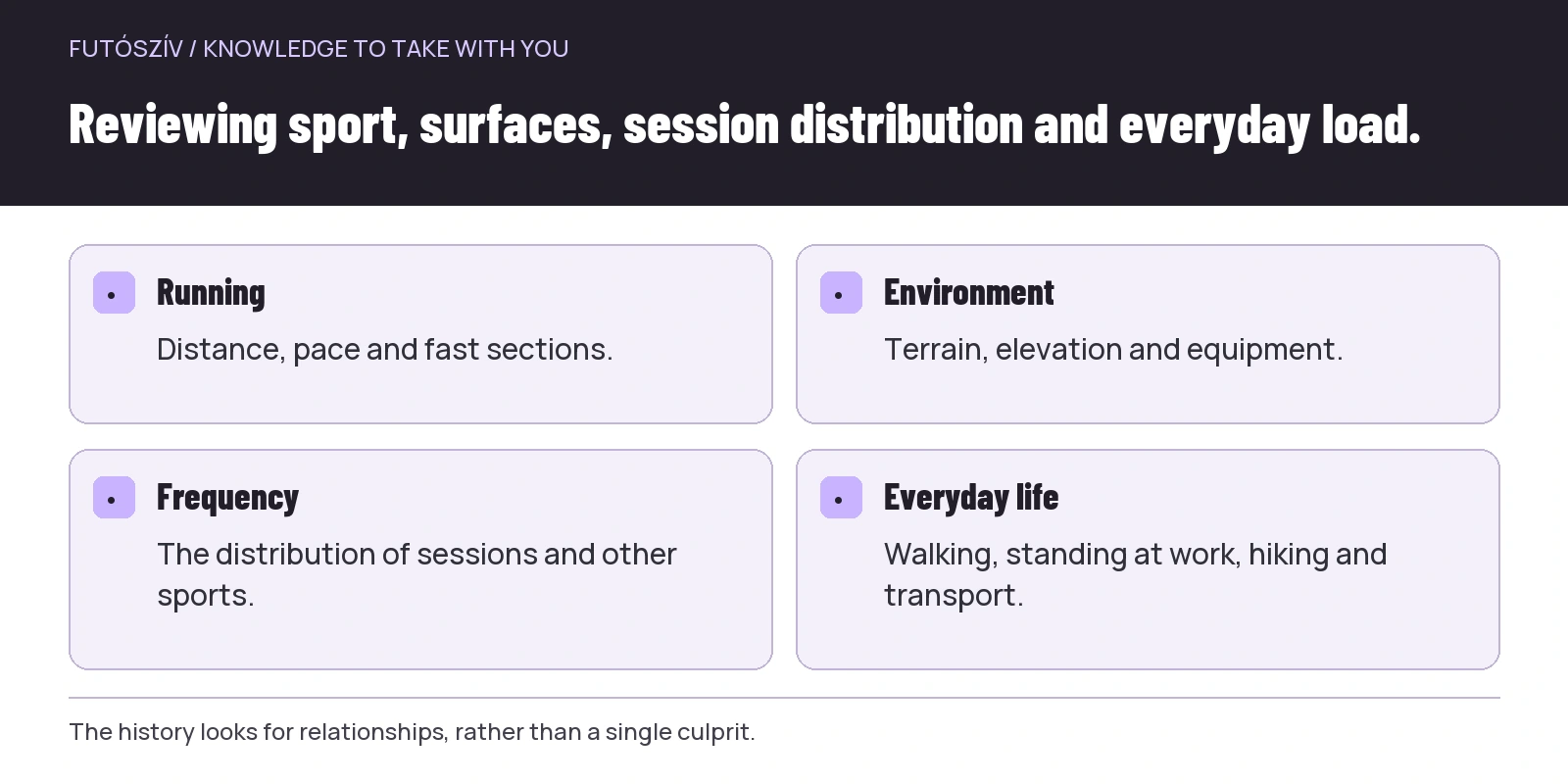 Enlarge diagram
Text version of the diagram
- Running
- Distance, pace and fast sections.
- Environment
- Terrain, elevation and equipment.
- Frequency
- The distribution of sessions and other sports.
- Everyday life
- Walking, standing at work, hiking and transport.
How can modifications become a manageable plan?
The NHS shin splints guide also mentions modifying the activity that provokes symptoms and thinking through the return. Your individual framework should make clear what movement you can do, what to observe and when to seek review. Do not leave with only “rest a little”, because its everyday meaning can vary enormously.
If you choose a different form of movement together, discuss its total load. A treadmill, bicycle or long walk is not automatically suitable in the same condition. Calling it something other than running does not tell you its effect on the lower leg. The choice should relate to your own diagnosis and function.
Daily work and transport should be part of the plan. Mention if you need to stand a lot or use stairs. A temporary change needs to be feasible; otherwise you reduce load on paper while the real day remains unchanged. Asking for help and sharing tasks can be practical tools here.
Under what conditions can you return to the running you want?
Return should be based on individual assessment and the instructions you receive. A general formula calculated from days missed does not decide when accelerations or long runs can resume. Ask which function or observation can guide changes to the amount, and which signals require stepping back or seeking a review.
Make the first permitted session easy to track. Record its duration, format and later response as well. If you write down only that you finished, next-day symptoms or everyday difficulties may be missing. You do not need to increase automatically after every successful session; repeatability is important information too.
Do not treat missed sessions as a debt when talking with your coach. The old programme was written for your condition then; the current one needs to be written for your situation now. The goal for an approaching race may change too. An entry is not a reason to push unresolved or recurring symptoms into the background with another long test run.
A good question about shin symptoms is specific
Prepare a brief sequence for the next meeting: where symptoms began, under what load, how they changed, what accompanied them and what they now prevent you from doing. Add important changes in training and daily routine. Documentation is not an exam; if you cannot remember something precisely, say so.
Your most important questions may be which condition is considered likely, what still needs clarifying and what you can do in the meantime. Ask for a precise contact plan if things worsen as well. That way, the next week is not assembled from your own guesses and more online tests.
Lower-leg pain can be a useful signal that symptoms and load need to be reviewed together. Even so, not all pain is the same and not everyone starts from the same place. Accurate observation, appropriate assessment and a workable individual plan provide the foundation for returning to running.
Sources
- AAOS OrthoInfo: Shin splints
- NHS: Compartment syndrome
- Winters and colleagues: MTSS diagnosis using history and physical examination
- Moen and colleagues: Treatment of medial tibial stress syndrome in athletes, randomized trial
- NHS: Shin splints
How Futószív articles are prepared: our editorial guidelines.