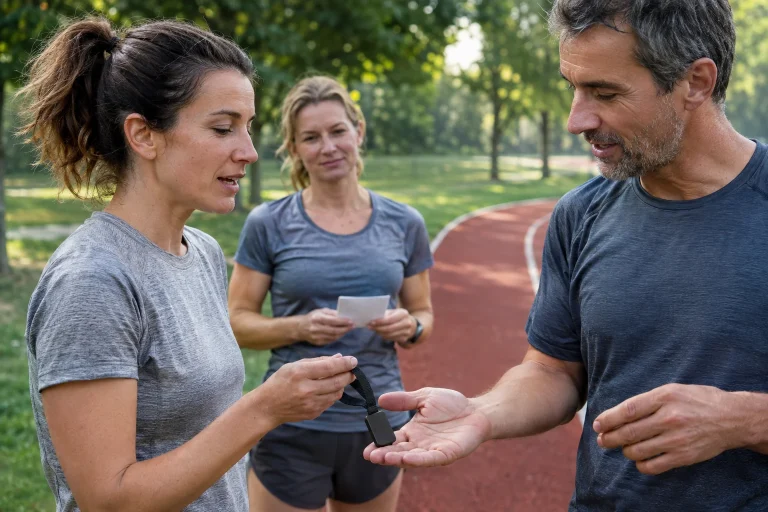
A borrowed running vest or lamp can help you try a solution without immediately buying it. Borrowing, however, does not automatically make equipment suitable for your task, and the owner’s familiar settings may not fit you. A useful trial requires preparation: know exactly what is being handed over, in what condition, how it can be used and when it will return after which care procedures. This article offers a practical editorial workflow for adults trying everyday running equipment. It does not replace the product’s own instructions or a provider’s particular rental conditions.
Say what you want to learn from the trial
A specific question helps establish whether the borrowed item is suitable at all. With a running vest, for example, you may want to explore fit, pocket access or using a hydration system of a particular size. With a lamp, the aim might be controls, positioning and operation appropriate to your route. Do not expect one brief trial to deliver a full durability assessment or laboratory performance evaluation. Tell the owner about the intended environment and use too, because this reveals whether the product’s intended purpose matches the agreed loan.
Collecting equipment needed for an important race differs from a short introduction that is easy to interrupt. Check the mandatory equipment requirements and the particular product’s suitability separately, leaving time for your own trial. Being borrowed is not certification of suitability, and the owner’s previous successful use does not guarantee the right size or comfort for you. If the item is unsuitable, the trial has still provided a useful answer. You need not force yourself to use it simply because someone kindly offered it.
Identify the precise product
Note the full model name, version and, where relevant, size. Find the appropriate manufacturer’s manual, care label and accessory information. Even items of the same brand with similar names may differ. The Salomon ACTIVE SKIN 12 product page , for example, gives its own construction and care details; it is not a general guide for every similar vest. Identify the particular borrowed item rather than automatically applying information about an old or different generation.
Read the product’s usage limitations too. The owner’s verbal demonstration is useful but does not replace the manufacturer’s instructions, especially when handling a power source, adjustable fitting or special material. The official Petzl lamp-use information , for example, treats understanding the instructions and learning the capabilities and limitations as part of preparation. That document applies to its named construction; the appropriate description for your particular borrowed model governs.
Make the complete handed-over kit visible
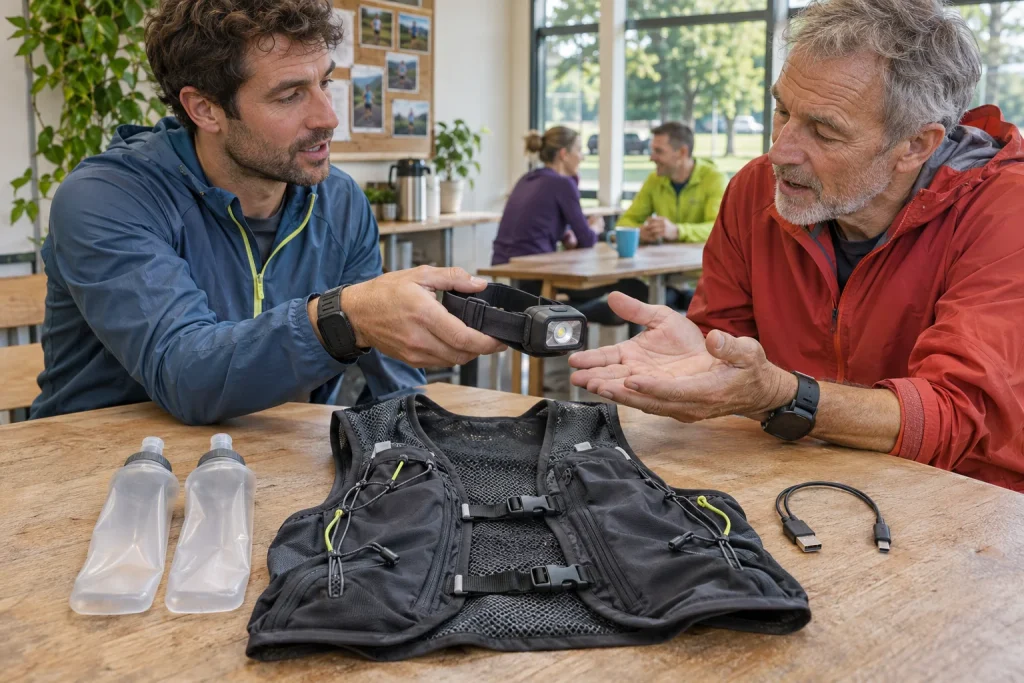
Lay out the equipment and the accessories actually being handed over together. For a vest, a bottle, hose, removable pouch or other element may be separate; for a lamp, a strap, power source and appropriate charger; for other equipment, the accessories belonging to that design. You can take an overview picture and make a brief list. The aim is not complicated inventory management but avoiding uncertainty at the end of the trial about which cap or cable was part of the package. Keep your own accessories distinguishable, especially when items have similar colours and shapes.
Do not substitute one item for another merely because they look physically similar. Bottle shape, hose connectors and charger compatibility are product-specific. If you want to try it with your own accessory, agree beforehand and check the exact permitted combination. A missing or uncertain part in the borrowed kit changes the trial’s conditions; it should not be ignored. A problem experienced with an unsuitable accessory cannot later be attributed cleanly to the properties of the main equipment either.
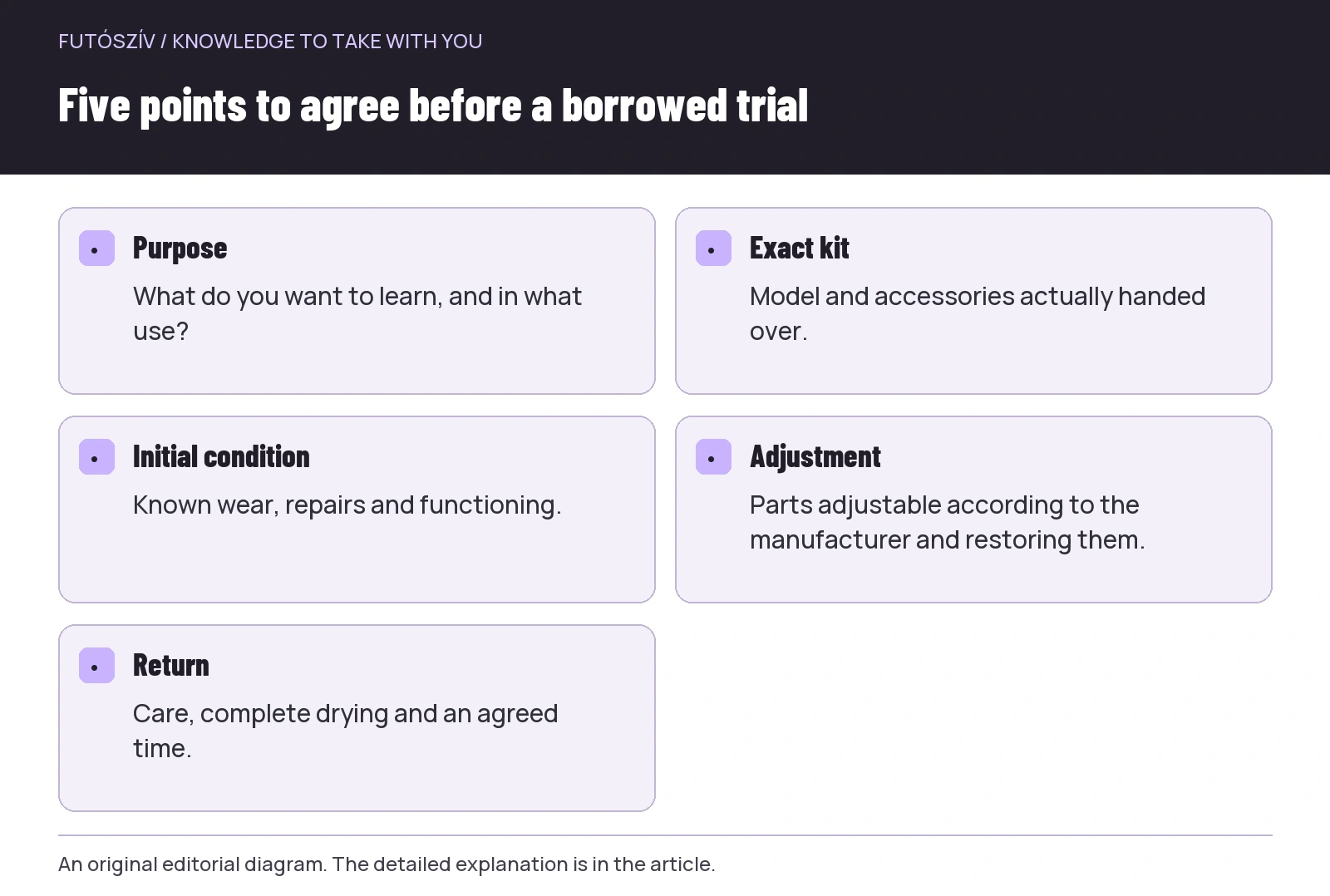 Enlarge diagram
Text version of the diagram
- Purpose
- What do you want to learn, and in what use?
- Exact kit
- Model and accessories actually handed over.
- Initial condition
- Known wear, repairs and functioning.
- Adjustment
- Parts adjustable according to the manufacturer and restoring them.
- Return
- Care, complete drying and an agreed time.
Initial condition: a calm joint inspection
Look at visible wear, previous repairs, fastenings and attachment points. Briefly describe or photograph observations, particularly if a difference is already known. This helps both parties: there is no need later to decide from memory whether a faint mark or damage was there before. The inspection is not an expert assessment, so a condition you cannot judge should remain a question. If an important functional point is damaged or uncertain, follow the appropriate manufacturer or service guidance before use.
Test functioning gently and as intended. There is no need to subject a borrowed zip, buckle or strap to a strength test. With a lamp, switching on and selecting the desired mode must be accompanied by preparation according to its own manual. A brief flash does not establish enough energy for a complete run. Precise observation aims to provide a known starting condition and understanding of how to operate the equipment. If you did not test a function, do not later describe it as having demonstrably worked correctly at handover.
Record the adjustment, then adapt it to yourself
You can photograph settings important to the owner if justified by the product and situation. Then adjust size, straps or fastenings for your own use according to the manufacturer’s instructions. Recording the setting does not mean you must run with another person’s fit. Agree restoration beforehand: sometimes the photographed position helps; at other times the owner prefers to reset it themselves. The point is a clear agreement and handling an element designed to be adjustable, not modifying the construction.
Do not cut off strap ends, relocate sewn attachments or glue on a new accessory for the trial. The owner’s agreement and the manufacturer’s permitted handling are two separate conditions; neither automatically replaces the other. On a fitting requiring adjustment, use only the specified movement and necessary tool. Borrowing is a good opportunity to learn about a suitable solution, but not permission to regard the object as a basis for your own development project. If it does not fit your task without modification, the trial may show you need a different product.
| Point to agree | What should you record? | What does it prevent? |
|---|---|---|
| Purpose | Where, how and what you want to try. | Use outside the intended purpose. |
| Kit | Exact equipment and accessories handed over. | Missing items and mix-ups. |
| Condition | Known wear, repairs and differences in functioning. | Guesswork afterwards. |
| Adjustment | What can change and how will it be returned? | Lost settings or modification. |
| Care and return | Tasks according to the item’s label and an agreed time. | Equipment returning damp or incomplete. |
Begin the trial by answering a narrow question
Choose a situation in which you can learn about the product calmly and as intended. With a vest, first look at putting it on with usual equipment and accessing items; with a lamp, at operation and positioning. The first encounter should not be an important event that is difficult to interrupt. Change few factors at a time during the trial to keep observations understandable. If strap settings and load keep changing, it is difficult to determine what caused a difference. This is not a laboratory test, only an organised way of gathering personal experience.
Note which questions were answered and which were not. For example, the bottle was easy to reach while standing, but you have not yet observed comfort during a longer run. Or the lamp buttons work with gloves, but you have not examined full runtime. Do not extend observations beyond the trial’s scope. Describe your comfort specifically too: where it pulled, what was hard to reach and under which settings. Sweeping judgements of “perfect for everything” or “unusable” rarely help later choices as much as a few precise descriptions of situations.
If a problem occurs, report it before attempting random repairs
If you notice new damage or different functioning during use, document the actual condition and inform the owner in the agreed way. Do not try to hide it with glue, strong cleaning products or dismantling before clarifying the appropriate next step. The manufacturer’s safety and fault-handling instructions take priority here. Forcing continued use of a faulty object does not become appropriate because the equipment is borrowed. An accurate account of circumstances and observations helps the next decision; a suspected cause should be treated separately.
You can also agree beforehand how to communicate in unexpected situations and through which channel the other person can be reached. This is practical cooperation, not a universal liability rule arising from this article. With a formal rental provider, learn the particular provider’s conditions; clear, mutually understood boundaries help with a friendly loan too. An awkward situation is eased by an orderly account of facts and agreed actions, not accusations prepared in advance. The trial aims to build shared knowledge and experience, so concealing a problem helps neither person.
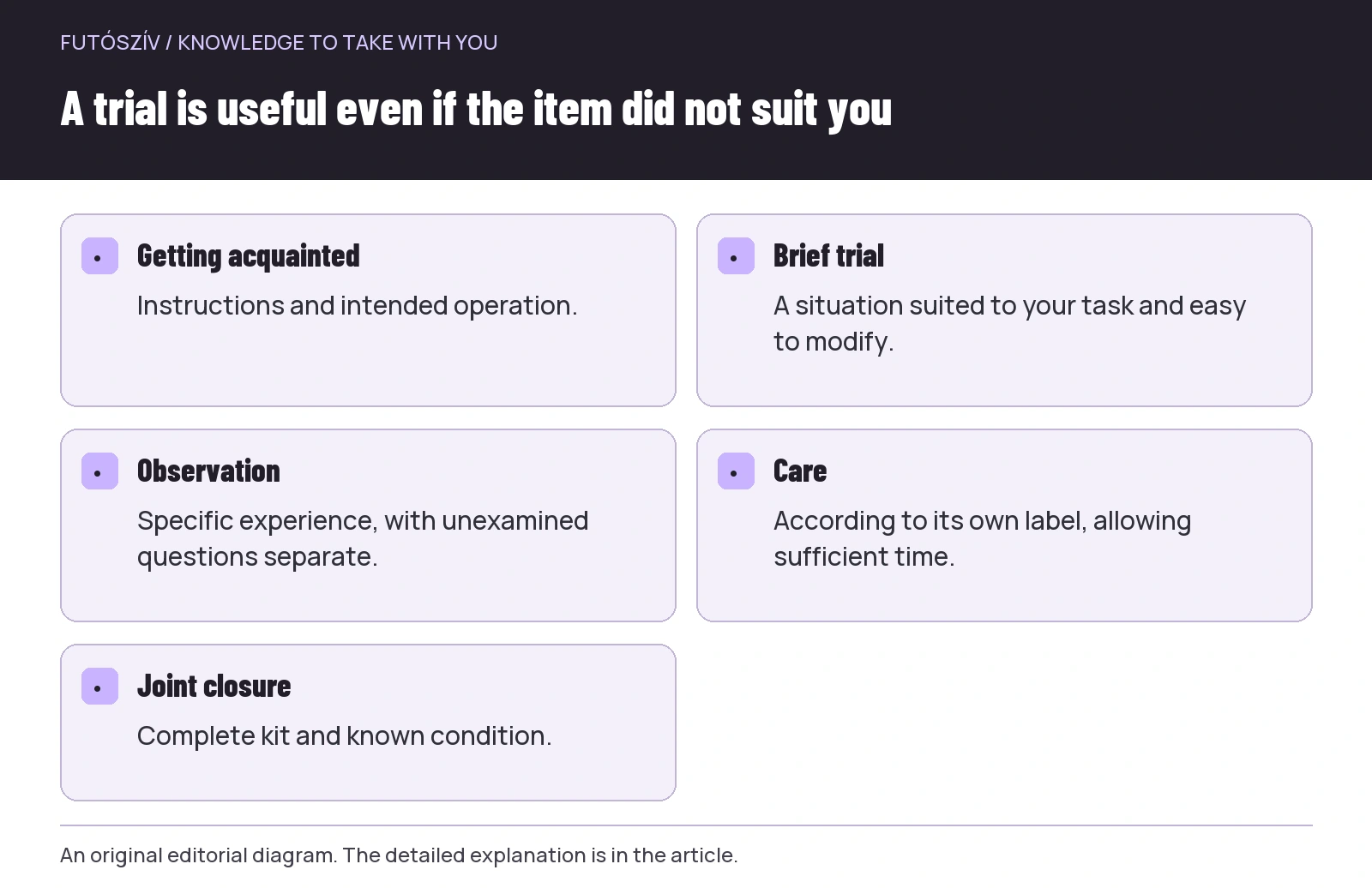 Enlarge diagram
Text version of the diagram
- Getting acquainted
- Instructions and intended operation.
- Brief trial
- A situation suited to your task and easy to modify.
- Observation
- Specific experience, with unexamined questions separate.
- Care
- According to its own label, allowing sufficient time.
- Joint closure
- Complete kit and known condition.
Before cleaning, agree on the actual requirements
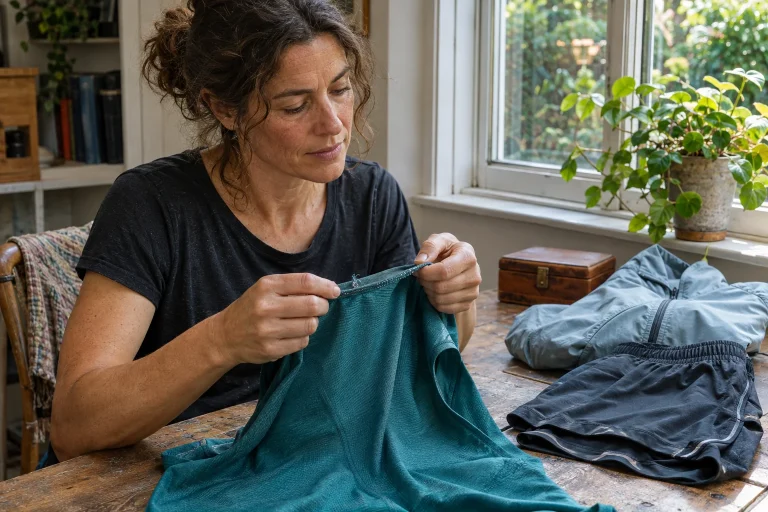
Carry out care before return according to the product’s own label and instructions. Clarify with the owner which steps you will undertake and which they want to do, but do not override permitted treatment with mere habit. The GINETEX guide to care symbols can help interpret a care symbol. Automatically putting all borrowed sporting equipment in the washing machine with clothing is inappropriate. A vest, hydration system and lamp strap may require different processes, while electronics have their own care conditions.
Strong fragrance does not replace cleaning and must not hide condition. Do not use an experimental substance on an unknown stain on the owner’s property or try to speed drying with prohibited heat to meet a deadline. If correct care and complete drying take longer, communicate and agree this in good time. When planning the return time, allow for treatment after use as well. The end of a muddy event is not the same moment as clean, dry kit being ready, even though the run itself is over.
Repeat the brief inventory before returning
Lay out the kit using the handover picture or list. Every accessory should belong to the correct device, and smaller elements should be identifiable. Check pockets so your own keys, phone cover or packaging do not remain inside. Cleaned parts should be completely dry according to permitted treatment; a damp strap or bottle repacked in a sealed bag is not ready. Deal with changed settings as agreed and explain any differences you observed. The return should be as transparent as the collection.
You can also describe the trial’s results in a brief conversation, marking their limits precisely. Your own experience may help the owner and your later choice, but there is no need to turn it into a general product review. If the item did not work for you, explain specifically which situation the size, pocket or controls did not suit. The value of the loan does not depend on ultimately buying the same model. Avoiding a poor choice is also a meaningful outcome if the trial provided clear information.
At the end of a good loan, both people know the condition
Naming the purpose, identifying the product, listing accessories, recording initial condition and providing correct care together create a simple, repeatable arrangement. It does not require lengthy administration, but a few important facts are better not left to memory. The opportunity for your own trial then becomes real decision support. At the end, the owner gets equipment back in a known condition, and you better understand which solution fits you and which question still needs clarifying with another item or more thorough information.
Sources and further reading
- Salomon ACTIVE SKIN 12: model information and care
- Petzl: official headlamp-use information
- GINETEX: Care symbols
How Futószív articles are prepared: our editorial guidelines.