Discussions of washing running clothes often feature microfibres, striking counts and large reduction percentages. The subject matters, but numbers can invite excessive conclusions. Which garments, machine and programme were studied? Were detached fibres measured, or fibres entering water? Which device sought to reduce them? This guide connects interpreting research with the order of household decisions. It promises no zero-emission laundry and does not rank current products from older studies under different conditions.
Microfibre and microplastic: clarify what you are reading about
Tiny fibres released from textiles can be made of different materials. Not every microfibre can be called microplastic under the same material description. Research findings therefore need the textiles studied and sample identification method. Total fibre mass from a mixed wash does not automatically equal the synthetic fraction. Precise wording prevents reusing an impressive total with another meaning. Your own wash’s exact output cannot be calculated solely from a T-shirt label.
The original 2020 study by Lant and colleagues analysed microfibre release from real soiled consumer laundry as well as sample composition. An important lesson for buyers is that textile range and washing conditions matter. Its result is not an identical emissions formula for every household. It provides information interpretable through named methods and samples, allowing proportionate conclusions tied to conditions.
What leaves the garment, and what enters water?
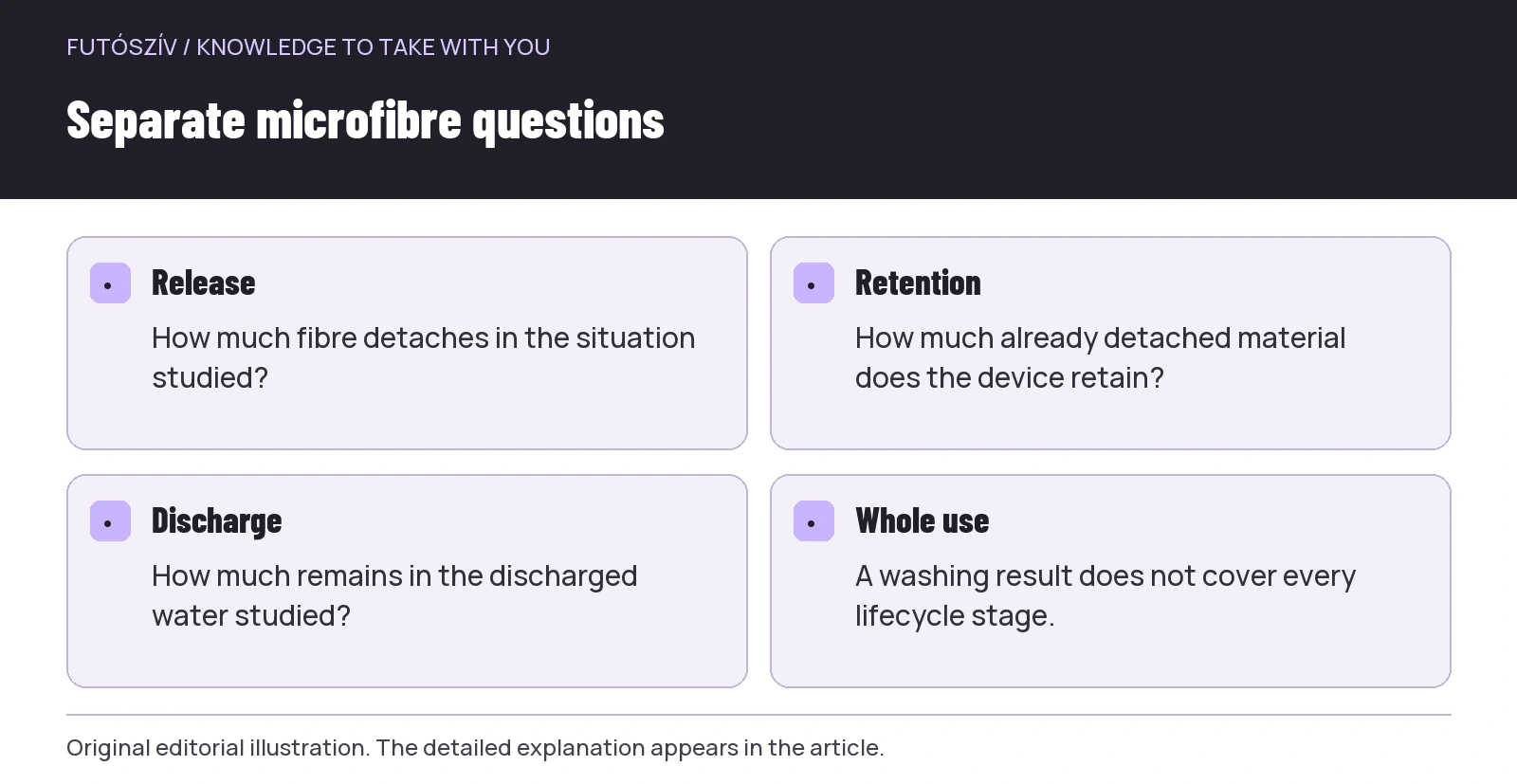
A device may act at two different points: reducing release during washing or retaining some already detached fibres. These are different processes. Measuring material in discharged water alone does not always reveal every intermediate mechanism. Mass manually removed from a device does not automatically equal all emissions prevented either. Without understanding the measured outcome, a product percentage may mean something different from your assumption.
The 2020 research by Napper, Barrett and Thompson examined six devices operating through different principles and found differing results under its washing conditions. It also emphasises fibre release during everyday clothing use. This does not identify one current device suitable for everyone. Understand the claim’s subject: entry into wash water, retention and the entire use lifecycle differ in scope. One washing intervention does not automatically cover every source.
 Enlarge diagram
Text version of the illustration
- Release
- How much fibre detaches in the situation studied?
- Retention
- How much already detached material does the device retain?
- Discharge
- How much remains in the discharged water studied?
- Whole use
- A washing result does not cover every lifecycle stage.
Read study conditions alongside the percentage
Find garment number and type, machine, washing process, control and measurement method. Is the result mass or count? Per wash, kilogram of textile or another basis? Repeated measurements and uncertainty matter too. Striking figures from separate studies do not necessarily occupy a common scale. Without detailed conditions, do not turn them into certain outcomes for your weekly wash. Precisely known circumstances give the research its value.
In an imaginary example, one device reduces wash-water mass for one blend, while another finding concerns fibre count under a different load. Declaring a winner directly can mislead. This is a comparison-logic example, not a real product test. Ask whether devices were compared through identical methods and conditions. Also check the exact device’s current version and instructions before buying, because the product may have changed.
A washing programme changes several factors together
Temperature, time, water quantity, mechanical movement and load interrelate. Comparing programmes does not always isolate each difference’s contribution. The original washing study by Cotton and colleagues , for example, analysed different time-and-temperature combinations for colour loss, dye transfer and fibre release. Within its findings, colder, shorter cycles performed more favourably. That does not authorise placing every garment and type of dirt on the shortest available programme.
A usable household decision must combine the cleaning task, garment label and machine requirements. Ignoring one creates inappropriate care. Nor is the aim repeated washing after failed cleaning. Seek the genuinely necessary, permitted process. Between a study’s general direction and household application sit your garment’s condition and appliance operation; one programme name cannot replace these.
A “delicate” name is not emissions data by itself
A delicate programme may describe mechanical treatment in the machine manual, but is not automatically a microfibre rating. The original water-volume study by Kelly and colleagues showed that the water-to-textile ratio can also affect discharged fibres. The finding does not justify putting delicate clothing on a stronger programme against its label. Distinguish a function’s name from measured information: it does not describe every environmental outcome.
When selecting a programme, check permitted load and settings in your own machine’s manual. Physically filling the drum is not the same as appropriate programme use. A delicate cycle’s load limit may differ from another programme, while garment requirements matter too. “More clothes together” only makes sense within the right framework. Do not translate research load comparisons into an automatic household kilogram target. Begin with a permitted load that can genuinely be cleaned, not general drum filling without label or manual.
| Information read | Detail to clarify | Limit of household conclusions |
|---|---|---|
| Reduction percentage | Which control and measured outcome does it concern? | Not an automatic result for your own wash. |
| Fibre mass | Which fibre materials and sizes were measured? | Not a count of every microplastic particle. |
| Colder, shorter cycle | Which garments and cleaning situation were involved? | Labels and necessary cleaning still apply. |
| Filter or bag | Does it reduce release or retain material? | Maintenance and collected material’s destination matter too. |
Washing bags: examine the specific device’s purpose
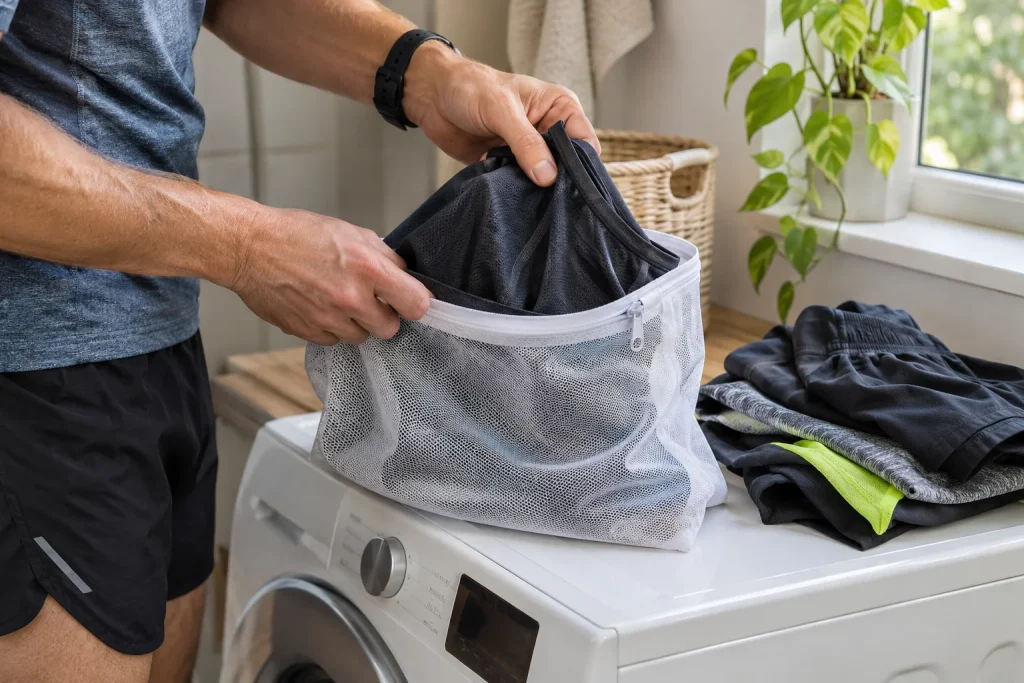
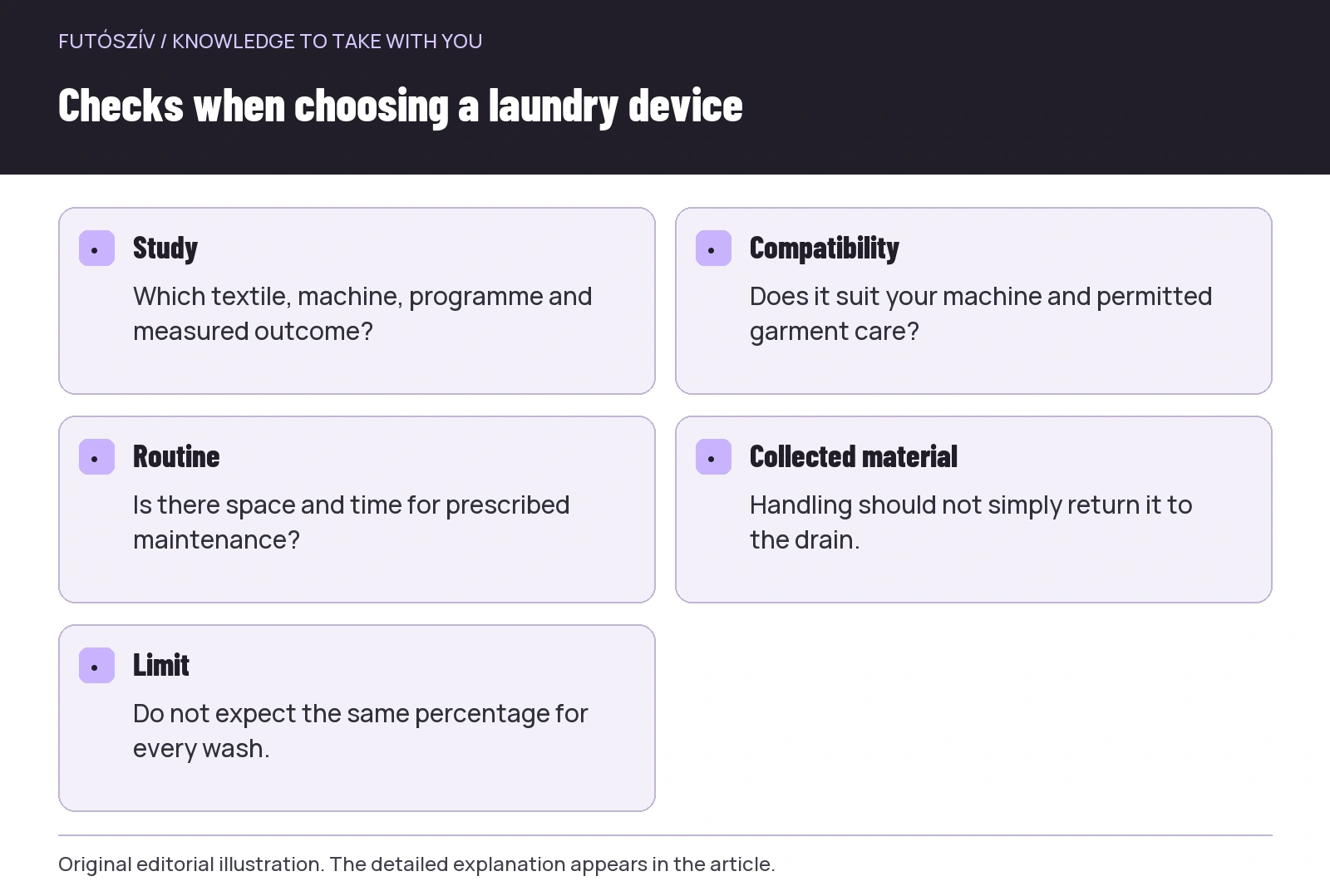
A fibre-retention bag and an ordinary coarse-mesh laundry bag are not necessarily equivalent. Find intended use, loading, closure, cleaning and collected-material handling in the manufacturer guidance. Interpret experimental results with the identified product and conditions. Not every bag has the same research, and construction changing under one brand name may matter. Know what you expect and what regular work is required.
A bag does not override clothing restrictions or automatically permit machine treatment of hand-wash-only equipment. Bag, machine and garment conditions must all be satisfied when loading. Compressing too much fabric can compromise cleaning and intended device use. Dry clothes and bag according to their instructions, and do not simply rinse retained material back down the drain. Choose handling according to the product and local waste arrangements.
 Enlarge diagram
Text version of the illustration
- Study
- Which textile, machine, programme and measured outcome?
- Compatibility
- Does it suit your machine and permitted garment care?
- Routine
- Is there space and time for prescribed maintenance?
- Collected material
- Handling should not simply return it to the drain.
- Limit
- Do not expect the same percentage for every wash.
External filters also involve installation and upkeep
For an external filter, machine and drainage compatibility, installation and maintenance matter to the choice. Follow the specific device’s instructions and obtain appropriate professional help where needed. The aim is not modifying washing-machine drainage with an unknown-resistance DIY arrangement. Clarify combined operating requirements. Experimental efficiency alone cannot establish suitable installation and upkeep in your household.
Maintenance time, replacement elements and collected-material handling belong to total effort too. Ask how to identify cleaning needs, which signs to observe and what happens to a used insert. Do not exceed instructions because the outside still looks orderly. Regular operation needs actual space and a manageable routine. Buying a device without appropriate care does not automatically deliver demonstration results; evaluate the whole use process.
What can you change without buying anything?
First inspect unnecessary repeated washes or care errors rapidly degrading clothing. Continue necessary cleaning according to labels; this topic does not justify neglecting dirty running clothes. Group compatible items, follow programme loading and avoid unjustifiably harsh processes. Organise drying and storage so a damp sealed bag does not force another wash of cared-for clothes. These are traceable maintenance decisions without precise emissions promises.
Do not abruptly discard usable equipment because it contains synthetic fibres. Buying another item also has consequences, and material choice is complex. Consider task, care possibilities and known product information together. Microfibre research is not a purchasing ranking valid for every garment. It supports better questions about construction, durability and laundry solutions, but sound decisions need more than one fibre name on a label.
A brief household check
Follow your own laundry sequence: when clothes enter the laundry, how you sort, why you choose a programme and what happens after drying. Identify changes genuinely possible within product and machine instructions. If considering another device, assess placement and upkeep against this real process. You need not perform home fibre experiments with adhesive tape or filter paper to improve a routine; such methods can produce incomparable, misleading numbers.
A sound conclusion stays proportionate: fibre discharge from washing can be influenced, but one solution does not cover every material, condition and lifecycle stage. A precise research question, your garment label and appropriate accessory handling together provide usable direction. Rather than buying a big promise, you understand the intervention, supporting evidence and everyday responsibilities remaining with you.
Sources and further reading
- Lant et al. 2020: Microfiber release from real soiled consumer laundry
- Napper et al. 2020: The efficiency of devices intended to reduce microfibre release
- Cotton et al. 2020: Colder and quicker washing cycles
- Kelly et al. 2019: Importance of Water-Volume on Microplastic Fiber Release
How Futószív articles are prepared: our editorial guidelines.