
Read forest-access notices against your own route
A headline says access to a forest is restricted. It does not yet establish exactly which area, day or path is affected. The opposite misunderstanding is common too: someone remembers that waymarked hiking trails are always exempt and skips the detailed notice. A useful check avoids both simplifications by connecting specific information to a specific outing.
This article explains a method for reading public official notices. It is neither a nationwide forest-access status for a particular day nor an interpretation of an individual legal dispute. Before setting out again, check your route through fresh sources. If wording is unclear, ask the relevant manager or appropriate leader of an organised outing for clarification.
First map which areas the loop enters
A forest name or popular destination does not always match the management unit named in a notice. Your route may cross several areas. Keep the planned main line, start, finish and preselected shorter finish in front of you while checking.
Identify the sections requiring official information. Searching broadly for the whole mountain range can be a starting point, but deciding also needs a more precise map connection. If the loop crosses into another forestry area, the manager responsible near the start may not cover the entire route.
Do not limit the check to the running section. Access and backup return may enter woodland too. If the alternative leads through the area covered by the notice, it is not automatically a usable backup.
Look for six fields in the notice
| Field | What should you extract? | What should you record? |
|---|---|---|
| Issuer | Who provides the information? | Official organisation and original page |
| Area | Which map or description defines the boundary? | Your affected route section |
| Date | Which days does it cover? | Whether your departure date matches |
| Daily period | Are particular hours specified? | Relevance to the entire time away |
| Affected use | Which paths or visits does it concern? | Exact exception or inclusion |
| Update and contact | What further information is available? | Checking time and question needing clarification |
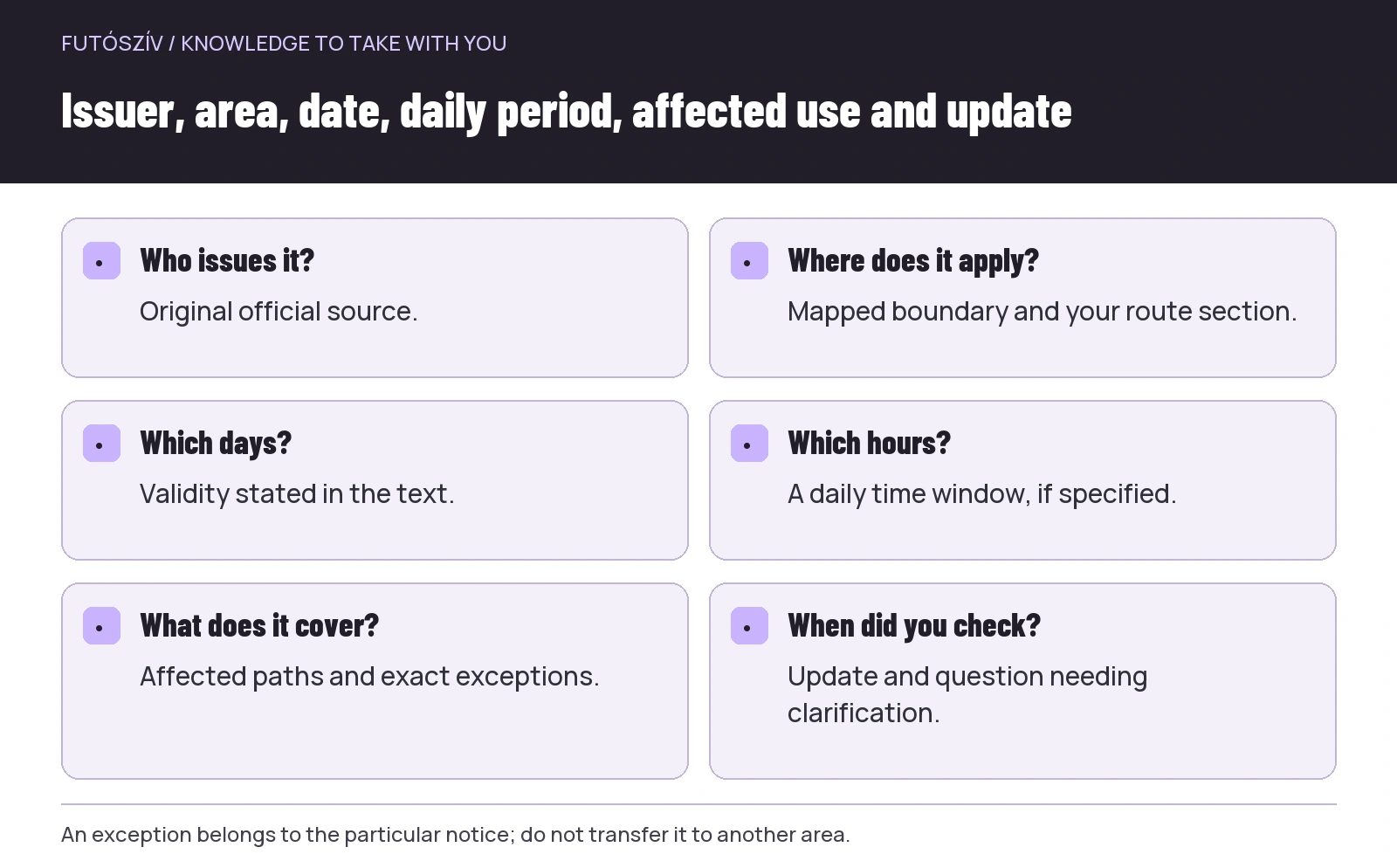
These fields form our reading framework. They do not replace the complete wording or attachment. Open a map if the notice refers to one. A headline and date range alone do not establish whether your loop is affected.
 Enlarge diagram
Text version of the illustration
- Who issues it?
- Original official source.
- Where does it apply?
- Mapped boundary and your route section.
- Which days?
- Validity stated in the text.
- Which hours?
- A daily time window, if specified.
- What does it cover?
- Affected paths and exact exceptions.
- When did you check?
- Update and question needing clarification.
Always find exceptions in the particular notice
Official examples show differing content. The SEFAG partial-restriction notice for September 2026 expressly says the restriction stated there does not affect designated hiking routes. This concerns a named period and area, not a general rule for every forest.
The Pilisi Parkerdő page collecting current notices , by contrast, also contains notices stating that marked hiking trails on the attached map cannot be visited at the specified time. When checked on 18 November 2026, the page included information on group hunts in 2026–2027. Open the current version before a new departure.
The lesson is not that one region is always more open than another. The exception or inclusion belongs precisely to the notice where you read it. A sentence learnt elsewhere cannot be transferred to another forest.
A summary map is a useful start, but find the original notice
The MTSZ hiking-trail warnings collect many kinds of changes and restrictions. This may reveal further information needing investigation near your planned loop. In the details, check date, affected section and linked source too.
If summary and original notice differ, do not automatically choose the apparently more favourable version. First identify which is newer and what each concerns. The difference may need clarification from the relevant organisation.
A route not appearing in your own quick search does not prove every condition is settled. Sources help find appropriate information, not manufacture a general access guarantee from one missing search result.
View the map attachment at the appropriate scale
On an overview, a boundary or affected area can easily merge visually with your route. Zoom into critical connections and read the legend. An area’s colour and a hiking trail’s colour may belong to different symbol systems; do not identify them solely through a similar shade.
If resolution is insufficient for deciding, treat that as missing information. Do not draw your own precise boundary from a blurred image. The notice’s contact or manager’s official channel may help clarify.
In your outing sheet, do more than copy the complete map: briefly name which route section prompted the check. Later, the question remains understandable. A map file alone, without date or explanation, can mislead just like an old weather screenshot.
Date and daily time window are separate conditions
A notice may cover an extended period but specify particular hours within each day. Another may identify one whole day. These cannot be summarised with the same simple sentence. Compare your departure and finish against the complete stated conditions.
If route duration is uncertain, do not plan against a restriction boundary with no room for even one minute’s difference. Understand the outing through its actual finish, including the connecting return. Your time estimate is not an official timetable, particularly on unfamiliar or changed terrain.
Do not confuse a stated time with publication date. A November news item may concern later dates, while an older page may state a condition valid for longer. Identify validity in the wording, not only the search result’s date.
 Enlarge diagram
Text version of the illustration
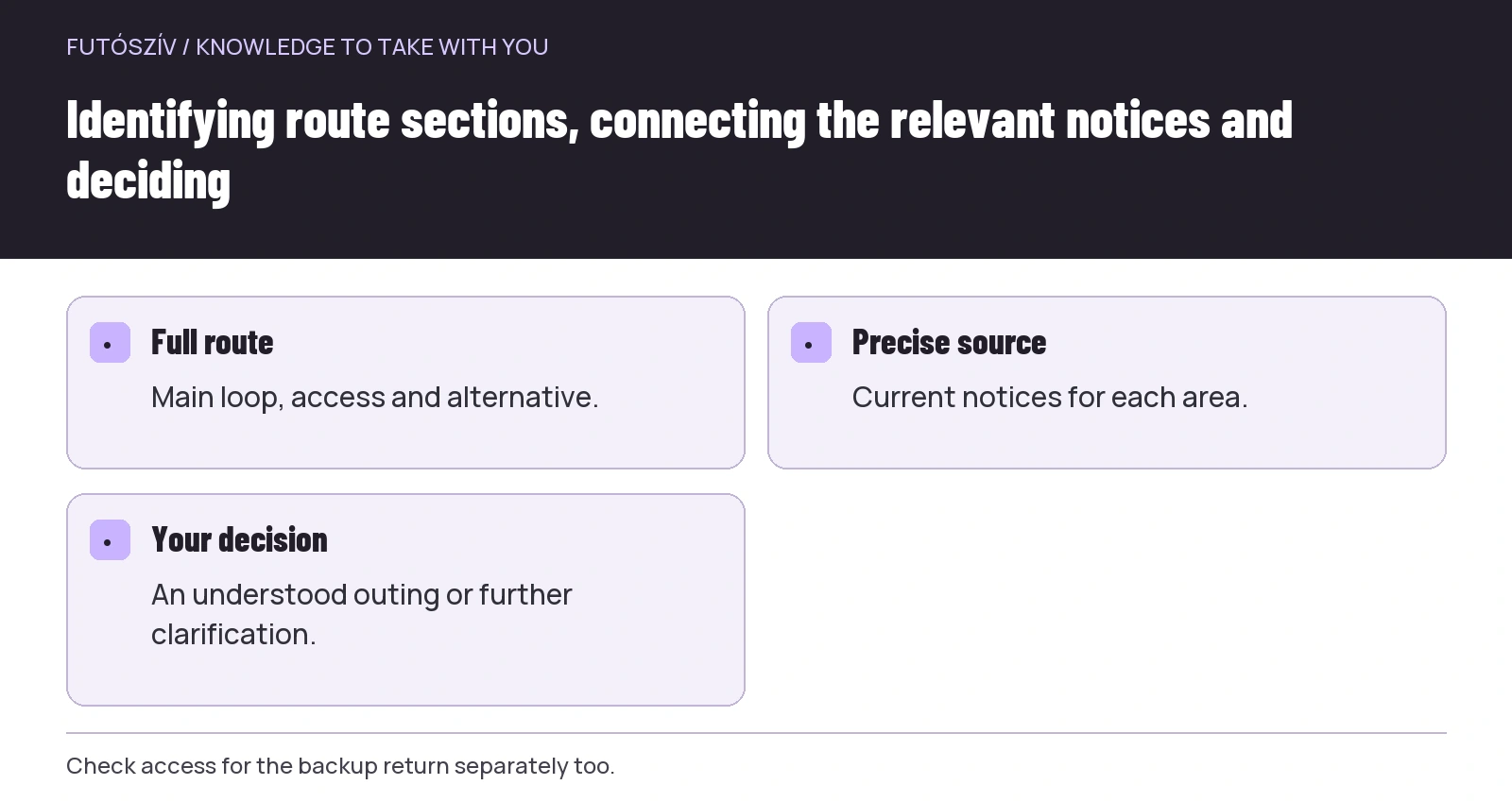
- Full route
- Main loop, access and alternative.
- Precise source
- Current notices for each area.
- Your decision
- An understood outing or further clarification.
An illustrative example of a partly affected loop
A runner plans a loop near two settlements. The notice found for the first forest area exempts designated hiking trails. The second half enters another mapped area with a separate notice. Initially, the runner would extend the first piece of information to the entire outing.
The improved check examines sources section by section. It reveals no clear, appropriate information available to the runner for the second part. They do not fill the gap with wording from the first notice. They request clarification or choose another checked outing whose conditions they understand.
The example gives no real geographical boundary or current route status. It illustrates the reading error: an exception in one area does not extend automatically to the neighbouring loop. Understand the entire length of your own route.
With new information on site, do not treat the saved line as an instruction
Even after pre-departure checks, you may encounter a fresh sign, diversion or information from an authorised person. Treat it as new information. Do not assume an old image remaining on your phone automatically overrides every on-site notice.
If the situation is unclear, do not invent a personal cross-country detour around the restriction. An alternative must also be understood and appropriately usable. A nearby-looking path does not become a checked connection merely because the main route is unavailable.
Your target time, travel expense or previously announced distance does not resolve access. These may be important personal organisational factors, but current area conditions require separate consideration. Changing the outing is a real planning task here.
Give a group one current summary
For a shared run, the person responsible for information should send a brief current message about the chosen route and checking outcome. Do not leave the group to build a common position during the outing from several links found at different times. Keep the source accessible alongside the summary.
If location or start changes, update access and finish too. A new meeting point may mean a different transport connection. Participants must know which version applies and where to obtain answers to remaining questions.
Do not treat the joint decision as a test of determination. Someone pointing out missing information is asking about one condition of the outing. Good organisation allows discussion before departure rather than filling unresolved information with social pressure.
What should you save and what should you recheck?
Keep the original URL, check date, stated validity and short name of the affected section in your notes. This helps explain the information behind your choice. It does not mean the sheet can be reused months later without another check.
Name archived files so their earlier status is apparent. A screenshot of an old notice should not mix with the current departure folder. Date the check in notes linked to your track version too.
When returning after a restriction ends, check for a new notice alongside the expired date. The old period ending and all current conditions being settled are different statements. Opening the fresh source remains part of the recurring routine.
A brief checking sequence for the next departure
First identify the full route. Then find official information for affected areas and summary warnings. Read the map attachment, dates, daily period and specific coverage. Finally record the decision and remaining question.
If conditions are unclear, check the alternative too. More search results do not necessarily provide a better answer; often the next step is a precise question to the responsible manager. In the meantime, choose a framework you understand for your outing.
Checking forest restrictions then becomes more than headline reading. The relationship between area, time and route becomes visible. Your running plan can use current notices according to their actual meaning, rather than generalisations carried over from memory.
How Futószív articles are prepared: our editorial guidelines.