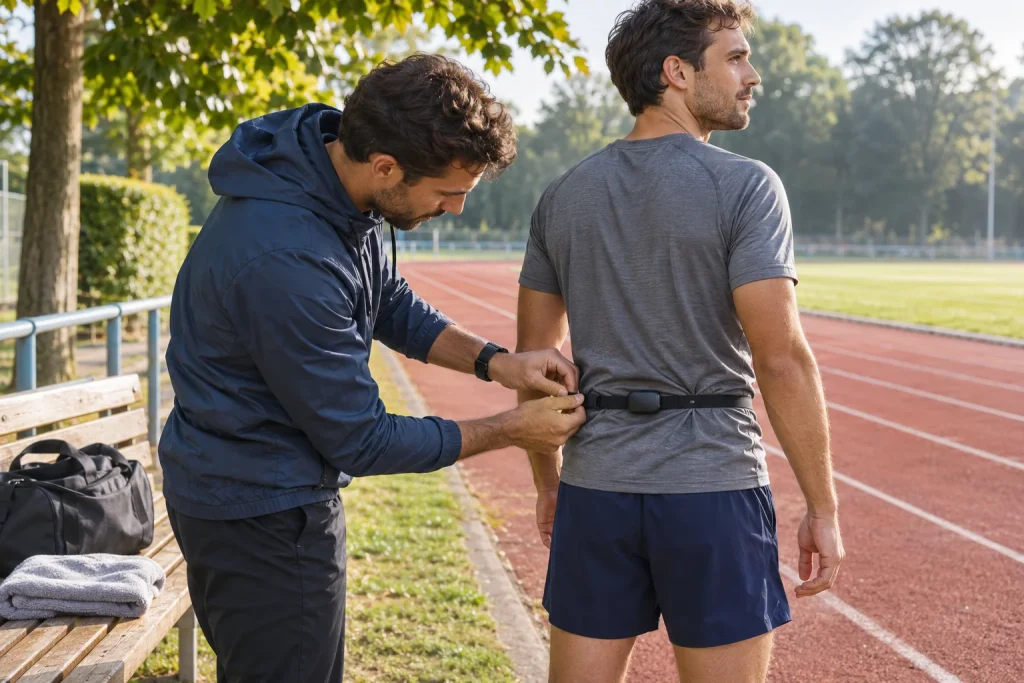
A small waist sensor records movement during the first half of a marathon, and a model searches for signs of substantial slowing later. The idea is exciting: the time pattern of running rhythm may reveal more than one momentary number. To understand its real value, follow the data from sensor to prediction, then examine the performance measures through a simple example.
What can a waist-worn sensor observe?
An inertial measurement unit, or IMU, attached to the body gathers signals about changes in movement. Running metrics pass through several processing steps before reaching an app: segments and step-related features are estimated from raw movement signals. Displayed stride length or ground-contact time is therefore not the same as a tape measure or laboratory force measurement placed alongside.
Waist placement allows repeated movement patterns to be followed over time. What matters is not only an average, but how the signal changes through the race. Initially stable running that gradually changes can tell a different story from movement with the same average but similar throughout. This difference provides one meaningful research direction.
The device cannot directly observe every circumstance. Waist movement alone cannot show what you ate, how hot you felt, why you stopped or which thought prompted a pace change. The sensor captures one slice of the event. Its best use may therefore connect movement patterns with other running information.
What exactly did the new research ask?
The study reported by Miyazaki and colleagues sought patterns associated with later substantial slowing using first-half waist-sensor data from Japanese marathons. Of 1,437 initial recordings, 665 complete cases meeting specified slowing or stable criteria entered final analysis. Many intermediate cases were excluded. Test-data accuracy was 73.9%, sensitivity 75.8% and precision 70.1%.
The study used time-varying curves rather than only single averages; stride length, ground-contact time and estimated vertical stiffness were important model variables. The authors identified validation in other running groups and eventual real-time application as further work. This is research prediction, not evidence that any shop-bought waist sensor already supplies ready-made individual marathon alerts.
Before the percentage: what exactly counted as slowing?
A prediction concerns an event defined in advance. Everyday “Hitting the wall” can mean sudden exhaustion, gradual pace loss or a particularly difficult section. Data analysis needs a more precise rule. If studies apply the same label to slowing of different durations and magnitudes, their results may not be directly comparable.
The research examining late marathon pace decline in a large database also analysed performance changes recognisable from splits. Splits are running outcomes, not measurements of every underlying physiological cause. A model can learn the likelihood of a defined pace pattern without explaining why it occurs in a particular runner.
Place two sentences together: this is the event the model sought; this is the event I want to avoid or understand. If they do not match, even good performance measures do not precisely answer your question. A brief aid-station stop or a slightly slower race throughout differs from sustained, substantial late pace loss.
 Enlarge image
Three performance measures answer different questions
Accuracy asks how many assessed cases the model classified correctly. Sensitivity, also called recall, is the proportion of actual events found. Precision shows how many positive predictions were confirmed. The official scikit-learn evaluation documentation treats these as separate metrics too.
Three concerns may matter to runners. You want generally correct classification, do not want real problems missed, and do not want excessive false warnings changing your run. One percentage cannot summarise all three. Which error matters more also depends on the application’s purpose.
A 70% precision does not automatically mean you personally have a 70% chance of trouble. The metric is a ratio within a particular dataset and decision rule. Validating a probability displayed to an individual would be a separate task. Do not translate group model evaluation directly into personal prediction.
A fictional thousand-case example shows why false alarms matter
This example explains concepts only; it does not recalculate the marathon study. Suppose one hundred of a thousand runs meet the target slowing criterion and nine hundred do not. An imaginary model correctly flags eighty of the hundred and misses twenty. Among the other nine hundred, it falsely alerts on ninety and correctly gives no alert on eight hundred and ten.
| The imaginary model | Event occurred | Event did not occur |
|---|---|---|
| Gave an alert | 80 true positives | 90 false positives |
| Gave no alert | 20 false negatives | 810 true negatives |
Accuracy is (80+810)/1000, or 89%. Sensitivity is 80/100, or 80%. Precision, however, is 80/(80+90), approximately 47.1%. Despite apparently high overall accuracy, more than half the alerts would be false. No complex algorithm is needed to understand this: event frequency and the four outcome counts already explain much.
A retrospective analytical note has different consequences from advice to change pace urgently during a race. The example does not imply every alert is useless. It means usefulness requires knowing expected false and missed alerts in the relevant setting. Evaluate the number alongside the decision.
Why do intermediate runs matter?
Imagine a club with three marathon patterns: stable pace throughout, substantial sustained decline, and smaller fluctuations followed by recovery. Keeping only the first two groups teaches a well-defined, more extreme difference. That may be a useful start, but runners in the third group will still appear in the next real race.
In everyday use, the system must handle uncertain or intermediate cases too. It might give a less confident signal or indicate that data do not fit the previous evaluation setting. Such restraint is often more honest than forcing a firm yes–no answer on every run. Excluded and incomplete cases therefore matter alongside final performance figures.
An unfamiliar runner is the real test
A model learns from training data, then requires evaluation on data whose outcomes were not used in learning. The scikit-learn guide to common pitfalls separately addresses data leakage: information from the test influencing preprocessing or learning can make evaluation overly optimistic. This is a general methodological rule, not an allegation that the marathon study acted incorrectly.
The next question goes further: what happens in another race, weather, runner group or device? Validation in a new environment helps show transferability. Evaluation always within the original collection setting may miss unexpected real-world situations.
For runners, this becomes simple questions: who participated, how similar was their task to mine, which sensor and attachment method were required, and was the system checked on new runs? These approach practical benefit more closely than choosing a news report’s largest percentage.
A predictor variable is not necessarily a movement to correct
A movement feature helping predict an outcome does not establish that changing it directly improves that outcome. Longer contact time may belong to a broader pattern rather than being an independent cause. The model learns associations with the defined outcome. An intervention’s effect would need another study design.
An analogy helps: umbrellas may indicate rain well, but removing umbrellas does not stop precipitation. Running movement is more complex, yet the logical distinction is similar. An algorithm finding a metric important may provide an interesting coaching question. It does not automatically instruct every runner to shorten steps or produce different stiffness.
The laboratory work examining physiological durability in marathon runners approached changes in long performance through different measurements. Movement signals, heart rate and laboratory findings are separate sources. Together they may add nuance, but none automatically replaces another. Understanding the task requires arranging several signals together.
 Enlarge image
What feedback would genuinely be useful?
Imagine cautious future feedback: your current movement pattern differs from previous similar runs; review pace and conditions. This differs from declaring that you will certainly hit the wall. The first offers observation and choice; the second implies excessive certainty. Good feedback should communicate both data reliability and prediction uncertainty.
The message must fit the running situation too. Retrospective coaching analysis allows comparing curves and explanations. During a race, guidance would need to be brief, clear and proportionate without distracting from the course. An algorithm’s value depends on the decision it asks of a person, not statistics alone.
Five checks for a sensor prediction
When reading similar news or product promises, first identify the outcome: exactly which slowing is predicted? Then ask who was measured and excluded. Third, seek different performance metrics rather than overall accuracy alone. Next check validation in a new environment. Finally name the particular decision the signal would help you make.
These questions do not reject new technology. They distinguish genuinely interesting results from a finished consumer service. The waist-sensor research’s value lies in seeking information about prolonged performance within movement patterns. The next step is making that information reliably usable across runners in real decision situations.
Meanwhile, your diary can pursue the same foundations: consistent recording, describing circumstances and marking uncertain signals. Sensor data may then become more valuable too. A number helps when you understand its origin, the event it concerns and a proportionate decision to attach to it.
Sources
- Miyazaki and colleagues: early IMU running data and later substantial pace decline.
- Smyth: late marathon pace decline in a large database.
- Hunter and Muniz-Pumares: durability of physiological parameters in marathon runners.
- scikit-learn: classification metrics and evaluation.
- scikit-learn: data leakage and consistent preprocessing.
How Futószív articles are prepared: our editorial guidelines.