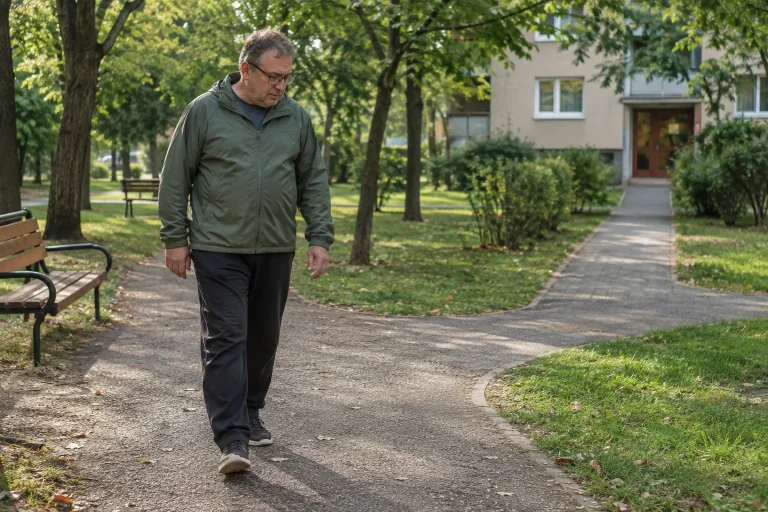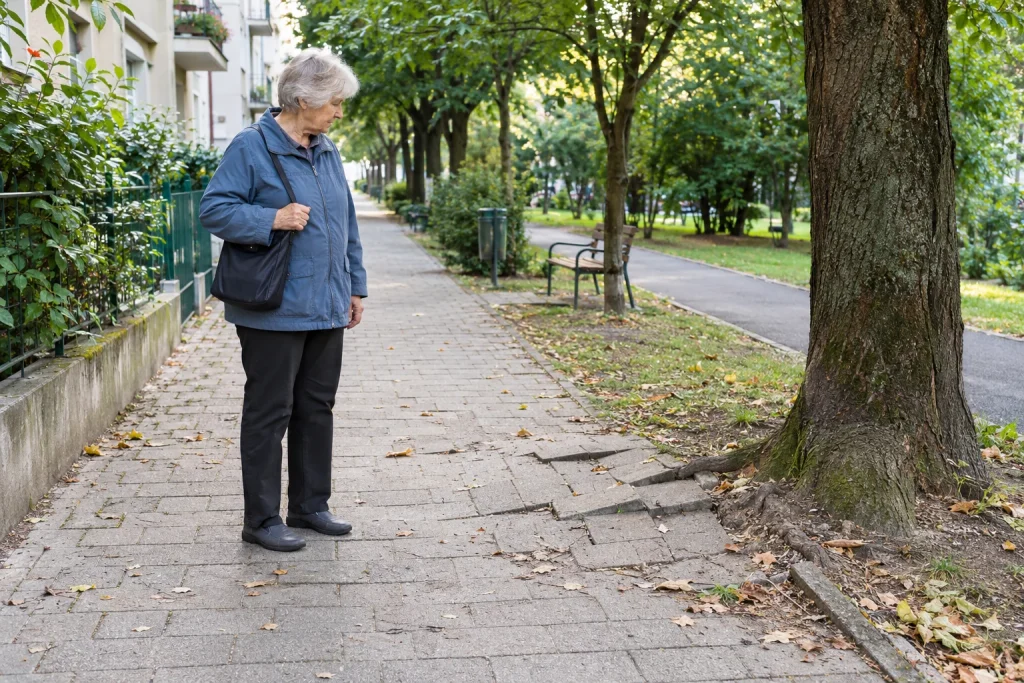
You suddenly slow on a familiar pavement. A raised slab makes your next step feel uncertain, and on the following stretch you must weave around parked cars. If you are planning to run as an older adult, this does not mean you need even more determination to get through the same route. Examine the location’s defects, your own unsteadiness and the alternatives separately.
Choosing your surroundings is a meaningful task before pursuing a running goal. A smoother route, clearer sightlines or fewer crossings may be a better organisational choice. However, changing the route does not automatically resolve newly emerging balance symptoms. If unsteadiness returns, worsens, or occurs with dizziness or other symptoms, an individual healthcare assessment may also be needed.
First identify what was uncertain about the situation
“The pavement was bad” may accurately describe the environment, but add your own experience. Did your shoe’s toe catch? Was the change in level hard to see? Did you have to hurry to let someone pass? Noticing a surface defect late is a different question from feeling dizzy on a clearly visible, smooth section. Do not merge the two stories under a general label of clumsiness.
You do not need to repeat the situation to be sure of the answer. Describing what already happened provides a starting point. If there was a new change in your own stepping, do not dismiss it solely as the street’s condition. Conversely, if a route really is full of obstacles, you need not blame yourself for being less willing to choose it today.
The WHO’s approach to healthy ageing also considers the relationship between individual ability and the environment. For everyday route choices, this means that a usable location is not a minor comfort extra. It can help you access an activity you value without placing responsibility for overcoming every obstacle on your own body.
Break the surface down into specific details
Unevenness takes several forms. A raised slab, a transverse crack, loose gravel and a depression create different situations. A single “asphalt” or “paving blocks” label is therefore insufficient. Observe the route’s actual condition and whether you can move calmly and predictably there. The table is an aid to your own site notes, not a standards inspection.
| What you notice | A useful planning question |
|---|---|
| Raised paving slab or root | Is there a smooth detour with clear sightlines that avoids stepping into the road? |
| Loose gravel or debris | Can another entrance avoid this section? |
| Unexpected change in level | Can you see it in time, or is the approach uncertain too? |
| Narrow section further restricted by obstacles | Is there a quieter time or a wider alternative? |
| Surface concealed by water or leaves | Would replacing the entire section with another route make sense? |
The solution should not be ever more skilful obstacle-avoidance movements. If the only detour would lead into the road or require hurried steps, you can choose another route. A running goal is no reason to treat an uncertain everyday passage as a compulsory practice course. The route’s condition is a factor in choosing, not a challenge you must complete.
Assess crossings together with waiting and continuing afterwards
A route may look short and straightforward on a map yet include several crossings where you would have to rush. Check the waiting area, sightlines and the surface you reach on the other side. Crossing involves more than the few steps in the roadway. Reaching the kerb and moving on afterwards also belong to the outing.
Arrange your first visit in conditions appropriate for you. If you want help or company to assess the location, agree this beforehand. You do not have to check everything alone or remain attached to a previously chosen loop. Even one uncomfortable crossing can make another entrance a sensible choice.
Do not assess a detour solely by distance. An apparently longer approach may involve fewer interruptions and better visibility. In another case, the longer route itself may be unsuitable for you. Consider your whole outing, including getting home; there is no single best detour for every reader.
 Enlarge image
Light and weather change the same pavement
A surface defect clearly visible in the morning may later be in shadow, and rain can change how a surface can be used. Treat the route as the location for this particular outing, rather than a permanently approved course. A previous pleasant walk is valuable experience, but not a guarantee for every later visit. A brief check of changing conditions is possible before setting out.
The NHS falls-prevention information also mentions considering vision, appropriate footwear and the surroundings. On your own route, this does not mean a compulsory equipment list. Rather, take difficulties with visibility seriously instead of always trying greater concentration or faster steps.
If a section cannot be used calmly today, the outing’s time or place can change. Clothing is not the only adjustable factor. Winter slipperiness need not become a test of willpower because you had planned activity that day. Another location, another activity or a break may fit current conditions.
Do not confuse the footwear question with repairing the pavement
Check whether footwear is securely fastened and has a fault that disrupts your usual walking. Size, fastening and comfort are, however, separate questions from the surface’s condition. New shoes do not flatten raised slabs or automatically permit repeating previously uncertain situations. Equipment needs to work within the chosen, appropriate environment.
If you feel new pressure or rubbing in a shoe, you can examine that specifically. But do not assume that persistently changed sensation in your foot or difficulty lifting it is definitely an equipment fault. Your experience and the object’s condition are different information. Sometimes clarifying a symptom is a more useful next step than making more purchases.
Do not choose a stick or other support solely from a route list either. Its suitability and use may be individual questions. If you already use assistance, consider the approach to the location together with how it actually handles. Support is not intended to make every poor stretch of pavement something you must accept.
Make the detour a simple alternative, not another obstacle course
You can create two usable route options: a shorter one that stays nearby and a longer location for another occasion. You do not have to complete both beforehand or regard the shorter as less valuable. The aim is to avoid tying all your outdoor activity to a single loop, especially if it regularly contains an uncomfortable section.
Review the alternative’s details just as you would the original route. A detour outside the park may introduce steps, a steep descent or a bend with poor visibility. A single connecting line on a map may not reveal them. Your own site information and reliable, current guidance offer more than a stranger’s brief “It is fine that way”.
The WHO guide to age-friendly cities emphasises the importance of supportive urban environments. We are not applying it as a local building regulation. As a planning perspective, however, it helps recognise that access and usability are just as real in route selection as distance or the view of a park.
If documenting a defect, stop safely first
A photograph or precise description of a pavement defect can later help identify the location. Do not try to take it while moving, on uncertain ground or by stepping into the road. If there is no calm place to stop, documentation can wait. Simply remembering the route is better than a photograph obtained at risk.
Make the specific location recognisable in your description: which entrance, which corner, or which clearly identifiable nearby landmark is beside the obstacle. Separate your experience from what you definitely saw. “Raised slab in front of the gate” is more factual than declaring the location certainly impassable for everyone. You need not minimise your own unsteadiness, however.
Before reporting, find the current reporting channel for that location. Not every section has the same responsible body, and one message does not imply an immediate repair. Do not base your activity plans on an assumed deadline. Until the location changes, a suitable alternative remains important.
 Enlarge image
Do not attribute new unsteadiness only to the street
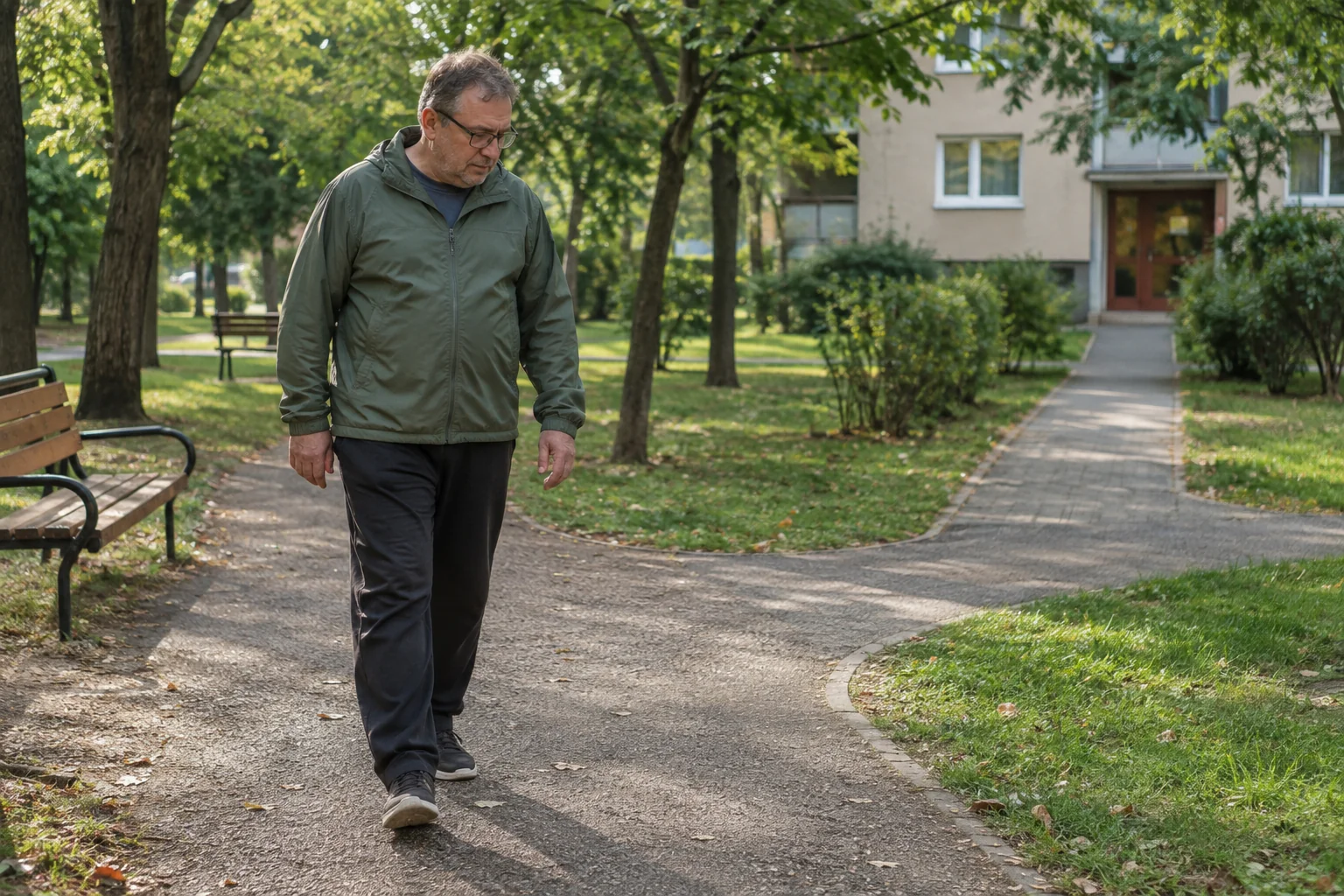
If your steps catch in more places than usual, you become unsteady on smooth ground too, or repeatedly need to hold on, take the change in yourself forward alongside your description of the environment. NICE NG249 supports assessment that considers falls history and individual factors. Not every case requires the same examination or help.
For a more precise account, use a separate sentence for the location and the symptom. For example: “The surface was damaged, but lately I also feel less steady elsewhere.” This neither establishes a diagnosis nor hides new information. Together, the two can help keep subsequent decisions from revolving around a single assumed cause.
With sudden illness, injury or serious new symptoms, do not focus on collecting route defects. Stopping safely and obtaining appropriate help matter more. Letting the running goal temporarily recede while the unsteadiness is clarified is also a meaningful decision. You can still retain your own intention to be active outdoors later.
The route towards running need not cross the most difficult pavement
In planning, separate the experience you want from the particular place you have previously associated with it. If the aim is time in the park or company, another entrance, time or form of movement may provide access. Letting go of a familiar route does not automatically mean abandoning the entire goal.
A change becomes useful when you can identify what it improved. Fewer crossings, better sightlines, a calmer start or an easier journey home are separate outcomes. Better conditions need not immediately be rewarded with a longer distance or faster movement. An appropriate environment’s first value is making the chosen outing easier to organise.
This way, you neither treat the pavement’s condition as a personal judgement nor hide your own unsteadiness behind the environment. Both have a place in the decision. The next step can be an outing appropriate now, with professional assessment where needed—not overcoming obstacles at all costs.
Sources
WHO: functional ability and the environment; WHO: guide to age-friendly cities; NHS: falls and prevention; NICE NG249: assessing individual falls risk. Checked: 20 November 2026. The site checklist is our own editorial aid, not a building standard, accessibility certification or clinical test.
How Futószív articles are prepared: our editorial guidelines.