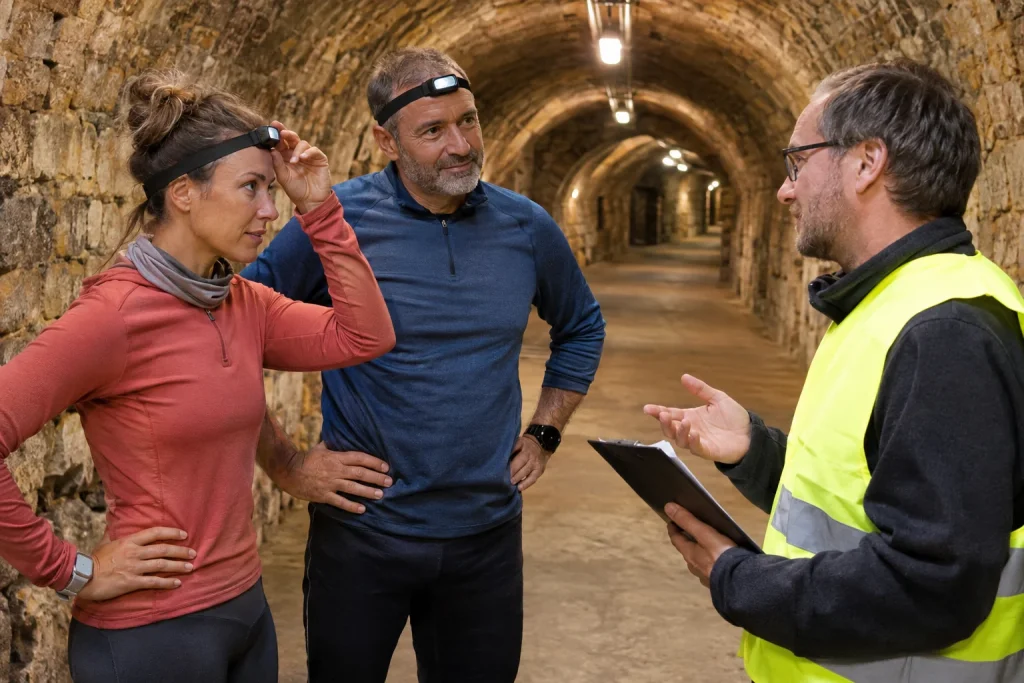
The name underground run promises an unusual location, but on its own offers too little to plan participation. A marked race course through a cellar system, a guided cave tour and a surface race with a short tunnel section are not the same programme. Before deciding, understand the specific event’s environment, course and equipment conditions.
An unusual venue does not require guessing at unknown dangers or bringing an entire equipment shop. It requires precise questions for the event organiser. The following checking method is our own practical aid for choosing an organised event. It is not intended for independent underground exploration, caving or assessing individual health suitability.
Look for the type of venue alongside the event name
Popular descriptions sometimes use cave, tunnel and cellar as atmospheric language. For the actual venue, however, it matters which area is used and within what organised programme. The Kőbánya cellar system, for example, is a historically developed network of underground passages associated with human use. The section used by an event does not mean every passage is freely accessible.
The official 2024 Cultural Heritage Days Kőbánya venue page described the cellar system’s history and its own visiting conditions. This is information for an earlier visitor programme, rather than a running-race announcement. Its entrance, access arrangements or conditions must therefore not be assigned automatically to a future running event.
For visits to a natural cave, look for different, location-specific rules. The Duna–Ipoly National Park cave-visiting etiquette draws attention to respecting natural features and visiting arrangements. A video of an underground run is not an invitation to run independently in another cave or leave the designated area.
Use the specific edition’s detailed information as the basis
On the organiser’s website, check the event’s full name, year and date, then the details attached to your chosen race. A page may still contain a previous year’s detailed programme while a new date has already been announced elsewhere. Do not combine the two sources into one complete set of race information.
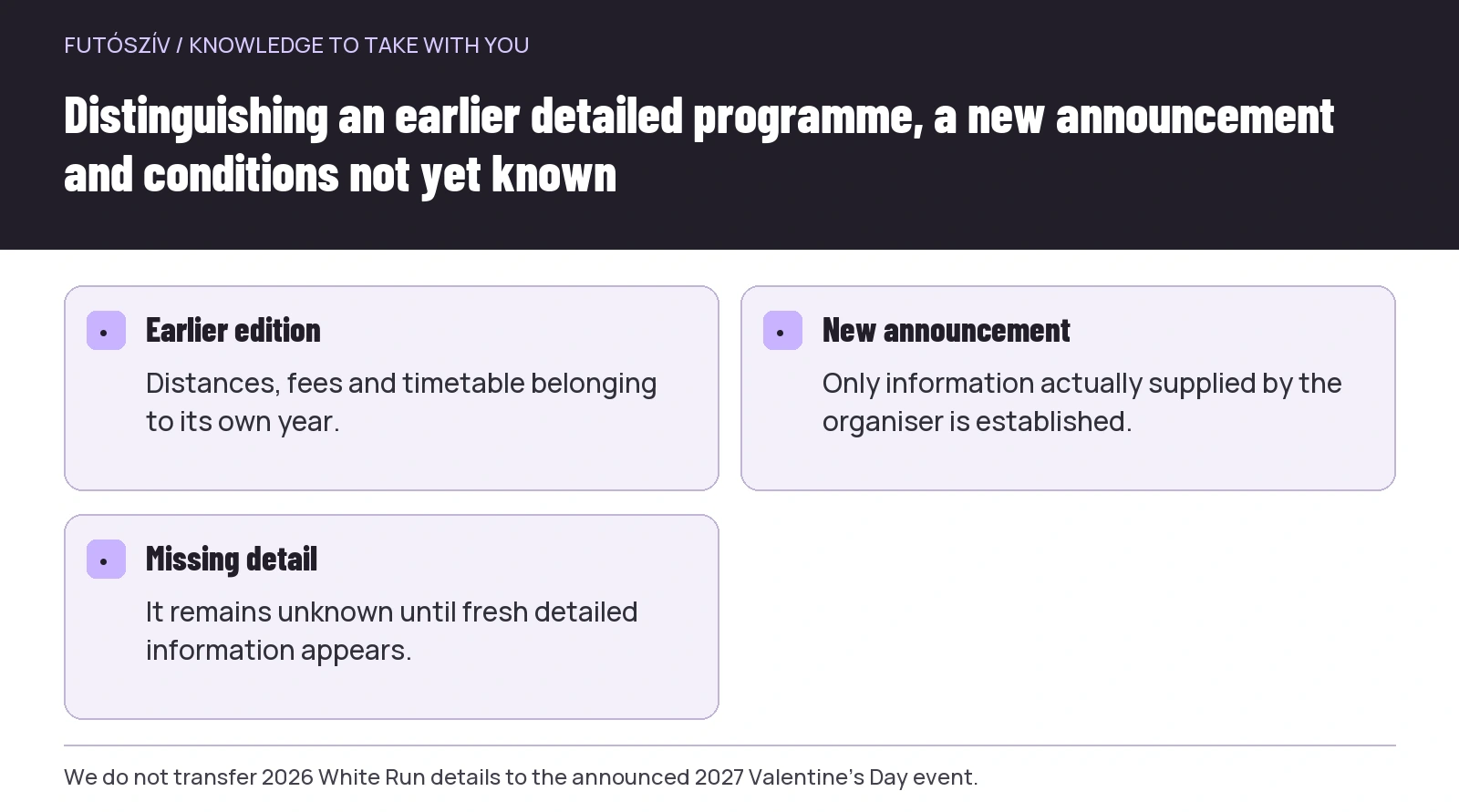
A good example of separating years is the 2026 BBU Underground Run page presented under the name White Run. Its detailed programme belongs to an event that has already taken place. In the organiser’s report of 11 November 2026 , a Valentine’s Day Underground Run was subsequently announced for 14 February 2027. The new date does not establish the old distances, fees or start times.
Keep the checking date in your own notes too. If only an announcement exists so far, unknown details should remain unknown. Do not fill them with an estimate from a secondary calendar or equipment carried over from an earlier year. Final participation decisions can be made when the appropriate edition’s detailed conditions are published.
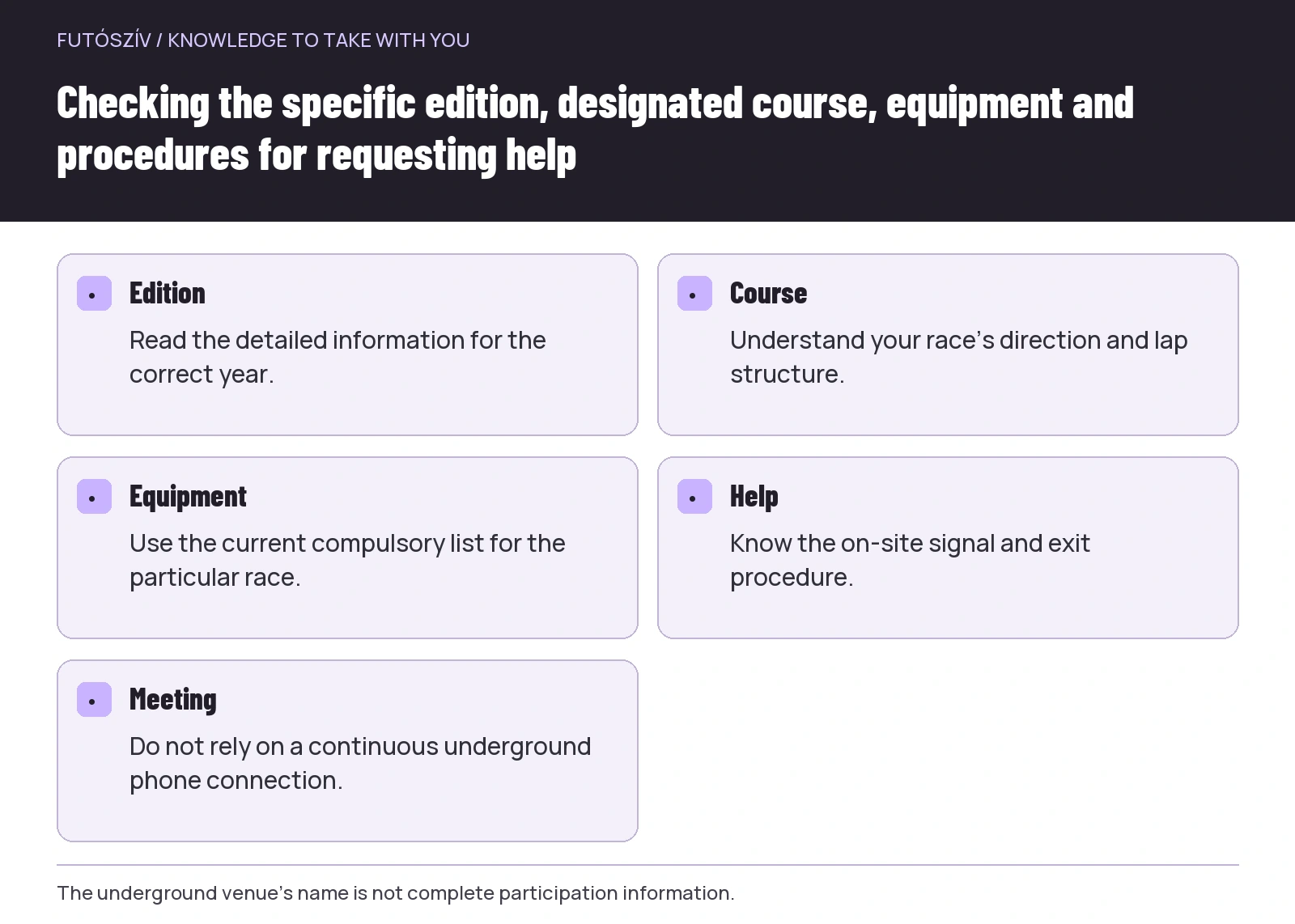 Enlarge diagram
Text version of the diagram
- Edition
- Read the detailed information for the correct year.
- Course
- Understand your race’s direction and lap structure.
- Equipment
- Use the current compulsory list for the particular race.
- Help
- Know the on-site signal and exit procedure.
- Meeting
- Do not rely on a continuous underground phone connection.
Find out how much of the full distance is underground
The race distance’s name is not necessarily the length of the tunnel section. There may be surface and underground sections, several laps or different routes for different races. On the map, check entry and exit points, lap structure and designated direction. You do not need to know every passage, but understand how your own race works.
If the event has several laps, clarify the relationship between lap count and total distance too. The distance shown on your everyday running watch may not, on its own, determine when you have finished the organiser’s designated course. Official markings, lap-counting procedures and organiser instructions belong to that event’s system.
Ask which markings and staff assistance cover the route, and how someone should signal if they need help or cannot continue. Searching independently for an exit in an unfamiliar passage is not a good plan. The purpose of on-site information is precisely to have participants follow the same designated system.
Separate compulsory equipment from personal choices
Read the compulsory equipment for the particular race first. Requirements for a headlamp, spare power, phone or other device depend on the event; one event’s list is not a general underground-running rule. If documents disagree, clarify with the organiser which conditions are current. Do not automatically interpret a missing list as meaning all necessary equipment is provided.
Think through the function of your own devices too. A light is useful when it is in appropriate condition, works as intended and is securely fitted alongside the complete clothing arrangement. Decorative lighting is not automatically route illumination. If the event provides its own lighting or imposes use restrictions, follow those.
Test equipment somewhere familiar and calm; do not begin searching the menus of an unfamiliar device for the first time in the passage system. Check switching on, fastening and the actual power source’s condition according to the manufacturer’s description. On site, consider others too; light adjustment should not disturb people around you or the work of directing staff.
You need specific information about the ground and passages
An atmospheric venue photograph is insufficient to assess the walking or running surface. Ask which paving, uneven areas, narrowings, stairs or other transitions appear on the chosen course. Current organiser information can answer this, rather than a visitor’s memory from several years ago. A section opened for another programme is not necessarily the race course either.
The 2024 Heritage Days venue page also mentioned a humid environment and wet walking surfaces for its own visit. This cannot establish the complete ground conditions of a future race. It illustrates why asking specifically about underground conditions is worthwhile. Choose actual clothing and footwear according to fresh event information and your own needs.
Express access requirements at route level as well. Approaching the event centre, reaching the course and exiting after the finish may involve different connections. A general description of a building or event does not establish the usability of all three. Request a detailed answer if a condition is essential for your participation.
Clothing belongs to the whole day
Alongside the underground part, include travel, surface sections and waiting before the start. A single temperature figure for the course is not a complete clothing plan. Your own base clothing, any costume and compulsory equipment should work together for access and movement too.
If choosing themed clothing, check whether it covers your light, race number or vision. A large prop can affect others in narrower sections and at the start. Clarify costume permission according to event rules. An organised, impressive setting is no reason to start in an outfit with functional problems.
Know how you will access your bag and any change of clothes after finishing. Baggage opening hours should fit your whole programme, particularly if you are not following the main race’s timetable. Do not leave something you need for the actual journey home in a closed storage area. Check service conditions for the chosen edition.
 Enlarge diagram
Text version of the diagram
- Earlier edition
- Distances, fees and timetable belonging to its own year.
- New announcement
- Only information actually supplied by the organiser is established.
- Missing detail
- It remains unknown until fresh detailed information appears.
A phone and GPS perform different tasks
Information stored on a device, satellite positioning and mobile connectivity are three separate functions. One working, or a map being openable, does not guarantee the others. Do not rely on constant connectivity or precise personal route recording underground without suitable, specific information.
The official GPS.gov accuracy overview includes indoor and underground use among factors that can impair positioning. This does not mean every device behaves identically and says nothing about a particular mobile network’s local availability. During the race, the marked course and organiser’s system determine the direction to follow, rather than an uncertain device display.
Discuss meeting arrangements outside the underground section with companions too. A known point and the official way to request help matter more than promising continuous location messages. You can learn your phone’s emergency features from the manufacturer’s guide; do not test them by making a real emergency call. Keep the procedure in the organiser’s information retrievable.
Your own question sheet for a first event of this kind
The following table does not substitute for missing organiser rules. It helps separate what you already know from a credible source from what needs an answer. Do not complete unknown information with assumptions simply to make every row appear finished.
| Question | What should you look for? | Who can give a precise answer? |
|---|---|---|
| Which edition? | Year, date and fresh detailed information | The event’s official page |
| What is the course like? | Underground part, surface part and laps | The organiser’s course map and information |
| What is access like? | Start, finish, intermediate passages and exit | The organiser familiar with the particular venue |
| What is compulsory? | Equipment and checks for the particular race | Current race conditions |
| How should I ask for help? | On-site signals and staff procedure | Participant information |
| Where do we meet afterwards? | A shared, accessible point for spectators and participants | Your own arrangement based on the organiser’s map |
Keep the answer with its date and event name. If you choose another race later, review which conditions change with it. A shorter distance is not necessarily the same course for less time, and a walking tour is not simply a slow race. Every participation format can have its own operation.
An earlier video is not a route guide
Images of underground events are easily memorable: an illuminated wall, costume, large chamber or narrower passage. A video, however, shows selected scenes, often from several races and times. A part that looks dark or bright can also differ from what participants experience because of camera settings. Do not use it to decide actual lighting conditions.
Treat archived material as belonging to its own year. BBU’s 2026 report itself describes course renewal, illustrating why an old memory is not a reliable guide. Earlier participation may be useful experience, but new markings, routes and on-site information still need attention. A familiar-looking turn does not authorise leaving the designated direction.
Adapt recording to the event’s arrangements too. If you stop, do not do so in a narrow passage or in others’ way. Do not ask other participants for sudden movements or alter their progress for a better picture. A personal memory works well when it does not occupy the event’s shared space.
Leave room in the decision for participating later
If conditions important to you are still unknown, you do not need to enter immediately. Underground running can remain appealing while you wait for specific information, consider another participation format or choose another event for now. Company and festive themes do not replace information needed for your own decision.
When choosing the event, build on established details: which edition, which race, which marked course and which prescribed equipment. Add your own travel, meeting and finishing arrangements. The unusual venue then becomes an organised programme whose essential conditions you genuinely understand, rather than a series of guesses.
How Futószív articles are prepared: our editorial guidelines.