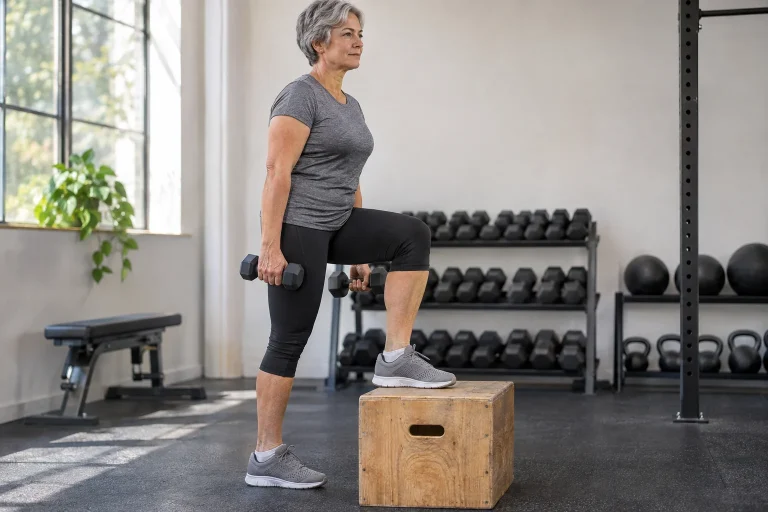
You wear the same trousers and the scales show no obvious change, yet getting up from the dining chair is harder. It is easy to doubt your own experience: if weight has not changed, why would movement be different? To answer, distinguish total body mass, muscle characteristics and how you perform an everyday task. These are related, but provide different information.
Harder standing alone is not a diagnosis. The chair, pain, your condition that day and several health circumstances may play a role. This article helps you avoid dismissing the change on the basis of one weight measurement or starting to diagnose yourself at home. A precisely named experience is a more useful starting point than either extreme.
The scales show an aggregate measurement
Body weight combines the mass of different components. It does not separately answer how strong your muscles are, how movement is coordinated or why a particular activity is difficult. The same displayed value therefore does not prove unchanged physical functioning. Clothing fit is still less a measurement revealing the details of muscle condition.
This does not mean weight is never important health information. An unintentional change may matter, for instance, and weight can have a place in individual care. The problem is unlimited use of one metric. A task becoming noticeably harder is not refuted by scales continuing to show a similar number for another characteristic.
The useful question is therefore not which information is “true”. Weight and movement experience can both be accurate within their own meanings. Neither must mirror the other. They can be interpreted together with other history, especially when a change is persistent, unusual or affects everyday independence.
Muscle size and strength are not interchangeable either
The original Health ABC study reported by Delmonico and colleagues followed measurements related to thigh composition and lower-limb strength in 1,678 older participants over five years. Strength declined more than muscle cross-sectional area; changes were also observed among participants with stable weight. Weight gain did not prevent strength loss by itself either.
The study does not establish how much your muscles changed or prescribe annual deterioration for everyone. These are group follow-up data using specified measurements. The important lesson is the distinction: body mass, muscle size and force production are different characteristics, so none should automatically be used to infer every other.
Getting up in everyday life is more complex still. It requires not only force but organisation of movement, use of the environment and execution suited to current condition. One harder attempt cannot reveal which component changed. This is precisely why observing the actual task helps more than guessing the presumed amount of muscle.
 Enlarge image
What has changed about standing up?
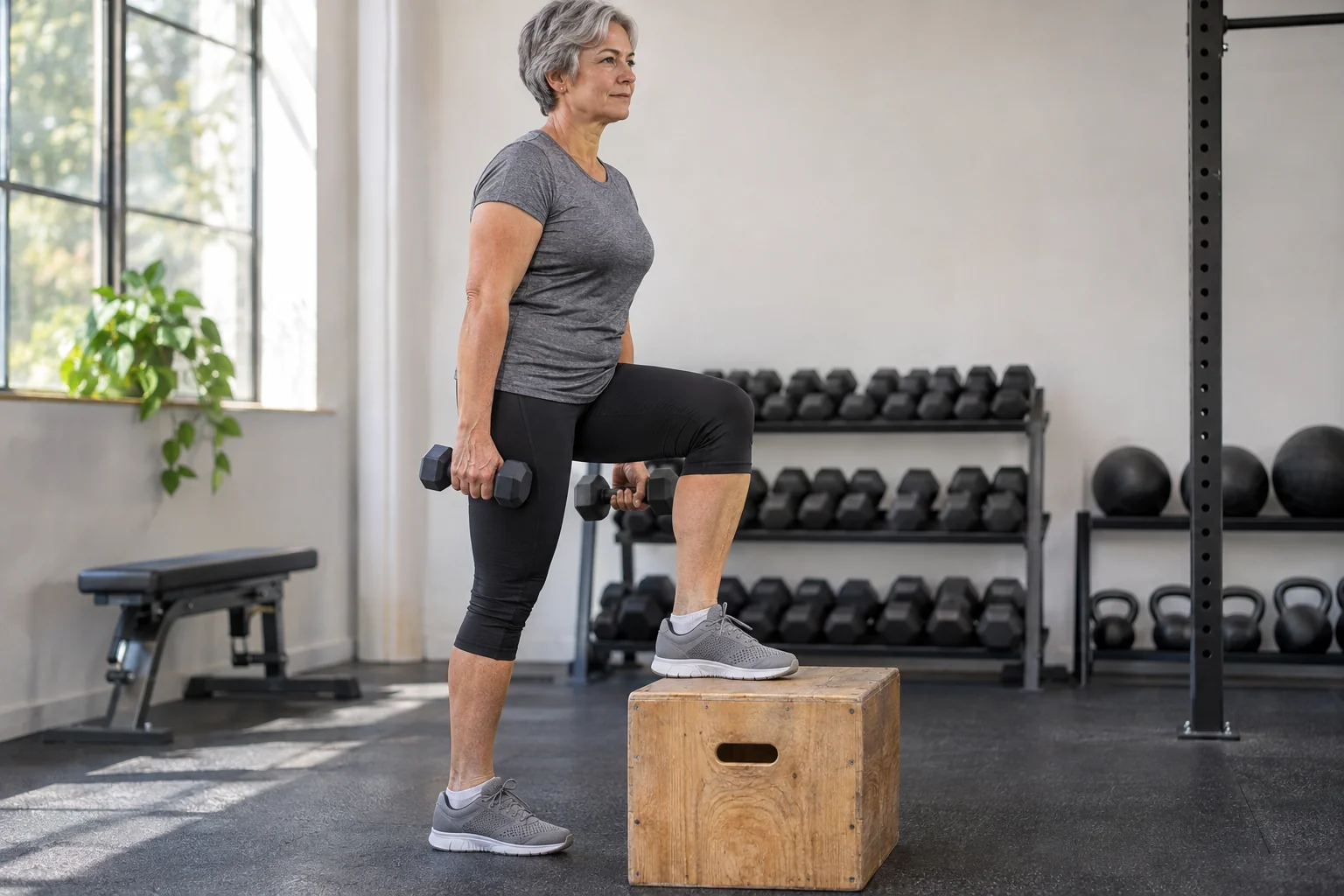
Consider what “harder” means to you. Do you use more support, start more slowly, take care because of pain or become dizzy afterwards? These are different experiences. Calling every difference simply weakness can lose important detail. For interpretation, the phenomenon described in your own words may be more precise than a diagnosis adopted online.
Recall the environment too. Is it the same chair, or have you changed to a lower, softer armchair? Are there armrests, stable support within reach and appropriate foot space? Changed task conditions do not prove physical deterioration. Equally, do not automatically blame the new chair if changes appear in several other situations.
You do not need to provoke the difficulty repeatedly or perform it against the clock. Describing a difference noticed in an ordinary daily situation may be enough to start. Do not abandon safe support for a “cleaner” result. The aim is understanding the experience, not a home competition to beat yesterday’s self.
Why does this not automatically mean sarcopenia?
Sarcopenia is a professional term whose identification requires specified assessment. The EWGSOP2 European consensus gives muscle strength particular importance, with examination of muscle quantity or quality also contributing to confirmation of diagnosis. Clothing, one uncertain attempt to stand or a photograph of body shape cannot establish this.
Professional definitions support appropriate recognition and care; they are not intended for a reader to classify themselves from a few numbers. Measurement methods and execution conditions matter too. An internet calculator or household device does not become the same assessment because it uses a similar name.
Therefore, neither dismiss a possible muscle-health question nor turn it into a certain diagnosis. A persistent functional change may warrant professional assessment, where other explanations can be considered too. The aim is an appropriate answer to the actual problem. Precise observation without a label helps more than confident but unsupported self-classification.
When is prompt help important?
Sudden one-sided weakness or changes in the face or speech may require urgent help; this is not a time to seek a muscle-strength programme. The NHS information on stroke symptoms emphasises the immediate importance of such new signs. Severe illness, serious injury or sudden inability to perform familiar movement are similarly important.
A more gradual change is different, but not negligible. If standing up or several daily activities remain harder, seek appropriate professional advice. Timing, associated symptoms, illnesses and medication changes together can help assessment. Unchanged weight should not be the reason for leaving it unmentioned for months.
If dizziness accompanies standing up, report it separately. Not every such experience concerns muscle strength. Pain, unsteadiness and breathlessness do not mean the same thing either. Naming symptoms separately helps because they do not point to the same solution. “I just need to train more” could close this distinction too early.
Put everyday functioning alongside running kilometres
As a runner, pace and distance can easily become your main feedback. They may matter in sport, but do not describe every everyday task. If a short jog still goes well while standing has become harder, both experiences may have meaning. You do not need to wait for running performance to change before taking the other difference seriously.
The NIA activity information gives separate roles to aerobic, muscle-strengthening and balance activities. One sport working well is therefore not an answer to every task. This is not a call to pile on new sessions immediately, but recognition that an individual movement plan can contain different goals.
The next plan can connect to the activity that actually matters. Using a familiar chair, rising from a low seat and difficulty at the end of a long day raise different questions. A precise goal makes the help received and later change easier to interpret. The aim is not to turn every movement into a sporting result, but make your daily life more workable.
 Enlarge image
What is worth noting briefly?
A few specific details may be enough: when you first noticed it, the situation, whether it is new or familiar and any associated symptom. Mention if another chair or environment makes it easier too. Notes are not compulsory administration, and every rise from a chair need not be counted. The aim is more than a vague impression in the conversation.
| General statement | A more precise personal account |
|---|---|
| I must have deteriorated. | In recent weeks, I have used more support from the same chair. |
| My weight is fine; nothing has changed. | My weight is similar, but standing and stairs differ from usual. |
| I am just weak. | Pain or dizziness also appears during the movement; I will report it separately. |
The more precise sentence does not prove illness. It conveys an observation interpretable with history. A medication change or post-illness period related to the situation is worth reporting too, but do not establish the cause alone. Events coinciding earlier can be important information without being a certain explanation.
The answer should not automatically be a diet or supplement course
If standing is harder, body size does not identify the appropriate solution. Independent food restriction, high-dose products or suddenly difficult strength work could answer a different question from the one actually raised. Nutrition and activity can have roles in an individual plan, but first understand the change and the circumstances in which you experience it.
The NICE recommendation concerning multiple long-term conditions considers daily functioning, individual goals and treatment burden. If you have several care recommendations, a new plan needs to connect with them too. Placing one internet muscle-building tip above them all is unhelpful, especially with a known condition or individual restriction.
An unchanged clothing size can therefore be a simple observation without becoming a health certificate. Harder standing can be an important signal without immediately naming its cause. Giving body size, strength and daily function separate attention tells a more accurate story than any one alone.
If you later change the plan with help, clarify beforehand how you will know whether it benefits the important task too. For example, do you manage more easily at the same familiar dining chair, or need less help in a daily situation? This does not mean independently abandoning support or introducing new tests; individual conditions must remain. Monitoring aims precisely to reveal changes in functioning important to you. Clothing size may change or remain stable meanwhile, but need not be the only proof of everyday progress. Naming the goal also makes a later conversation more precise.
Sources
Delmonico and colleagues: original five-year follow-up of muscle strength and composition, 2009; EWGSOP2: European professional consensus on defining sarcopenia, 2019; NIA: different forms of activity; NICE NG56: daily functioning and individual goals; NHS: stroke symptoms. Checked: 21 November 2026. The description examples do not constitute a diagnostic test or individual training plan.
How Futószív articles are prepared: our editorial guidelines.