A nearby park toilet can matter greatly to someone living with ulcerative colitis who wants to keep outdoor movement as an option. But planning can go wrong if every question becomes a map question. A toilet nearby does not tell us the state of the disease, why symptoms have changed or whether the intended run is appropriate now. A good location can be a practical condition for an individually agreed programme.
This article does not give you ready-made loops or a required exercise dose. It brings together checks to fit an option discussed with your care team to a real place and routine. The aim is to leave fewer surprises to manage alone and avoid expecting a logistical decision to provide medical safety. Being able to change a programme is valuable when cancellation is an option too.
Changes in symptoms come before choosing the loop
The NHS information on ulcerative colitis describes an inflammatory condition of the colon and rectum. Frequent or urgent bowel movements, diarrhoea, abdominal pain and bleeding are among possible symptoms. Quieter and worse periods may alternate. Other symptoms, such as exhaustion, can also make the day harder. Familiar symptoms do not mean every new change automatically has the same meaning.
According to the Crohn’s & Colitis UK information on flare-ups, reviewed in November 2026, worsening symptoms cannot always be explained by how they feel alone. Causes other than inflammation may contribute; the care team and, when necessary, investigations help clarify them. Following an individual care plan and contacting professionals matter when a flare-up is suspected. Shortening a running route is not that kind of assessment.
Before leaving, ask separately whether the current situation fits what you discussed with your clinician. If new or worse symptoms leave you uncertain, you do not have to settle it with a trial lap. A mapping app may tell you about a usable path, not disease activity. A better moment in the morning does not automatically override changes over previous days. Give your care team the timeline you actually experienced.
A nearby toilet and a usable toilet are not the same
A map marker is only the start of planning. Check whether the facility actually operates, when it opens and whether the entrance you expect is accessible. A sports ground’s toilet may be available only during events, while a café may have different rules from a public park. You can ask in advance without disclosing a diagnosis or personal history. ‘When and how can it be used?’ is usually a sufficiently precise practical question.
Do not treat the running path as the entire route. Think through the journey from your starting point to the actual entrance: must you change levels, go around fencing, cross a busy road or queue at reception? A building may be close as the crow flies but awkward to reach. You do not need to turn this into a medical risk score. Simply keep uncertain details separate from checked facts.
Keep the date on which information was checked. A facility open last year may not operate in the same way this year. If using a running club’s map, ask who updated it and when. It helps an organiser to distinguish ‘opening hours confirmed by telephone’ from ‘older map marker, not yet checked’. Such transparency offers more value than advertising a route as suitable for everyone.
 Enlarge image
What makes an outing genuinely easy to shorten?
A short loop is flexible when you do not have to finish it to reach the starting point. Even a small-looking forest loop may be difficult to leave if it has only one narrow gate. An out-and-back route may be simpler, but only if turning back has no organisational or traffic barrier. Look beyond the route’s name to how you can actually reach the agreed place from different points.
The programme includes getting there and going home too. If toilet access in the park is straightforward but a long journey on a fixed schedule follows, the whole day looks different. Consider where your coat, phone, keys and belongings for the journey home will be. You should not have to retrieve them from a group that has already moved on. Independent departure can be organised in advance without making a scene.
| Planning detail | What should actually be clarified? | What remains a separate question? |
|---|---|---|
| Toilet | Opening hours, access, entrance and any payment. | The cause of urgency or bleeding. |
| Interrupting the loop | Where can you turn back, and how do you reach the exit? | Whether running is medically appropriate for you. |
| Belongings | Will you keep your keys, phone and equipment needed to leave? | Changes to medicines or treatment. |
| Company | Who knows if you leave separately or change the plan? | Professional assessment of symptoms. |
| Travel | Is another way home available? | Care needed for new illness. |
You do not need to cover every imaginable scenario perfectly for one afternoon. A useful plan is short and clear: where you meet, how to leave independently, how to signal a change and which questions require another kind of help. If too many details are uncertain, choose another place or day. Attachment to a favourite route need not override your own conditions.
What should you discuss with your care team beyond toilets?
The Crohn’s & Colitis UK information on exercise emphasises current disease activity and symptoms. Much exercise research has involved remission or mildly active disease; evidence concerning high intensity is more limited. The possibility of daily activity therefore cannot automatically be translated into a particular running loop or race. Discuss appropriate conditions for movement in light of your own situation.
Describe the whole outing: the activity you have in mind, travel and waiting involved, whether someone will accompany you and which aspect concerns you. Giving more than the distance makes a precise answer easier. ‘I would like to rejoin the club outdoors, but I do not insist on running’ is a different goal from ‘I must complete a measured distance this Saturday’. Bring your actual decision to the clinician.
Ask separately about fitting existing eating, fluid or medication guidance around the outing. Do not invent skipped meals, reduced drinking or a new medicine schedule to avoid using a toilet. The NHS also emphasises following prescribed treatment and discussing dietary changes with your care team first. A toilet open for long hours does not remove these individual considerations.
If several professionals are involved in your care, keep your current guidance together. This is not to build your own running protocol from it, but to ask about possible contradictions. When deciding about an outing, consider when advice was given and which condition it applied to. Do not automatically treat an old statement from before surgery or a different treatment as an answer for the present.
Privacy can be planned in a group run too
The group does not need your full medical history to respect your requests. Set a simple practical framework: you may change the plan, do not want persuasion and will tell one chosen person if leaving separately. If a companion would accompany you, agree whether they should ask each time. Help remains supportive when it does not become monitoring or unwanted public explanation.
It can also help to ask that a toilet stop not become a joke, a training judgement or a social-media post. Sharing someone’s story without consent may remain uncomfortable later, even if kindly intended. A club can have a general culture where changing a route carries no shame. That does not require every member to know who has which condition.
If you organise, provide information and choices rather than a medical judgement. Explain where a checked toilet is, how long someone will remain at the meeting point and how to reach the group contact. Do not promise a short loop is safe for a particular diagnosis. ‘Someone else has run with this here’ is a community story, not an individual fitness decision.
When does the situation stop being a route question?
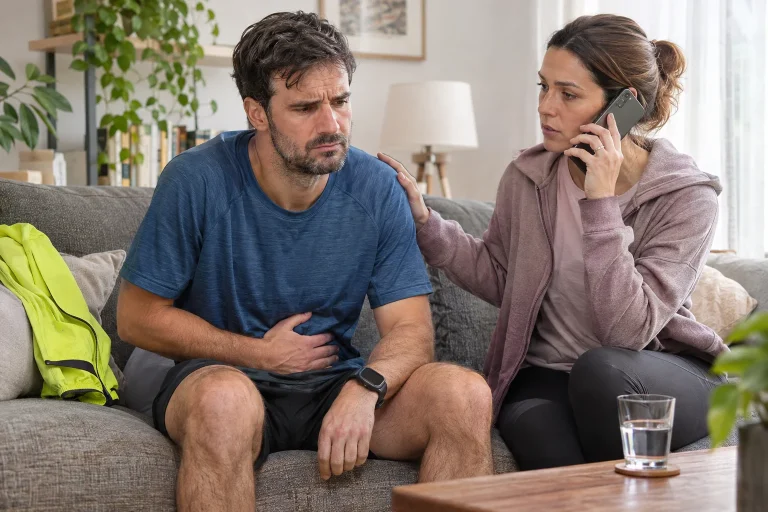
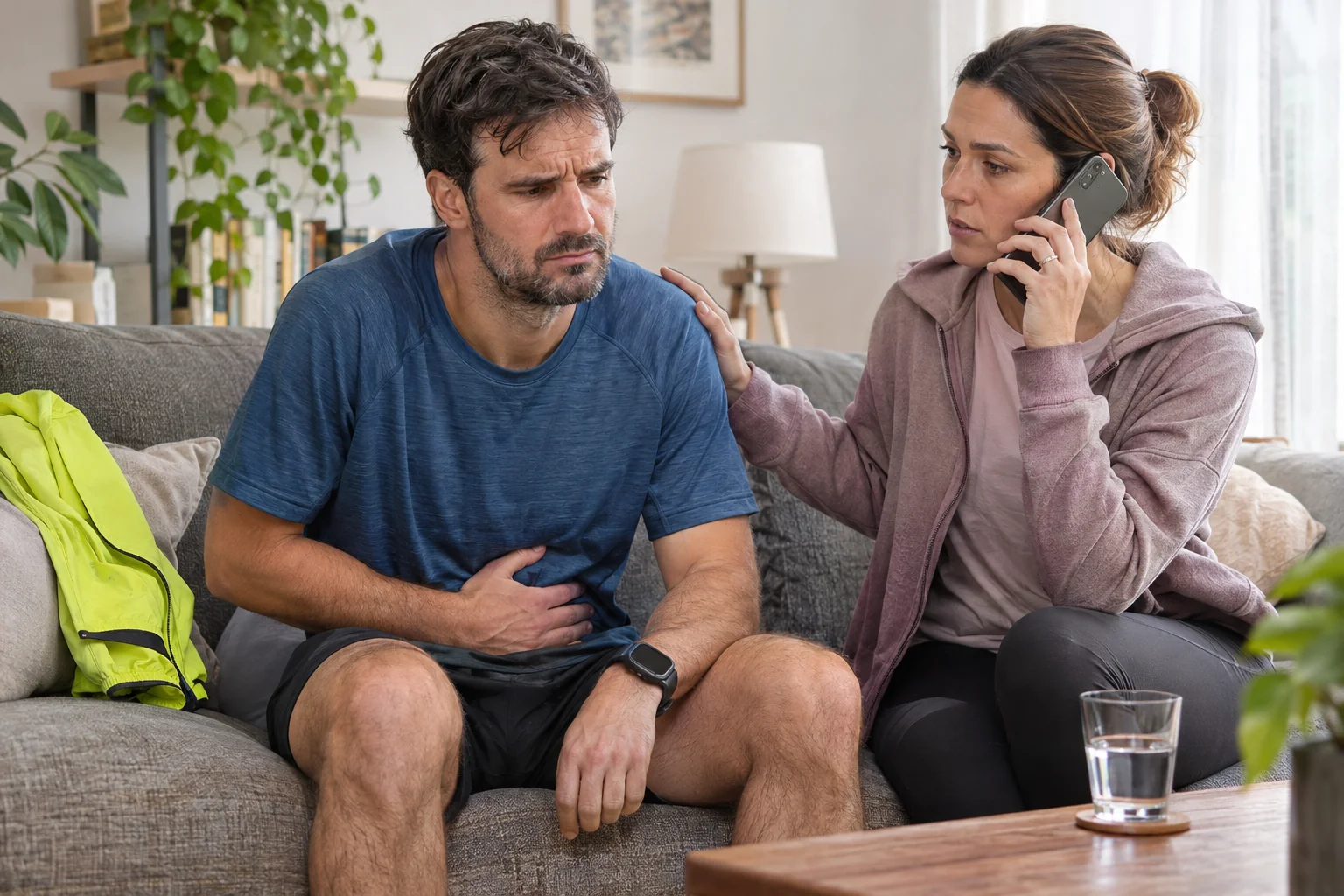
The NHS lists very severe or bloody diarrhoea, fever and a rapid heartbeat among symptoms that may need urgent medical assessment. Severe abdominal pain, continuous rectal bleeding, a large amount of blood or large clots may require immediate help. In Hungary, call 112 for severe illness or immediate danger. The nearest toilet or remaining distance is then not the deciding question, and you do not have to finish the outing on foot first.
A companion does not have to diagnose either. Tell the person providing help where you are, what happened, which symptoms you can see and, if known, that the person has an existing condition. Make the location understandable to a non-runner: an entrance, street, building or another clear landmark can help. A route’s invented app name is less useful. Follow the dispatcher’s instructions rather than letting a group debate decide what to do.
An individual flare-up plan is valuable partly because it can guide contact between appointments. Crohn’s & Colitis UK advises following specific professional guidance already given rather than independently changing medicines; any self-management step applies only if agreed for that situation. A running friend’s suggested product or an internet dose is not such a plan. Suppressing a symptom does not replace assessing its cause.
 Enlarge image
A usable loop is not a loop you must complete
Imagine two afternoons. In one, you find a familiar, easy-to-leave place for an individually agreed option and clarify changes with your companion in advance. In the other, you have a new symptom but intend to go because the route is well planned. The same park may feature in both; a good map does not make the health circumstances equivalent. Logistics support an appropriate decision, rather than manufacture permission.
Your note can be brief: what you checked, what remains open and what became the next topic for discussion. You need not log every toilet visit as public workout data or measure the day’s value against others’ distances. If the outing is cancelled, the location information may still be useful later. Flexibility means actual freedom to decide: your condition and guidance remain ahead of completing the loop.
Sources
How Futószív articles are prepared: our editorial guidelines.