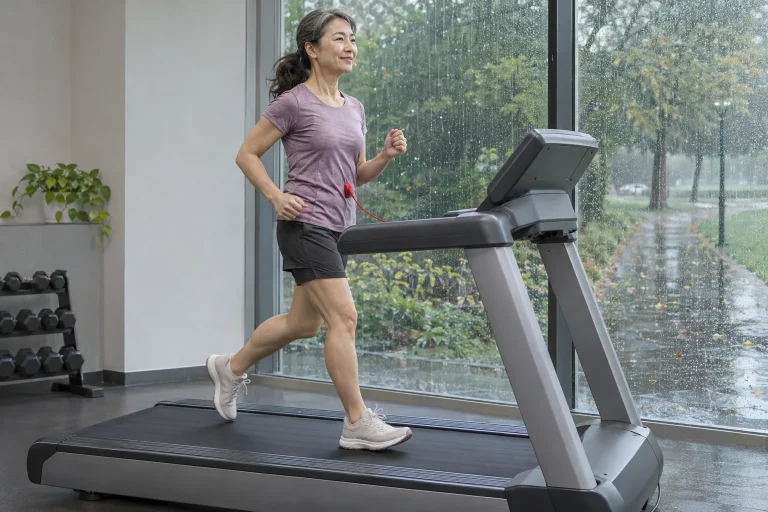
At home, you switch on a series, start the treadmill and get some exercise. The next day, you get dressed, step outside, reach the park and run your usual route. The two sessions might last a similar time, yet feel very different. That difference need not come from a single mysterious switch in the brain: setting off, the focus of your attention, the space, your movement through it and the meaning you give the activity can all change together.
That is why the question of why treadmill running in front of the TV does not feel the same as running outside deserves an answer in several layers. Indoor exercise can be convenient and enjoyable, while an outdoor outing may offer something a programme cannot. Neither establishes a ranking that applies to everyone. The more interesting question is what makes that particular session feel easier, freer or more demanding for you.
The transition before exercise can be part of the experience
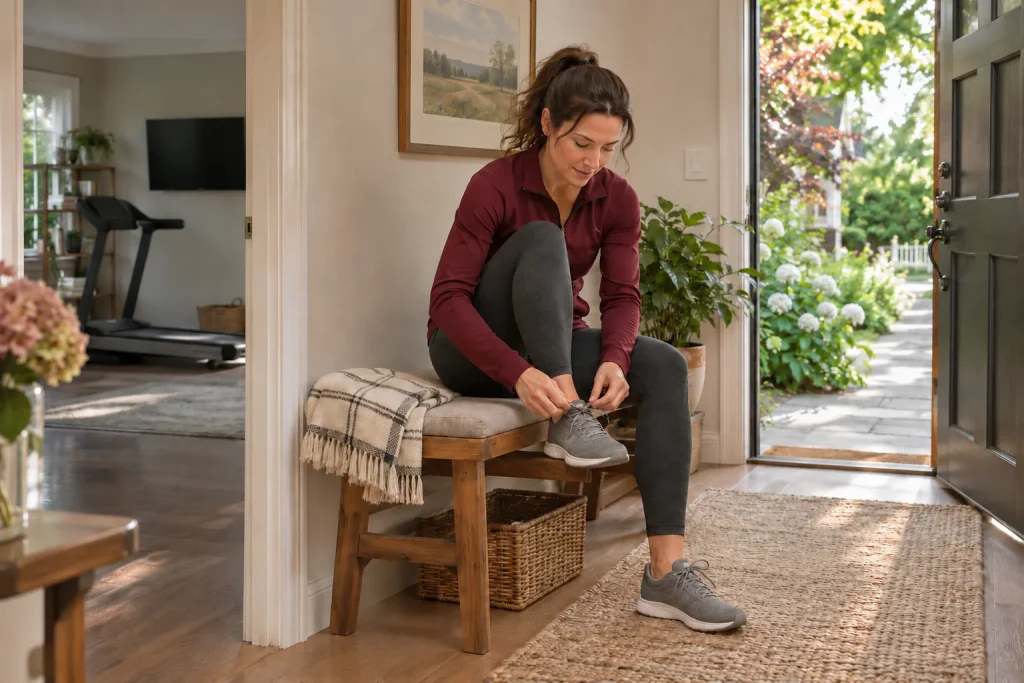
An outdoor run often creates a clearer transition from the rest of the day. You put a household task aside, choose clothes and step into a different space. For some people, getting ready is a pleasant way to settle into the activity; for others, it is an obstacle to starting. It is unhelpful to give it the same meaning for everyone. Something that helps you leave work behind one day can feel like an unnecessary burden when time is short on another.
At home, there may be less distance between everyday tasks and exercise. That is an advantage when time is limited, but it may also make it easier for your mind to stay with your to-do list. The dishes or a reminder of unfinished work may be beside the treadmill. This describes an everyday situation, not a proven harmful effect of the home environment; you can equally develop pleasant, distinct exercise time in your own home.
If you enjoy getting ready, you can keep part of that experience indoors: choose a separate time and outfit, or let yourself and the people you live with know when you will exercise. There is no need to turn it into a compulsory ritual. The aim is not to force a psychological effect, but to create a framework that makes it clear to you when your own exercise time begins and ends.
A programme can direct attention elsewhere
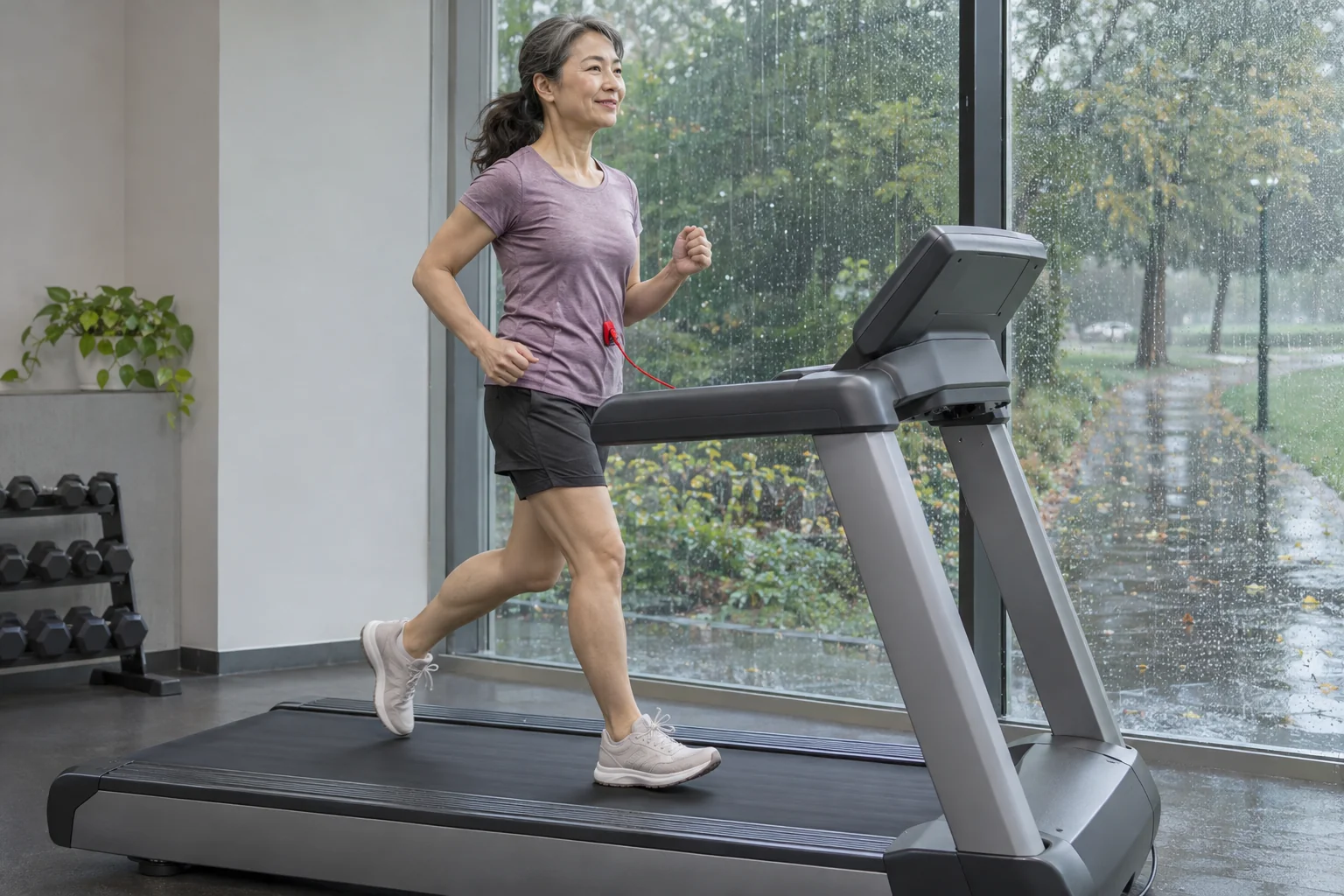
Hutchinson, Karageorghis and Jones studied 24 participants on a treadmill under music, combined music-and-video and control conditions at two relative intensities. With combined sound and visual stimulation, they reported greater external attentional engagement, lower perceived exertion and a more favourable emotional response. The study concerned specific experimental media, not a complete comparison of every home television programme with outdoor running.
As you follow a story, characters, plot twists and sounds can occupy your attention. Movement may then recede into the background when you describe the experience: afterwards, you mainly remember what you watched. That can be pleasant if you enjoy combining the two activities. At other times, you may miss having exercise feel like an activity in its own right, rather than an accompaniment to another story.
Diverting attention is not the same as ignoring your body’s signals. A favourite programme is no reason to exercise longer or harder than planned, or to continue with symptoms. Nor is the aim to forget completely about the moving machine. Using the equipment safely and noticing your own condition remain necessary, regardless of your attentional experience.
 Enlarge image
Outside, you also adapt to your surroundings
In a park, the view changes as you move. A bend opens onto a different space, you let other people pass and you adapt your movement to the surface and route. The surroundings are not a pre-edited programme watched from the same viewpoint. For some people, this brings variety and a sense of being present; for others, it demands more attention. An outdoor experience is therefore not necessarily less demanding simply because it is called more natural.
A real place also has unpredictable elements. A favourite route may temporarily be crowded, the weather can alter conditions, or you may have to go another way. You can enjoy variety and want predictability at the same time. Sometimes choosing a more readily planned indoor session does not reject an experience of nature; it is a decision that fits that particular day.
The two situations can also offer different kinds of freedom. Outdoors, moving through a place and choosing a route may matter; at home, easy access and being able to stop may matter more. There is no need to declare either universally freer. It is more precise to say what you use each option for and which limitation bothers you. Your choice can then reflect your actual needs rather than an imagined ideal running lifestyle.
Why is it difficult to separate everything in one study?
In a crossover study comparing mountain walking, treadmill walking and sitting, the outdoor activity produced more favourable results than the indoor one on some emotional outcomes. Participants took part in sessions lasting approximately three hours, and the machine could not reproduce the descent on the mountain return route. The study illustrates how comparisons of environments cannot always be fully separated from differences in the movement task itself.
A series at home and a park can differ in even more ways: the content, route, air, social setting, circumstances of setting off and even the exercise load you choose. If one session felt better, it is difficult to say exactly how much was due to the TV or the place. Your personal experience remains valid, but claims about its causes need care.
This does not mean the question cannot be answered. Individual details can be studied: the effect of a particular video, the usability of a route or a difference in the social setting. Everyday decisions, however, do not always require every detail to be isolated. It may be enough to recognise the combined experience you want that day, without attributing an all-explaining effect to a single component.
The meaning of clothing and setting off is personal
Putting on running clothes may bring back previous sessions, social experiences or a favourite route. For one person, tying their shoes marks the end of the working day; for another, it is simply a practical task. There is no need to invent a special hormonal explanation for its meaning to matter. Your personal story can be part of exercise in its own right.
Equally, you do not have to expect getting ready to produce a reliable surge of motivation. You might still feel little enthusiasm after dressing and ultimately choose something else that day. Clothing is not an emotional switch that must produce the same response every time. If a helpful habit accumulates too many rules, it can easily become another task. It can stay simple and flexible, according to your day.
Indoor exercise can develop its own meaning too. A familiar corner, carefully reserved time or favourite content may signal that you are now doing something for yourself. You do not have to treat a home session as an incomplete version of an outdoor run. It can have its own setting and value even though it naturally cannot provide some other experiences, such as travelling along a real route.
Being alone and being around others are separate questions
In front of the TV, being alone can be pleasant, or exercise can feel lonely. In a park, you might enjoy other people’s presence without speaking to anyone, but a crowded route can also be irritating. Physical location and social experience are not the same variable. It is therefore worth asking whether the indoor setting really is the issue, or whether you would prefer to share a session with another person.
If you want to exercise with others, there may be outdoor or indoor ways to do it, depending on what the place and equipment actually allow. If quiet time alone matters more, you need not replace it with a group activity simply because other people find that motivating. Your needs can change during the week. A mix of different sessions may work well, and every exercise session need not serve the same social role.
When describing your experience, two separate sentences can help: what the place was like, and what it was like to be alone or alongside other people there. This can make it easier to notice what you would like to change. A new route will not necessarily meet a need for company, just as a shared session will not automatically make an environment you find difficult more pleasant.
 Enlarge image
A favourite programme is more than a distraction
A series, concert recording or other content may interest you in its own right. Enjoying it alongside exercise does not necessarily mean you are trying to escape running. Two favourite activities can meet, and using your time this way can be practical for you. You do not have to justify the choice by claiming it certainly produces better psychological effects than every alternative.
At other times, the emotional world of the content may not suit the session. A tense story can absorb you without leaving you feeling calmer afterwards; rapid visual changes may bother you. These possibilities remind us that ‘TV’ is not a single, uniform stimulus. The particular content, how you use it and your own preferences all matter, so a laboratory result cannot be applied unchanged to every programme.
Set up and search for content, and adjust devices, from a stable position before starting to move or after stopping. A programme is not worth creating an attentional task that interferes with safe use of the machine. Seeking a more pleasant experience can remain simple: choosing to switch the screen off is a valid option too.
What can you do with your own different experiences?
If getting ready and going to the park gives you a feeling you value, take that seriously. You do not have to prove that a single study has already explained the whole phenomenon. If the treadmill and a favourite programme fit your day well, you do not have to portray that as less real exercise either. A personal preference can be clear without becoming a universal law.
Naming the differences helps when it makes the next choice easier. Perhaps the treadmill is not the problem; moving straight from work means the session does not feel like your own time. Perhaps you are not bored with the park, but find the journey there difficult to organise. Changing the framework, choosing another time or alternating between the options may help. These are editorial suggestions, not interventions demonstrated to work for everyone.
The two running experiences may therefore remain different because two different sets of events come together around the movement. In one, the screen, home environment and easy access may dominate; in the other, setting off, moving through a place and the real surroundings may come to the fore. You do not have to make them identical. You can use what each situation actually offers and allow different kinds of exercise to feel right on different days.
Primary sources and interpretation
Hutchinson, Karageorghis and Jones: See hear: psychological effects of music and music-video during treadmill running, 2015. Experimental sound and visual conditions at two relative intensities; the findings do not apply to all home media.
Niedermeier and colleagues: Affective responses in mountain hiking, 2017. Comparison of combined outdoor and indoor walking programmes with different route conditions. The examples about getting ready and everyday choices are our own editorial interpretations. This article is not based on our own experiment or documented medical review.
How Futószív articles are prepared: our editorial guidelines.