
You want to get faster, run more, improve descending and strengthen more regularly at once. By the weekend, every goal has received a little attention, yet the organising purpose remains unclear. Choosing a main emphasis for a training period can create order. This differs from compressing many hard sessions into a few days, and does not require developing one ability in isolation.
Sport uses “block” in several ways. A simple thematic phase of a few weeks is not necessarily the concentrated block periodisation examined in research. Always inspect actual content to understand a programme.
A main emphasis helps you choose
A useful block goal is brief and assessable: making the weekly routine predictable, for example, or gradually exploring a target race’s terrain. “Improve everything” provides too little guidance about each session’s purpose.
An emphasis does not forbid other movement. It helps decide what develops, what is maintained and what can wait. Available time and recovery are finite, making priority a genuine programming decision.
For consistency, stable appointments may matter more than new intensity. For trail preparation, technique and location knowledge may lead. A block is not valuable because you choose the hardest-sounding quality.
What does block periodisation mean in the literature?
Issurin’s overview describes successive, more concentrated development of selected components, contrasting with traditional organisation targeting several abilities in parallel. High-level athletes’ preparation problems form much of the background.
This means more than giving your diary a four-week theme. Concentrated load, maintaining other capacities and timing may require professional planning. Especially intense blocks should not be copied directly from a study.
Clarifying emphasis can help recreational runners, but a method’s label does not automatically make a programme appropriate. First understand your starting point and purpose, then choose the tool.
Research does not show one winner
The cycling study by Rønnestad and colleagues found favourable results with more concentrated organisation. Participants were well-trained cyclists, with a specific intense load distributed differently. This is interesting, not a beginner-running prescription.
A later twelve-week cycling study found no performance advantage between block organisation and well-designed traditional organisation. Total load and actual programme content matter. Together the studies provide more nuance than either title alone.
A smaller comparison study involving runners also examined different periodisation models. Limited numbers and chosen outcomes cannot establish a reliably superior method for every runner. Read research with its conditions.
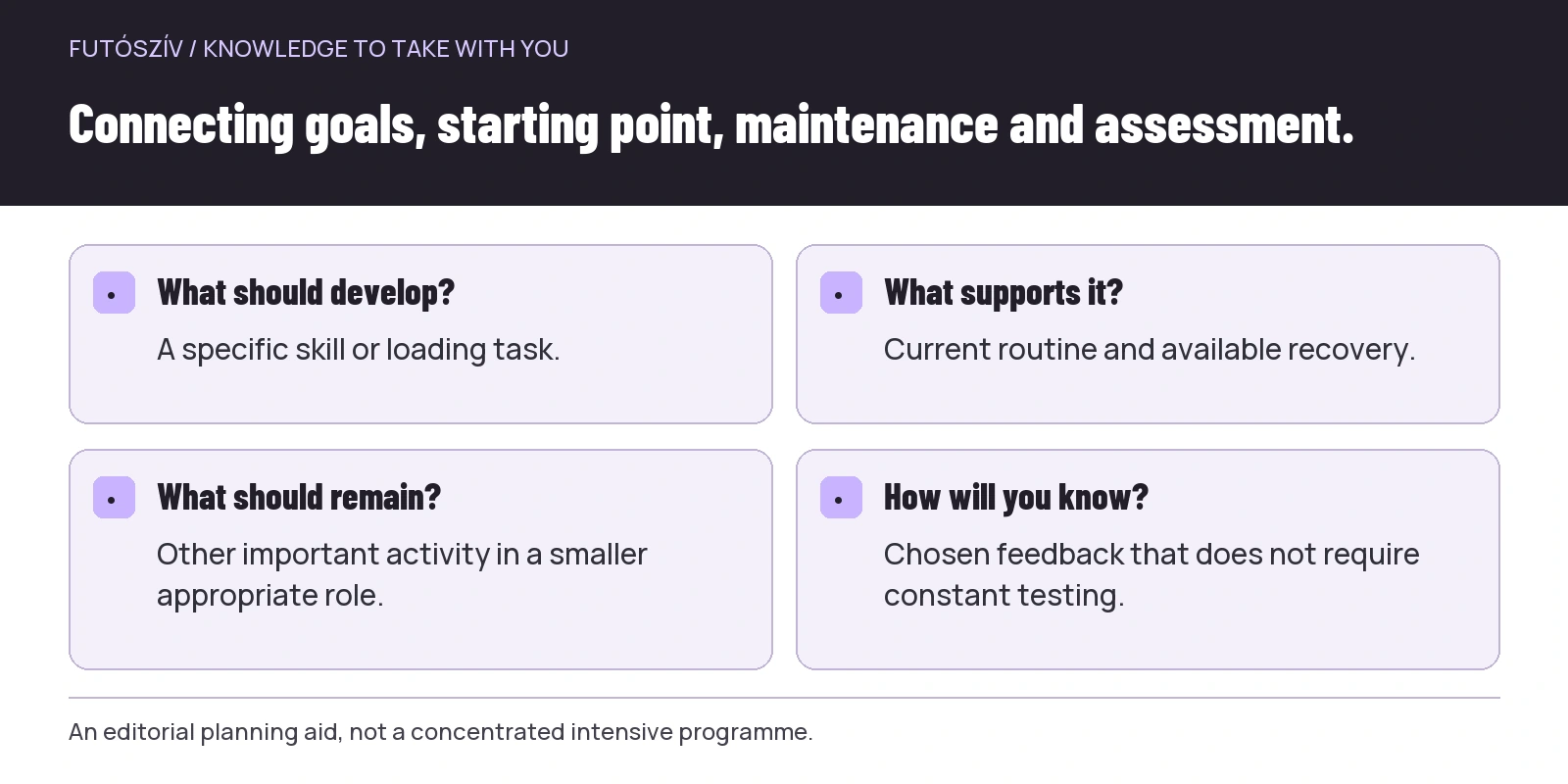 Enlarge diagram
Text version of the illustration
- What should develop?
- A specific skill or loading task.
- What supports it?
- Current routine and available recovery.
- What should remain?
- Other important activity in a smaller appropriate role.
- How will you know?
- Chosen feedback that does not require constant testing.
At the start, examine your foundation
Describe current run frequency, approximate duration and unfamiliar tasks. With an irregular routine, other organisational questions probably matter more than a concentrated hard block. Last week’s record is not necessarily a stable starting point.
Account for demands beyond sport. Busy work, travel or little sleep create different conditions from a quiet period. A planned block start does not oblige you to begin on that day at any cost.
With illness, injury or persistent symptoms, first ask which movement is appropriate. A periodisation model cannot decide that. Individual medical or physiotherapy planning may be needed.
Choose a goal genuinely needing particular attention
Make it specific enough to change weekly decisions. Terrain adaptation needs an available setting; consistency needs manageable appointments; pace awareness needs more than reviewing averages afterwards.
Write what is not the current goal too. You may not want simultaneously to increase running days, longest run and fast-work volume. This is not a season-long prohibition, but allocation of present attention and load.
Clear purpose also helps decline accidental extras. An invitation or appealing race may be enjoyable, but consider whether it fits the phase. Every interesting event need not enter immediately.
Maintenance work is not zero
Giving an ability less attention need not mean abandoning it. Sporting history and goal shape proportions. Maintenance matters particularly when preparation involves several activities or technical skills.
An endurance emphasis can still include learned strength tasks; a technical phase still has room for comfortable running. Quantities are personal programming decisions, not numbers supplied by a label.
Do not secretly turn maintenance sessions into additional main tasks. Adding a little extra everywhere can return you to the original problem: too much of everything and a lost emphasis.
Concentrating intensity requires particular caution
Several intense days in research do not mean anyone can safely try the sequence. Participant preparation, monitoring, sport and recovery all form the setting. A self-made dense week is not the same intervention.
If a coach proposes a concentrated period, ask the rationale, prerequisites and signs prompting change. Know what follows the harder phase too. Planning includes observing responses, not merely delivering load.
Do not treat pain, worsening wellbeing or unusual illness as compulsory block companions. Higher goals do not justify ignoring health warnings. This article gives no clearance for intensive loading.
What shows a phase is working?
Choose observable signs beforehand. A consistency block concerns a manageable routine; a trail phase may concern route knowledge and more predictable movement. More even pacing can be valuable in pace practice.
A maximal test every week is unnecessary. Testing is load too, and weather or fatigue affects current results. Simple repeated observations suited to the goal often provide more useful information.
Include the cost: fatigue, organisational difficulty and missed sessions. One improved metric does not establish long-term suitability.
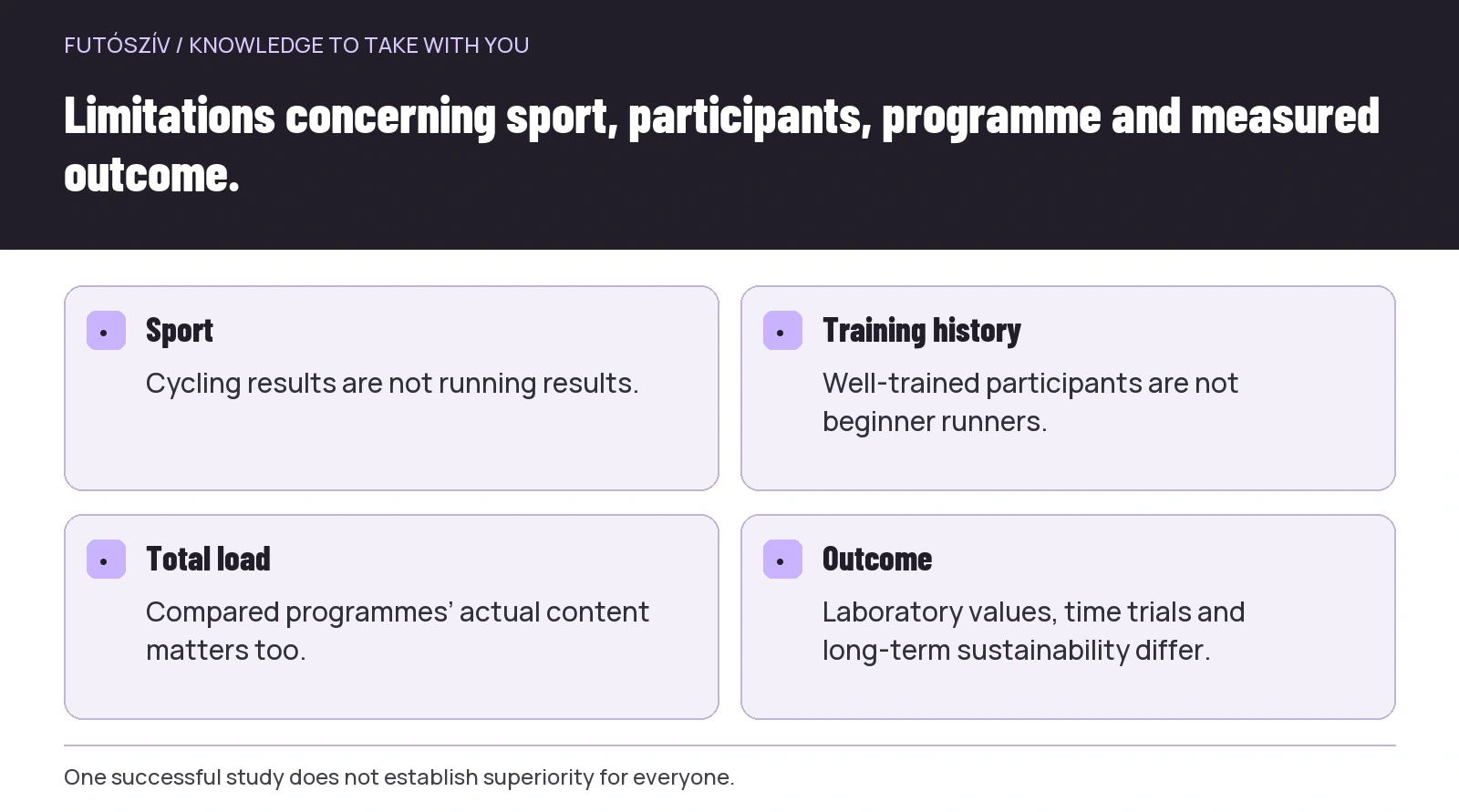 Enlarge diagram
Text version of the illustration
- Sport
- Cycling results are not running results.
- Training history
- Well-trained participants are not beginner runners.
- Total load
- Compared programmes’ actual content matters too.
- Outcome
- Laboratory values, time trials and long-term sustainability differ.
A thought experiment: technical emphasis on trails
Imagine an experienced road runner choosing a trail event. A thematic period might gradually explore route reading, changing ground and descending. The main change need not be increased weekly mileage.
Familiar flat running and learned strength work may remain alongside easier trail outings, adjusted to overall demands. Progress is more than covering the same path faster. More confident line choice and fewer unexpected stops matter too.
This is a planning example, not a ready-made block. Surface, elevation, duration and frequency depend on the individual starting point. An emphasis makes decisions clearer.
Do not let the calendar alone end the block
A planned date helps, but review reality. If illness or travel removed most of the phase, the same next step may not be justified as after completing every session. Build from actual history.
Even success does not require immediately making things harder. Consolidating a habit or reducing load may be right next. Change should have a purpose beyond novelty.
Record three things at closure: the goal, what happened and what you carry forward. Later, this supports personal experience rather than merely choosing new method names.
When two goals compete for the same time
List each goal’s location, equipment and time-of-day needs. Track training and technical trail practice may both fit only one free evening. You may need an organisational priority rather than a physiological theory.
Decide which task can wait until another phase and which can remain in simpler form. The block then creates room for present priorities rather than merely renaming an overcrowded week.
What to ask your coach
Why this emphasis now? What remains maintenance? Which task can change when I am tired? How does this connect to the next phase? What will show it is time to progress? Such questions make a programme understandable.
A method not fitting daily life is important professional feedback too. A theoretically interesting block is unusable if it requires continual rushing or insufficient sleep. A good plan serves the athlete rather than proving the model.
Sources and editorial note
This article cites a conceptual overview and three comparative studies with different participants. Differing findings are not treated as proof of one method for everyone. Scenarios are our own editorial thought experiments, not concentrated training programmes or rehabilitation advice. Sources checked: 18 November 2026.
How Futószív articles are prepared: our editorial guidelines.