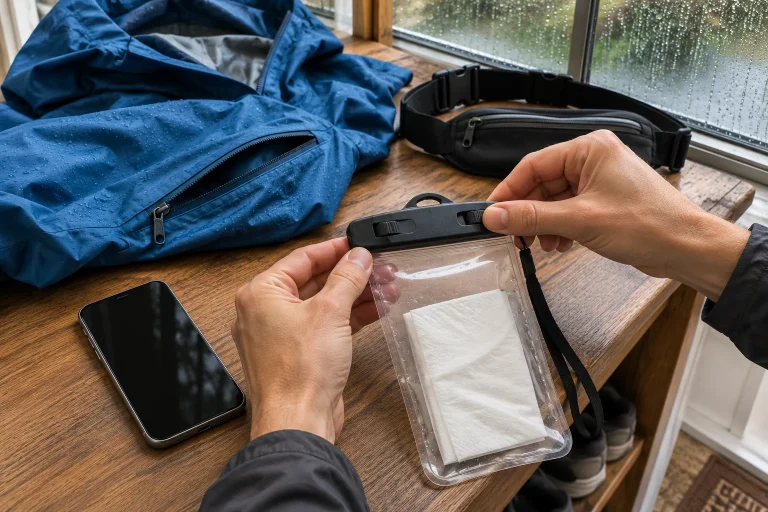
The hourly forecast displays 30% beside a rain symbol. Can you fit in an easy loop, should you bring a jacket or leave later? Before using the number, read three accompanying details: which place, which period and which precipitation event it concerns. Without them, the percentage is an incomplete sentence. It does not independently specify how many minutes rain will last or how wet you will become on the planned route.
Probability is not an enemy of planning a run. It helps show that possible weather can be considered through more than one apparently certain icon. The examples below make the percentage meaningful, then connect it with your own outing. Calculations are explicitly labelled editorial mathematical examples: they are not actual forecasts, models fitted to Hungarian weather or a general departure threshold.
The provider names the event whose chance you see
The Met Office public explanation defines its hourly table as the chance of at least 0.1 millimetres of precipitation within an hour, and gives at least 0.3 millimetres for a three-hour display. The US National Weather Service PoP explanation concerns at least 0.01 inches, approximately 0.25 millimetres, at a particular location during a specified period. These examples show why your own service’s definition matters: threshold and time window are part of the data.
The 30% therefore first belongs to a defined event. Do not quietly replace it with another question, such as whether you will certainly see a drop sometime or your top will become uncomfortably wet. A measurable-precipitation threshold and personal comfort are separate concepts. Clothing, route duration and current surroundings may influence experience, while the forecast percentage alone supplies no personal result for these.
If using several apps, record precipitation type, accumulation threshold and time window alongside the provider in a short comparison note. Do not begin by accepting whichever number is larger or smaller. You may be comparing different events from the outset. Forecasts may still differ after checking details, but you will at least avoid automatically calling a difference between an hourly and half-day figure an app fault.
30% is not thirty per cent of your run or a designated sequence of rainy minutes
Thirty per cent of an hour is arithmetically eighteen minutes. This is correct multiplication, but not interpretation of precipitation probability. An event’s chance does not imply rain for precisely that many minutes of the hour. Met Office information specifically notes that precipitation may last longer or occur in a short intense spell within the period. Probability of rain occurring and its timing once it occurs provide different information.
Likewise, thirty per cent of the running loop does not become a predetermined wet section. You move along your route, while the forecast concerns a specified space and time. A percentage draws no dry detour and identifies no tree where rain will begin. For spatial information, consult the appropriate map layer, official text information and current situation; the percentage cannot simply be laid like a ruler over a GPS track.
| Common reading | Why does it not follow? |
|---|---|
| Rain lasts exactly eighteen minutes of the hour | Probability is not the proportion of rainy minutes |
| The first or last thirty per cent of the loop will be wet | The number does not identify such a route section |
| If it rains, it will only be light | The chance of occurrence differs from intensity |
| Your clothes remain seventy per cent dry | Personal wetness is not the named forecast event |
Prefer a complete sentence: With this provider, at this place, within this time window, the chance of the defined precipitation event is 30%. This may initially seem more cumbersome than glancing at an icon, but you need learn your system’s meaning only once. Recognising details then becomes quicker. Precise interpretation does not promise weather will never surprise you; it helps you start from the information the app actually provides.
 Enlarge image
Your hour of running may cross two forecast windows
Leaving at 15:30 and returning at 16:30 does not necessarily match a single displayed hourly cell. First check whether the time shown begins, ends or otherwise defines the period. The Met Office, for example, interprets precipitation chance from the stated time until the next period. We do not automatically copy this to other providers: your interface’s time handling determines the meaning.
Do not halve an hourly percentage merely because you will be outside for half the hour. An event chance for the complete window generally does not reveal how risk is distributed across its two halves. Several temporal situations can produce the same aggregate chance. Further information at the relevant time resolution would be needed. A minute-by-minute map slider on a phone does not itself prove that the underlying data are that precise.
Add preparation, waiting and getting home to the route time if these also take place outdoors. At a club meeting, for example, the measured hour of running is not all your time outside. This simple organisational detail changes which forecast periods deserve checking. The outing description then approaches the actual situation more closely than matching only the watch’s recorded activity duration to one cell.
Two successive 30% figures do not automatically make 60%
Let A mean the defined event occurs in the first hour and B in the second. The chance of occurrence at least once depends on their joint relationship as well as individual chances. In our mathematical example, both hours have 30%, yet different combined situations can be constructed. The following table illustrates only that relationship; no row represents observed weather frequency or a precipitation model recommended for use.
| Imagined relationship | Both occur | Neither occurs | At least one occurs |
|---|---|---|---|
| They always occur together | 30% | 70% | 30% |
| Mutually exclusive events | 0% | 40% | 60% |
| Events explicitly assumed independent | 9% | 49% | 51% |
In the last row, assuming independence gives a probability of no event in either hour of 0.7 × 0.7 = 0.49, so occurrence at least once is 1 − 0.49 = 0.51. The calculation is detailed precisely to keep that assumption visible. Two displayed weather percentages do not automatically give independence. Without appropriate data on the relationship between hours, do not present 51% as a ready two-hour running forecast either.
In this two-hour mathematical setup with 30% in each part, the chance of occurrence at least once can fall between 30 and 60%. This is not a forecast uncertainty band for today’s actual run; it shows the logical limits of the two numbers alone. Practically, seek an appropriate forecast issued for the whole period rather than substituting home addition for missing information. Spatial relationships along a moving route may add further questions.
A smaller chance does not necessarily mean a smaller consequence
Read the event description alongside the probability. The HungaroMet precipitation explanation, for example, discusses chances of exceeding separate accumulation thresholds and different aggregation periods. The chance of a multi-day event exceeding a specified amount differs from an hourly display with a low precipitation threshold. Comparing two percentages is therefore insufficient; their underlying events would need to match too.
Your route and options also matter in a decision. Changing an appropriate outing near home may require different organisation from changing a distant route that is harder to leave. We derive no universal rule to set out below a certain percentage. Ask what you prepared for, what other conditions are reported and what you can actually change. Do not use precipitation chance to override storm warnings, closures or information about flooded sections.
Name beforehand what changes your plan. It may be an unusable route, official warning or an environment unsuitable for your outing. These need not be compressed into one percentage boundary. Packing a jacket is only an equipment decision; it does not mean preparation for every precipitation situation. Probability remains part of gathering information, while a full decision involves further details specific to the outing.
One rainy occasion does not rate a percentage forecast
The ECMWF statistical guidance assesses reliability through the relationship between many forecasts and observations. What matters is how often events assigned the same probability occur over a longer series. A single rainy occasion forecast at 30% does not establish that 30% was definitely wrong. Verifying a probabilistic forecast differs from holding one certain yes-or-no claim to account once.
You can note what you checked before departure and what happened, but would first need to record the same event. I got soaked differs from a provider-defined precipitation threshold being reached at a fixed place within a time window. A moving runner’s subjective note is a useful personal memory, rather than a standard weather-measurement series. Recognising this clarifies the diary’s value: collecting preparation lessons, rather than necessarily ranking providers.
The ECMWF probability-interpretation guidance also emphasises that increases in percentages on preceding days cannot be projected linearly. If the same future time showed 10% two days ago, 20% yesterday and 30% today, tomorrow’s 40% does not follow. Use new valid information in planning rather than predicting the next app display from an earlier change. An update may incorporate new information rather than simply continue a number sequence.
 Enlarge image
Read five details together before deciding on the running outing
First identify place, second the validity period and third the event threshold. Fourth, check update time and accompanying text information. Fifth, add your whole outing: where and when you will be outside, along which route and with which modification options. This original practical reading routine can become a brief thought process after a few uses. It does not require a lengthy analysis before every session.
The meaning of 30% then becomes more than a riddle beside a rain icon. Treat it as a defined event’s chance, separate it from duration and intensity, and avoid unjustified aggregation for your loop. Rain or dry weather may still occur on that occasion. More accurate interpretation changes how you prepare for possibilities: instead of one scenario believed certain, you plan with appropriate information and a usable alternative.
Sources and the origin of the numerical examples
Met Office: What does this forecast mean? – definitions and time handling for its hourly and three-hour precipitation chances. National Weather Service: What Does Probability of Precipitation Mean? – PoP according to its own threshold and period. HungaroMet: precipitation explanation – accumulation thresholds and periods. ECMWF: statistical assessment of probability data; ECMWF: interpreting probability. The two-hour table and accompanying calculations are original mathematical illustrations, rather than actual weather forecasts or measured frequencies.
How Futószív articles are prepared: our editorial guidelines.