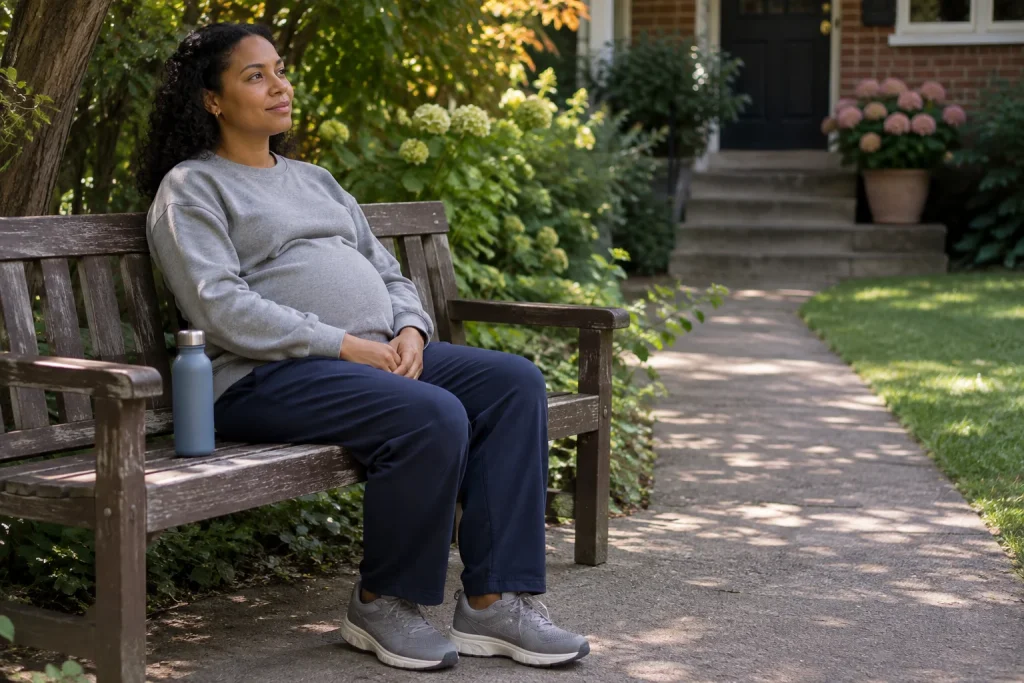
Being able to shorten an activity now has value in its own right
In the third trimester, the best movement is not necessarily what you can calculate precisely in advance. Often a more usable option is something comfortable to start, adaptable if needed and safe to finish. Shortening can be part of the original plan rather than merely an emergency solution.
The Pregnancy, Birth and Baby information on the third trimester allows a place for safe, gentle activity towards the end of pregnancy. Individual maternity circumstances remain decisive, however. No general calendar date means compulsory cessation of running or unchanged continuation for everyone.
Reconsidering goals is practical work now: what supports wellbeing, which route is manageable, when help is needed and what fits the rest of the day. Former performance is an important past, not a compulsory weekly task list for late pregnancy.
Discuss current condition, not only past running
Tell your maternity professional which activities you actually do: running, walking, water-based movement, strengthening or a combination. Alongside frequency and effort, symptoms during or after movement matter. Advice from an earlier pregnancy stage may change with new information.
The Pregnancy, Birth and Baby material on sport also emphasises accounting for changes in comfort and balance. If movement feels uncertain or uncomfortable, stop and reassess. Previous skill does not automatically resolve every new situation.
An individual plan can clarify which activities remain, which need adjustment and which signals mean stopping. Moving by feel works when you know which symptoms should not be met with further experimentation. Attending to personal signals together with appropriate professional boundaries provides meaningful freedom.
Small loops can make a worthwhile outing
Choose somewhere you can decide whether to continue between several short sections. Going around a nearby park or taking a short walk is not valuable only when the watch shows a large distance. Its advantage may be continuous access to home, a toilet or a place to rest.
Agree with a companion beforehand that reaching the furthest point is not the aim now. If they want longer, arrange a meeting point from which you can continue separately. You then need not fit your comfort to someone else’s training plan, while retaining the shared section.
The loop should have a safe surface and good visibility. Steps, uneven ground, slippery sections or crowded traffic may require different attention from before. Reducing risk does not necessarily mean abandoning activity entirely: it often means selecting the location and form appropriately.
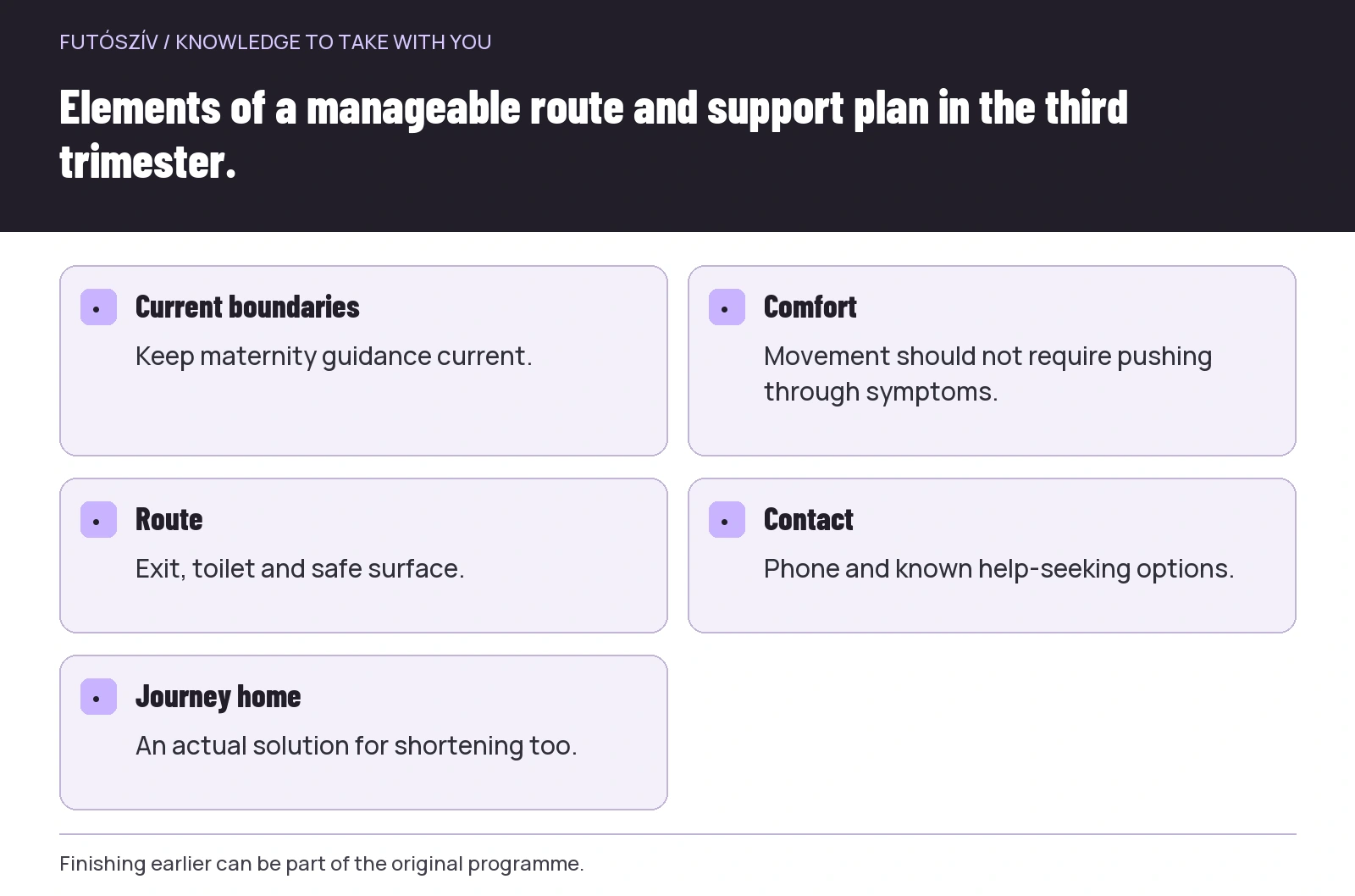 Enlarge diagram
Text version of the diagram
- Current boundaries
- Keep maternity guidance current.
- Comfort
- Movement should not require pushing through symptoms.
- Route
- Exit, toilet and safe surface.
- Contact
- Phone and known help-seeking options.
- Journey home
- An actual solution for shortening too.
Walking and other easier movement are not running substitutes
If running is no longer comfortable, another activity fitting your plan can be a choice in its own right. You need not target the same duration or calories burned as former training. General activity recommendations are not intended to assign precise replacement quantities to every omitted running kilometre.
The UK Chief Medical Officers’ recommendation counts various everyday and recreational activities as movement. Smaller sections fitting personal health circumstances can have a place too. The sports programme and the day’s other activity together form the actual demands you undertake.
If maternity care specifies restrictions, general goals need not be met at any cost. Ask what is permitted and why. Individually narrower temporary boundaries do not deny movement’s health value; they are a decision suited to the situation.
Effort should be manageable relative to the present
Old pace, session duration or heart-rate zone may mean something different now. If reaching a familiar figure requires straining, you need not continue for the watch. Unusual breathlessness, dizziness, pain or weakness during movement is a signal requiring assessment, not a performance fault.
Choose a companion who accepts slowing and finishing. Encouragement to do just a little more can conflict with current aims. Agree beforehand that shortening does not require proving a new justification.
If the rest of the day becomes difficult after activity, reconsider next time’s demands too. Mood during movement alone does not distinguish an enjoyable outing from complete exhaustion. Sleep, daily tasks and opportunities to rest belong to the feedback too.
Changed baby movements should not lead to a home sports test
The NHS information on baby movements states that feeling less movement than usual, no movement or a change in the baby’s usual pattern requires immediate contact with maternity care. Do not wait until the next day, even at night. Clarify local contact details beforehand with your maternity provider.
There is no identical daily movement count for every baby that guarantees reassurance. Change from your own usual pattern matters. Do not use a running watch, another walk or another home test to decide whether everything is all right.
The NHS also does not regard a home heartbeat listener as a reliable way to check the baby’s condition: assessment may be needed even when a heartbeat can be heard. Do not delay seeking help through reassurance from your own device. If you notice change again after assessment, report it again.
Contractions, fluid leakage and new back pain: why does timing matter?
The NHS page on premature labour lists regular contractions before the thirty-seventh week, period-like pain, unusual backache and vaginal trickling or gushing fluid as signs requiring immediate contact with maternity care. Stopping running alone is not sufficient assessment.
A runner need not determine whether this is genuinely labour or amniotic fluid. State gestational week, symptom onset and progression. The provider organises appropriate assessment from the current history and advises on next steps.
The NHS page on signs of labour also distinguishes situations. Do not turn general information into a home rule requiring walking around or waiting a certain time first. You can seek advice when uncertain too, particularly for a new symptom.
Do not address pain and bladder-control symptoms solely through kit
If pelvic pain, pressure or bladder-control difficulty appears during running or walking, tell maternity care. A new strap, tighter trousers or a pad may be practical additions in some situations, but do not replace assessment of the symptom’s cause and appropriate exercise demands.
Describe which movement troubles you: turning, stairs, longer walking or running strides. Specific functioning helps determine appropriate advice or physiotherapy support. You need not keep forcing a movement to prove the symptom sufficiently.
Pelvic exercises may need individualisation too. A general video or advice to always brace harder does not answer every symptom. If an exercise is uncomfortable or uncertain, request feedback on technique and suitability.
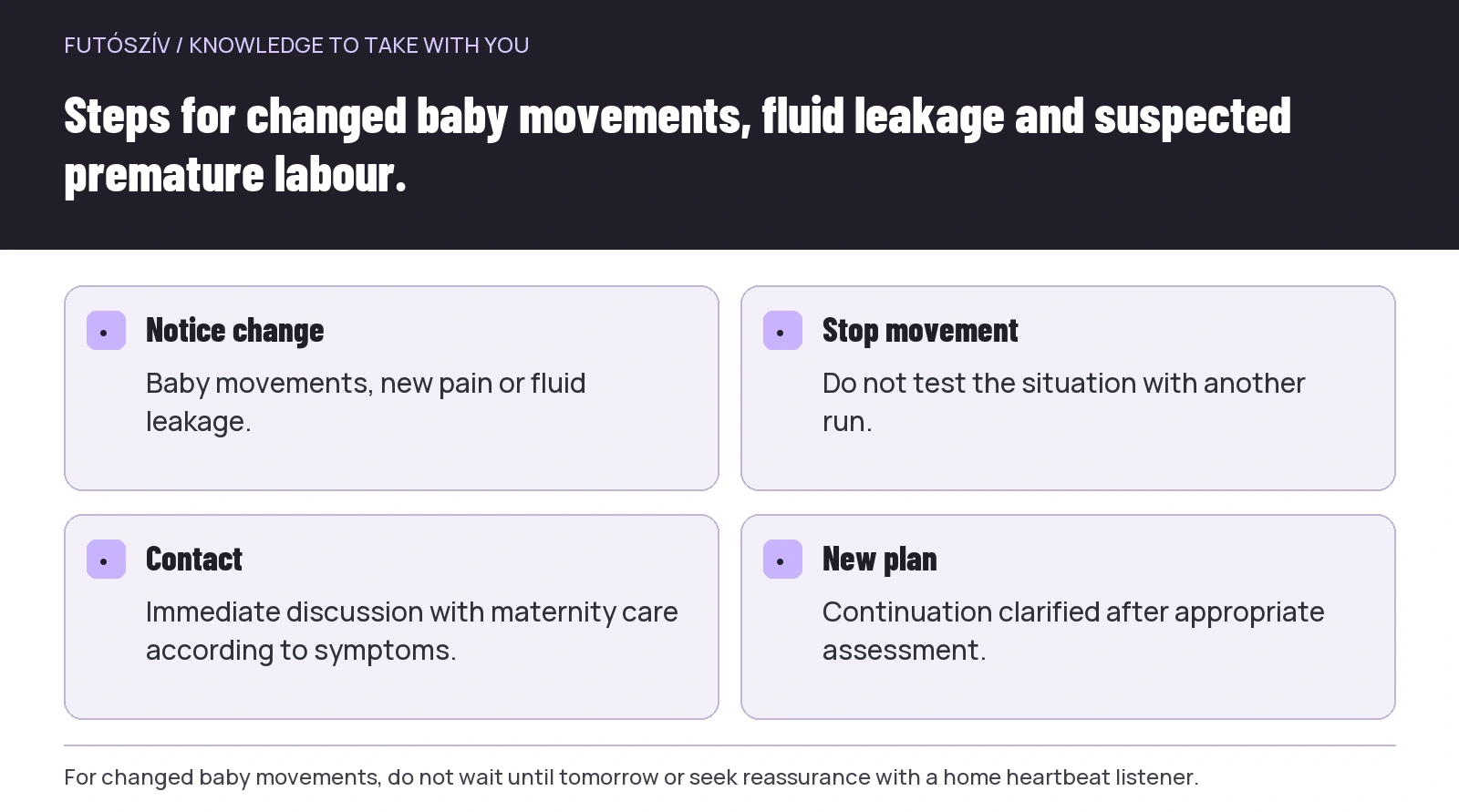 Enlarge diagram
Text version of the diagram
- Notice change
- Baby movements, new pain or fluid leakage.
- Stop movement
- Do not test the situation with another run.
- Contact
- Immediate discussion with maternity care according to symptoms.
- New plan
- Continuation clarified after appropriate assessment.
Plan logistics for turning back too
Carry a phone and know your location if help is needed. An easily described meeting point or known park entrance is simpler than a distant trail difficult to explain. A companion should also know your maternity contact and which care unit you belong to.
If clothing, shoes or a bottle are hard to position comfortably, simplify. A short outing does not require long-run equipment. Keep water, an appropriate layer and personal necessities accessible without unnecessary luggage creating new pressure points.
The journey home should not depend solely on your companion continuing. If finishing earlier, have an actual solution rather than a long solitary wait beside the route. This planning particularly helps when daily life already includes many organisational tasks.
You can choose a participation goal instead of a race goal
If previously entered for an event, reassess distance and starting now. A decision fitting your health plan may be postponement, transferring entry, supporting or missing it entirely. A paid fee need not become an argument overriding current condition.
Belonging to the community does not depend on one race number. If you want to see others, organise a shorter comfortable programme. If rest feels better now, it has a place too. Your decision need not be compared with another pregnant athlete’s performance.
Preparing for birth is not a race awarding a higher score for retaining running volume until the end. Movement guarantees neither a particular birth experience nor rapid recovery. Choose current activity for present wellbeing and appropriate maternity care.
A short discussion before the next week
- Has health condition or maternity guidance changed?
- Which movement is comfortable now, and which causes symptoms?
- Where can you easily shorten, find a toilet and return home?
- Whom do you call for a new symptom or changed baby movements?
- What should remain the week’s aim if the former sports programme is unmanageable now?
This review may produce a smaller but better-working programme. You need not decide the entire remaining period beforehand. Maternity care and personal experience allow the coming days’ plan to change again.
Running life can have temporary, open-ended periods too
In the third trimester, a predictable weekly plan is often less important than flexible participation. Comfortable movement, accepting support and appropriately reporting important symptoms can form a meaningful routine together. Every day need not finish as a sporting result.
A personal plan for later return can wait until birth and actual recovery are known. The usable aim now is keeping movement possible where appropriate, without attaching failure to finishing or seeking help. A shorter route can also be a complete, good decision.
Sources and further reading
- Pregnancy, Birth and Baby: Playing sport during pregnancy
- Pregnancy, Birth and Baby: Third trimester
- NHS: Your baby’s movements
- NHS: Premature labour and birth
- NHS: Signs that labour has begun
- UK Chief Medical Officers: Physical activity for pregnant women
How Futószív articles are prepared: our editorial guidelines.