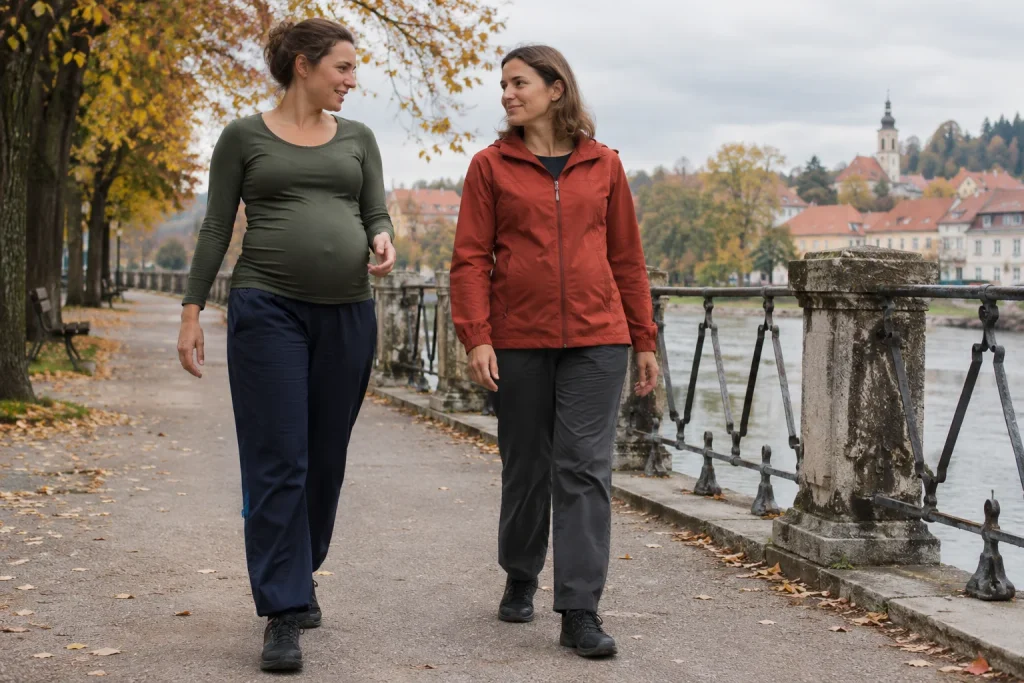
Your old pace may remain familiar while reaching the top of a hill in the same time feels very different today. During pregnancy, continuity on the map and watch can be particularly misleading: the same route, shoes and running partner, yet activity requires fresh questions. The talk test is a simple reference point. It needs no laboratory, but does not automatically make activity appropriate.
This guide concerns interpreting the test and communicating around it. The aim is not to obtain permission to run through one sentence, but to make how you feel during an activity already discussed individually less open to misunderstanding. Discovering that today calls for walking, a shorter outing or a different programme is also a valuable outcome.
What is the talk test, and what are you observing?
The NHS pregnancy exercise information illustrates moderate intensity partly as being able to talk but not sing. This is an everyday description of effort, not assessment of fetal condition or an obstetric screening test. It also notes that feeling unwell, overheating or discomfort can be reasons to stop. The NHS practical description should be read alongside individual circumstances.
Talking here means real communication. Tossing out a single yes differs from telling a companion you would prefer to turn back at the next junction. Using one rehearsed word loses the useful information: how natural does conversation feel now? You do not need to count aloud, sing or compete over who can say the longest sentence. Those can turn a simple observation into a separate task.
Choose a short everyday sentence, such as ‘Let’s decide at the next bench whether to continue.’ This is a communication example, not a validated Hungarian test sentence. We attach no score, word count or permitted number of breaths. The aim is to notice change, not make permission to slow down depend on completing the sentence.
Saying a sentence successfully is not clearance to run
The CDC links modifying pregnancy activity to discussion with the care provider; general guidance for healthy pregnant people is not personal approval for every situation. Previous running and starting a new intensive sport are not the same question either. The CDC overview provides a framework without knowing your circumstances.
An important order follows. First clarify whether the activity is an option in your situation and with which individual adjustments. The talk test can then help orient you during the outing. It cannot work backwards: telling a story easily while walking or running does not invalidate an earlier restriction.
Keep these on separate lines in your notes. One records the personal discussion: which activity, under which conditions and when to consult again. The other records today’s observation: how talking went, whether changes were needed and what differed from usual. An intensity signal then does not slip into the role of a medical decision.
Why not use it to justify an old kilometre pace?
Imagine two purely illustrative situations. One day, you converse with a partner on a quiet, flat section with no reason to hurry. Another time at the same place, your phone flags a pace difference and you are already explaining why you should be faster. The talk test can become an excuse in the second case: instead of asking how you feel, you ask whether the sentence remains possible at the chosen pace.
A practical solution begins with stating goals. Instead of ‘keep my old loop’, choose an intention allowing modification: ‘during the agreed activity, I will notice whether I can communicate comfortably’. You need not use the same movement throughout. If today becomes a walk, no later fast section is needed to prove you originally intended to run.
A route name is not a contract either. The ‘usual loop’ can conceal long-unnoticed features: a short hill, underpass stairs, narrow crossing or a long straight at the end. Changed conversation can help reveal where the experience changed. You do not need to diagnose the cause while moving. The current format being uncomfortable is enough to change it.
 Enlarge image
How should you discuss the test with a running partner?
A partner helps when they accept your answer. Before leaving, clarify that the question is not an exam or a debate about pace. Set aside ‘but you can still talk’ from the start. Being able to answer does not remove your option to finish at any time. You do not need to look sufficiently tired first.
- Question: ‘Is this comfortable, or should we change something?’ This allows several answers.
- Answer: ‘Let’s walk to the exit.’ That is an actionable request without detailed justification first.
- Shared rule: an agreed shortcut does not involve persuasion, another pace test or judging the distance completed.
If your companion talks a lot and you only listen, that provides no information about your own speech. Silence can also mean pleasant company, so they should not look for a problem behind every pause. A good question is personal, simple and does not suggest the desired answer. Also say separately if you simply need quiet and otherwise do not feel there is a reason to continue.
Let the route make decisions possible
Observation helps less when its result cannot change anything. On an outing where returning requires the same long section, ‘let’s turn back’ can still mean substantial distance. This is organisational: the talk test does not shorten the journey home or create a rest place beside a road.
Choose a setting considered appropriate during your individual activity discussion and inspect exits before departure. In an understandable area, walking, stopping and going home can be separate options. Do not base ‘there’s a bench in two minutes’ solely on a green map symbol: the bench may be inaccessible during repairs or across the road.
| Question beforehand | What does it make simpler? |
|---|---|
| Where can we interrupt the route? | You need not complete the original loop before acting on a decision. |
| How do we get home if we stop walking? | Getting home does not remain an unspoken assumption. |
| Who knows where I am? | Communication has a specific recipient. |
| Which change means discussing the plan again? | A new situation does not look like an automatic continuation of an earlier agreement. |
What if conversation becomes difficult?
Do not treat that as failing a task. The question is not how many more seconds you can maintain pace. A simple adjustable outing means you need not prove the legitimacy of continuing. Modify or stop under your own prior guidance. Do not turn the talk test into an automatic ‘after this many walking minutes I can run again’ rule.
Avoid ready-made explanations in your observation. ‘Before today’s second hill, conversation stopped feeling comfortable, so we went home’ is more precise than ‘my fitness must just have been poor’. It remains understandable later without closing the question beforehand. Include place, activity and change; no invented physiological cause is needed.
Alone, saying a sentence to yourself can at most remind you to notice current effort. It does not replace a companion’s availability, and you need not repeat it to test limits. A trial phone call is not a safety assessment either. Organise communication for what it genuinely offers: reporting your situation and requesting help if necessary.
Symptoms always deserve more attention than a completed test
CDC urgent pregnancy warning signs include chest pain, difficulty breathing, fainting, severe persistent abdominal pain and vaginal bleeding or fluid leakage. These are not intensity-testing tasks; they may require immediate medical help. The CDC symptom list does not replace individual care. In immediate danger in Hungary, call 112.
The reasoning is simple: do not wait until speech becomes impossible too. Being able to say a complete sentence does not override assessment of a concerning symptom. An earlier symptom-free outing does not automatically explain today either. When seeking help, say you are pregnant and describe what happened, rather than only listing recorded pace or heart rate.
 Enlarge image
A heart-rate watch and the talk test do not arbitrate one another
A familiar watch zone can accompany movement that feels wrong, or the value may seem unusual during a calm walk. This article establishes no universal pregnancy heart-rate limit. Ask individual, meaningful questions about settings, interpreting readings and personal activity limits rather than choosing whichever of two signals feels more pleasant.
Separately record the display and experience: ‘the watch showed this; talking went like this; I changed this because of it’. The statements mean different things. A screen supplies data, you make observations and a decision follows personal guidance. Reducing everything to one green indicator loses details worth discussing with the care provider later.
A short note may help more than another pace test
There is no need to log every minute outdoors. If a question arises, however, a short note helps you say more at consultation than ‘it felt odd’. Record the activity, what changed, what you noticed, your next action and any remaining question. In an urgent situation, seeking help naturally comes before note-taking.
Bring specific questions. Which activity are we considering in my present condition? Does earlier advice still apply to this new situation? Which symptoms mean stopping and whom should I contact? What should the talk test do within this framework? With those answers, the next outing need not repeat the previous route or duration.
The talk test’s useful role is modest: it starts a conversation about how you feel during an activity. It does not collect proof for maintaining past performance. When your answer genuinely allows shortening, stopping or going home, the simple sentence becomes part of a more flexible shared outing rather than an exam question.
Sources
- NHS: pregnancy and exercise
- CDC: activity during pregnancy and after birth
- CDC: urgent maternal warning signs
How Futószív articles are prepared: our editorial guidelines.