Stretching advice often swings between two extremes: it is compulsory before and after every run, or runners should never stretch. The useful question is more precise. Which range of motion do you want to change, over what period and for which task, and where does stretching fit into training?
Increasing range of motion, preparing immediately for running, feeling comfortable and preventing injury are different goals. One exercise does not automatically have a proven effect on all of them. Choosing appropriately requires naming both the purpose and method separately.
Static and dynamic: what do the names mean?
In static stretching, you hold a chosen position for a specified time. In a dynamic task, you move through a range with control. Dynamic does not necessarily mean flinging limbs or forcing movement through momentum; static does not necessarily mean a painful end position.
Intensity, duration, repetitions and the complete situation matter for both approaches. A comfortable ten-second hold and a long, highly demanding set are not the same intervention. The label cannot predict a precise effect.
Other, more complex stretching approaches exist too, but a catalogue of methods does not itself help choose a goal. First clarify why you want to stretch. The specific exercise then gains meaning.
Immediate effects and changes developing over weeks
A greater range of motion after one session and a change measured after a regular programme are different questions. The first does not prove a lasting structural change in muscle; the second requires consistent execution and appropriate measurement.
In a study examining a ten-week stretching programme participants improved their flexibility-test result while the oxygen cost of the running tested did not change significantly. Both findings can be true: greater range does not automatically mean better or worse running economy.
Therefore choose a time frame appropriate to your goal. If seeking to change the range of an uncomfortable movement, one quick pre-run trial may not reveal the programme’s value. If examining immediate race performance, the acute sequence becomes more important.
What do we know about longer static stretching before running?
A crossover experiment in ten trained male runners compared longer static stretching with no stretching. After the protocol tested, treadmill performance and energy cost were less favourable. This was a finding for a specific dose and task.
In another study using a three-thousand-metre trial total running time did not differ significantly despite certain neuromuscular and pacing changes. Performance therefore cannot be described by the same simple statement for every stretching situation.
The practical conclusion is cautious: do not introduce a new, long and forceful stretching block before an important race. An established warm-up suited to the task and individual experience provide a more useful basis than a ban or obligation extended to every static movement.
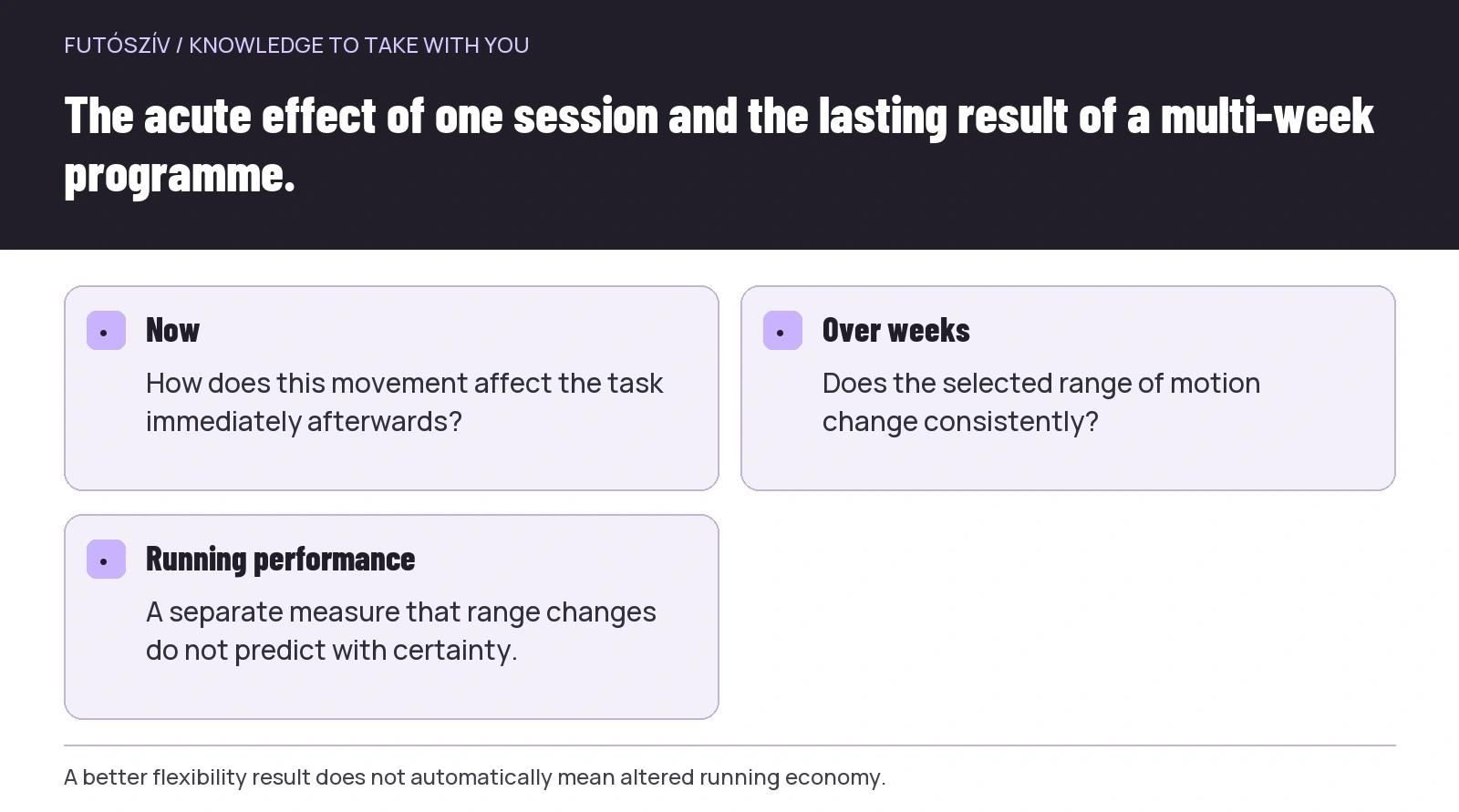 Enlarge diagram
Text version of the illustration
- Now
- How does this movement affect the task immediately afterwards?
- Over weeks
- Does the selected range of motion change consistently?
- Running performance
- A separate measure that range changes do not predict with certainty.
Dynamic exercises do not automatically replace the entire warm-up
A few controlled movements may help prepare for a task, but getting ready to run can involve several parts. Easy movement, gradual transition and timing have separate roles. A sequence consisting only of knee lifts may not address every goal.
How tiring the chosen exercise is matters too. Many jumps or high-intensity repetitions can become new training load. Do not measure warm-up value by the number of impressive movements.
If unfamiliar with a task, learn it in calm circumstances. The pre-race crowd or fast lane of a running track is not a suitable practice area. A clear routine with few elements often adapts more easily to the venue.
Is more range of motion always better?
Comfortable movement usable for running matters, rather than maximum range in every joint. Personal build and the task may differ. An end position seen on social media is not a general suitability requirement.
Passively available range and actively controlled movement are not exactly the same either. Reaching farther in a stretch with assistance does not mean being able to generate and control force appropriately there while running.
Do not therefore measure progress only by hands reaching the floor or a large angle. A more useful question may be whether the task can be performed more comfortably, with better control and without symptoms. If symptoms are present, professional assessment may help define the goal.
Do not promise more injury prevention than evidence supports
A randomised trial involving 1,538 military recruits examined the effect of static stretching added to a warm-up on lower-limb injuries. The programme did not significantly reduce overall injury risk compared with the control.
Military training is not identical to every recreational runner’s life, so the result need not extend to every purpose. It does not, however, support the simple promise that a typical stretching routine alone makes you injury-free.
Workload selection, background, symptom assessment and the complete programme are separate questions. Stretching does not override a disproportionately large running day or ignoring pain. Do not attach a false sense of safety to a pleasant routine.
Strength development and range of motion can be considered together
A five-week comparative experiment assessed full-range resistance training and static stretching in untrained adults. Certain flexibility changes appeared in both groups. The small sample and specific tasks limit generalisation.
The lesson is that developing range of motion need not belong to one method alone. Strength, control and range can be planned together if exercises and workload are chosen appropriately.
This does not mean replacing all stretching with weights. Seek a method suited to the goal. If your existing programme already addresses the movement appropriately, a long supplementary list may be unnecessary.
How can you choose one clear goal?
Rather than “everything feels tight”, observe which specific movement bothers you. Climbing stairs, a strength exercise or a general feeling after running provide different starting points. The sensation alone does not identify which tissue needs stretching.
Without symptoms, comfortable movement or a predictable movement routine may be a simple personal goal. With pain, locking or recurring functional decline, do not diagnose yourself with a shortened muscle from an online test. An individual examination can help establish the problem.
Make the selected goal more measurable: does the same comfortable movement become easier under similar conditions? Not everything needs an instrument accurate to a degree, but the starting task should be consistent.
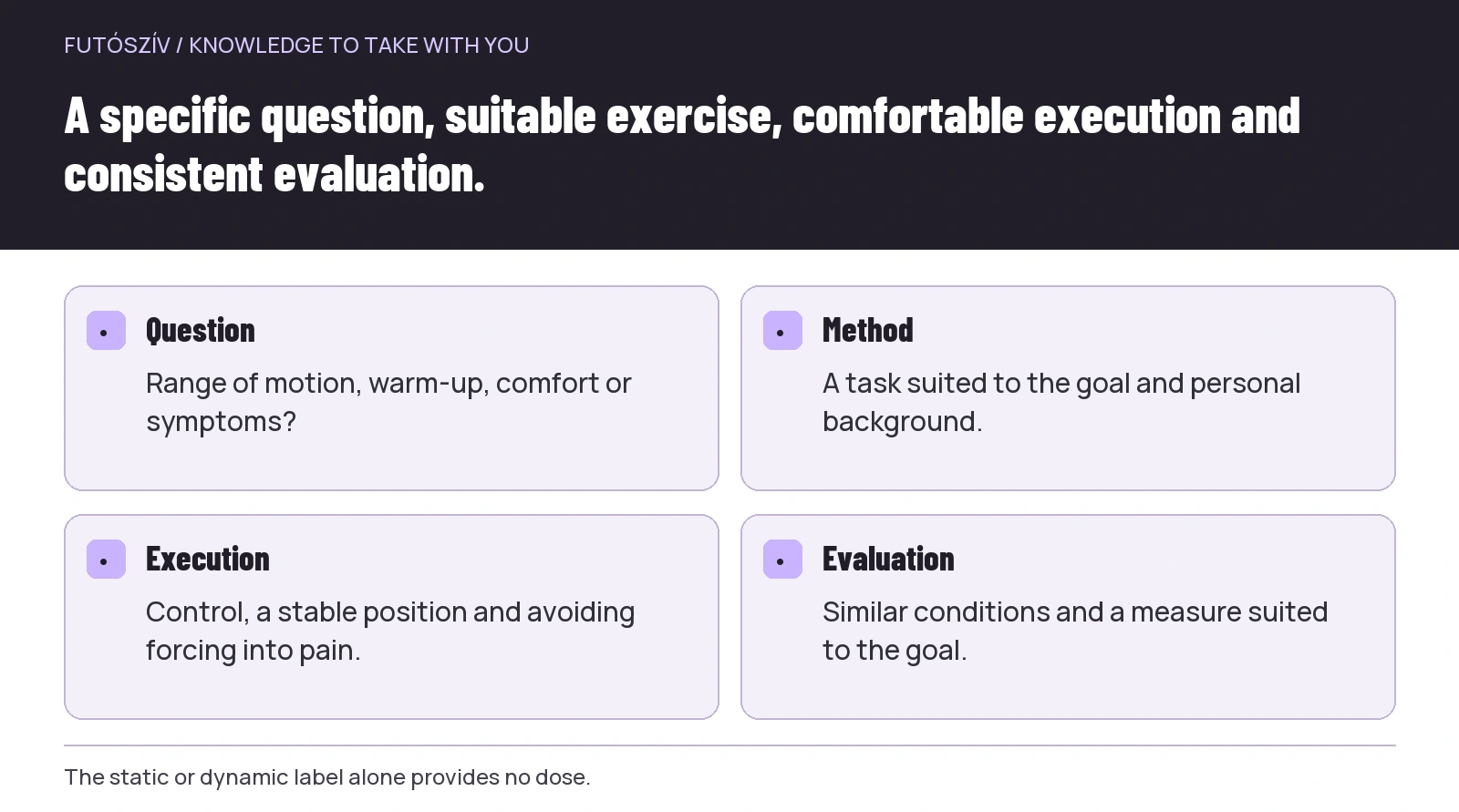 Enlarge diagram
Text version of the illustration
- Question
- Range of motion, warm-up, comfort or symptoms?
- Method
- A task suited to the goal and personal background.
- Execution
- Control, a stable position and avoiding forcing into pain.
- Evaluation
- Similar conditions and a measure suited to the goal.
What should a comfortable trial look like?
Start in a position where you can move steadily and calmly. The intended muscular sensation differs from sharp, stabbing or numbness-associated symptoms. Do not treat the latter as proof of correct stretching.
Do not make maximum range the first repetition’s goal. Observe what happens with comfortable, controlled execution. Forcing into pain or another person suddenly pushing further is not necessary for a general running routine.
If you have individual rehabilitation or healthcare instructions, these guide you. A general article cannot override post-injury movement restrictions. If uncertain, clarify the exercise’s purpose and limits with your treating professional.
Where should it fit in the week?
Targeted range-of-motion work can have its own calm time. You need not squeeze every important exercise into the few minutes before running. If a task is longer or demanding, show it in the complete weekly workload too.
After a run, a comfortable movement may feel pleasant personally, but do not automatically expect it to accelerate every recovery process. Food, sleep and overall workload remain important circumstances. The routine should not take their time away.
Before an important race, follow your familiar sequence as far as circumstances allow. Evaluate new methods and greater volume earlier in training. Seeking an extra advantage at the last moment can easily add unnecessary uncertainty.
Do not turn a test result into a judgement of yourself
A flexibility test measures a specific task. It is not a complete health score and does not by itself say how good a runner you are. Body proportions and the measurement method also influence the result.
If following the same test, perform it under similar conditions. Warm-up, position and how hard you push can change the result. A higher number does not necessarily mean lasting change usable in every task.
Do not repeat the test into pain to make it improve. Measurement aims at observation, not a separate training contest. Function and comfort may matter more than a best moment on a display or tape measure.
When should you stop, and when should you seek help?
Stop the exercise for sharp pain, numbness, unusual weakness or feeling unwell. Recurring symptoms or a problem limiting movement requires individual assessment. Do not try to address every symptom with increasingly forceful stretching.
After a recent injury or surgery, with a known joint problem or a specific health restriction, choose suitable movement according to the individual situation. A general stretching video is not automatically an appropriate rehabilitation programme.
A good stretching decision may involve a few carefully chosen exercises or omitting separate stretching for a period. The point is connecting the method to the goal, rather than maintaining it through exaggerated promises or compulsory habit.
Sources
- Chronic stretching and running economy.
- Effects of static stretching on energy cost and running endurance performance.
- Static stretching alters neuromuscular function and pacing strategy, but not performance during a 3-km running time-trial.
- A randomized trial of preexercise stretching for prevention of lower-limb injury.
- Resistance training vs. static stretching: effects on flexibility and strength.
The cited studies used different participants and doses. The examples are not personal treatment or stretching prescriptions.
How Futószív articles are prepared: our editorial guidelines.