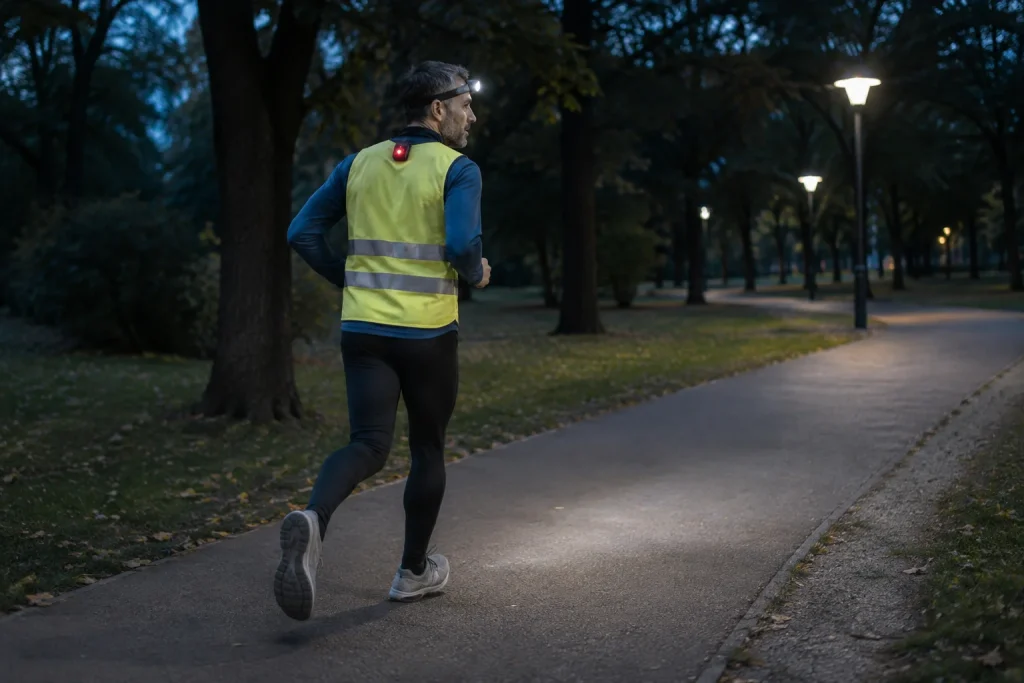
Before an evening run, preparation can shrink to one question: do I have a light? The real task is more complex. You need to see the pavement, bends and route changes; others need to notice you in time. One tool does not always serve both purposes. A powerful forward-facing headtorch does not automatically show your back, and a reflective strip does not illuminate a pothole. A suitable system starts with the route and considers clothing, light, power and behaviour together. This creates usability, rather than the number of items.
First, choose a place you understand in darkness too
Even a park familiar by day can have closed gates, obscured sections and changed traffic after dark. For your first night trial, choose a short, known route that is easy to leave. Check crossings, places without pavement and encounters with fast-approaching cyclists or cars. A lit loop separated from traffic is often simpler than a strong light beside a risky road. Equipment should not serve to declare a difficult setting acceptable at any cost.
Safety does not depend solely on one runner’s clothing: traffic environment, lighting, speeds and others’ attention matter too. Visibility equipment can make detection easier but provides no protective shell. The NHTSA pedestrian-safety guidance emphasises separate pedestrian spaces, considered crossings and attention alongside visibility. For runners, the practical lesson is that a glowing accessory cannot replace planning. Crossing remains a deliberate decision.
A bright colour is not a light source
A vivid neon or fluorescent fabric can stand out in ambient daylight. That does not make it a light source in complete darkness. Reflective surfaces work differently, returning light that strikes them; retroreflective materials typically return it towards the source. The 3M technology explanation illustrates this distinction. You need not be a materials expert, but the three phenomena are not interchangeable.
Do not judge an entire evening setup under a room lamp. Check visible surfaces from front, back and sides, including those hidden by a vest or jacket. A tiny logo may not do the same job as a deliberately positioned larger area. Visibility also depends on illumination, angle and obstruction. A flash-lit advertising photo is not a real traffic trial. A camera can make an effect appear stronger than you expect.
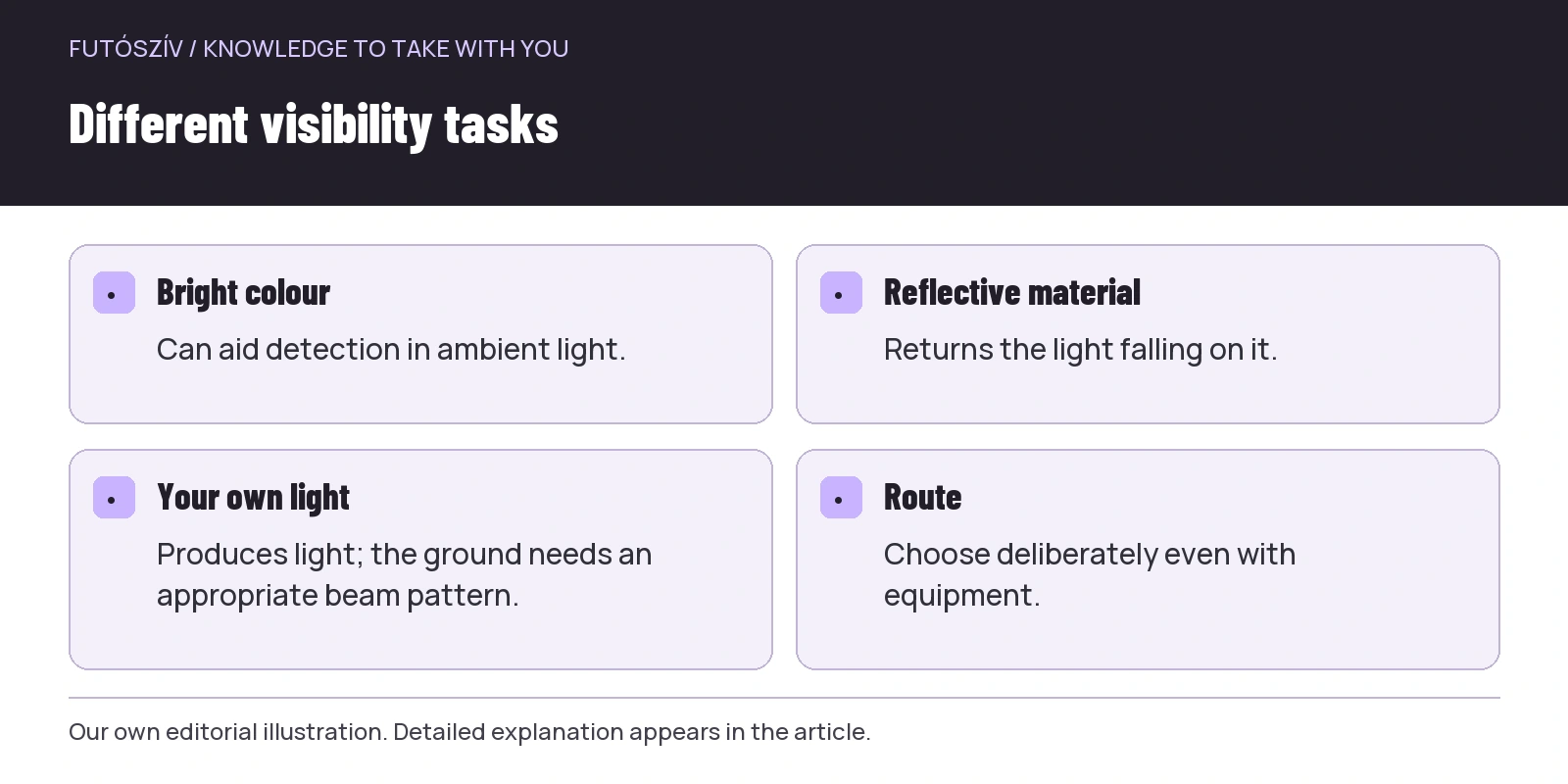 Enlarge diagram
Text version of the illustration
- Bright colour
- Can aid detection in ambient light.
- Reflective material
- Returns the light falling on it.
- Your own light
- Produces light; the ground needs an appropriate beam pattern.
- Route
- Choose deliberately even with equipment.
Your own light can do two different jobs
Some lights mainly help others notice you; others help interpret the ground and surroundings. A small marker light may not illuminate a rocky path sufficiently. A powerful headtorch may be excessive or poorly directed on a busy city pavement. Name the function before buying: greater visibility on a lit loop, or reading ground on a completely dark route? Slow urban jogging and a technical descent need different things. Maximum brightness alone is not the answer.
Beam distribution, attachment and usable runtime matter together. The Petzl manufacturer information on running lights also highlights stable wear, terrain-appropriate beam patterns and runtime. These are manufacturer considerations, not an independent model ranking. In your trial, check whether you see both the area before your feet and the next section, whether you continually lower your head and whether each step makes the light move distractingly.
Do not plan from the biggest number on the box
Alongside brightness, inspect the runtime for each mode and the conditions behind the figures. Maximum brightness may be available only briefly or under a different operating mode. How the light dims as charge falls matters too. Plan around a mode that genuinely lets you travel on your chosen route. “Still glowing” does not necessarily mean usable light in a dark forest. A route calculated to the battery’s limit without reserve can become uncertain after a detour.
Do not check charge merely by switching on before departure. Learn indicators and charging equipment, then occasionally test your usual mode safely. For longer or remote night outings, consider a working backup. It might be another suitable light or a compatible power source, but helps only if you can manage it in darkness. A phone light can supplement an emergency response, yet battery and hand-use constraints mean it is not automatically equivalent to a running light.
Test attachment through running movement
A headband comfortable standing still may slip or bounce when jogging. Wear it with your actual hat, hairstyle and hood, then move for a few minutes somewhere safe. Check adjustment stays put, cables do not catch and battery placement does not press uncomfortably. Excessive tightening does not solve every attachment issue. If stability requires squeezing, another design may suit better. Comfort is part of usability: constantly adjusting a slipping beam leaves less attention for surroundings.
Headtorches and chest- or waist-mounted lights follow movement differently. Everyone need not choose the same type, but understand where the beam points when turning your head or torso. A narrow beam turns elsewhere when you look sideways while your feet continue forward. Therefore make the first test neither fast nor on unfamiliar terrain. Reading uneven ground requires reaction time. Adapt pace to visibility rather than a daytime loop record.
Other people’s eye level matters too
Poorly adjusted light can disturb approaching people, running companions and other travellers. Aim it at the needed area and avoid pointing directly into someone’s eyes while talking. “Stronger means safer” can easily mislead here. In a group, agree stops, single-file movement and light use beforehand. People at front and back can face different surroundings and visibility tasks; starting together does not mean equal equipment.
Flashing modes can attract attention but are unsuitable for some environments and tasks. Continuously observing ground usually requires something different from a marker light. On enclosed or busy promenades, consider others’ comfort too. Knowing modes prevents prolonged button pressing while approaching a junction. Practise controls at home first, with gloves if you will wear them. A good function helps when you can access it.
| Equipment or decision | Main task | Does not replace |
|---|---|---|
| A light, conspicuous colour | Easier detection in suitable lighting | Light needed after dark |
| Reflective surface | Returning incident light | Illuminating the ground |
| Running light | Seeing route and surroundings, or signalling | Careful crossing |
| A considered route | Fewer difficult situations | Necessary equipment and attention |
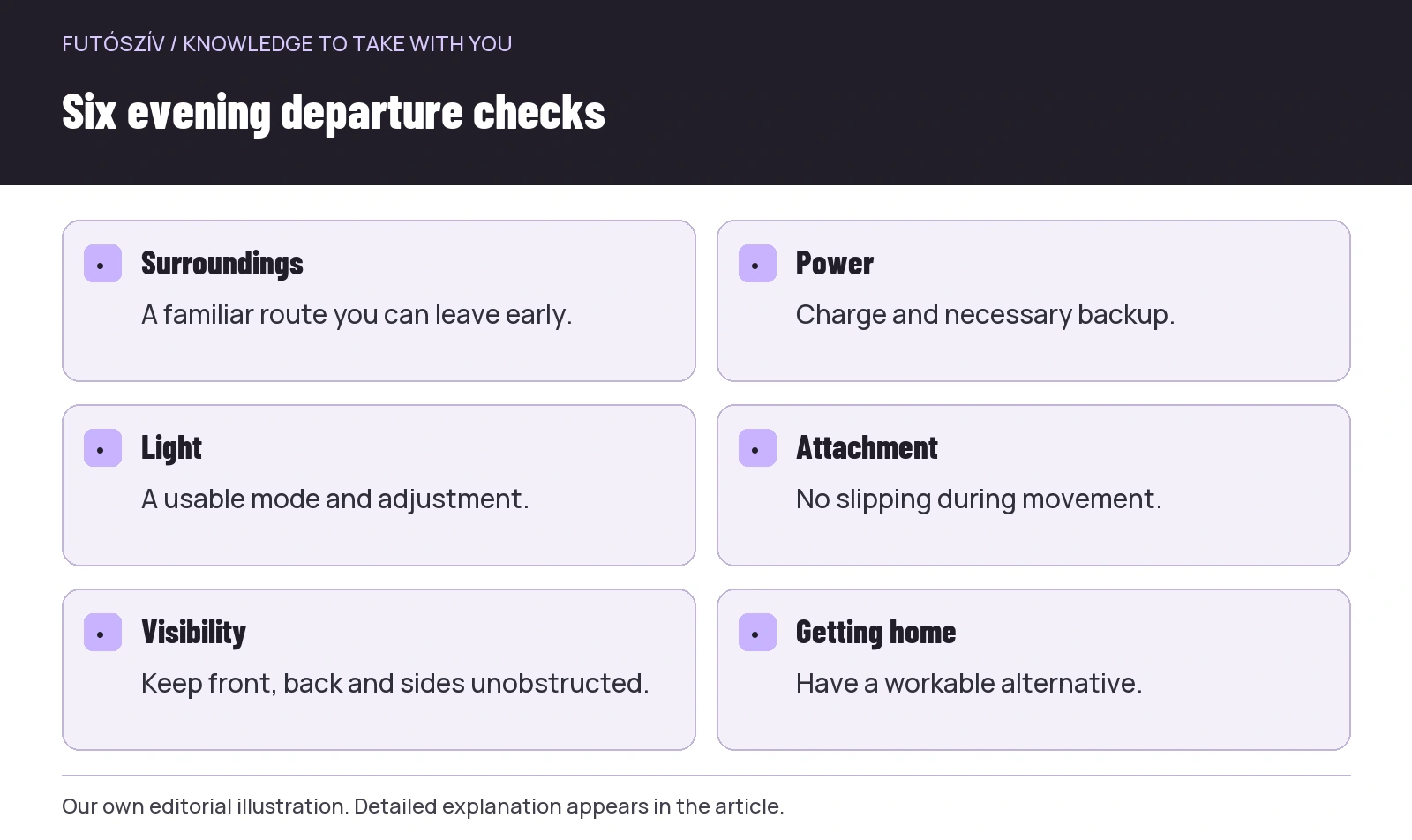 Enlarge diagram
Text version of the illustration
- Surroundings
- A familiar route you can leave early.
- Power
- Charge and necessary backup.
- Light
- A usable mode and adjustment.
- Attachment
- No slipping during movement.
- Visibility
- Keep front, back and sides unobstructed.
- Getting home
- Have a workable alternative.
Front, back and sides: assess the whole setup
At home, assemble all clothing with outer layer, bag and vest. Ask someone to help inspect which surfaces remain exposed from different directions. Use a safe yard or other traffic-free area rather than experimenting beside a road. The aim is to discover obvious obstructions, not measure detection distance. A vest under a jacket or reflector beneath a backpack can barely do its intended job. Check attachment in actual movement too.
The Hungarian police guidance that also mentions runners recommends visibility accessories too. Always verify exact, situation-dependent traffic requirements from current official sources; this equipment guide is not a statutory minimum list. A comfortable strap or small flasher can help, but do not automatically call it equivalent to another required item. Recommendations, product properties and legal requirements are separate questions.
Fog and rain change the task
Wet-surface glare, water on glasses and visible beams in the air can complicate reading the surroundings. More power does not necessarily solve poor vision. Try another manufacturer-supported setting and, above all, slow down or shorten the route. Learn water protection from the device’s own instructions; a general “outdoor” label tells you little. Follow instructions for charging-port closure and drying too.
Pay attention to transitions between dark and brightly lit stretches. Vision and attention need to adjust, and a pavement does not become smoother beneath a street light. Avoid staring at a watch screen. A simple, readable display makes it easier to check necessary data and return attention outside. Adapt headphone use to the setting too. Divided attention is practical here: one misread bend or approaching vehicle can change the situation.
Maintenance and a departure routine
Reflective surfaces need to remain free of persistent mud or other obstruction; follow clothing care instructions for cleaning. Inspect peeling or badly damaged areas and active-light mounts and housings. Charge and store batteries as instructed and do not leave with a damaged unit. Switching on is not the only sign of condition. Headband, buckle, switch and connector are part of the system too, and a small fault can become disproportionately disruptive in darkness.
Create a short departure sequence: route and conditions, charge, usable mode, exposed reflective surfaces, necessary backup and a way home. With repetition, it becomes quick. You need not mount an equipment exhibition before every run, but should not discover in a dark street that the light remained in another bag. Good evening equipment works quietly: you see, become easier to notice and retain attention for your surroundings. Build that system around your own setting.
Sources and further reading
- 3M: how retroreflection works
- Hungarian police: be visible so others notice you in time
- NHTSA: pedestrian-safety advice
- Petzl: considerations for choosing running lights
How Futószív articles are prepared: our editorial guidelines.