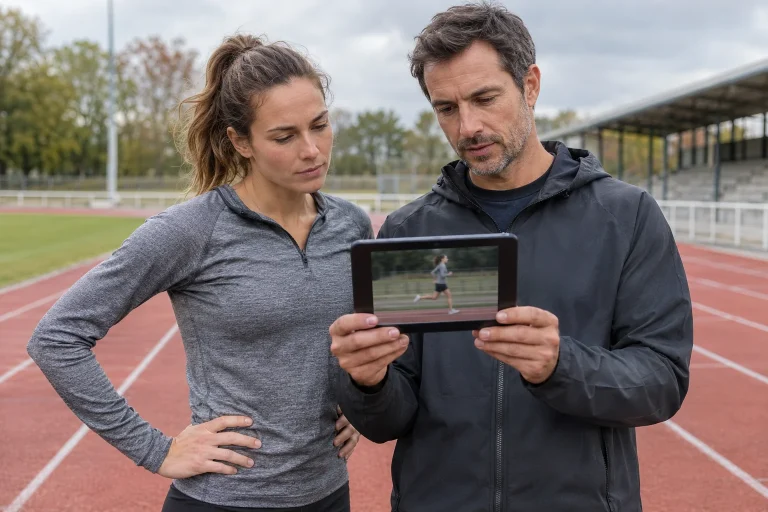
Run a little wider: a simple-sounding technique tip that can change more than footprints. Original experiments measured differences in hip angles and some knee-moment characteristics too. What do these mean, how does an angle differ from force, and why is an immediate mechanical change different from a long-term injury promise?
Step width is not shoe width
Step width describes the lateral placement of left and right steps relative to each other. Measurement requires defining which foot points are used and the direction of travel against which they are calculated. This is neither shoe-sole width nor the angle at which the foot turns outwards. These are separate characteristics easily confused in an image taken from behind.
The appearance of footprints alone is not always an unambiguous measurement either. Referencing a heel point, another anatomical marker or the shoe outline can yield different results. Direction of travel must also be retained: on a turning route, the screen’s horizontal axis need not be the actual lateral direction. A consistent definition therefore precedes judging something wider or narrower.
The practical question here is not the width in centimetres within which everyone should run. Research examines what happens to movement when usual placement is changed under specified conditions. Prescribed experimental width and natural running are different situations. Participants, speed and the assessed outcome jointly determine interpretation of a measured difference.
Hip adduction: a movement angle in the frontal plane
In simplified terms, frontal-plane analysis also concerns lateral movements interpreted from the front or rear. Hip adduction angle describes the thigh’s position relative to the pelvis in the chosen model. It is not the distance between knees seen in a photograph. Defining the angle also requires specifying body points and the coordinate system.
The original research involving thirty healthy runners compared lower-limb characteristics measured with usual, narrower and wider steps. The wider condition was associated with smaller peak hip-adduction and rearfoot-eversion angles than the narrower condition. Knee mechanical measures changed alongside those at the hip. The result came from an acute laboratory comparison.
This meaningfully shows that a lateral step change affects more than footprints. It does not justify calling every visible hip movement an error or establish that the smallest angle is best for everyone. The study measured changes between specific conditions. An individual technique or health aim requires separately explaining why modifying that metric would matter.
 Enlarge image
Knee moment differs from total force at the knee
The study also reported reductions in knee abduction moment and its associated time-based measure in the wider condition. Moment can be described through force and moment arm, but exact sign conventions and the calculation model matter in movement analysis. The study’s knee moment must not simply become another name for the total force acting in every direction within the knee.
An original purely mechanical example helps explain the concept. A force of six hundred newtons with a perpendicular moment arm of two centimetres produces twelve newton-metres; with three centimetres, eighteen. Force remains the same while the moment arm changes. This does not calculate a runner’s actual knee loading: real movement involves several forces, segments and positions changing over time. It merely illustrates what moment means.
Peak moment and moment impulse are separate data too. The former is the largest value of a curve changing over time; the latter relates to summing the curve over time. With a smaller peak, duration of action may differ, so the two measures should not simply be treated as an identical result.
If a selected knee moment became smaller in an experiment, the precise statement names that measure. There is no need to add that every structure in the entire joint certainly did less work. Different mechanical outcomes answer separate questions. Retaining the source’s actual measured variable lets us explain clearly and without exaggeration what step width changed.
What did the newer study at two speeds add?
The original 2025 study compared several step widths at two running speeds in thirteen healthy Chinese men aged twenty to twenty-four. It used motion capture and force plates. Wider steps were associated with smaller hip-adduction angles and smaller peak knee-abduction moments. Prescribed changes were defined relative to leg length.
A change relative to leg length is different from increasing usual step width by a given percentage. The denominator matters here too: the definitions could produce different absolute distances. Research-protocol percentages should therefore not simply accompany run wider as though they were a ready individual exercise. First understand precisely what changed and relative to what.
The narrow sample of young men limits generalisation. The study was not long-term follow-up of runners of every age, sex and background. New data can strengthen a mechanical question while other information remains necessary for your own practical and health decisions. A recent publication year does not automatically make the protocol directly applicable to everyone.
Step length and foot strike can also affect the picture
The controlled laboratory research involving forty-two healthy runners examined different foot-strike conditions and step lengths. Several movement characteristics changed, and shorter steps were also associated with a change in width. This shows that a technique modification described under one name can shift other spatial characteristics.
If you simultaneously shorten steps, try another foot strike and alter footprints sideways, knowing which part accompanied what becomes difficult. Accurately describing the change therefore matters in your observations. I ran more consciously is insufficient. Research experiments are interesting precisely because they arrange conditions in defined ways rather than merely giving many instructions at once.
Foot strike and step width are therefore separate concepts, but not necessarily independent in actual movement. Turning the foot outwards is another question again. If the goal is understanding footprints’ lateral position, a tip about heel or shoe angle may not change that. Precise language helps keep the task and observed result aligned.
An immediate mechanical difference is not a long-term injury promise
These studies measured acute differences between specified running conditions. That differs from following a whole season to count new injuries under different programmes. A mechanical measure being discussed in relation to injury does not make its reduction direct evidence of fewer later injuries.
An individual answer also includes symptoms, history and the planned task. Describing a symptom-free runner’s movement differs from designing a personal plan because of pain. The two situations cannot be combined into one width target. A laboratory result offers interpretable professional background, rather than an individual diagnosis or identical treatment for everyone.
A precise claim remains substantial: changing step width modified certain measured hip and knee characteristics under particular conditions. It needs no promise of universal injury prevention. Acute mechanics are useful in their own right when limits remain visible. Exaggerated conclusions would instead obscure what the studies actually showed.
 Enlarge image
How can your own observation become interpretable?
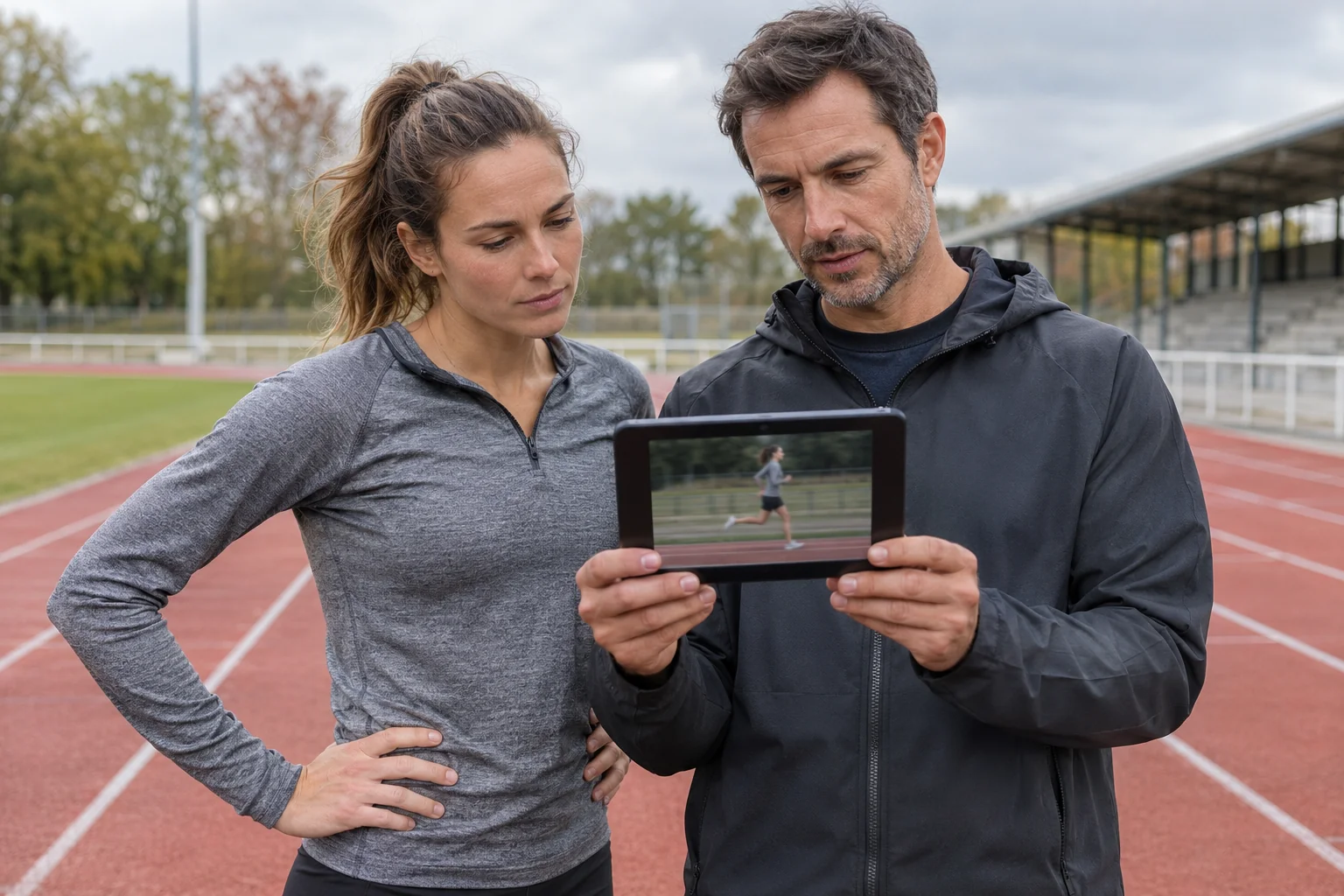
When preparing for movement analysis, bring the specific question: in which task and why is lateral step placement interesting? Record speed, surface and the equipment used for observation. An angled camera view or a bend does not offer the same measurement conditions as a straight laboratory corridor. Accurate description of circumstances strengthens an observation’s value.
Let video document your movement rather than prove a preselected error category. Retaining several steps and the whole situation helps prevent overinterpreting one unusual frame. If movement differs conspicuously from usual, also note whether there was a specific instruction. Natural running and a deliberately modified movement performed for the camera are separate data.
Do not treat lines or footprint markings borrowed from an experiment as compulsory practice for everyone. Such tools may create a research condition. Before your own change, its goal and assessment method matter more than a distance taped onto a floor. This prevents a technique question accidentally becoming a forced movement pattern whose individual usefulness nobody has assessed.
Keep width as one variable within the whole picture
Separate three lines in your summary: the movement task, the width or difference observed and the outcome whose change was sought. Then add measurement method and notes. This brief sheet conveys more than my knee needs wider steps. A conclusion should connect with the data actually observed.
Comfort and usability can also be retained in assessment, but under different names from laboratory moment. A change feeling strange is personal experience; an instrument showing a smaller angle is a measured geometric difference. Neither automatically substitutes for the other. Information kept separate supports a more precise professional discussion together.
Deliberately running wider can indeed change some mechanical characteristics at the hip and knee. Research nevertheless describes specific samples and tasks, rather than a footprint template for everyone. Step width is useful when kept alongside speed, measurement definition and your own goal. It then supports understanding rather than steering all runners into one universal lane.
Sources
- Brindle and colleagues: step width and lower-limb biomechanics.
- Xu and colleagues: different widths at two running speeds.
- Boyer and Derrick: step length, foot strike and associated movement characteristics.
How Futószív articles are prepared: our editorial guidelines.