It looks easy in a short video: the person closes their eyes, lifts one foot and watches the time. The challenge may suggest that the harder the situation, the better the balance training. As an older runner, however, it is unhelpful to make such a striking task a general benchmark at home. Difficulty and a personally appropriate learning goal are different things.
This article does not teach you to perform the test. It helps explain what changes the task, what a video timing leaves out and how movement aimed at balance can connect with your own everyday needs. New balance difficulties or dizziness should not be clarified through a challenge. Sudden weakness, changes in speech or severe illness may require appropriate urgent help.
Balance involves several kinds of information working together
The National Institute on Deafness and Other Communication Disorders information page explains that the eyes, inner ear and sensory signals from the body work together to maintain balance. Vision therefore does more than accompany the task. Closing your eyes changes the contribution of one information source while placing different demands on the other systems.
This does not mean one sense always matters equally to everyone. The situation and individual condition also count. In everyday movement, seeing your surroundings serves several tasks: you orient yourself, notice edges and people, and follow your direction of travel. Removing vision creates a different situation, rather than simply a slightly more demanding version of the same task.
Balance difficulties can have various causes, and NIDCD also discusses different health and medication connections. A video test cannot establish how each system works in your case. Success does not rule out every problem, while difficulty does not identify a single specific disease. Assessing the whole system involves more than how long a position lasted.
One leg and closed eyes are two separate changes
Reducing support and removing visual information change the task in different ways. Adding several difficulties together also makes it harder to understand which part caused uncertainty. An online challenge often shows the final striking position, while individual preparation, the reason for choosing it and any assistance remain unseen.
The word advanced does not automatically mean an appropriate next step. A task may have a place in a professionally selected setting while being unsuitable as a general home recommendation. The question is not whether such an exercise exists, but why, for whom and under which conditions it is chosen. A video’s popularity does not supply that individual context.
You need not view increased difficulty as a test of courage. Keeping support or leaving out a task does not reject progress. If another form suits your own goal, choosing it makes sense. In learning balance, a usable task may matter more than completing a version chosen merely because it looks more impressive.
 Enlarge image
The home environment does not disappear beyond the frame
The edge of a rug, a nearby table, a moving chair, a cable or limited space forms part of the whole task. A camera frame may exclude some of these. A video therefore does not show what losing balance could mean in your room. The visible movement and whether the actual location is usable provide different information.
The NHS page on balance exercises also gives examples involving a manageable, gradual progression and necessary support. These are general examples, rather than individual prescriptions applying to everyone. Even an object that looks stable may not offer appropriate help for a particular movement. The roles of the task and support need to be understood together.
A companion’s presence does not by itself turn a home challenge into a professionally led session. They may not know when and how to help, or may be unable to manage the situation safely. Assistance is a specific task, rather than a mere promise. When individual support is needed, its content should be established with an appropriately trained professional.
A professional assessment asks a different question
An assessment task may have a defined purpose, method and interpretation. A professional may observe movement for a different reason from a challenge counting seconds. Circumstances and history also matter. Borrowing one detail from the internet does not automatically recreate the same assessment situation.
The NICE falls-prevention guideline emphasises individual falls history and, where appropriate, assessment across several areas. The same guidance matches an exercise programme to the participant’s needs, goals and abilities. What matters is therefore a question connected with the whole history, rather than an isolated skill result.
If you feel less steady on a pavement or have repeatedly nearly fallen, describe that everyday experience. You need not produce a timed result at home beforehand. An accurate account of your situation may connect more directly with the problem than a challenge performed under different conditions. Assessment is about interpretation, rather than rewarding you for attempting a difficult test.
A learning goal can begin with a specific everyday situation
Do you want to turn more comfortably in the kitchen, move more easily through a familiar place or understand what support a task requires? Naming an everyday goal helps you seek a programme that actually connects with it. Time spent holding a single static position does not show improvement in every important ability.
The WHO approach to functional ability discusses valued activities together with the environment’s role. Your goal may therefore be to make a task in your own life more accessible. Appropriate help or arranging the environment can also contribute; challenging the body again is not the only approach.
A specific goal does not mean the task must always be an exact copy of the everyday movement. A professionally designed programme may use several elements. It is important, however, to understand the connection: why you practise this, how it adapts to you and how changes will be reviewed. An explanation helps distinguish a learning plan from an impressive feat.
For example, finding it harder to recognise a kerb in dim light does not mean you should practise removing vision completely at home. Lighting in your everyday environment, contrast, the route and assessment of visual symptoms may each be separate questions. The specific obstacle needs understanding, rather than simply creating a difficulty assumed to resemble it. Likewise, buying an unstable piece of equipment is not an automatic answer to problems with uneven surfaces. In place of such conclusions, a plan based on your own situation and developed with appropriate help keeps practice meaningful for you.
What should you ask the instructor before increasing difficulty?
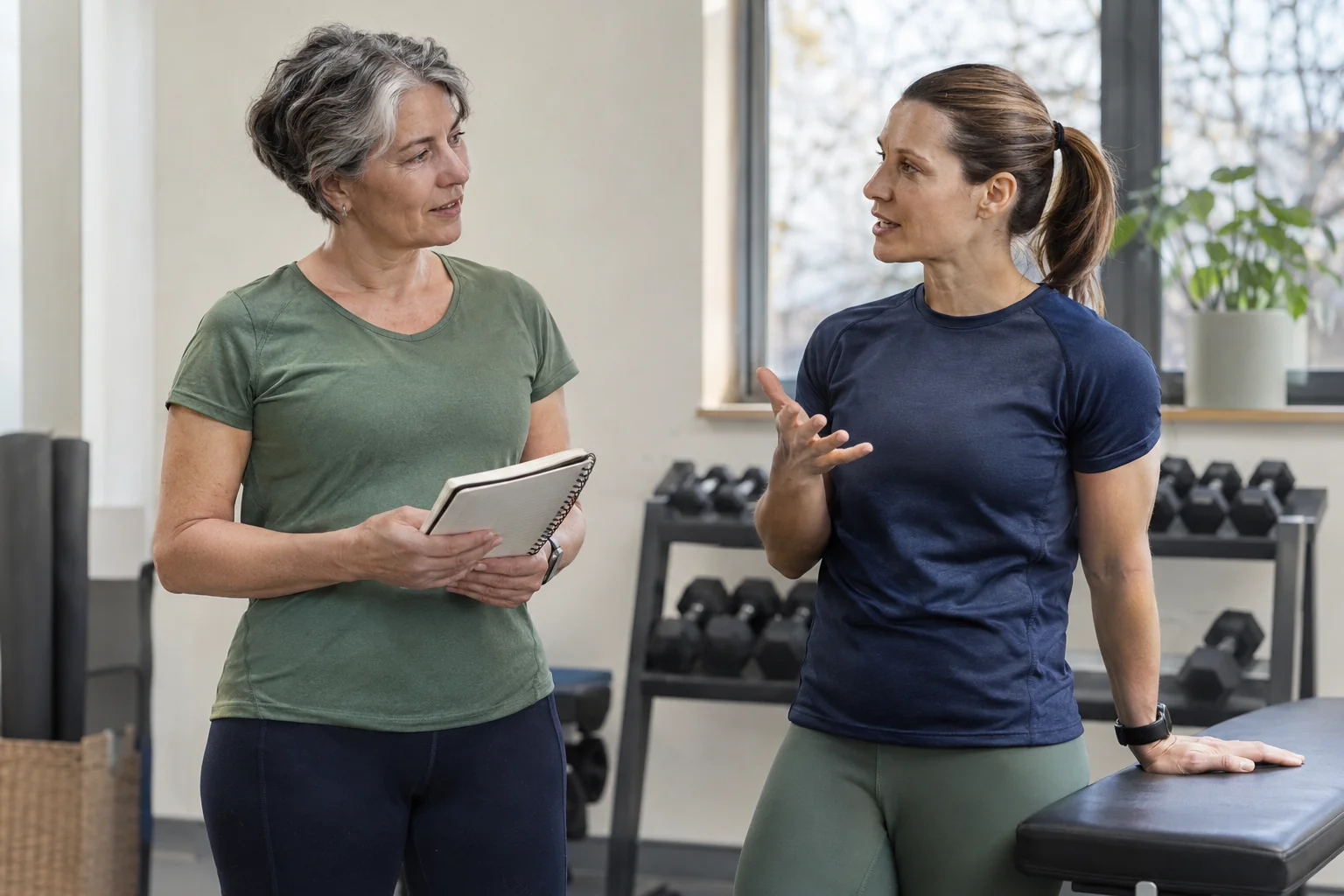
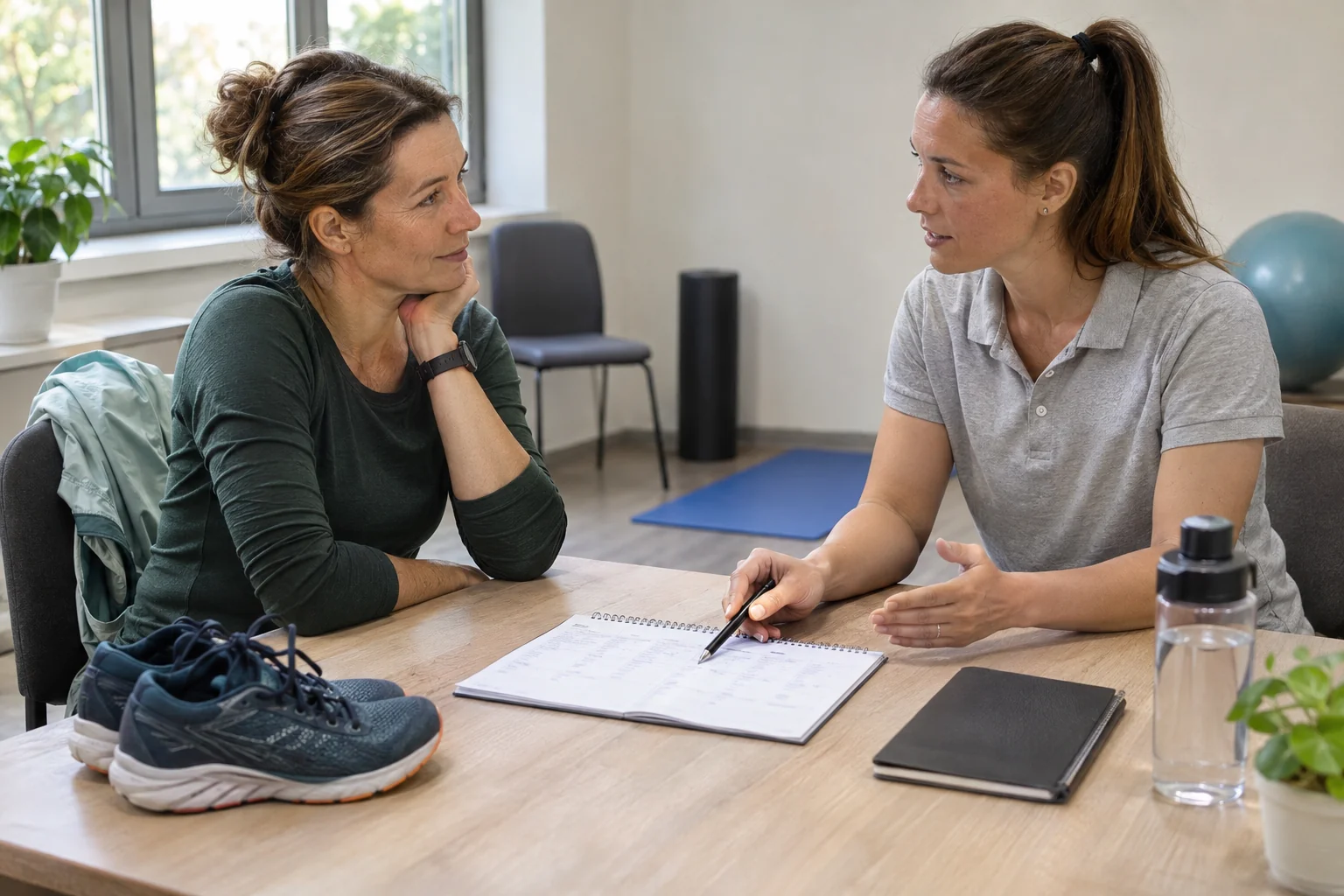
A useful question goes beyond whether you can do this yet. You can ask the purpose of increasing difficulty, which part changes and what support or assistance remains. Changes in an appropriate programme have an understandable reason. You need not add another obstacle every time merely to make the task look advanced.
| Question | What does it clarify? |
|---|---|
| Why are we changing this task? | The connection between the individual goal and the exercise. |
| Which condition changes now? | What the difficulty actually consists of. |
| What assistance and means of signalling remain? | A manageable individual framework for carrying it out. |
These questions are neither a test for rating instructors nor an independent approval checklist. They help you participate in understanding your own learning. Asking for an explanation when something is unclear is not a delaying excuse. Following a task involves understandable instructions and communicating your experience too.
If a leader’s only answer is not to be afraid, that may fail to resolve the specific circumstance. There may be a real need for support, a new symptom or a misunderstood movement. These require clarification in their own right. Encouragement can provide support, but cannot replace necessary professional adaptation.
 Enlarge image
Do not turn a timing into a personal prediction
How long someone held a position is data from a particular attempt. It does not describe every environment, falls history, everyday functioning or conditions for the next run. A better result does not guarantee safety for every movement. A poorer one is not a final judgement on a person’s independence or future.
The meaning of a better number achieved after many attempts may also be uncertain if the method, support or environment changed meanwhile. A social-media video often shows only one selected moment. It does not tell you what happened during the other attempts or which assistance was available. Visible success cannot automatically be generalised to the viewer’s own situation.
You need not prove to the running community that you can complete the same task. If challenged, a simple answer can be that you choose tasks suited to your own goals. Social connection need not depend on increasingly hazardous skill challenges. Someone else’s video can be interesting without becoming part of your personal programme.
A more useful story in place of the challenge
An imaginary woman runner in her seventies becomes interested in balance because she feels less steady on a familiar stretch of pavement. Instead of timing a stance with her eyes closed at home, she keeps the specific experience in mind: where it happened, under which conditions and what changed. She seeks appropriate professional help to interpret it, then uses that understanding to find learning opportunities suited to her.
In the next programme, she learns the task’s purpose and the role of support. She need not complete the movement in the video for her balance question to be taken seriously. The story does not specify which exercise she receives, because that is an individual decision. The difference is that the task follows from her own situation, rather than an online number of seconds.
Closed eyes and standing on one leg are therefore not general entry requirements for worthwhile balance work. An appropriate goal, individual assessment and a usable environment together provide a better foundation. Difficulty makes sense when it serves something in your own programme, rather than simply creating another demand to prove yourself.
Sources
NIDCD: sensory systems involved in balance and their assessment; NICE NG249: falls history and an individualised exercise programme; NHS: balance exercises and gradual progression; WHO: the relationship between individual activity and environment; NHS: symptoms of a stroke. Checked: 21 November 2026. These examples do not constitute a home balance test or individual exercise prescription.
How Futószív articles are prepared: our editorial guidelines.