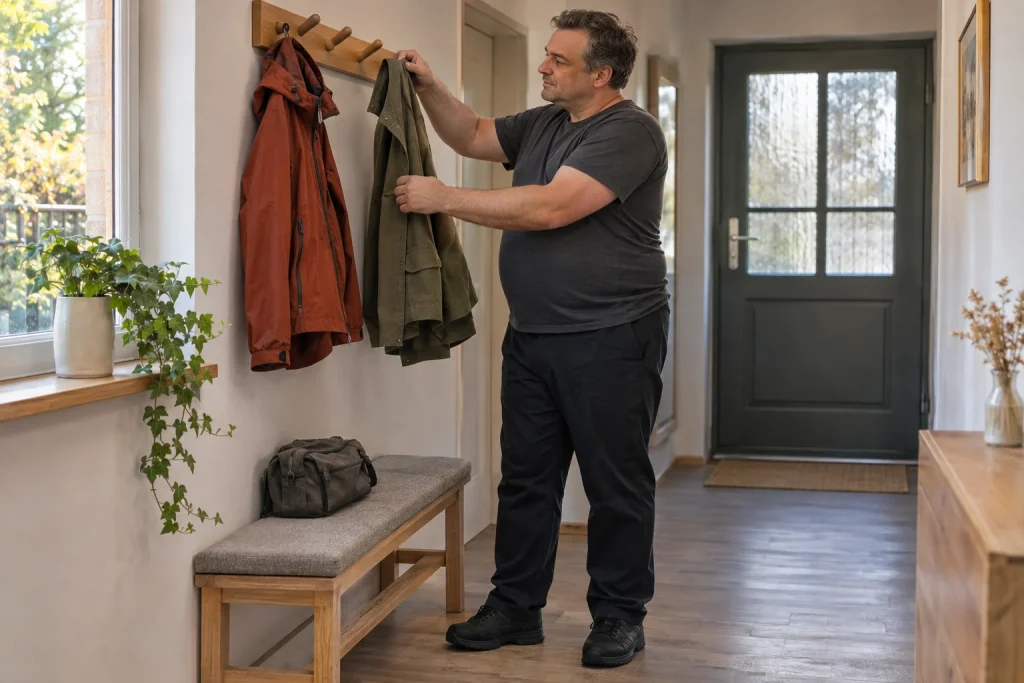
Your legs feel tired after a shift, although the app says you have not trained today. You want to restart running but do not know how the working day should count. Standing cannot simply be converted into running kilometres. Yet something does not disappear from your daily story merely because it was not labelled ‘sport’.
At a higher body weight too, name the work specifically: standing still, walking extensively, carrying things or frequently changing tasks? These are different situations. Sport planning connects with reality when it sees the whole day and does not automatically interpret post-work fatigue as weak willpower.
A new symptom should not remain merely an end-of-shift story
If you have a new, severe or worsening symptom, do not make prolonged standing its only explanation. The NHS information on leg and ankle swelling identifies unexplained one-sided swelling and sudden painful, warm or red changes as needing urgent assessment. Swelling accompanied by breathlessness or chest symptoms may require immediate help.
Recurring pain or pain making daily function harder also belongs in individual healthcare assessment. You need not wait until work or sport becomes entirely impossible. Describe onset, location and change. The occupation’s name may be important history, but does not establish the cause alone.
If an individual health or work-capacity plan applies to your workplace situation, sport should connect with it too. A general article cannot override specific restrictions or modifications. The aim is not to ‘run off’ symptoms, but to understand your day and appropriate movement options more clearly.
Standing still and varied movement are different tasks
The Canadian CCOHS occupational-safety information on standing work describes leg comfort, muscle fatigue and other symptoms associated with prolonged standing. It emphasises workplace and task design separately. Standing jobs are not all identical, and personal freedom to move varies between workplaces.
At a checkout or workbench, you may remain in a similar position for long periods. Another job alternates steps, turns, lifting and waiting. ‘I am on my feet all day’ can describe both. Naming the distinction prevents sport planning beginning from one vague category.
Maintaining a posture also requires effort, while differing from running rhythm or an individually selected strengthening task. CCOHS discusses circulation and local muscle fatigue with prolonged positions involving little change. The explanation does not mean every end-of-shift symptom has the same cause.
Days of similar duration can differ too. Could you sit, change position, perform another task or take a calm break? These are not trivial comforts at the edge of the story. They can determine the conditions in which you arrive home before sport.
Does work count as activity?
The WHO physical-activity overview includes movement related to work, transport, household tasks and leisure. Physical activity exists beyond workouts. This does not automatically turn every work task into moderate aerobic exercise or complete running preparation, however.
The NIOSH 2024 professional overview separately discusses differing conditions of occupational and leisure activity. Research asks, among other things, how prolonged work demands with little control and limited recovery may differ from chosen recreational movement. Possible explanations need further research.
This does not mean all movement at work is harmful or everyone must run afterwards. The precise conclusion is that environment and task type matter too. Sport planning needs more than choosing whether work ‘already replaced everything’ or ‘did not count at all’.
 Enlarge image
Describe daily demands instead of converting them into imaginary kilometres
To place work beside your sporting plan, a few details help: dominant tasks, unusual changes and comfort afterwards. Shift character matters alongside length. You need not claim a given number of standing hours equals a running distance.
A step counter does not reveal every part of the day either. Standing still, lifting or a hard-to-change posture does not appear identically in step totals. It still happened. Equipment and personal experience preserve different information, so neither needs immediately overriding the other.
| Workplace detail | A useful note |
|---|---|
| Prolonged standing in one place | How much could you change posture or tasks? |
| Walking and travel | Which routes and frequency belonged to the day? |
| Carrying or repetitive tasks | Were demands different from usual? |
| Breaks and getting home | Which opportunities remained for rest and continuing the day? |
This table does not create a general load score. It helps describe your situation, particularly when planning with a professional. Specifics beside ‘it was a hard shift’ can be worth more than a sporting-app metric not designed for that purpose.
Do not reduce workplace conditions to running shoes
The CCOHS guidance on sitting and standing emphasises posture changes and suitable rest opportunities. These conditions do not depend solely on personal perseverance. Work environment, task organisation and available equipment jointly shape options.
If work regularly causes symptoms, report them through an appropriate workplace, occupational-health or safety channel too. This article is not employment-law information and does not transfer Canadian rules to Hungary. The practical question is who can meaningfully address your actual job’s conditions and individual problem.
Comfortable footwear may matter but does not resolve every organisational or health question. Do not arbitrarily replace required protective equipment with trainers. Necessary protection and personal fit both matter. Seek a solution for the particular workplace task if equipment is problematic.
Likewise, home stretching or an evening run does not automatically replace addressing poorly designed working conditions. Sport can be valuable, but you need not personally ‘correct’ every workplace consequence in leisure time. Different problems may need appropriate help in different places.
How can activity fit a shift-working week?
The activity section of the NICE recommendation supports considering current fitness and ability while working towards agreed goals. A shift day and a day off can therefore represent different environments. You do not need to force the same occasion into the same time every day.
A closer venue, shorter journey or another time of day may fit better. These are organisational questions provided activity content stays within your appropriate individual framework. If the difficulty is a new symptom, simply choosing another time is insufficient. Retain the health strand separately too.
A day off is not necessarily unlimited catch-up space. Other family and daily tasks may belong there. Weekly planning should not assume every missed activity must be repaid through one long occasion. Manageability depends on more than minutes reserved for sport.
A morning session is not universal either. It may suit one person but conflict with another’s departure, sleep opportunity or travel. Planning your rhythm is not choosing a morally superior time. Seek a framework connected to your actual day and present condition.
Retain comfort and symptoms separately
If you feel generally tired after a shift, name which part of the day it relates to. If pain, swelling or new functional difficulty occurs in a particular place, mark it separately. Do not turn every observation into the same phenomenon. ‘Tired legs’ can conceal different histories.
The rest of the day matters after sport too. If work and movement together repeatedly prevent an important task, that is meaningful feedback. Do not dismiss it with ‘sport is supposed to be hard’. An individual plan’s usefulness connects to the whole life, not just finishing the session.
If several conditions or treatments affect your day, make them visible when planning. General workplace advice is not individual rehabilitation. Equally, sporting interests need not disappear behind health questions. Name the goal and necessary conditions together.
 Enlarge image
Body size should not become fatigue’s moral explanation
As a larger-bodied person, you may hear that end-of-shift fatigue simply proves poor fitness. That is too quick a judgement. The whole situation cannot be interpreted without actual work tasks and individual condition. Naming tiredness is information about your day, not asking to be excused.
You can connect your sporting goal to present opportunities too. You need not add running after work to prove you take health seriously. Seeking appropriate movement and acknowledging rest needs do not exclude each other. External opinion should not have to win your choice anew every day.
A supportive companion can help specifically: agree another time, choose a nearby venue together or accept that only meeting fits now. ‘It is hard for me too, but I still do it’ tells little about your programme. Different workdays and individual conditions are not parts of one willpower competition.
A decision beginning with the whole day
A fictional larger-bodied man wants to restart sport after standing work. Initially he considers only the run’s shortness; later he describes the shift, opportunities to change position and journey home. Programme organisation gains real context. He reports new or recurring symptoms separately through the appropriate channel.
Another day allows more freedom of movement and a more manageable schedule. He does not assume he was lazier one day and more disciplined the other. He recognises different conditions and adapts within an appropriate individual framework. The story prescribes no occupation-specific exercise dose; it illustrates considering the whole day.
Standing work should therefore not be counted as running training, but cannot be omitted from the sporting story either. Task character, posture changes, rest opportunities and experience can support planning together. Appropriate movement and improving workplace conditions can be separate, mutually supporting tasks.
Sources
WHO: activity in different areas of life; NICE NG246: activity goals adapted to ability; CCOHS: standing work and working environment; CCOHS: changing between sitting and standing; NIOSH: occupational and leisure activity; NHS: ankle and leg swelling. Checked: 21 November 2026. The shift-work examples are original illustrations, not an employment-law opinion or individual load prescription.
How Futószív articles are prepared: our editorial guidelines.