We naturally expect to try running shoes and move in them. Yet sports bras are often chosen from a size chart, an old underwear size or a “high support” label. Comfort while running requires more than looking good or being wearable while standing. Band, cups and shoulder straps must work together while you breathe freely and move your arms. Choosing well means finding construction that suits your body and the task, rather than changing your body. Trying and observing are this article’s main tools.
Sports bras are not equipment for only certain body types
Appropriate support is not confined to one cup size or competitive level. What matters is your activity, how you feel during it and the support that particular garment provides. The University of Portsmouth expert guidance treats sports bras as important equipment for recreational activity too. This does not mean one cut suits everyone. A sensible starting point is avoiding constant changes to your running movement because of breast movement or garment adjustment.
Do not expect one universal size to solve everything across brands and life stages. Breast shape, torso proportions and individual sensitivity differ, as does manufacturer sizing. Treat measurement as a starting point and fitting as part of the decision. If your last purchase was long ago, do not insist first on the same label as years earlier. A usable bra adapts to you, not the reverse. Changed needs are neither a shopping failure nor a body fault.
Three constructions, different sensations
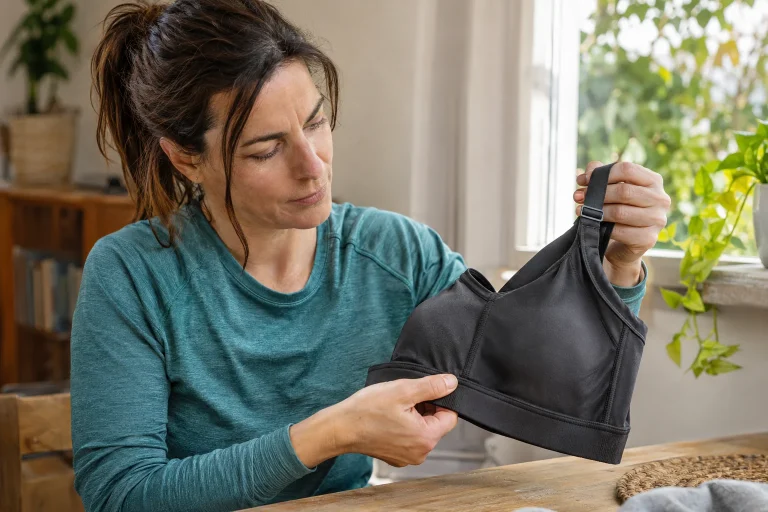
Compression reduces movement by holding breasts closer to the chest. Encapsulation uses separate cups to support each breast; combined models use both principles. The description alone does not decide comfort. Examine cup shape, seams, strap position, material stretch and adjustability. Putting it on and taking it off matter too: a very tight pull-over garment may be difficult to manage even if supportive during movement.
Do not read “high support” as an individual certificate. An original study examining 98 sports bras found differences in actual movement reduction, with manufacturer classifications not fully matching research groupings. This does not make every label worthless; it means your own trial is still needed alongside the category. Laboratory comparisons cannot identify where a seam will rub your neck or how a band feels at the end of your longer run.
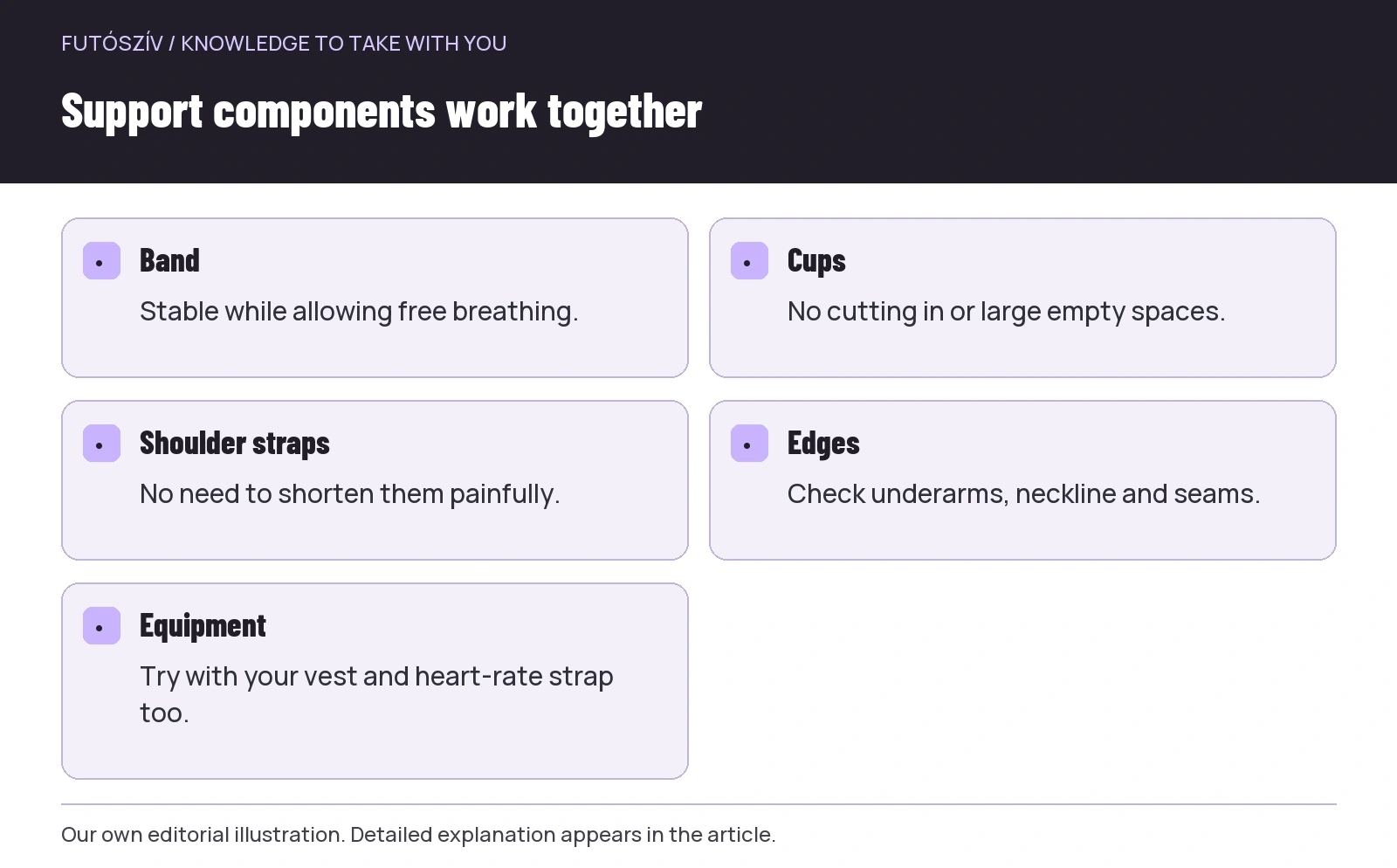 Enlarge diagram
Text version of the illustration
- Band
- Stable while allowing free breathing.
- Cups
- No cutting in or large empty spaces.
- Shoulder straps
- No need to shorten them painfully.
- Edges
- Check underarms, neckline and seams.
- Equipment
- Try with your vest and heart-rate strap too.
Observe the band separately first
The band around your chest should be stable without uncomfortable tightness or restricting breathing. Standing, check that it runs roughly level, then raise your arms and turn sideways a few times. If it rides up, twists or keeps shifting, reassess size and cut. Shortening shoulder straps may not solve a band problem. The whole system’s balance matters. Interpret firmness alongside stability in use, rather than solely by how many fingers fit underneath.
Try breathing deeply and calmly, then move briefly. If it feels tolerable only while holding your breath, the garment is unsuitable for the task. Do not hold your stomach in or adopt an unusual posture to improve the mirror image while fitting. You will run with the posture and breathing natural to you; the garment must serve those. With an adjustable band, check that light movement does not undo the setting or press the fastening uncomfortably into skin.
Cups need room without unsupported empty space
Check that cups encompass breast tissue without pronounced spilling at the neckline, underarm or above the band. At the other extreme, substantial wrinkling and empty space offering no support are signals too. Not every slight wrinkle is a fault, and natural differences between sides can affect fit. The goal is appropriate positioning and comfortable support, not perfect mirror symmetry. Arrange removable padding before the trial, or you will judge folded material rather than the bra’s actual behaviour.
For an underwired model, check where the wire sits and whether it presses breast tissue. Neither wired nor wire-free construction is compulsory: correct fit and intended use matter more than a general rule. Different cup shapes can behave very differently under similar size labels. Name the precise problem: “it cuts towards the underarm”, “it presses in the middle” or “it moves underneath”. This helps find another model more than simply “too small” or “too large”.
Shoulder straps should not take over every task
Strap adjustment fine-tunes support, but shortening excessively often creates new discomfort. Digging into shoulders, pulling towards the neck or causing numbness is not the natural price of high support. Strap width, line and meeting point affect comfort. Crossed or racerback designs suit some tops but are not automatically better for running. Test easy arm swing and usual shoulder movement, not only arms raised overhead.
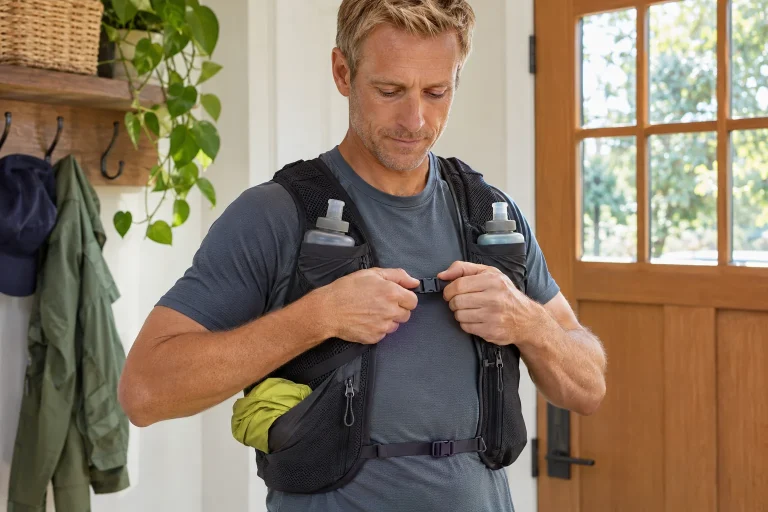
Check adjuster placement too. A running vest, backpack, bottle carrier or heart-rate strap may occupy the same area, making an otherwise comfortable bra press when combined. Bring the upper layer actually used to the shop or home trial. For a new setup, consider the order of dressing and what you need to access later. Rearranging everything to refill a bottle or adjust a vest can annoy on a long run. Ease of use is as real a product feature as material composition.
A movement trial in three stages
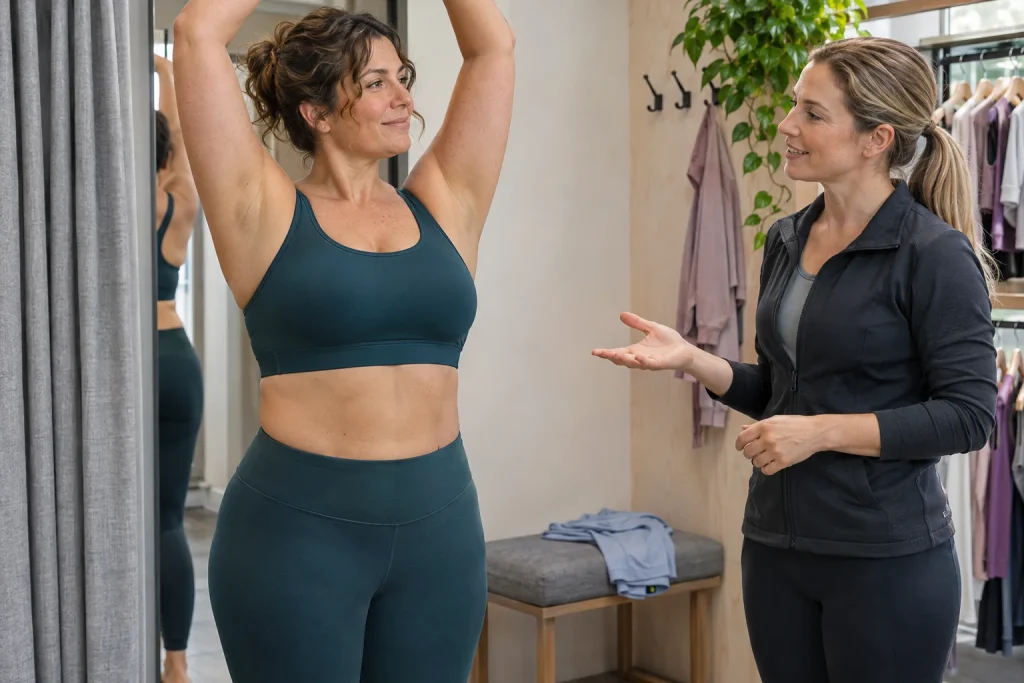
First stand and breathe naturally. Second, try gentle marching, arm swing, torso turns and a few easy running-like movements where appropriate for you and the setting. Third, stop and observe any changed positioning. The goal is a trial resembling intended activity, not the most vigorous possible jumping. On a treadmill, a few natural, easy minutes may be more informative than one dramatic jump. Do not perform a movement solely to test clothing if you would otherwise consider it unsuitable.
Repeat the trial similarly across candidates where possible, noting impressions. One may be stable but rub at the neckline; another comfortable at the shoulders but twist at the band. This is a useful comparison. The chosen model should support and remain tolerable throughout intended use. “It squeezes more, so it is better” cannot replace this assessment. If every size feels uncomfortable, seek different construction instead of an even smaller version of the same.
| Trial situation | Observe | Ask yourself |
|---|---|---|
| Natural breathing | Tightness, pressure and fastening position | Can I breathe freely? |
| Arm swing | Where straps meet the underarm | Does it interfere with my usual movement? |
| Easy jogging | Support and overall comfort | Do I need constant adjustment? |
| After stopping | Parts that have ridden up or twisted | Has the garment stayed in place? |
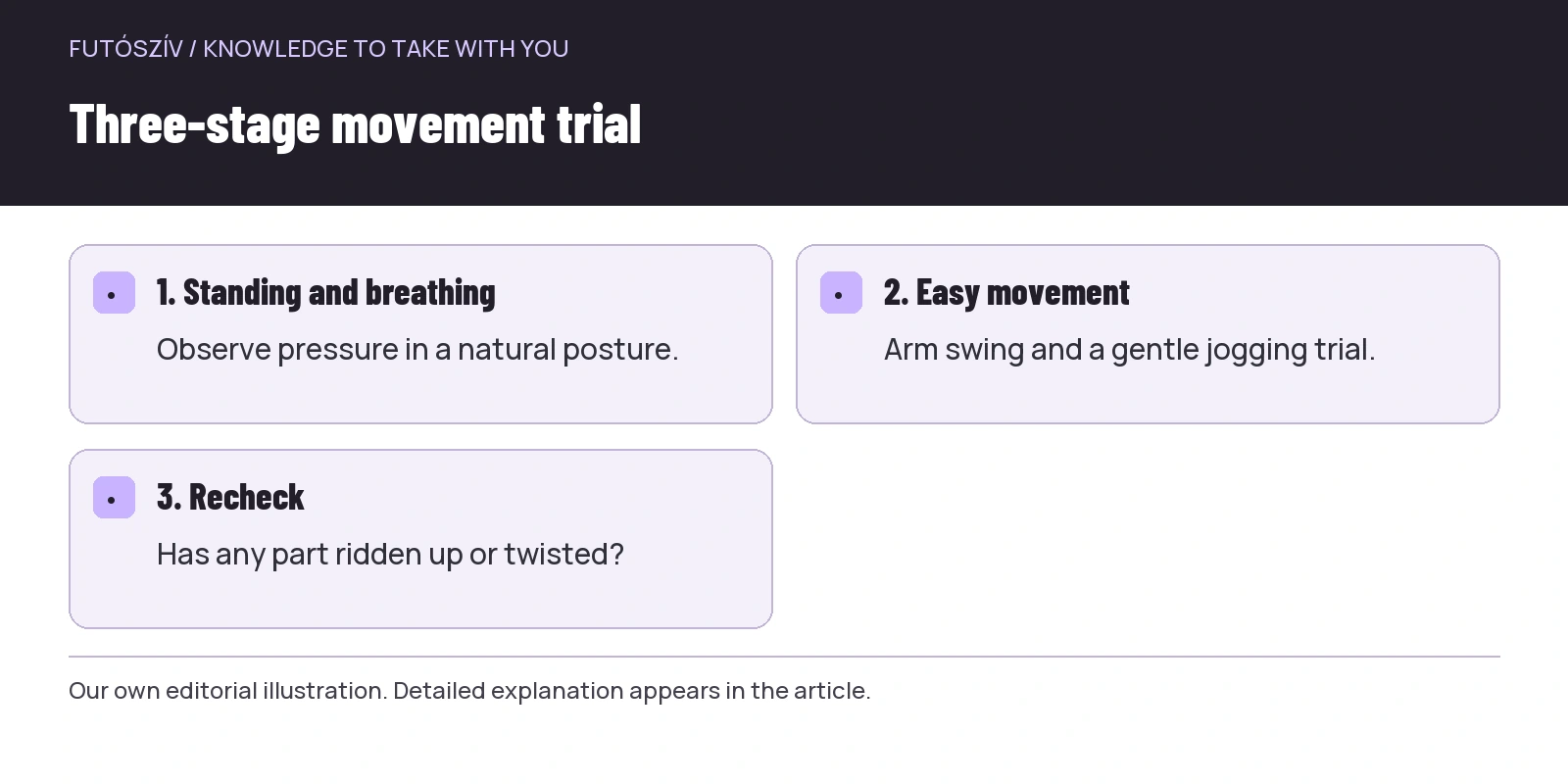 Enlarge diagram
Text version of the illustration
- 1. Standing and breathing
- Observe pressure in a natural posture.
- 2. Easy movement
- Arm swing and a gentle jogging trial.
- 3. Recheck
- Has any part ridden up or twisted?
Moisture, seams and longer use
A few dry minutes do not fully reveal comfort in heat and sweat. Inspect edges, internal labels, seams and areas touching other equipment. Initial softness does not prove every edge will avoid chafing. Make the first outdoor trial a run that is easy to stop, not a long race. Stop and adjust at a sensitive area rather than waiting for substantial skin irritation. An online cream or tape suggestion will not necessarily solve an unsuitable cut.
Consider removal as well as dressing. Wet fabric and tired shoulders can make a complicated action uncomfortable. With front or back fastenings or zips, assess closure comfort and security; with pull-over designs, assess manageability. Limited mobility, shoulder symptoms or other individual needs make this especially important. Theoretically excellent support has little value if you cannot use the garment independently as intended. Seek individual fitting help if needed.
When should you reassess size?
Recheck fit when your body, comfort or bra material changes. After pregnancy, breastfeeding, weight change or another life stage, a previously reliable model may no longer provide the same result. This does not mean automatically replacing everything. First check whether adjustment suffices and what the movement trial shows. For a breastfeeding model, consider access, fastening and present comfort too. If treatment creates specific needs, include your care team’s guidance.
Do not automatically classify pain as an equipment fault. The NHS breast-pain information lists several possible causes and recommends assessment for new, different, non-improving or concerning symptoms. A lump, skin or nipple change, or fever with a warm, swollen breast area is not a bra-shopping question. Seek appropriate healthcare help. This is a fit guide, not a symptom-assessment or diagnostic tool.
Care: support can wear out too
Wash and dry according to the label. Handle fastenings, zips and removable padding as instructed, without assuming all technical underwear tolerates the same programme. Afterwards check shape: twisted straps, folded padding and separating edges. Use and material condition determine support together; age alone does not decide. If increasingly tight adjustment is needed to keep it in place, or it behaves differently while moving, repeat the fitting trial.
Two genuinely reliable garments can help prevent washing and drying from forcing wet or ill-fitting kit. This remains a comfort and organisational choice, not a compulsory quantity. Before buying, note what you like in the existing one and what you would change: a more adjustable band, another neckline or easier removal. The search becomes targeted. The right sports bra is not necessarily the most striking or tightest, but one that lets you focus on running and that you willingly use in everyday life.
Sources and further reading
- University of Portsmouth: expert guidance on choosing a sports bra
- Norris and colleagues: sports-bra characteristics and performance
- NHS: Breast pain
How Futószív articles are prepared: our editorial guidelines.