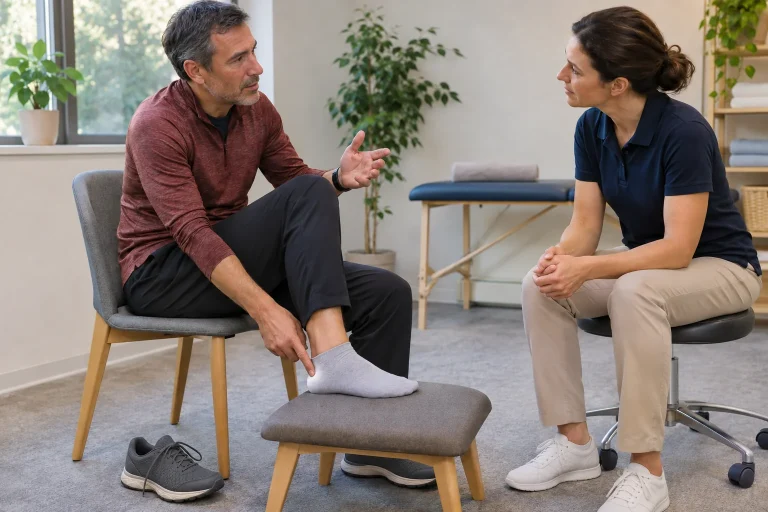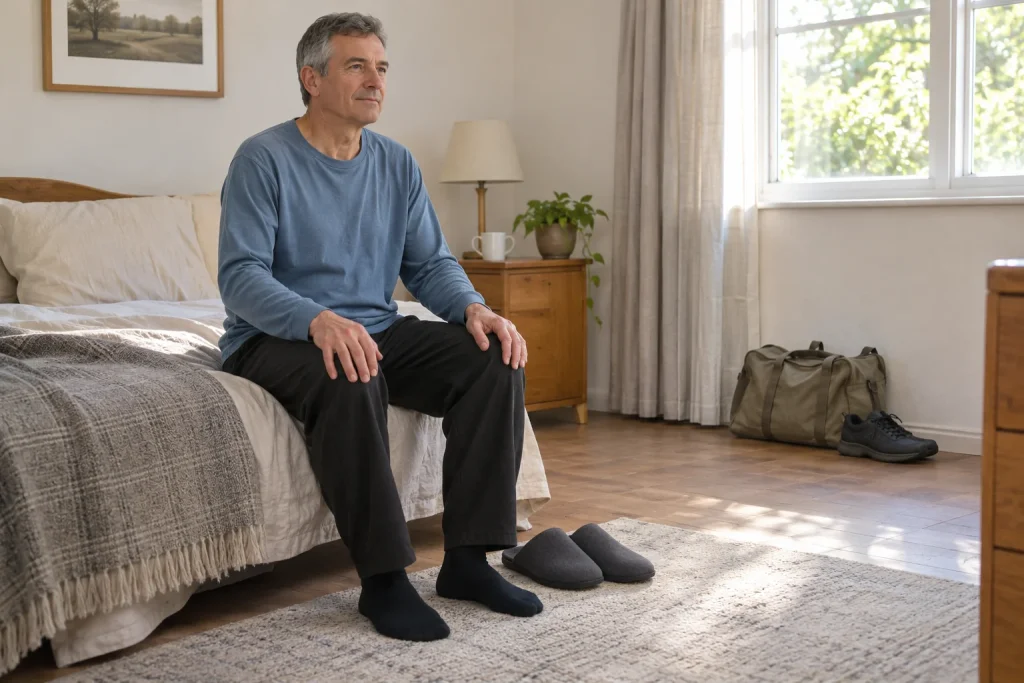
You get out of bed and the sole hurts with the first steps. A few minutes later it feels easier, so by the end of getting ready you almost forget. Online, the same pattern quickly appears with a condition name and many home solutions. Recognition can help orientation without replacing clarification of exact location, the rest of the day and other important symptoms.
Seek healthcare help for severe, worsening sole pain or pain limiting daily activity, numbness or loss of sensation. The NHS specifically highlights these. Inability to walk after a new injury, deformity or a hot, swollen, painful foot may warrant urgent assessment according to the general foot-pain information. A morning pattern does not override the significance of such change.
The sole is not one pain point
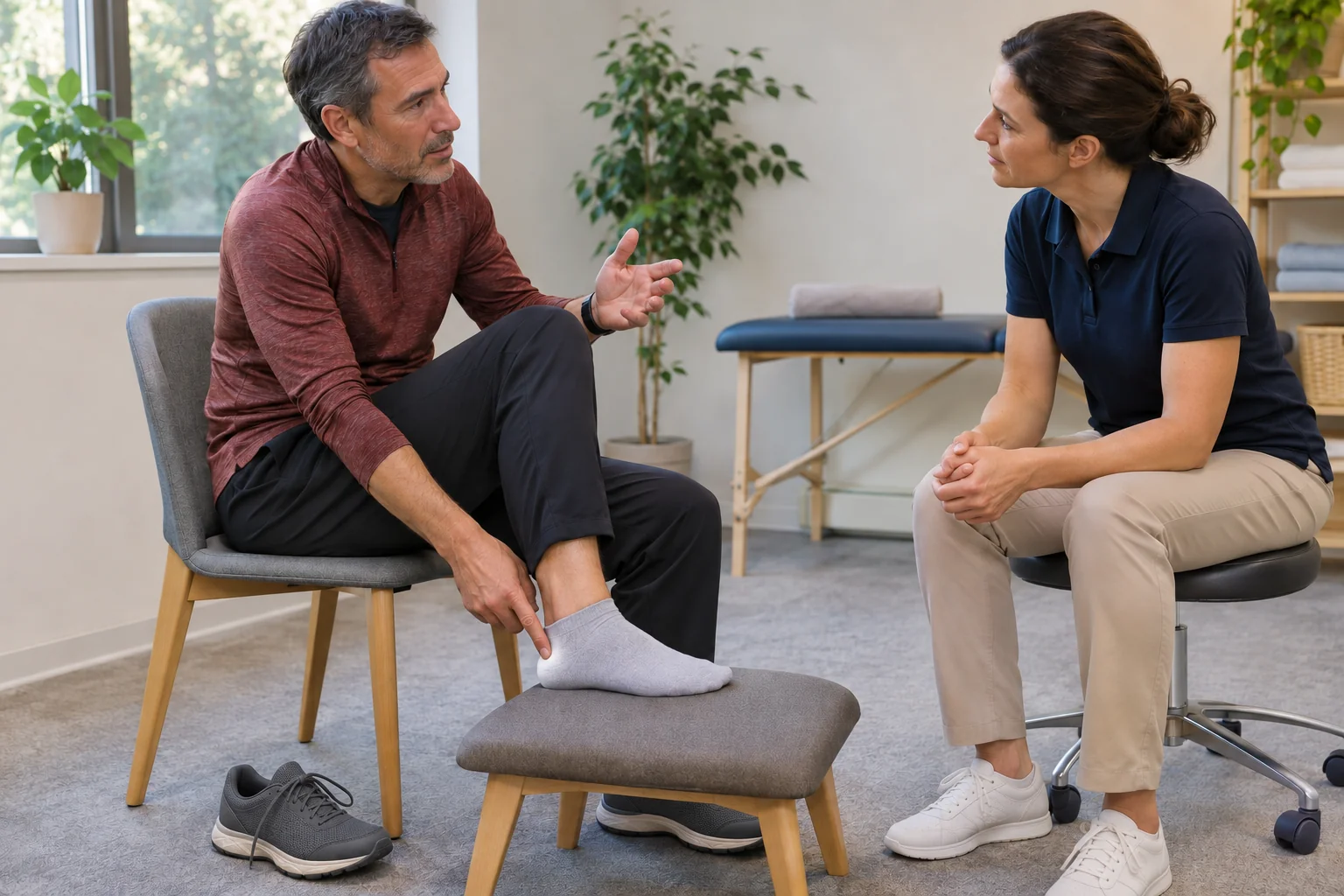
“Sole” covers the area beneath the heel, arch and forefoot. Clarifying location therefore matters more than it may seem. Heel-area pain and pain behind the toes can raise different questions. Anatomical terms are unnecessary: point to and describe the location in everyday words.
The NHS plantar-fasciitis page describes pain beneath the heel and arch. Worse pain with first steps after rest can be characteristic, easing with movement and increasing again after prolonged standing or activity. This is an orienting pattern rather than one sign reliably establishing every sole pain’s cause.
The NHS discusses forefoot pain separately with several possible backgrounds. This shows why “my sole hurts” cannot select one programme. Report difficulty locating it too. You need not search painfully through deep pressing or tiptoe standing merely to make your description seem more precise.
What does the plantar fascia do?
According to the AAOS explanation, the plantar fascia is a strong tissue structure extending between heel and forefoot that also supports the arch. Everyday walking and sport both load it. This explains why symptoms can relate to loading situations, but does not itself establish what causes your pain.
Knowing the tissue’s name does not make stretching or painful rolling compulsory. Individual assessment lies between recognising it and appropriate treatment. Plantar heel pain is an umbrella term for several possible problems; the 2023 clinical guideline likewise takes a broader assessment approach. Local pain is not a certain diagnosis of one tissue.
Another runner’s apparently identical symptom does not prove a shared cause either. They may already have a clarified condition and individual plan while you notice symptoms for the first time. Their experience can help formulate questions rather than replace assessment. “This ball solved mine” is not the same information as knowing what is involved in your case.
 Enlarge image
Let the story continue after the first step
Morning departure can be a prominent part of symptoms without describing the day. Recall what happens before noon, after prolonged sitting and towards evening. Easing does not necessarily settle the question, and end-of-day worsening does not alone establish the cause. The timeline is more useful than only first-step intensity.
A short illustrative note might read: pain beneath the heel on rising, easing while getting ready, noticeable again after prolonged standing. Another person’s symptoms may persist after the first step or hurt elsewhere. Preserve differences between accounts. You need not fit actual experience to an online description.
Recall starting after a long drive or another rest if already noticed. Do not arrange special tests to establish whether symptoms appear after every rest. Notes aim to understand your ordinary day rather than produce symptoms. Not having observed it before is an acceptable starting point too.
Loading is more than running training
The sole has tasks even without sport: walking to work, standing there, shopping, stairs or household chores. Skipping running therefore does not automatically create the same load change for everyone. Explain essential daily tasks and what can genuinely change to build a sensible individual plan.
The AAOS discusses new or increased activity and prolonged standing among relevant history. These are not blame-based explanations. You need not prove a loading error for symptoms, and one factor cannot reliably establish the cause. Recent changes inform assessment rather than grade personal failure.
Report a new running shoe, work shoe or insole too. Wearing situation and comfort may be useful information. You do not need comparative test loops in several shoes before the next appointment, however. Switching equipment does not produce a certain diagnosis and may obscure the original symptoms in an ordinary day.
| Part of the day | What is worth describing? | What does it not establish alone? |
|---|---|---|
| Getting up | Where does it hurt and which usual task is harder? | First-step pain does not provide a certain diagnosis. |
| Daytime movement | Do symptoms ease, persist or return? | Easing is not automatic running clearance. |
| Work and travel | How much standing, walking and other demand is involved? | Running distance does not describe total load. |
| After a longer rest | If already observed, how does walking restart? | You need not produce the pattern through another test. |
Which symptoms should not be forced into the familiar pattern?
Do not dismiss numbness, altered sensation, a new injury or unusual walking difficulty because the rest “fits” plantar-fascia symptoms. The NHS calls for healthcare assessment of such changes. If you have diabetes and foot symptoms appear, tell the care provider promptly too. Individual health background matters more than similarity to a popular running story.
If symptoms continuously worsen or limit usual activities, do not delay help until an online waiting period expires. A hot, swollen, painful foot or inability to walk after injury may raise a different urgency. Do not then treat the morning symptom as the main explanation of the whole situation. Report the new condition separately.
The 2023 APTA guideline also stresses considering another cause with an atypical picture or symptoms not resolving as expected. This does not mean the initial idea was definitely wrong. New follow-up information can change the question, so an old label must not automatically explain every later change.
Painful ball rolling is not the mandatory next diagnostic step
Online suggestions often include hard balls, strong pressure, frozen bottles or intensive stretching. A common method need not be performed painfully or used to determine symptom origin. A general article cannot select pressure location, strength or the right exercise variation for an unresolved condition.
The professional guideline discusses several treatment options for clarified plantar heel symptoms, linked to individual assessment and goals. Targeted stretching, improving muscle function or other care differs from pressing the sole painfully onto an object every morning. Selecting and learning a method is part of care rather than an automatic consequence of recognising an online pattern.
If an individually given task produces new or increasing symptoms, request feedback. You need not increase repetitions independently because the change is unclear. Understand the exercise’s purpose and modification conditions. Rehabilitation is a learning process for a specific condition rather than a contest in pain tolerance or harder tools.
 Enlarge image
A heel spur does not answer everything either
If an X-ray was taken, the report may mention a heel spur. The AAOS notes that many people with spurs have no heel pain and plantar-fascia symptoms are not simply a question of removing the spur. A striking report term therefore does not replace assessment of symptoms and function.
This does not make X-rays unnecessary or every imaging finding insignificant. An investigation can address a targeted question interpreted by the clinician. Ask instead what relationship they see between finding and current symptoms. Do not infer running suitability or mandatory treatment from spur size on a phone screen.
Follow-up should also show changes in tasks important to you. Is usual walking easier, how do symptoms develop under the agreed plan and what is not working in use? Improvement need not relate solely to an anatomical image. The goal is addressing difficulties in your life rather than one identical programme for everyone organised around a report term.
Turn a familiar pattern into a meaningful question
Bring a short account of first morning steps and the rest of the day. Pain location, onset, everyday demand and possible sensory changes may help. Report what you tried and what came with individual advice. You need not complete every possible home treatment before saying symptoms persist or limit you.
The plan should clarify the interpreted condition, purpose of agreed steps and follow-up. Recognising the morning pattern can prompt a precise question: “Does this pain really belong to this condition, and what is needed in my day?” This may yield more useful information than immediately assigning every sensation and home tool to one name.
Morning sole pain need be neither dismissed nor treated as certain proof of disease. Location and timing matter, with symptoms and function assessed together. A recognisable pattern helps when it makes the story and help-seeking more precise, rather than ending further questions and automatically starting painful self-treatment.
Sources
- NHS: plantar fasciitis, symptoms and seeking help, 2025
- NHS: forefoot pain and urgent signs, 2025
- AAOS OrthoInfo: plantar fascia, heel pain and spurs
- AOPT/APTA: final 2023 plantar heel-pain guideline
- Koc and colleagues: Heel Pain – Plantar Fasciitis, Revision 2023
How Futószív articles are prepared: our editorial guidelines.