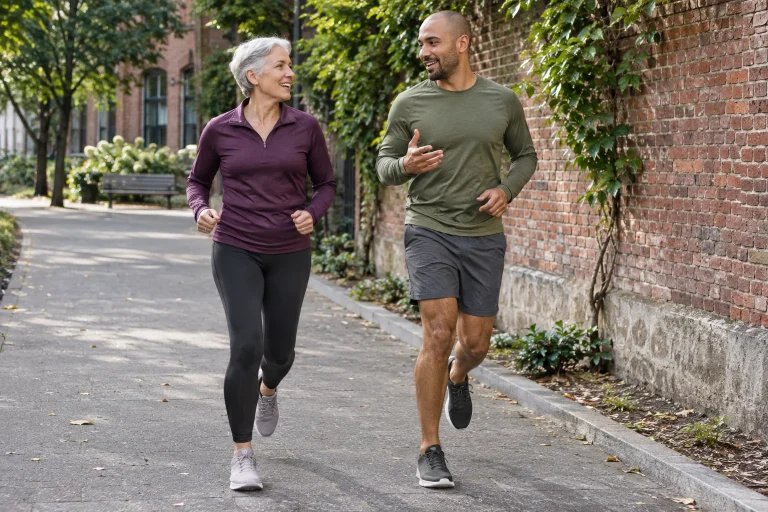
A familiar runner greets you in the park, you smile and carry on. That differs from being asked on a treadmill to smile for a defined section and frown later. Similar expressions may appear in both scenes, but their meaning and context differ. Research on smiling while running is interesting because it made such an instruction measurable. Understanding the result, however, requires separating facial movement, experienced feeling and physiological indicators of movement.
The story is not that good runners must look cheerful throughout. You can feel satisfied with a serious face or smile while finding a task difficult. A run’s value is not decided by how happy you look in a photograph. Research helps when it makes the measurements clearer, rather than giving you another compulsory expression.
Smiling and good mood can be related without being interchangeable
In everyday situations, a smile can mean many things: greeting, pleasure, awkwardness or a response to a companion’s comment. The meaning is not always visible from outside. Do not read an expression as a whole emotional state, in yourself or another runner. A visible movement and personal account are separate information.
In an editorial example, two people join the same loop. One often smiles during conversation; the other moves quietly with a serious face, yet both later describe a pleasant occasion. Appearance does not rank their pleasure. Ask how they experienced the activity rather than only observing their faces.
The same applies to your own running. Looking tired in a picture does not mean the entire session was bad. Smiling does not prove everything was easy either. Several details help explain the memory: what happened, what was pleasant or effortful and why that moment stayed with you.
How was facial expression studied on a treadmill?
In Brick and colleagues’ original study published in 2018, 24 trained runners completed four brief treadmill conditions. Smiling, frowning, deliberately relaxing the hands and upper body, and usual attention were compared. The six-minute blocks were randomly ordered. Researchers collected physiological data and ratings of effort, pleasant or unpleasant feeling and activation.
Oxygen consumption while smiling was lower than under the frowning and control conditions. Perceived exertion was higher while frowning than while smiling or relaxing. Pleasantness or unpleasantness, known as affective valence, did not differ between conditions. Not every participant was most economical while smiling, so the average result is not an individual rule.
This was a short, controlled task, not a comparison of marathon times achieved while smiling. Do not turn the measured difference into a percentage speed gain for everyone. The study’s value lies in examining separate outcomes. This shows why a physiological indicator changing and a participant becoming happier are different claims.
Running economy is not the same as better mood
In this research setting, running economy relates to the oxygen required by the specified task. It does not measure how much someone likes running, their day or life satisfaction. A physiological label can easily become confused with the everyday phrase ‘it went well’, although they answer different questions.
Perceived exertion describes how demanding someone finds a task. Pleasantness or unpleasantness is a separate report: a task may be effortful while valued, or require less effort without being enjoyable. Distinguishing these concepts gives more ways to describe your own experience accurately.
Activation is another consideration: how alert or energised you feel. Greater activation is not inherently good or bad. Do not combine research indicators into one wellbeing score. When a study asks several separate questions, describe results in several separate statements too.
 Enlarge image
Why does the object of conscious attention matter?
In another original treadmill study from 2014, 32 active runners were directed towards different internal attentional focuses. Oxygen consumption was higher when focusing on breathing and movement execution than when observing body sensations; the latter resembled the control. The specific instruction therefore mattered in this sample.
The study does not say you should never notice breathing or bodily signals. A task directing conscious control differs from sensing your condition. Read it in its actual measurement context, rather than as a ban claiming all internal focus while running is bad. Awareness of safety signals is not identical to a laboratory attentional instruction.
This also adds to the smile question: ‘relax’ need not create one identical internal task for everyone. One person hears general reassurance; another starts inspecting every hand and shoulder movement in detail. When discussing advice, clarify how the particular person understood it.
A spontaneous encounter is not a laboratory smiling block
A greeting in the park may involve a familiar face, shared history and conversation. If the next minute feels more pleasant, you experience the complete social situation. You cannot automatically claim facial-muscle movement alone caused the change. Your experience is no less valuable because you did not isolate every component.
Research, by contrast, aimed to compare different instructions in a defined setting. Keep the everyday scene and laboratory condition distinct. Connecting them can generate interesting questions without making a friendly greeting equivalent to an experimental intervention.
Every good moment need not become an optimisation task. You can greet someone because you are glad to see them and smile because something kind happened. You need not calculate a percentage effect on your running meanwhile. Human connection’s value can exist beyond a physiological indicator.
What does individual variation in a small sample mean?
An average result is not an identical story for every participant. In the smile experiment, not everyone showed their best economy in the same condition. You need not reject the average or wear it as a personal instruction. The sample reveals a studied relationship while individual experiences may differ.
An analogy can help. If participants in a group outing rate a route pleasant on average, someone may still prefer another section or setting. This is not a replication of the research, only a linguistic illustration of why a group finding differs from a rule for everyone.
You do not need your own oxygen-measurement experiment to decide whether smiling while running is allowed. An everyday decision can be simpler: if it comes naturally, it can belong in the experience; if it feels forced and distracting, it need not become compulsory technique. The study does not prescribe the face with which you must demonstrate your running’s quality.
How to read an impressive headline about smiling
‘This makes running easier’ can conceal several claims. Was oxygen consumption measured, effort rated or an actual race result compared? The difference matters. Find the task and outcome behind the precise finding. A few basic method details often clarify more than the most emphatic summary.
| Claim | What should you look for? |
|---|---|
| More economical movement | Which physiological data were measured, at what speed and in which task? |
| A task feeling easier | Which report of effort changed? |
| Better mood | Was pleasant or unpleasant experience measured, and did it change? |
| A faster race | Was an actual comparison of race times made? |
The table is not a research-appraisal exam. It helps avoid accepting every possible benefit at once because of the word smile. If a study did not measure race time, do not pass on that promise. If a mood indicator did not change, do not say participants became happier. The more accurate story can still be interesting.
 Enlarge image
You can discuss running without grading facial expressions
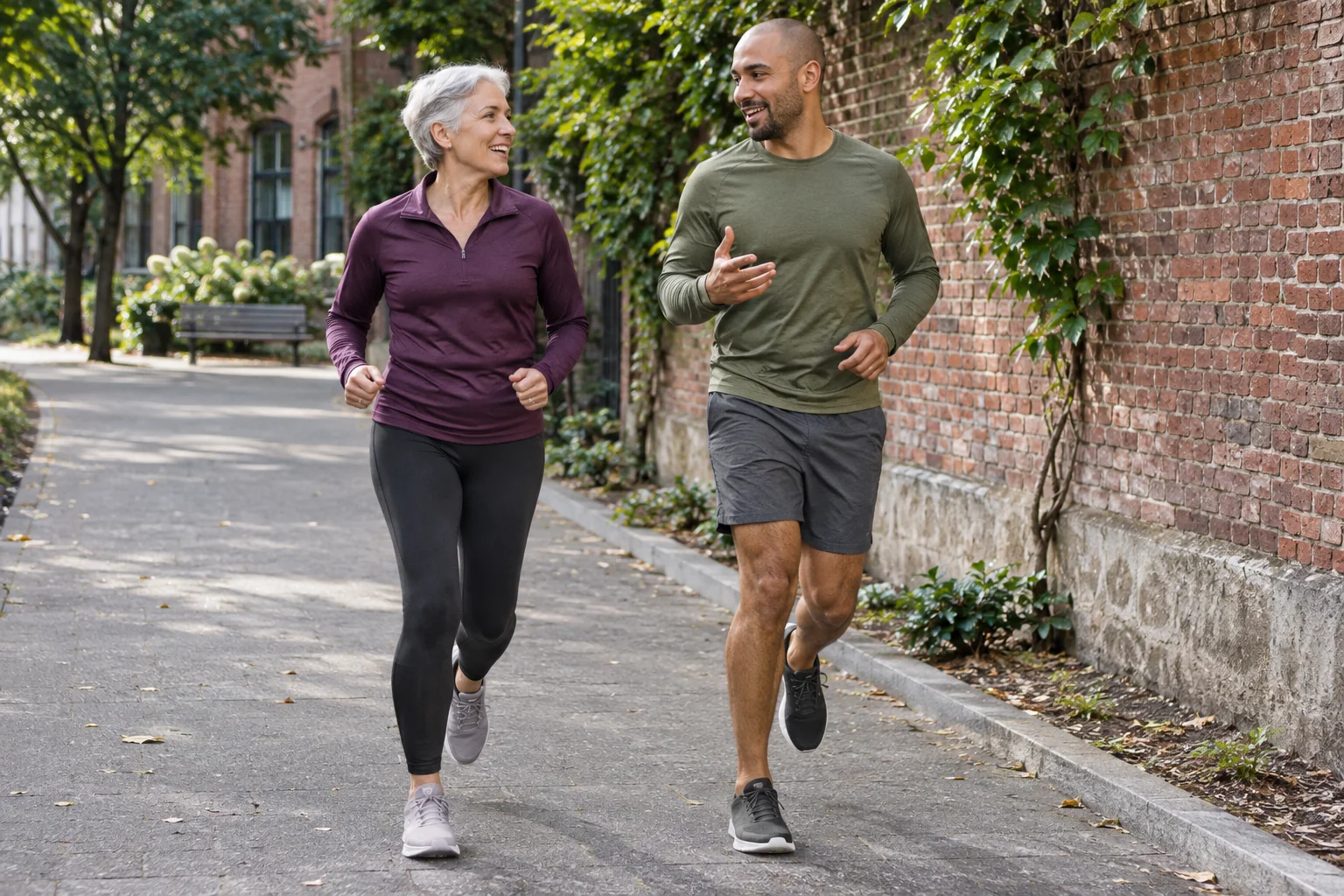
Asking a companion may tell you more than analysing pictures. What did they like? Which part was effortful? What do they remember fondly? These questions make room for their account. You need not decide from outside whether they ran cheerfully enough or immediately interpret a serious face as a negative experience.
Your notes can contain several details too. A brief meeting felt good, the middle was quiet and you were pleased to arrive home on time at the finish. This is a personal story, not one mood score. Every element need not receive a psychological state name to help explain why the session stayed with you.
Less pleasant days need not have smiling endings either. You can honestly say it was not particularly enjoyable while the activity was appropriate in another respect. Expecting outward cheerfulness can hide that nuance. Discussing running experience helps when several truthful accounts fit within it.
A smile can remain a human gesture, not a compulsory performance tool
Research shows interesting relationships between facial expressions, attentional instructions and some running indicators. The lesson is not to begin monitoring your face continuously. Rather, the experiment’s exact question and the meaning of its result deserve separate attention. Curiosity can remain without adding another duty to perform.
If someone recommends smiling, ask what they mean: a relaxed social atmosphere, a brief reminder or a research finding? These are different answers. Conversation becomes clearer when it concerns the specific goal and actual claim, rather than debating the general goodness of smiling.
A park smile can simply belong to a pleasant encounter. A laboratory result can be interesting without promising faster races or happier runs for everyone. You need not choose between them. Keep the gesture’s everyday value while understanding precisely that expression, emotional experience and running economy are separate questions.
Sources
- Brick and colleagues, 2018: a treadmill study of facial expressions and relaxation instructions
- Schücker and colleagues, 2014: different internal attentional instructions and running economy
How Futószív articles are prepared: our editorial guidelines.