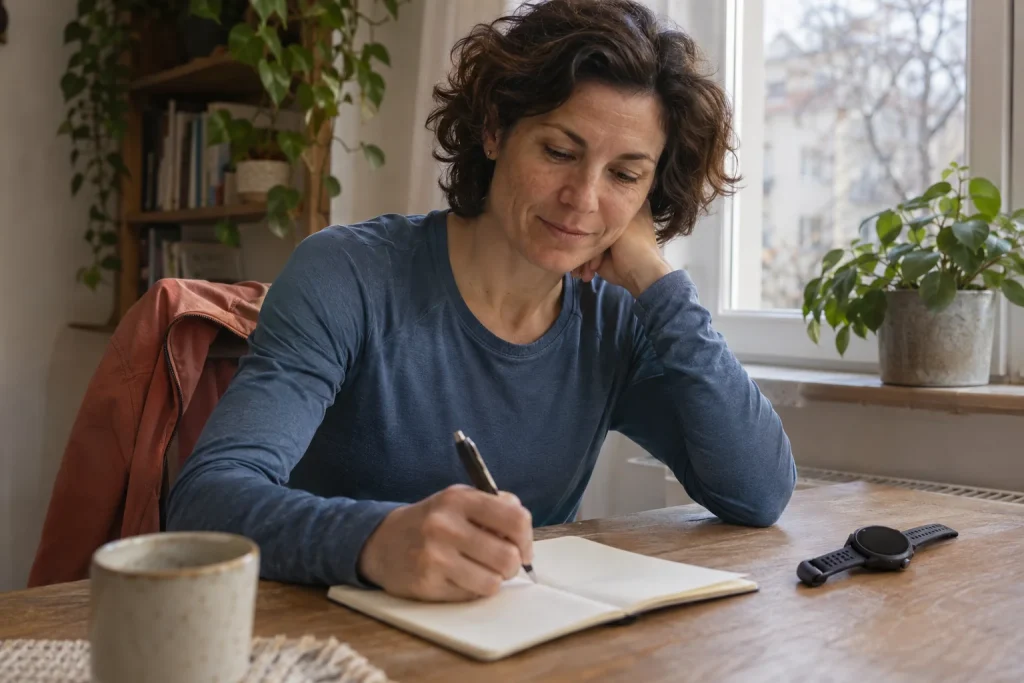
In the consulting room, it is easy to say: I have been sleeping badly lately. It is harder to recall immediately whether a bad night meant taking a long time to fall asleep, waking early or dozing off during the day. As a runner, you also want to place training within that story: did an early start shorten the night, or did rest remain elusive despite enough time? A short, consistently kept sleep diary can provide a reference.
This diary is not another performance contest. You do not need perfect data, nor should you stay awake supervising the night to produce more accurate numbers in the morning. The aim is a clear account showing ordinary days, exceptions and the consequences that actually trouble you. The examples below are editorial models, not a diagnostic questionnaire to complete or personalised sleep treatment.
What would you like the diary to help you explain?
First express your main difficulty in one sentence. For example: I take a long time to fall asleep although I must leave early in the morning; I am awake several times during the night; or I unintentionally doze off during the day. These are different observations. NHLBI says that one to two weeks of sleep diary may help before a medical discussion; sleep problems that interfere with daytime functioning warrant seeing a doctor. You need not wait until a particular period has been recorded perfectly. NHLBI: diagnosing insomnia.
At the top of the page, write why you started. “I want to run faster” is too broad to provide direction. “Even after several alarms I struggle to get up and fall asleep in morning meetings” shows what change you want to understand. You do not need to choose a disease name yourself. A specific situation can tell a doctor more than an online label.
If your healthcare service provides its own form, use it and ask which period they want. You do not need to keep this article’s example alongside the official form. Short notes work well when they are easy to review in the consulting room without becoming disproportionate extra work at home. Clarifying format, dates and time units matters more initially than choosing a complicated app.
Separate night-time events that are easy to merge
The 2012 development of the Consensus Sleep Diary used expert discussion and feedback from potential users to establish standardised questions. Its core version separately addresses getting into bed, trying to sleep, estimated time to fall asleep, intervening awakenings, final awakening and getting up. This shared language supports comparability; the paper does not show that the diary alone cures insomnia. Carney and colleagues: Consensus Sleep Diary.
Our example: you lie down to read at ten in the evening, but only switch off the light and try to sleep at half past ten. Getting into bed and attempting sleep are two separate events in this story. The morning can be similar: you wake for the last time at six but get up at half past six. Simply recording both as “I got up at six” loses a half-hour detail that might be discussed at the appointment.
The time taken to fall asleep and time awake during the night are estimates. The consensus diary instructions do not ask for night-time clock-watching or minute-perfect figures. A note such as “roughly twenty minutes” may therefore be more honest than an apparently precise number. If you do not know, mark it as uncertain. Mark forgotten days too; do not turn a vague memory into firm data later. The diary’s original publication and completion instructions.
 Enlarge image
A brief record of the running day should not overshadow sleep
NHLBI also considers recording exercise, caffeine and alcohol timing, together with daytime sleepiness, useful in a diary. As a runner, you do not need to paste in your entire workout file. One understandable line may suffice: “easy group run after work, then a late arrival home”. If a professional requests more detail, you can find it in your training log later. The note describes the context rather than identifying training as the cause. A diary to support the medical discussion.
| Running-day detail | Useful short note | Premature conclusion |
|---|---|---|
| Early start | The alarm went off earlier than usual because of the group run. | Morning running definitely causes a sleep disorder. |
| Late programme | After training I still had to travel and spent a long time getting ready at home. | All evening exercise should be banned. |
| Caffeine source | Afternoon coffee and the sports product used were recorded. | This definitely caused one particular bad night. |
| Day without running | The usual routine and evening events are still recorded. | A rest day necessarily means good sleep. |
The information on the left of the table consists of observations; the statements on the right are unproven explanations. Preserve that distinction in your diary too. When several things change within a week, it is hard to know which is connected with a difference. Notes can therefore help even without revealing a striking pattern. They may also show that the difficulty occurs on both running and non-running days.
The following day completes the story
Time spent lying down is not all that matters. NHLBI’s information on sleep deficiency asks about feeling refreshed in the morning, daytime sleepiness, unintentional dozing and staying awake during usual tasks. Reviewing sleep habits may need to be supplemented by other investigations; a diary cannot determine every sleep disorder. NHLBI: assessing sleep deficiency.
In your own words, distinguish fatigue from being close to falling asleep. “My legs felt heavy on the stairs” is a different observation from “I nearly fell asleep on the bus”. You do not need to diagnose yourself from these two sentences. They help prevent one all-purpose word for tiredness from dominating the discussion. Note which part of work, study or family responsibilities you struggled with too.
You can describe daytime naps alongside whether they were intentional: I planned to lie down after lunch, or I unintentionally dozed off while sitting. With shift work, make dates and times clear; your main sleep period may not occur at night. Do not automatically label an unusual day a mistake. The task is to help the provider understand your actual schedule, rather than fit the notebook to an imagined model day.
Record the essentials of accompanying circumstances
NHLBI’s general advice on sleep habits includes allowing enough time to sleep, maintaining a regular schedule and a calm, dark, cool sleeping environment. Caffeine, alcohol, light and evening activities are also discussed. These are general considerations and do not automatically explain an individual’s difficulty. A simple contextual note may suffice: noisy accommodation, an unusually warm room or a late shift. NHLBI: healthy sleep habits.
You do not need to measure ten separate environmental values each evening. If hotel corridor noise woke you several times during a race trip, record that. If you only thought the next day that the room might have been warm, label it as uncertain too. Separating an impression from an event you actually noticed does not weaken the diary: it shows more accurately what you know for sure.
Keep a separate, current list of medicines and other preparations you use that you can take to the appointment. Do not omit prescribed treatment for the diary or independently experiment with sleeping medicines. The NHS recommends talking to a doctor before taking anything for sleep; some products can also cause daytime drowsiness. A clear record of the name, actual use and timing supports the discussion. NHS: insomnia and seeking help.
Keep watch data in a separate column
A sports watch may estimate sleep through a different process from your morning recollection. If they disagree, do not automatically alter your own observation to suit the app. The AASM’s 2018 position statement on consumer sleep technology says such information may form part of a medical conversation but does not replace medical evaluation; diagnostic use requires appropriate validation and regulatory conditions. This is not an accuracy test of a specific current watch model. AASM: consumer sleep technology.
As a practical layout, use two clearly named spaces: “my morning estimate” and “device-reported data”. Add the device name and whether you wore it all night. This keeps the origin of each number visible at the appointment. Information from different sources need not be blended into one score; ask about the interpretation of what actually concerns you.
If the app produces a long report, ask the healthcare service in advance what format it accepts. Hundreds of screenshots may not be the most helpful option. Keep the detailed file alongside a brief summary and open it only if requested. Do not automatically share your health and sleep information with the whole running group: organising a shared session generally does not require your personal medical report or every overnight note.
 Enlarge image
When should a complete diary not be the first priority?
If the sleep problem persists or its consequences are difficult to manage in everyday life, seek help. The NHS also recommends assessment for insomnia when changing habits does not help. Do not drive when sleepy; a journey by car to morning training does not become safe because your diary shows enough time in bed beforehand. Notes do not take precedence over an immediate safety decision. NHS: when to see a doctor.
Specifically mention loud snoring, pauses in breathing during sleep, gasping and constant daytime sleepiness. The NHS sleep apnoea information recommends medical discussion for these; a description of what someone else saw can help too. A diary alone neither rules out nor confirms apnoea. If needed, the healthcare provider can refer you for a targeted sleep investigation. NHS: sleep apnoea symptoms and assessment.
You may only need to tell a running friend that your morning attendance is uncertain and you will not offer lifts. Detailed discussion of symptoms can belong in the healthcare appointment. That allows the practical group arrangements to be settled without deciding how serious your difficulty is through friends’ opinions. A good race result or regular training attendance does not replace describing your problem.
One page that is easy to hand over and discuss
Before the appointment, select two characteristic but different days: for example, an ordinary workday and a day when the difficulty was particularly disruptive. Do not bring only the worst night if other days are available. The whole short period shows how exceptional that story was. Mark missing data and any change that makes comparison between preceding and following days uncertain.
Three questions can fit at the end of the page: what further information is needed; whether another investigation is appropriate; and when to return and with what changes. If the professional requests another diary format or different observations, note that down. Do not turn the notebook into your own treatment system by independently shortening time in bed or changing medication when a number is reached. Observation and treatment decisions are separate tasks.
The tangible result need not be a new record or a higher sleep score. It may be finally being able to explain clearly when you have the opportunity to sleep, what happens during the night and what you experience the following day. The medical conversation can then begin with your own clearly described circumstances rather than a general statement about poor sleep. A diary serves its purpose when it helps you discuss the problem and you can put it aside afterwards.
Sources
- NHLBI: diagnosing insomnia
- Carney and colleagues: Consensus Sleep Diary, 2012
- NHLBI: sleep deficiency and assessment
- NHLBI: healthy sleep habits
- NHS: insomnia
- NHS: sleep apnoea
- AASM: consumer sleep technology, 2018 position statement
How Futószív articles are prepared: our editorial guidelines.