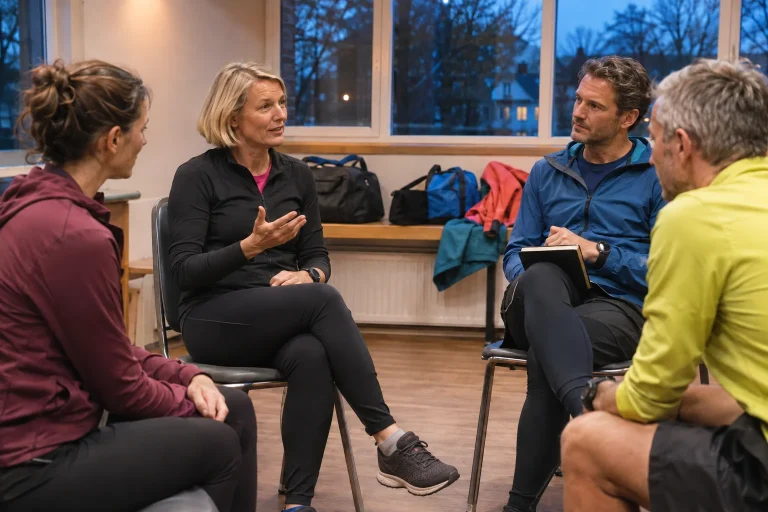
Moving alongside others, knowing companions’ movements and finding a shared rhythm can be distinctive social experiences in many sports. Runners may recognise a moment when an activity feels shared, rather than merely performed simultaneously. This is interesting to study. Interpretation nevertheless requires distinguishing what happened to participants, what was measured afterwards and which explanation the authors proposed.
A well-known rowing experiment and a dance study offer a good opportunity. Both involved coordinated movement, but tasks and participants differed. Their story reveals something about belonging and about reading sports research passed on with a striking biological explanation.
Being together and moving in synchrony are different
Several people may run simultaneously in a park while following separate programmes. You can be alongside one another without steps landing on the same beat. Elsewhere, movement may be deliberately coordinated, as in a shared rhythm task. These describe different social situations. Being present together, choosing a goal together and performing movements at the same time are not automatically interchangeable.
Movement synchrony refers to temporal coordination. It does not necessarily imply friendship, equal skill or shared values. Two strangers can move precisely together briefly, while old friends can enjoy a shared activity at different rhythms. One research question is whether coordinated tasks add something to social experience. Clarifying concepts provides its foundation.
As an everyday example, imagine three people setting off on the same wide path. One sees conversation as the activity’s essence, another the jointly chosen route and the third enjoys moving together. These experiences can connect without meaning the same thing. This is our own illustration, rather than participant reports. It explains why a study must specify the form of cooperation.
What happened in the rowing study?
In Cohen and colleagues’ original paper, Rowers’ high, published online in 2009 and in a 2010 journal issue, individual and synchronous group ergometer exercise were compared among university rowing-team athletes. Twelve male athletes were recruited; one participant’s extreme outlying data were excluded from the main analysis. Researchers sought comparable exertion and examined pain threshold before and after exercise.
In the study, the shared synchronous condition was associated with a larger threshold change than individual exercise. The authors interpreted this through a possible explanation involving the endogenous opioid system. They did not directly measure molecules or perform brain imaging. The group was small and specific, rather than a general Hungarian runner sample, and the finding alone does not establish lasting belonging in a running club.
What initially catches attention is the possibility of shared movement. What inference requires is the measurement’s precise name. The experiment did not ask whether every participant liked their team more the following year. It did not measure everyone’s enjoyment during a street run. It revealed a result in a brief experimental setting within a specified athlete group, generating further questions.
Why does calling it a proxy matter?
A proxy is a measurement used to infer another process not directly measured. A simple non-biological analogy helps: several wet umbrellas outside a door may suggest rain outdoors. Umbrellas are nevertheless not direct rain gauges and do not establish rainfall quantity. A signal can help, but inference remains a separate step.
In pain-threshold testing, the measured result is the response to a specified experimental stimulus. An explanation concerning endorphins occupies another interpretive level. Retelling the story as though a particular molecular quantity was directly detected in participants’ brains would be inaccurate. Separating measurement and explanation preserves the finding’s interest while clarifying the claim’s basis.
Headlines can easily lose this distinction. ‘A measured response changed after shared movement’ can immediately become ‘the team definitely produced this molecule’. The latter claims more. An attentive reader therefore looks for what was directly measured and what belongs to the authors’ explanation. You need not become an expert in every study to keep these questions separate.
 Enlarge image
The dance experiment varied two things separately
Tarr and colleagues’ original 2015 study separately varied synchrony and the nature of exertion in group movement among Brazilian schoolchildren. They used standing dance involving fuller-body movement or seated hand movements, comparing coordinated and partly differing movement sequences. Adult running workouts were not studied. Separating the factors was an important design feature.
In the full paper, each factor was independently associated with pain-threshold change and reported connection to the small group. The latter was a social questionnaire report, rather than the same data as threshold testing. Positive and negative emotional changes showed no equivalent main effects. Multiple endpoints therefore cannot be combined into one general result about pleasure here either.
The logic of combining two factors is instructive itself. Comparing only a group dancing together with seated individuals alone would obscure which difference related to the result. Identical movements, movement amount and social presence easily become bundled. Multiple conditions help ask separate questions, even without automatically resolving every interpretive problem.
What does combining the two factors mean?
The table below illustrates the simplified logic of the dance-study design. It is neither a home group exercise nor a workout. Its purpose is to show coordination and the nature of exertion as separate variables. It provides no personal advice about which movement or intensity to select.
| Design factor | Coordinated movement | Partly different movement |
|---|---|---|
| Fuller-body movement while standing | The same movement sequence with shared timing. | Different sequences within a shared musical setting. |
| Smaller hand movements while seated | The same hand movements with shared timing. | Different hand movements within a shared musical setting. |
In such a design, we can ask whether a factor has an independent result or only differs in combination with another. Everyday storytelling often omits this, compressing observations into ‘together is good’. Research asks a more detailed question. Understanding design logic reveals that being together has several components and the result is more than a catchy title.
Closeness, enjoyment and bodily responses are different questions
A social-closeness response expresses how someone judges their relationship with other participants. Emotional experience concerns feelings. A bodily experimental response comes from another data-generating procedure. They can relate without one translating the other. A situation may matter socially without everyone reporting special exhilaration.
In our own illustration, three runners complete an agreed route together and highlight different things afterwards. One appreciates joint planning, another the landscape and the third mutual attentiveness. This is not a laboratory finding. It reminds us that one occasion can carry different personal meanings, which need not be replaced with one biological word.
Social connection can be named as an experience in its own right. You need no hormonal proof for a shared session to matter. Biological research can examine interesting additional questions, but does not replace participants’ own reports. Equally, a laboratory difference does not determine whether someone feels at home in a particular running community.
What can this contribute to thinking about running?
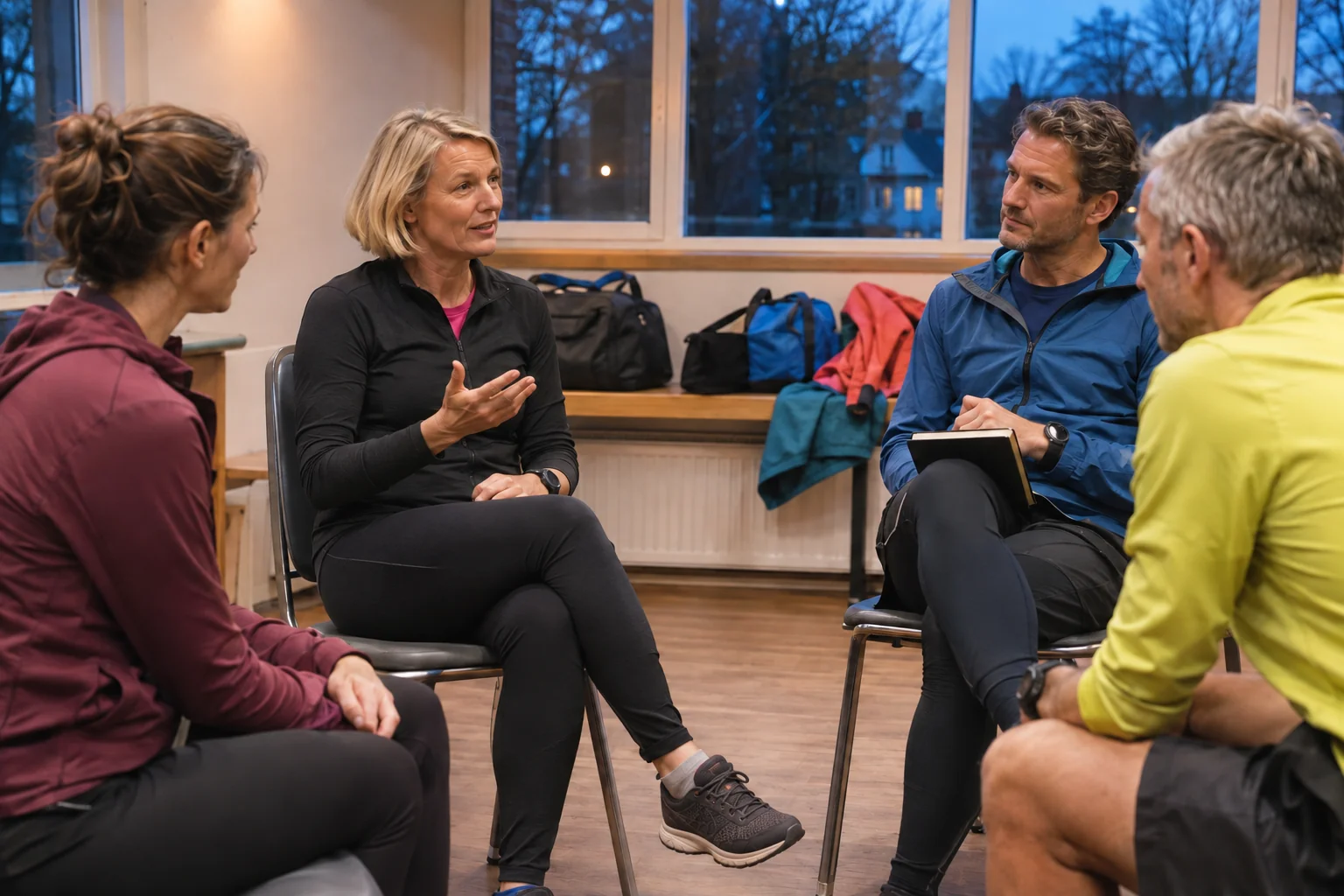
Shared rhythm can be interesting, but runners need not match every step. Rowing and dance tasks differ from street running. Moving together may mean shared time, a chosen route or attentiveness in your own situation. You need not copy another sport’s experimental task for your social experience to be real and important.
In everyday language, coordination can also mean organisation: knowing where to meet and considering different needs. This differs from the motor synchrony studied. Keep the meanings separate. An inclusive session does not necessarily require identical speeds or movements, but clear, voluntarily accepted shared arrangements.
If adapting to others is unpleasant for someone, this is not a failure of community ability. Their goals, physical characteristics, experience or preferences may differ. Research findings do not authorise forcing anyone into unwanted effort or rhythm in the name of connection. Genuine choice can be part of a shared activity’s value too.
 Enlarge image
Pain threshold is not a sporting self-test
Experimental measurement does not mean seeking pain during a run or testing how much you can endure. The cited studies collected data in specified research settings. Assessing an everyday symptom is separate. A pleasant group atmosphere or belonging is not healthcare clearance or a reason to turn a bodily signal into a test of commitment.
Nor do findings imply that more effort produces more friendship. Comparing conditions in the dance study does not create an unlimited exertion–connection rule. Social experience should not be treated as a recipe requiring everyone to do the same amount for a desired feeling. A session’s meaning can remain personal and situation-specific.
When discussing research, simply preserve the measurement’s name. Pain threshold was one examined outcome, rather than a membership test. Social reports were another, while neurochemical explanation was separate interpretation. These three statements communicate the story more accurately than a promise of simultaneous pleasure, healing and certain belonging.
How should you read research news about shared movement?
First identify participants and what moving together meant. An established rowing team, a school dance task and an informal running group can differ. Second, identify actual data: questionnaires, movement measurements, bodily test responses or direct biological measurement. Third, separate conclusions the authors proposed as possibilities.
Shared rhythm loses none of its interest. Its story becomes more detailed: task, participants’ experience and the search for explanation are separately visible. As a runner, you need not prove a molecule’s presence to value a social activity. Precisely naming what was shared, what it meant to you and which arrangements you would choose again is enough.
Sources
- Cohen and colleagues: Rowers’ high: behavioural synchrony is correlated with elevated pain thresholds, online 2009, journal issue 2010.
- The original rowing study’s PubMed record.
- Tarr and colleagues: Synchrony and exertion during dance independently raise pain threshold and encourage social bonding, 2015.
- The original dance study’s PubMed record.
How Futószív articles are prepared: our editorial guidelines.