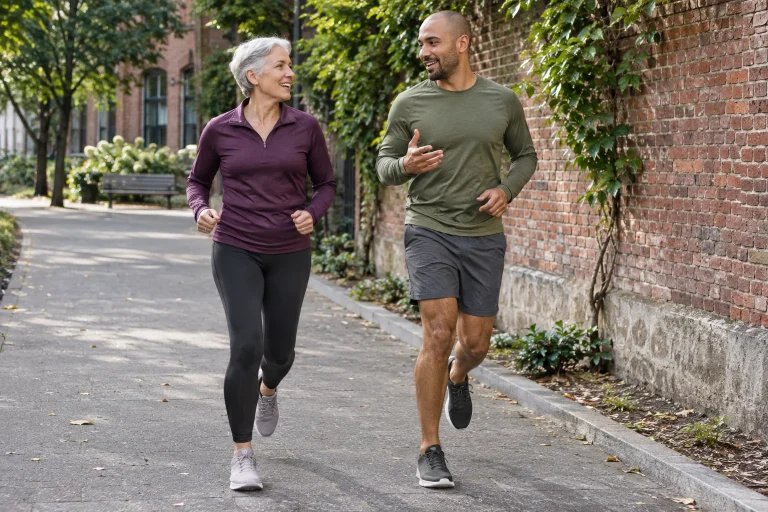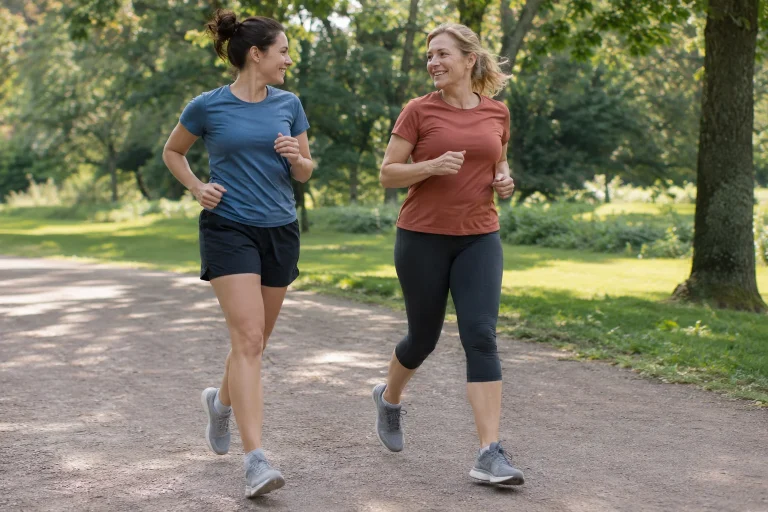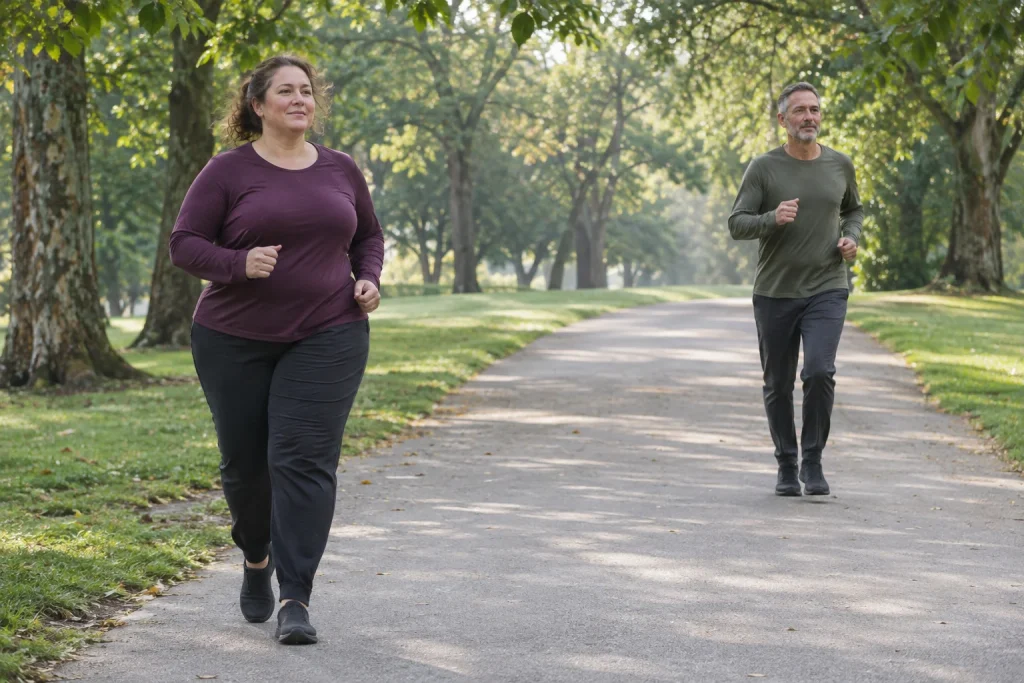
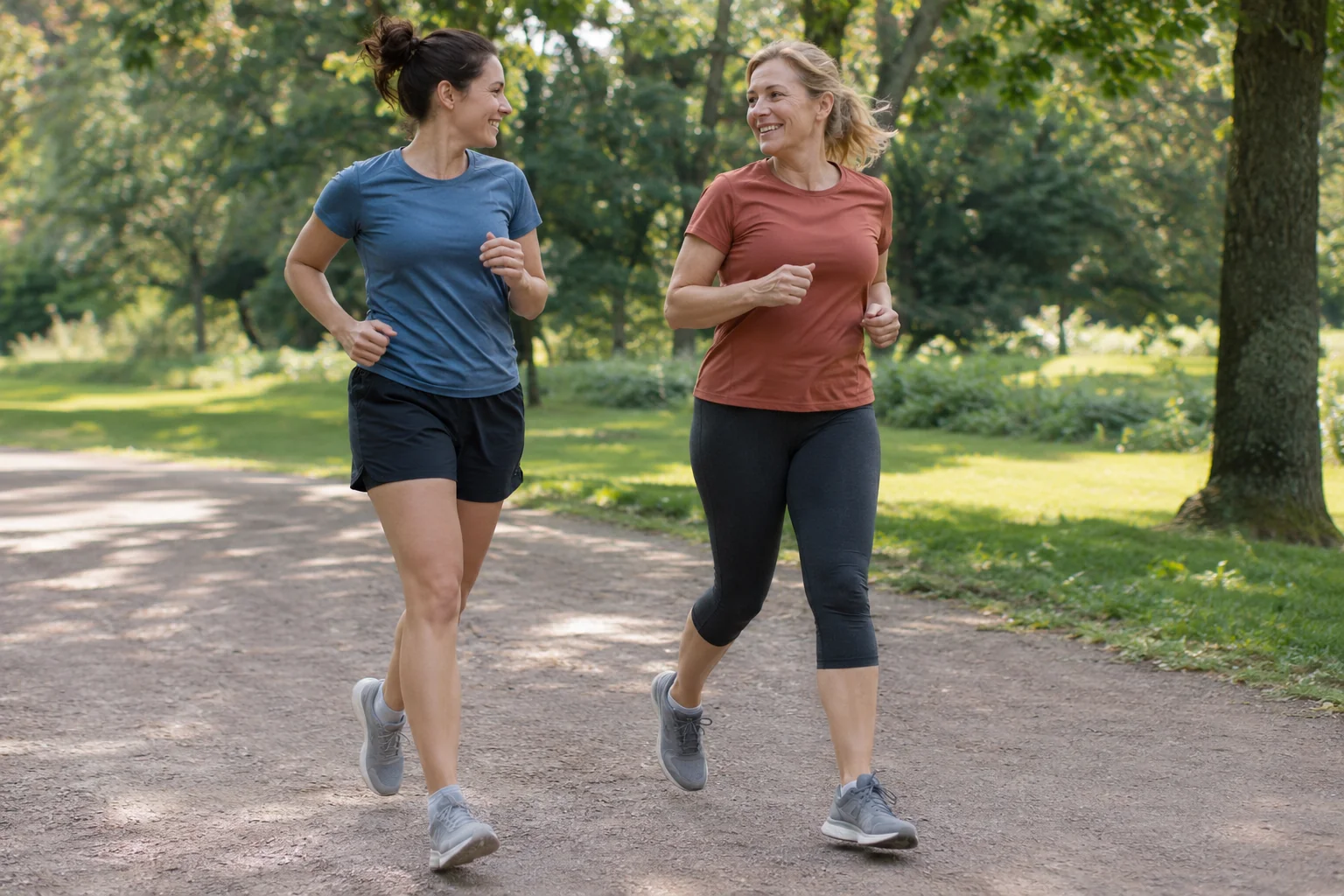
You and a friend choose the same short loop. They return earlier while you move more slowly, so you assume your task must have been smaller. That conclusion is too simple. Distance can match while movement time and personal effort differ. Slower pace does not automatically make the whole outing identical or easier.
As a beginner, including at a higher body weight, retain several separate kinds of information. The aim is not a complicated load formula, but avoiding judging your own day by someone else’s kilometres. Distance, time, intensity and physical experience answer different questions. None completely replaces the others.
What does distance tell you, and what remains open?
Distance describes how far you travelled according to the chosen measurement. Alone, it does not explain how: running, walking, stopping, uphill or on level ground. Identical kilometres can conceal different histories. Actual content matters alongside the programme’s name.
The relationship between pace and time is simple arithmetic. In a fictional example, two people each cover 2 kilometres; one spends 6 minutes per kilometre and the other 9, producing journey times of 12 and 18 minutes. This is neither a beginner dose nor a recommended pace. It shows only that the same distance takes longer more slowly.
The six-minute difference does not establish a particular injury risk or load percentage. The arithmetic calculated time, not tissue condition. Clarifying units helps prevent using a simple distance value in place of the whole personal task.
| An original numerical example, not training advice | The same distance | Different pace | Calculated time |
|---|---|---|---|
| Person A | 2 km | 6 min/km | 12 minutes |
| Person B | 2 km | 9 min/km | 18 minutes |
Another person’s pace does not reveal your effort
The CDC intensity guidance distinguishes absolute intensity from intensity relative to the individual. The same activity can challenge people differently depending on fitness. Another person’s comfortable run does not prove that you experience the same speed identically.
‘Slow running’ can also be a social label. A club’s experienced members may call a pace slow while it requires high effort from a beginner. You do not have to adjust your breathing or well-being to match the word. Interpret the task in your own situation. If your individual programme calls for easier work, do not infer it from a faster companion’s habits.
Being able to talk or using perceived effort can provide intensity reference points, but neither rules out illness. Unusual breathlessness or feeling unwell cannot be dismissed with ‘I am a beginner’. Interpreting intensity and appropriate assessment of a new symptom remain separate tasks.
What did researchers observe about beginners choosing their own pace?
An exploratory study published in 2018 with one week of follow-up described self-selected programmes in 914 novice runners across three BMI groups. Participants recorded distance, time and speed with GPS watches. Higher-BMI groups ran more slowly on average, while weekly distance and time were similar between groups.
This is an observational group description, not proof that two particular people sustained identical loads. It is neither a personal injury prediction nor an indication of the pace you should choose. The study highlights that beginners’ self-selected amount and speed are not simply two expressions of the same data.
You cannot select your own story from a group average. You may start with different history, another type of movement or different daily opportunities. The BMI group’s name does not reveal those details. Keep the study within its precise scope and connect individual decisions to your actual experience and health situation.
 Enlarge image
Loading involves more than breathing
The musculoskeletal system also participates in running. The NIAMS overview of sports injuries discusses repeated overload and increasing intensity too quickly. Cardiovascular effort and a particular body part’s loading experience are not necessarily the same information. Comfortable breathing alone does not describe every tissue’s present state.
This does not mean slower running is definitely worse or faster running definitely better. This article creates no such ranking. Speed alone cannot calculate a person’s whole risk. Activity type, history, frequency and individual condition do not fit into one ‘slow’ label.
Do not estimate bodily load simply by multiplying body weight and kilometres. The resulting number does not become a clinical metric. Likewise, step count alone cannot identify how a particular body part adapted. An apparently precise number can readily lack an actual evaluation method.
If pain or functional change occurs in a particular place, treat it as its own question. Do not explain it away because your companion covered the same kilometres comfortably. Two people’s different experiences are not an argument in which one must be feeling incorrectly. Both belong in shared planning.
You can agree something other than identical distance
When moving at different rhythms, you do not need to force the outing into identical distances and finishing times. Choose a shared meeting point, different loops or conversation afterwards. The actual solution depends on the route and individual plan. Community consists of more than identical steps side by side.
Clarify beforehand whose needs guide the shared section and what happens if you continue separately. A faster person running back or looping is not automatically appropriate everywhere either. On a narrow path, in traffic or on a poorly visible section, that solution may create another problem. Organisation must fit the actual place.
The slower beginner should not be responsible for delivering the other person’s entire workout. You can say that another format or shorter section fits your own framework. This is not apologising for your body’s existence. Clear discussion can give both of you more attention than silently struggling to maintain someone else’s pace.
Walking can be the shared experience too, where appropriate for participants. Both people need not achieve the same sporting goal every time. Connection and individual training can have separate time. Stating your goals helps prevent one person seeking their performance’s worth on the other’s screen.
Several views can coexist in your own log
Record distance and movement time, then add a brief personal note. How did effort feel, did an important route detail change and how did the outing fit your day? You do not need to make a new score from everything. Keeping separate data already supports more precise recollection.
Distinguish movement time from the whole occasion’s duration when relevant to comparison. Conversation, crossings and stops may belong to the outing while differing from continuous running. Understand the watch summary’s labels. Do not calculate confident conclusions from an unknown field.
| Data or experience | Which question does it address? |
|---|---|
| Distance | How far did you travel according to the selected recording? |
| Time | How long did movement or the whole outing last? |
| Effort | How demanding was that situation for you? |
| Physical change | Was there a symptom or functional difficulty needing separate assessment? |
The table provides no formula assigning a value to each item. You need not calculate one final load number from it. Different views help different questions. Your story becomes clearer when one metric is not expected to provide every answer.
A slower pace is not necessarily an easy day
If you call a session easy, know what that means in your individual programme. A pace slower than someone else’s is merely a comparison, not demonstrated easy intensity. Considering your own effort and condition helps prevent the day’s label from contradicting your actual experience.
The same applies to comparing with your earlier self. An old pace may be a different task today after a long break, illness or changed circumstances. Keep earlier achievements as memories without forcing the present programme to match. Today’s starting point does not diminish your earlier sporting story.
If a task feels unusually difficult, further reducing speed or choosing another activity may be considered within your individual framework. A new or worsening symptom needs separate appropriate assessment. ‘I am already slow’ should not stop you reporting a real change.
 Enlarge image
Symptoms are not a comparison contest
The NIAMS emphasises avoiding continued movement through injury-related pain. You do not need to be faster or have your companion feel the same thing to take an appropriate next step. You can name your symptom even if everyone else finished the loop satisfied.
Seek appropriate and, where needed, urgent help with severe pain, substantial swelling, inability to bear weight or serious illness. For a less urgent question, precise onset, location and change may matter. Do not use another person’s reaction to decide whether your experience is significant enough for help.
Comments based on body type do not automatically explain the situation either. Weight may have a relevant role in assessment but does not replace every other piece of information. Respectful discussion retains the specific symptom and task. A sporting community should not grant acceptance in exchange for hiding symptoms.
Your own rhythm can have a more precise meaning
Two fictional beginners choose the same local loop. One returns faster; the other spends longer moving and experiences effort differently. Before the next occasion, they do not simply say the slower person ‘worked less’. They name distance, time and the shared programme they want separately.
They may choose different sections and meet afterwards, or make the shared part a walk. This is not personal training advice but a discussion replacing a mistaken comparison. Movement remains a shared interest even when the actual tasks differ.
Identical kilometres therefore do not mean identical histories. Slower movement can mean more time, while personal effort cannot be read from pace alone. Your own rhythm becomes useful when connected to current function, an appropriate programme and actual experience.
Sources
Bertelsen and colleagues, 2018: beginners’ self-selected distance, time and speed; CDC: absolute and relative intensity; NIAMS: repeated overload and sports injury; NIAMS: pain and an appropriate individual next step. Checked: 21 November 2026. The two-kilometre example is original arithmetic illustration, not a recommended distance, pace or clinical load calculation.
How Futószív articles are prepared: our editorial guidelines.