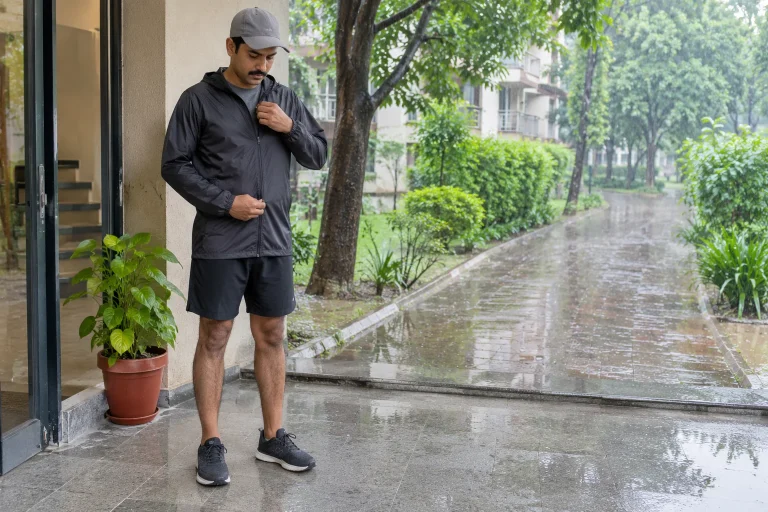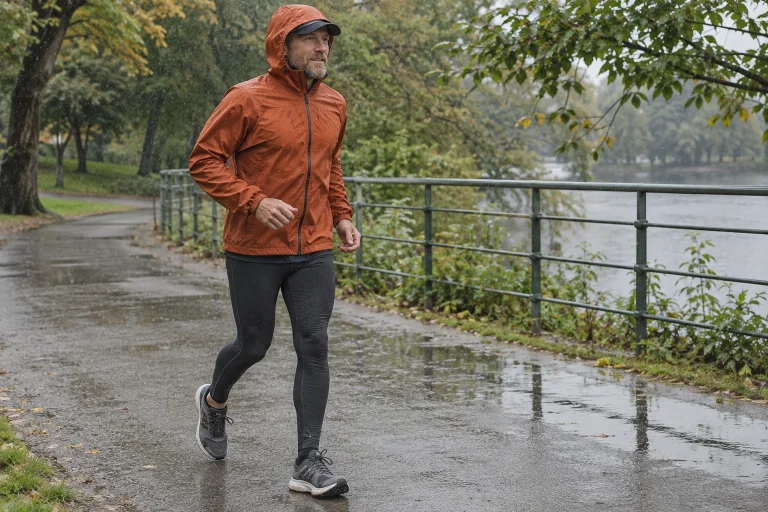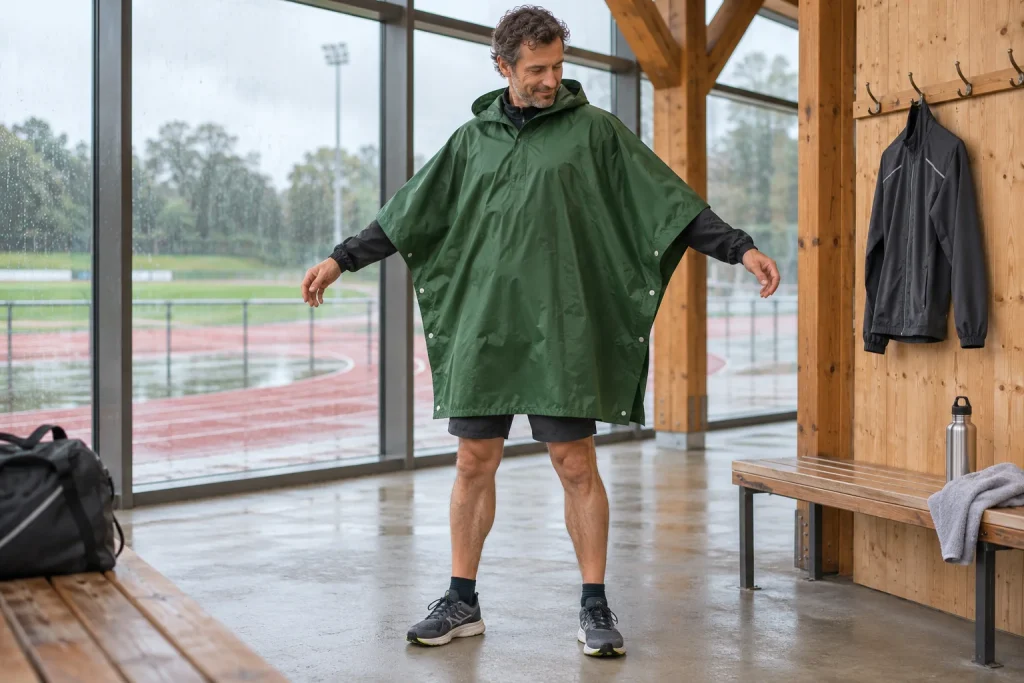
A lightweight rain poncho initially looks simple: throw it on, cover a large area and pack it small. For running, however, packed weight is only one question. The same loose fabric that drapes comfortably around you while standing may settle differently with arm movement, head turns and wind. A meaningful comparison with a jacket therefore also considers how you wear it, what you can see, what you can reach and the intended use of the particular model.
Treat waiting before the start, running and changing after the finish separately. An item can be useful in one situation while you would not choose it for another. The following points offer an original practical trial sequence. We do not classify every poncho as suitable for running or provide a universal wind limit for unfamiliar garments. Manufacturer intention, the actual location and event organiser requirements all belong in the decision.
First name when you want to wear it
Waiting for the start of an urban race and a long, windy trail section are very different clothing tasks. In the first, you may mainly want an easy-to-put-on outer cover for conditions appropriate to you. In the second, sustained movement, kit access and changing surroundings are also decisive. Reducing both tasks to “I need it for rain” can lead you to choose an advantage unrelated to actual use.
Keep your task description specific: “I will stand waiting until the start”, “I would run a short loop in it”, “I want to organise changing after the finish”. Beside each, note what else you will wear and carry. If you would use a poncho only while waiting, you need not assess it as clothing for running. If actual running is the purpose, intended use for movement and a comfortable trial cannot be omitted.
A precise task also helps establish what not to expect. An outer layer reserved for waiting does not automatically keep every item underneath and your shoes dry. A compact package does not prove manageability during movement. The first buying question is therefore not which is lightest, but under which conditions a particular item can serve your named task.
A loose cut has geometry during movement too
Fabric length, side closures and openings around the arms together determine how you can move in a poncho. First stand in a clean, safe place and see where the hem ends and your arms sit. Then take a few natural steps and make comfortable arm movements while observing the fabric. Do not try to prove suitability through forceful, exaggerated movement: you want usable room for your own normal movement.
Observe separately whether your hands are freely accessible and whether you must keep holding the fabric. If an everyday action always requires moving a large section aside, that adds an operating task. You may find this manageable in one situation and a limitation in another. Do not dismiss an obstacle identified during fitting by assuming you will get used to it while running. First understand precisely what happens and which movement it makes harder.
Assess space around your legs using your own body size and clothing too. A general size description does not replace checking how far the fabric reaches on you. If it interferes with stepping, do not change natural movement merely to make the trial seem successful. You are fitting clothing to the task. Before arbitrarily cutting the hem or modifying fastenings, clarify use instructions and return conditions too.
 Enlarge image
Flapping fabric and wind raise a separate decision
The manufacturer page for the Sea to Summit Nylon Tarp Poncho explicitly states that this model was not designed for very windy environments. It also mentions a fastening option to reduce flapping. This is a use statement about a particular product, not a general rule for every poncho. It does show why weather and usage limits must be read alongside weight, and why waterproof fabric alone cannot determine the garment’s value.
Do not try to manufacture a safe running limit through a home wind experiment. An impression in front of a fan does not replace actual use testing, and a mild outdoor outing does not reveal behaviour in stronger gusts. If all your description establishes is comfort in a room, preserve that precision. Do not fill unknown behaviour with a confident weather promise or override a manufacturer restriction with a short trial that felt successful.
For your own comparison, observe how much fabric remains free, where the model’s intended fastenings are and how you understand the conditions of use. If your task would take you into an environment for which the product is not intended, choose another suitable solution or change the programme. Manageability and a safe environment matter more than using an already purchased lightweight item at any cost.
Airflow and protection at openings belong together
Space beneath loose clothing and the presence of openings can create a different situation from a closer-fitting jacket. For its model mentioned here, Sea to Summit explicitly separates fabric properties from poncho ventilation. This does not mean every poncho interior will feel pleasant or remain free of condensation at every intensity. The particular garment, layer underneath and current movement still contribute together to the experience.
For your trial, ask which openings you can operate as intended and which body area is covered in that position. Look from the side and behind too, preferably with a helper or mirror in a calm place. Coverage seen externally and comfort inside are different information. Neither automatically yields a number of “hours staying dry”. Naming where an arrangement is open and what you can access is more useful.
When comparing with a jacket, do more than say one is more open. Work through which openings close, which tasks require stopping and how your own pack changes the situation. Openness can offer comfort while also being a detail to consider in the weather. A useful decision connects both aspects to actual movements and manufacturer design, rather than declaring a general poncho-versus-jacket winner.
Watch, phone and bottle: try frequent movements separately
Reading a running watch may matter even if you rarely look at it. While standing, try bringing your wrist into view and notice what must be moved aside. Test phone and bottle access in their actual locations too. A phone in a jacket pocket and a bottle in a vest beneath the poncho have two different access routes. One comfortable movement does not prove the other is equally simple.
If the poncho is mainly for pre-start waiting, work through small tasks suited to that situation. Can you reach your bag-drop package, find a necessary small item and remove the poncho at the designated place? You do not need to solve everything while keeping it on. A calm stop and a prepared bag arrangement may be more practical. Your own scenario helps identify beforehand what needs a free hand and suitable space.
Perform trial movements only in an ordinary clean environment. A crowded starting area should not be the first place you discover how to pull the garment over your head without obstructing others. Current event arrangements and on-site possibilities determine the actual task. Your preparation should prevent having to decipher unfamiliar clothing in the last minute before the start.
Put packing and repacking alongside the grams
When comparing weight, clarify what the stated value includes: which model, size and accessories? If you weigh an existing item yourself, identify it as your own packed-item measurement. Grams alone do not express how much space it needs or how you retrieve it. A soft flat package and a differently shaped pouch may settle differently in your vest or bag.
Removing and stowing a wet garment creates a new task. Before departure, consider which container it will enter and what you want kept separate inside the bag. A poncho’s own pouch does not necessarily protect every other possession alongside wet contents. Check the particular container’s properties separately. You need not soak equipment for this trial; its arrangement can be learned dry.
After arriving home, follow the manufacturer’s care and drying instructions. Quick packing is not an invitation to leave a wet bundle in a bag until next use. Preserving condition is as much part of usefulness as departure weight. When comparing two items, include packing away and subsequent care suited to your own routine among the selection criteria.
 Enlarge image
Do not turn aerodynamics into a poncho finish-time prediction
The 1986 primary study on the aerodynamic drag of running clothing shows that clothing design and drag form a meaningful research question. It does not provide data for calculating your personal seconds lost between your poncho and another jacket. Different clothing, body positions and surroundings create different tasks. We therefore mention the older study as background, not a running test of a particular current product.
If a poncho tangibly interferes with movement or attention, you do not need an aerodynamic percentage to make that a consideration. Describe what happened: you had to hold the fabric, it covered the watch, looking around was harder or another specific task was obstructed. These are personal observations. Keeping them separate prevents a real comfort problem from being dressed up with a nonexistent measurement to sound more scientific.
Alongside performance aims, manageability is an equally valid named criterion. You may value quick dressing before the start while preferring the movements of a familiar jacket during running. The same item need not win every task. A sensible equipment decision organises the parts of your own programme. Grams and laboratory concepts can support it, but cannot replace understanding the actual use task.
Read the specific requirement before a race
If a race prescribes mandatory kit, compare your poncho’s name and properties with the current rules. Do not assume “waterproof” on any rain garment automatically meets a specified jacket requirement. Organisers can define details, and conditions may differ by event or weather decision. Find the actual event’s current document rather than relying on memory from another race.
If the wording does not clarify whether a poncho is accepted, ask the organiser before departure using precise model information. You might write: “I plan to bring this particular rain garment, and this is what its manufacturer states. Does it meet the current kit condition?” The answer clarifies that event’s rules, not every other race. Organiser acceptance and your own comfortable use trial remain separate checks.
For pre-start removal and placement, follow the venue’s rules. Do not assume collection or that a garment left on the ground will be dealt with appropriately. Decide beforehand whether you carry it, hand it in or place it as designated. This is a specific task affecting the environment and other participants too. A poncho helps the day when putting it on and handling it later both have known places in your plan.
Sources and the framework for practical comparison
The particular manufacturer example is the official Sea to Summit Nylon Tarp Poncho page. Research background on clothing drag is provided by the primary study The effect of athletic clothing aerodynamics upon running speed. Checked: 21 November 2026. The trial sequence, task lists and pre-race enquiry example are our own editorial explanation. We claim no hands-on product test, personal time gain or equipment rule uniform across every event.
How Futószív articles are prepared: our editorial guidelines.