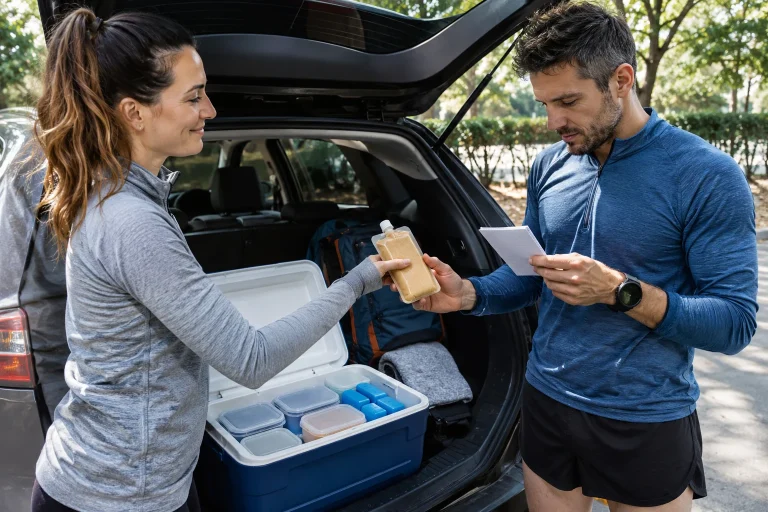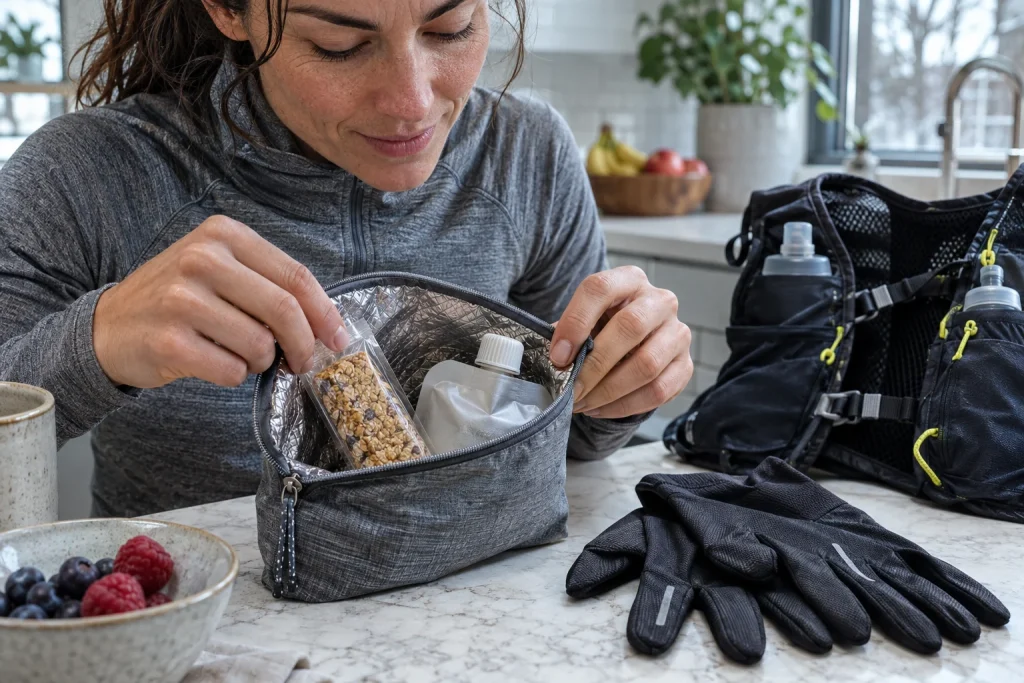
A snack that is easy to handle on the kitchen counter may behave differently later in a run. A coating may soften, a denser food may become harder to squeeze out, and gloves can change how you grip the packet. Temperature in a running pack is therefore a practical planning task. Knowing it will be hot or cold outside is insufficient: consider the specific product’s storage instructions, the entire transport journey and use within your own equipment together.
This article provides adult recreational runners with a framework for packing and observation. It does not recommend sports products or prescribe personal fuelling quantities. With a known allergy, medical condition or individual dietary plan, follow your own professional guidance. Manufacturer storage conditions take priority: testing texture is no reason to deliberately store food outside them. Branded examples illustrate specific manufacturer information, not a quality ranking or one temperature rule for all food.
Separate three questions
The first is safe storage in accordance with instructions: what conditions do the particular food and its packaging permit? The second is texture: within permitted use, how can you retrieve and consume it? The third is individual nutritional suitability: does it fit your plan and comfort? A pleasant texture does not establish that the first or third requirement has been met. A packet’s appearance and softness cannot reveal its entire history.
If a product behaves differently from before, first describe the specific situation. Exact version, storage method, carrying location and observed texture are observable details. Saying it is definitely spoiled or definitely fine is already an inference. Do not resolve uncertainty by tasting if storage conditions or packaging integrity are in question. Product instructions and, where needed, manufacturer information help in that situation.
Do not build a personal fuelling plan through random product swaps in reaction to weather. If the selected food cannot be handled appropriately in the planned conditions, find another option fitting your needs beforehand. Packaging that is easier in cold or more stable in heat does not mean an equivalent composition. Check nutrient information, allergens and any caffeine separately for every new version.
A chocolate coating can be temperature-sensitive
The Hershey manufacturer information mentions the sensitivity of chocolate’s cocoa butter to heat and moisture and discusses changes in texture and appearance. For a running pack, this means handling a chocolate coating may need separate attention. It does not mean all cocoa-containing foods behave identically. Coating, filling and the specific product’s storage instructions matter together.
If a coating softens within permitted storage conditions, sticking to the wrapping can create practical difficulty. In your own trial, examine how to handle the packet and store the remainder. You need not hold the whole bar with bare hands if the packaging helps support it as intended. Prepare a collection space for the opened wrapper beforehand. The sticky surface should not end up on your phone, clean food or vest lining.
A paler surface on chocolate can have several explanations, but a runner should not classify their own food from a general online image. A manufacturer’s explanation of a particular phenomenon does not mean every white mark and storage history is identical. Packaging condition, date and history must also be considered. Do not turn a product of uncertain condition into a texture trial. Appropriately stored options provide a usable starting point.
 Enlarge diagram
Text version of the diagram
- Storage
- Are the specific product’s instructions met?
- Texture
- Can it be gripped, opened and used?
- Personal plan
- Does it suit your needs and comfort?
- Limitation
- Pleasant texture does not verify the entire history.
Cold can change how easily a product squeezes out
The GU Australian product information describes thickening in cold for its Original Energy Gel. This is a specific manufacturer example of texture depending on circumstances, not a measurement result equally applicable to all gels. Handle your product according to its instructions. If squeezing changes in cold, include packet handling and any necessary safe stop in the practical plan.
Do not force food that feels harder or denser with your teeth or dangerous use of tools. If you cannot comfortably use it under the required conditions, reassess the selected form’s suitability. External heating of the packet, placing it beside a hot object or another improvised procedure is not automatically permitted. Follow manufacturer storage and use conditions and request specific product information when uncertain.
Hand and packet together define the task. With gloves, gripping the tear point may be harder even if the food itself remains manageable. Storage position, pocket opening and the packet’s top design therefore need examining together. The trial need not concern food texture alone. Sometimes an easier-to-reach pocket or a planned calm stop improves use more than immediately looking for a different product.
Temperature instructions belong to a specific product
The official Maurten Gel 160 product page describes storage between ten and thirty degrees Celsius, for example. This is the specific product instruction on that page, not a limit for all gels. Check the current label on your locally purchased packet too. The example shows that even the term room temperature may conceal a more precise condition that must not be disregarded for running or travel.
Do not guess about storage and brief conditions of use. If the manufacturer provides only general information but the whole planned journey presents a different situation, ask about appropriate handling. Your experience that no visible change occurred before does not override the instructions. Preparation may include selecting another solution fitting both your personal plan and the circumstances, with appropriate professional discussion.
Supplies left in a car can be a separate risk point in storage arrangements. Outside air temperature does not automatically describe the packet’s actual environment. Food placed in the boot the previous day has a different history from food taken directly from appropriate storage at departure. Review the entire sequence. Focusing only on running hours is insufficient when the food has already undergone a longer journey and wait.
| Observed situation | Practical question | Basis for checking |
|---|---|---|
| Softening coating | Can the packet remain manageable and tidy? | Specific product storage instructions |
| Thicker gel | Can it be used as intended? | The product’s own guidance |
| Gloved hand | Can the packet be reached and opened? | Trial with actual clothing |
| Uncertain history | Was appropriate handling maintained? | Timeline, label and manufacturer information |
The packet’s position is part of the system too
An outer vest pocket, storage beneath clothing and a separate pack waiting for the run may provide different environments. None can be called universally ideal for every food. Specific product conditions, equipment instructions and access needs determine the choice together. A position closer to the body does not automatically make every storage arrangement appropriate, nor is an outer pocket always suitable in every condition. Check your own combination beforehand.
Packaging protects food from contamination and helps handling, but a thin pouch does not guarantee constant temperature. Do not judge an allegedly insulated container’s performance by its name either. The equipment’s conditions of use and the whole journey matter. If required storage cannot be maintained, changing the system is the solution. A convenient pocket alone is insufficient reason to abandon product instructions.
Handle homemade food requiring refrigeration and other perishable combinations with particular attention. The Nébih shopping guidance also discusses appropriate transport of products requiring refrigeration. In a running pack, the same question extends over the entire journey, from preparation or purchase to consumption. Homemade origin and apparently suitable texture do not replace necessary refrigeration.
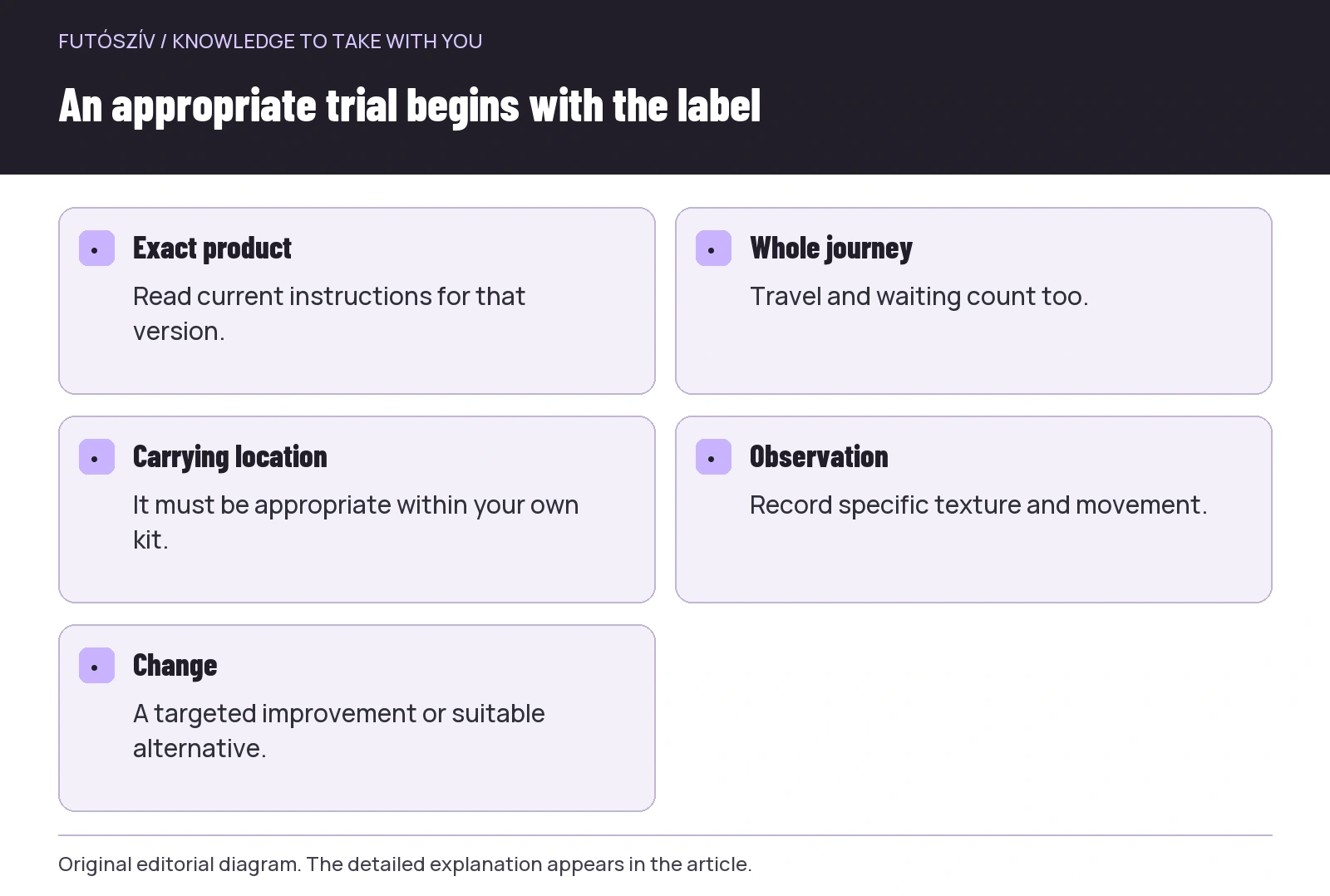 Enlarge diagram
Text version of the diagram
- Exact product
- Read current instructions for that version.
- Whole journey
- Travel and waiting count too.
- Carrying location
- It must be appropriate within your own kit.
- Observation
- Record specific texture and movement.
- Change
- A targeted improvement or suitable alternative.
How to conduct a useful trial within appropriate boundaries
Choose a day and training situation that fit your preparation. Handle the product according to storage and use requirements and use the actual carrying location. Record the precise product, packet position, important journey conditions and observed texture. If environmental temperature was not measured reliably, do not enter a definite number. A weather app’s data does not measure the inside of your pocket.
Make observations specific. The packet opened but the food came out with difficulty; the coating stuck to its wrapper; you could not find the tear point with gloves. These allow targeted changes. Bad in cold or withstands heat is too broad, particularly after one occasion. Your experience concerns that product and circumstance and is insufficient for a general product ranking or safety threshold.
If appropriate storage could not be maintained during the trial, do not regard it as a successful food test merely because texture remained acceptable. Restore the required conditions or choose another solution. The investigation does not aim to find how far you can deviate from the label without consequences. You want to make your own fuelling arrangements usable under conditions supported by appropriate product and storage information.
Have an alternative considered beforehand
If a selected food cannot be handled appropriately in planned conditions, find another version fitting your personal plan before the important event. Check the new product’s composition, allergen information and use instructions separately. Do not compare texture alone. Flavour, caffeine and other ingredient differences may matter too, so clarify personal sports-nutrition questions with a professional where necessary.
The alternative may be another food form or a different supply arrangement if compatible with race rules and your needs. Every situation need not be solved by buying another packet. Sometimes access to a verified resupply point or a package stored appropriately beforehand is the key. The solution should be specific and previously understood, not an improvised food swap during an important run.
Check leftovers after the run too
Review which packets remain unopened, whether any are damaged and what conditions you definitely know they experienced. Arrange further storage according to the specific product’s instructions. Do not return leftovers of uncertain history unmarked among intact, properly stored supplies. If asking the manufacturer, the product name and a precise description of circumstances can help. A visible texture change and uncertain storage can be identified separately.
A temperature-aware running pack rests on knowing requirements and observing actual use. A chocolate coating, thicker gel or drier snack may each raise a different question that no single universal rule answers. When product, carrying location and personal plan fit together, the pack takes less attention during the run. Useful experience remains precise: you know what you tested, under which conditions and which detail to change next time.
Sources and further reading
- The Hershey Company: Frequently Asked Questions – chocolate storage
- GU Energy Australia: Original Energy Gel – FAQ
- Maurten: Gel 160 – storage instructions
- Nébih: Shop wisely!
How Futószív articles are prepared: our editorial guidelines.