Why can a running event mean more than a few kilometres?
After finishing, one person says they finally felt they belonged. Another is pleased to have chatted easily with strangers. For a third, the best part was an hour away from usual responsibilities. These accounts matter, but describe different experiences. It makes a difference whether we ask about mood at the event, satisfaction with health, community belonging or an evaluation of life overall. Discussing running psychology accurately means not weaving these threads into one wellbeing metric that explains everything.
Participants’ positive experiences can quickly become an advertising promise: come along and you will feel better. Research usually answers a narrower question. It may show how a group in a particular sample evaluated life, or how belonging related to event attendance. Personal benefit can still be real. Readers gain from distinguishing the experience described from a promise no longer supported by the study’s design.
This guide starts with two parkrun studies, then uses our own editorial examples to show how to read news or recommendations about community running. Parkrun is the specific research setting here, rather than a scientific equivalent of every Hungarian running race. A recurring community occasion and a large annual race may offer different experiences. We therefore do not calculate personal happiness gains from the studies or promise identical changes for everyone who signs up.
What did the survey of 865 Australian participants investigate?
Grunseit and colleagues’ 2017 paper, Running on a high: parkrun and personal well-being, analysed online responses from 865 adult Australian parkrun participants. General wellbeing measures and measures for particular life domains were compared with population norms. The sample’s overall pattern was mostly similar to population values, with a favourable difference also appearing in satisfaction with health. This is not a finding that every participant was happier in every area studied.
The study was a cross-sectional survey. People were not randomly assigned to event and no-event groups over an extended period, then compared from the same starting point. Respondents came from people already connected to an event. This matters when applying the result to your own first run: the reported association offers context, rather than a personal change measured in advance.
A correction was published in 2019 concerning the reporting of age proportions in the participant sample. We therefore do not copy age-group percentages from the old text. The lesson for readers is straightforward: corrections and additions form part of interpreting a scientific source. A later clarification does not make the whole study unnecessary, but may change which detail can be cited.
Who reaches the questionnaire, and who remains outside it?
Imagine a voluntary post-event questionnaire. Someone who reads the organiser’s email, remembers the event and has time may be more likely to complete it. People with unpleasant experiences may have unsubscribed or never returned. Others may write detailed answers specifically because they have criticism. Response numbers alone do not establish how closely all starters, registrants or local residents resemble respondents.
Self-selection does not mean participants are being untruthful. It means their inclusion is not independent of the world being studied. Someone who already enjoys activity, has a flexible schedule or social connections may reach an event more easily. Equally, someone may seek community precisely because life is difficult. Possible directions of selection therefore cannot be dismissed as one automatically favourable bias.
While reading, note three questions separately: who was invited, who responded and which group does the conclusion concern? Starting from a self-selected event community does not make a finding a prescription for every adult merely because the sample is large. Personal stories need not be devalued. Instead, identify whose stories you are hearing and whose voices may be missing.
 Enlarge image
A population norm is not the same as a pre-event baseline
A population norm provides a reference. If a group gives more favourable scores on a particular scale, we know its evaluation differs from that reference. This does not automatically reveal its pre-event scores. Participants may already have rated their health similarly beforehand. Their circumstances may have changed, or they may have engaged in several forms of activity. A reference does not replace a starting point over time.
In an editorial example of our own, two runners both rate their day eight on a homemade ten-point diary scale. For one, this is a usual weekend; for the other, an improvement on recent days. The same post-event number covers two different histories. This is neither a research finding nor a validated wellbeing scale, but illustrates why the baseline and exact meaning of a question also matter.
If an event invitation says participants are more satisfied, look for the rest of the sentence. More satisfied with what, compared with whom, when were they asked, and how large was the difference? Health-related evaluations, enjoyment of the event and general life satisfaction are different questions. An accurately quoted result must preserve these boundaries, even if this makes a short recommendation less striking.
What does research on group identification add?
Stevens, Rees and Polman’s parkrun study analysed relationships between group identification, participation and several experiential measures in 289 people. Alongside questionnaire variables, participation was assessed objectively. Stronger group identification showed favourable associations with participation, exercise-specific satisfaction, cohesion and life satisfaction. This is an association study, rather than proof that everyone will have the same experience after one visit.
Objective participation data is an important distinction: asking how often someone intends to attend differs from using a measure of actual attendance. Wellbeing is still described through the questions selected for it, however. Recording attendance is not a direct measure of pleasure in the brain, nor does it reveal what happened throughout a participant’s life. A more precise datum solves one part of a problem, rather than every causal question at once.
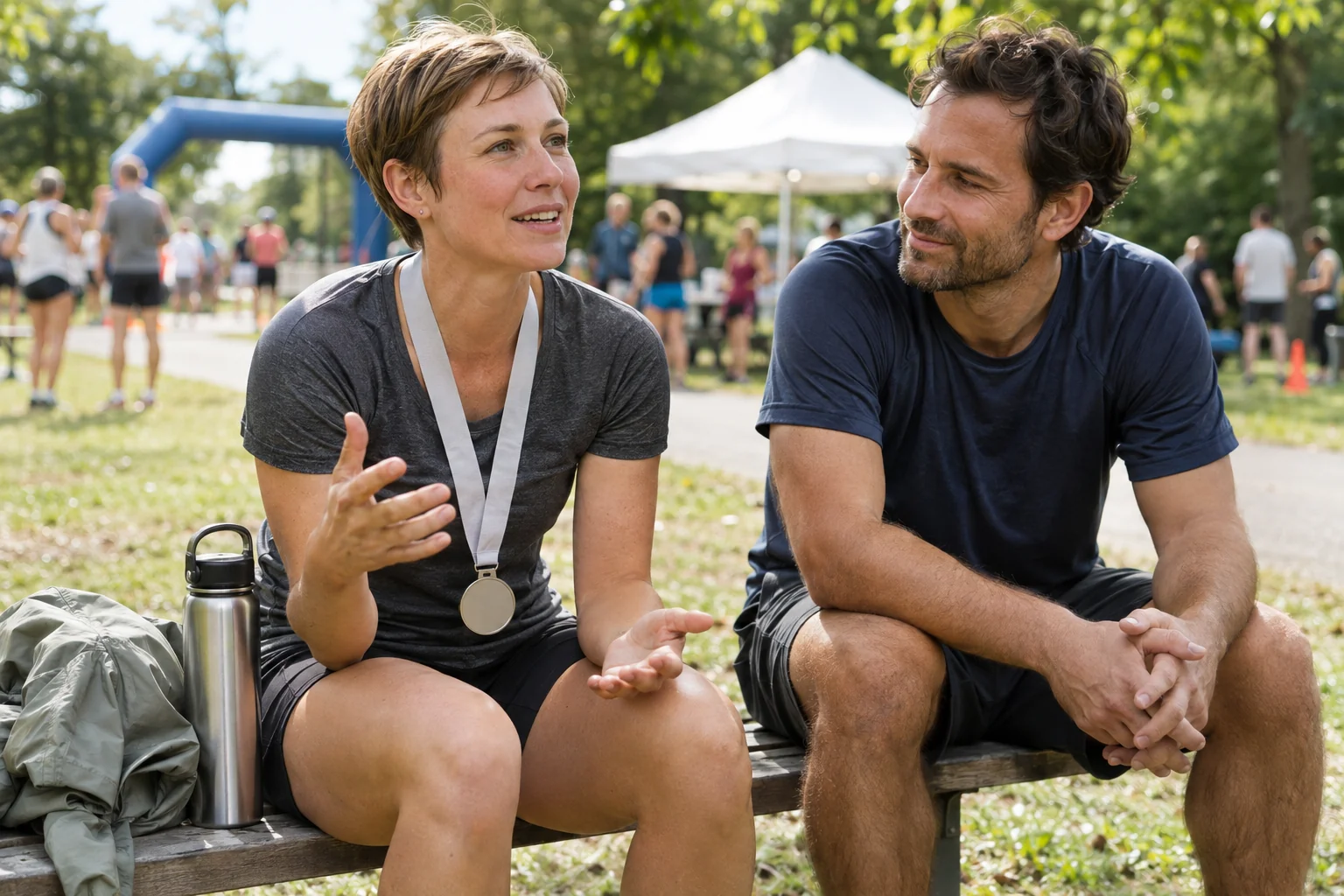
For a runner, connection may appear in everyday signs: someone recognises you, you remember where the group meets, or choosing a slower loop feels natural. These are illustrative possibilities here, not programme steps mandated by the study. Belonging does not require feeling the same thing every time. Notice how much room remains for your own pace, quieter days and absence too.
The relationship can develop in several directions
One possible account is that repeated meetings create familiar faces, making return more enjoyable. In another, someone already more sociable or satisfied connects more easily and therefore attends more often. In a third, an external change such as moving home, freer weekends or a friend’s invitation shapes both. Several paths can remain open when reading an association. An appealing explanation is not automatically the proven one.
In a personal log, keep observation and explanation separate too. An observation might be that starting conversations felt easier after two visits. An explanation might be that familiarity with the place helped. That makes sense, but is not necessarily exclusive: you may have been more rested or someone welcomed you especially thoughtfully. Separating the two does not make a good experience less valuable; it helps later recognition of the conditions associated with it.
A social opportunity built around running is therefore something you can choose to try, rather than a personality test. Someone who does not connect at one event has not proved themselves unsuited to community. A different group size, time, shorter shared section or one familiar running companion may suit them. A group-level research pattern does not justify calling one person’s worse day a faulty attitude.
Three different experiences: mood, connection and life satisfaction
A few well-chosen words can describe immediate mood: tense, relieved, calm or excited. Connection may concern knowing whom to approach and having a place in the group regardless of performance. Life satisfaction is a broader evaluation involving work, family, health, finances and other domains. A pleasant morning can affect one thread without an immediate dramatic shift in the others.
A personal observation sheet therefore need not ask only whether everything improved. Separately describing what was enjoyable in the activity, whether there was a safe opportunity to connect and anything tiring or uncertain is enough. Such a note does not replace a research instrument or psychological assessment. It helps you decide about another outing from more than one general impression and name your needs more easily.
If only the route appealed to you, you can say so. If conversation was enjoyable but the pace too high, address the social aspect and physical load separately. A pleasant social experience does not override pain or feeling unwell. With persistent psychological difficulties, shared activity may be part of life, but is not guaranteed treatment or a reason to delay necessary professional help.
 Enlarge image
How can you try an event without competing with expectations?
Choose a small, meaningful question beforehand. You may want to learn whether the meeting point is clear, whether there is room for a conversational pace or whether arriving alone feels manageable. This is not a compulsory performance goal, and you do not need to tick off euphoria at the end. A specific question simply helps you know what to notice. Ask the organiser about walking options, accompaniment, a shorter distance or a point where leaving is easy.
Keep physical and social challenges separate. In a new setting, you need not simultaneously choose your longest-ever distance and join every conversation. A brief visit, waiting for the programme’s end or arriving with someone familiar may be possible if the event allows it. The aim is not compulsory conquest of discomfort, but learning the conditions under which attendance is manageable. Your health and safety limits take priority here too.
Allow time afterwards for the experience to settle. A crowded start may be tiring while conversation after finishing is enjoyable; both can be true. Briefly note what you would like more of, less of and what you would change next time. Not wanting to return need not become a final verdict on every running community. Trying a different format is not failure, but new information about an activity setting that suits you.
What should a running community ask its participants?
An organiser may learn more by asking about specific experience than how much happier everyone became. Was arrival clear? Were pace groups easy to understand? Was shorter participation easy to choose? Did any part make someone feel like an outsider? These questions can lead more directly to organisational decisions that can be improved. They do not need an unvalidated diagnostic score to make answers meaningful.
Feedback remains valuable when it is not praise. Alongside an easily accessible, brief response option after the event, make space for people not planning to return. Participation and response rates need separate treatment: answers from a few enthusiastic regulars must not be presented as everyone’s opinion. In a summary, the question, respondent group and timing should be at least as clear as favourable quotations.
A participant’s story remains theirs before it is shared. Turning a personal wellbeing account into event advertising requires permission, accurate quotation and respect for boundaries. Someone need not disclose health details for their experience to be accepted. A good community account leaves open the possibility that the same programme gives another person a very different experience.
Sources and interpretive framework
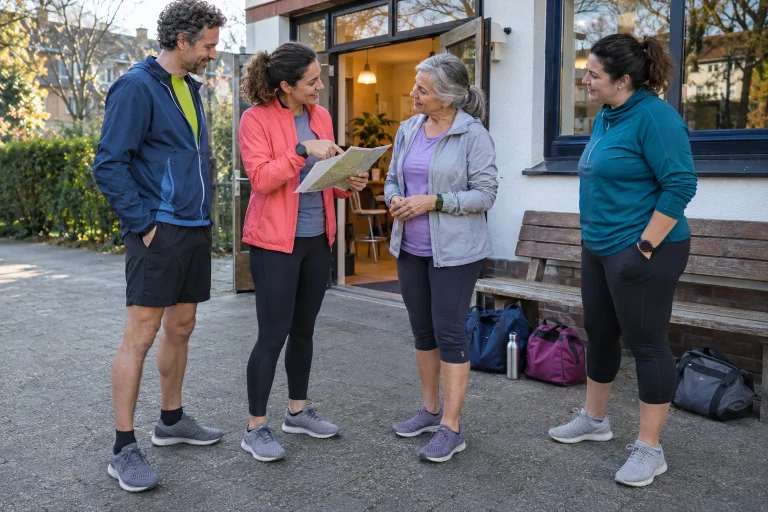
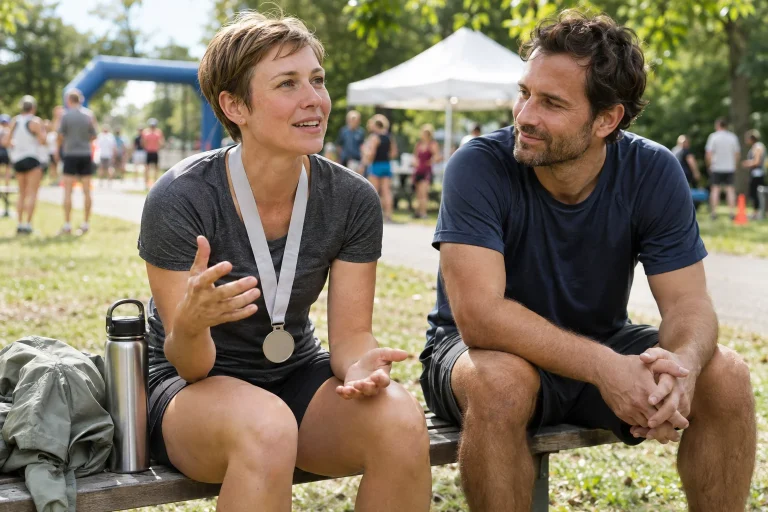
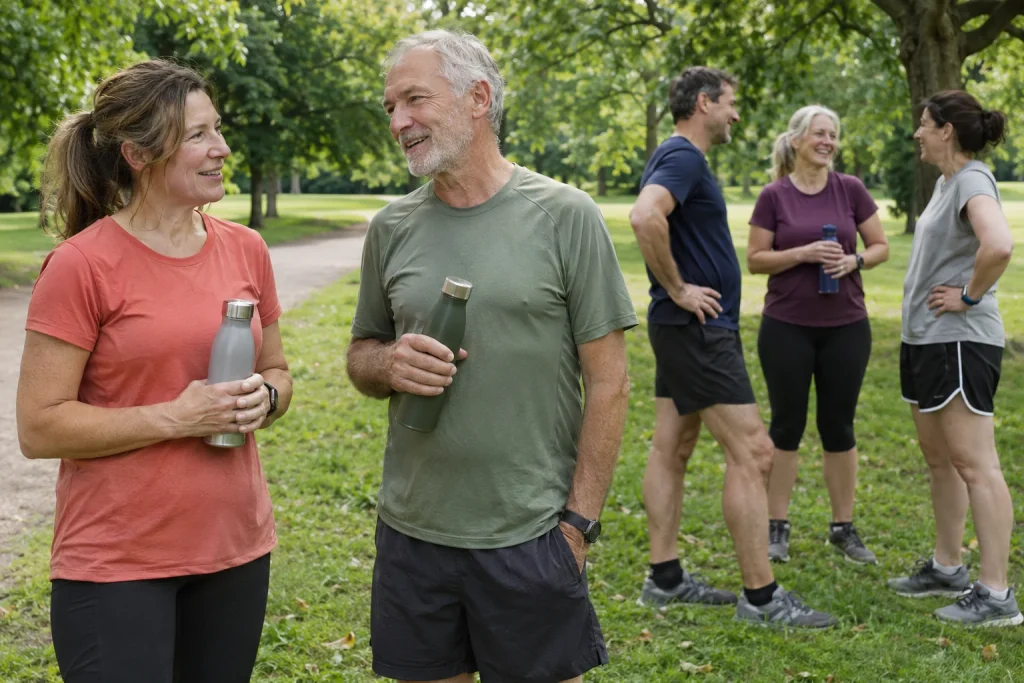
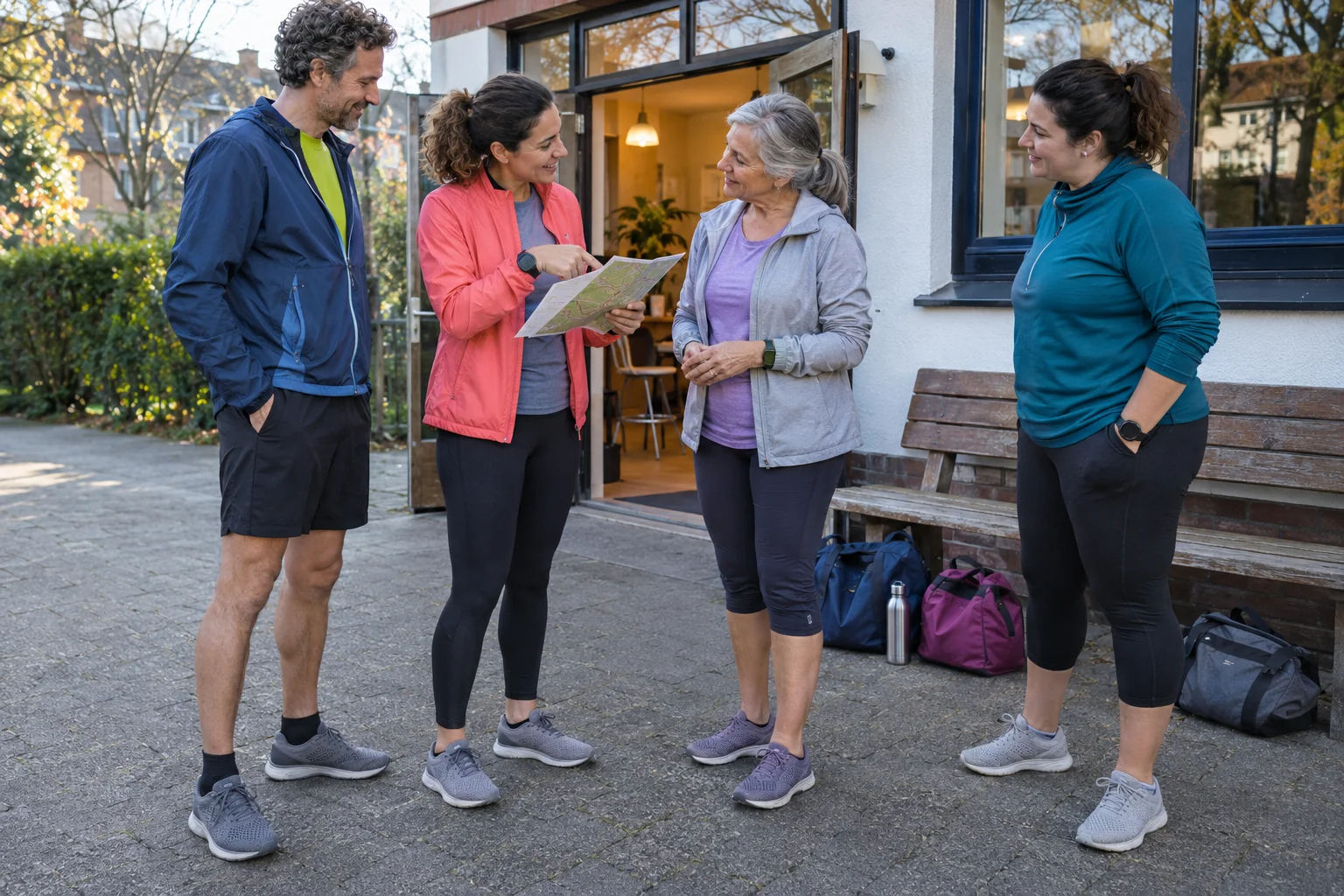
We checked the primary publications below on 21 November 2026. Research findings are tied to the particular sample and design; practical questions and diary examples are our editorial suggestions, rather than universal treatment instructions drawn from the studies. Images are original AI illustrations, not documentary images of study participants or actual parkrun events.
- Grunseit and colleagues: Running on a high: parkrun and personal well-being, 2017
- Grunseit and colleagues: correction to the 2017 study, 2019
- Stevens, Rees and Polman: Social identification, exercise participation, and positive exercise experiences: Evidence from parkrun
How Futószív articles are prepared: our editorial guidelines.